Discourse Meaning
eBook - ePub

Discourse Meaning

The View from Turkish

  1. 294 pages
  2. English
  3. ePUB (mobile friendly)
  4. Available on iOS & Android
eBook - ePub

Discourse Meaning

The View from Turkish

About this book

The volume aims to bring together original, unpublished papers on discourse structure and meaning from different frameworks or theoretical perspectives to address research questions revolving around issues instigated by Turkish. Another goal is to offer methodologically different solutions for the research gaps identified in individual chapters. The contributions are based on empirical generalizations and make use of, for example, computerized corpora as the data, examples compiled from naturally occurring discourse, or data gathered in experimental conditions. Hence, the book has a firm theoretical standing and it is empirically well-grounded.

The collection is expected to be of direct interest to the community of scholars and researchers in discourse structure and semantics as well as corpus linguistics. It will appeal to undergraduate and graduate students and all interested readers, offering them a fresh view on various discourse-related phenomena from the perspective of Turkish.

Frequently asked questions

Yes, you can cancel anytime from the Subscription tab in your account settings on the Perlego website. Your subscription will stay active until the end of your current billing period. Learn how to cancel your subscription.
No, books cannot be downloaded as external files, such as PDFs, for use outside of Perlego. However, you can download books within the Perlego app for offline reading on mobile or tablet. Learn more here.
Perlego offers two plans: Essential and Complete
  • Essential is ideal for learners and professionals who enjoy exploring a wide range of subjects. Access the Essential Library with 800,000+ trusted titles and best-sellers across business, personal growth, and the humanities. Includes unlimited reading time and Standard Read Aloud voice.
  • Complete: Perfect for advanced learners and researchers needing full, unrestricted access. Unlock 1.4M+ books across hundreds of subjects, including academic and specialized titles. The Complete Plan also includes advanced features like Premium Read Aloud and Research Assistant.
Both plans are available with monthly, semester, or annual billing cycles.
We are an online textbook subscription service, where you can get access to an entire online library for less than the price of a single book per month. With over 1 million books across 1000+ topics, we’ve got you covered! Learn more here.
Look out for the read-aloud symbol on your next book to see if you can listen to it. The read-aloud tool reads text aloud for you, highlighting the text as it is being read. You can pause it, speed it up and slow it down. Learn more here.
Yes! You can use the Perlego app on both iOS or Android devices to read anytime, anywhere — even offline. Perfect for commutes or when you’re on the go.
Please note we cannot support devices running on iOS 13 and Android 7 or earlier. Learn more about using the app.
Yes, you can access Discourse Meaning by Deniz Zeyrek, Umut Özge, Deniz Zeyrek,Umut Özge in PDF and/or ePUB format, as well as other popular books in Languages & Linguistics & Languages. We have over one million books available in our catalogue for you to explore.

Part I: Negation in discourse

Discourse negation via the ne … –sI structures in Turkish

Hasan Mesut Meral
Yıldız Teknik University, Department of Turkish Language Education, Faculty of Education, İstanbul, Turkey
Note: I am deeply indebted to Dr. Sabahat Tura for encouraging me to study linguistics and our discussions on the structure of Turkish. Her approach to Turkish linguistics inspired me a lot during my academic career and will continue to do so in the future.
I thank the editors and the reviewers of this volume for their invaluable remarks, criticism and suggestions which improved this work a lot. Usual disclaimers apply.

Abstract

The aim of this work is to investigate the issue of discourse negation observed in ne … –sI structures in Turkish casual conversations. We show that discourse negation observed in the structures under discussion involves strong objection to the original statement and a subsequent rectification of it. The strength of the utterance provided by the special linguistic forms and intonation in these structures is the main tool which differentiates them from other regular instances of negation in Turkish. We provide three sets of discussions for the issue: (i) argumentative discourse mode, (ii) tri-partite discourse structure, and (iii) descriptive vs. metalinguistic negation.
With respect to (i), the paper claims that the structures under discussion involve an argumentative discourse mode where Speaker B asserts a strong objection to, denial and refusal of the statement made by Speaker A as the first part of his/her answer. The consequent strong rectification in the second part of the answer by Speaker B is another support for the argumentative mode. For (ii), we show that a tri-partite discourse structure is observed where the first part involves an expectation statement by Speaker A, the second part includes Speaker B’s strong objection to this expectation, and the third part includes Speaker B’s strong rectification of the denied information. With respect to (iii), the paper shows that the structures under investigation have a dual nature with respect to descriptive vs. metalinguistic negation. We present some cases of descriptive negation with a strong objection as opposed to others that may include metalinguistic negation with weak or “fake” denials.

1 Introduction

Negation is traditionally defined as a logical operator which reverses the truth of a proposition. This semantics-oriented definition of negation has been the focus of many works in the literature (Klima 1964; Payne 1985; Frawley 1992 among others) and various types of negation within a sentence have been investigated (sentential vs. verbal negation as involving an external negation operator vs. internal one respectively). Accordingly, negative elements may cover (i) the whole proposition in a sentence having the widest scope in the logical structure: propositional negation (Payne 19...
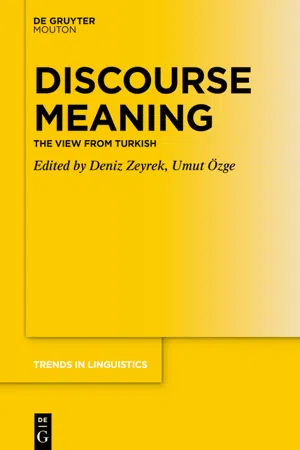
Table of contents

  1. Title Page
  2. Copyright
  3. Contents
  4. Preface
  5. Introduction: Discourse structure and discourse meaning: The view from Turkish
  6. Part I: Negation in discourse
  7. Part II: Discourse functions of reference
  8. Part III: Subjectivity in discourse
  9. Part IV: Assessment of discourse-annotated corpora
  10. Index