Contemporary Criminological Issues: Moving Beyond Insecurity and Exclusion tackles some of today's most pressing social issues—from the criminalization of Indigenous peoples to interpersonal violence, border control, and armed conflicts—,advances cutting-edge theories and methods to make sense of these issues, and proposes policy responses that promote social inclusion and security.
This book advances cutting-edge theories and methods, with the aim of moving beyond the scholarship that reproduces insecurity and exclusion. The breadth of approaches encompasses much of the current critical criminological scholarship, serving as a counterpoint to the growth of managerial and administrative criminologist and the rise of explicitly exclusionary and punitive state policies and practices with respect to 'crime' and 'security.'
This edited collection featuring two books, one in English and one in French, includes important contributions to knowledge and public policy by eminent experts and emerging scholars.
Published in English. Also available in French: Enjeux criminologiques contemporains : Au-delà de l'insécurité et de l'exclusion.
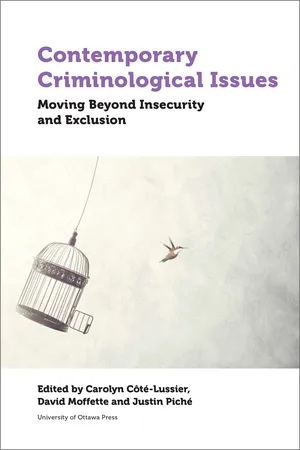
eBook - ePub
Contemporary Criminological Issues
Moving Beyond Insecurity and Exclusion
- 266 pages
- English
- ePUB (mobile friendly)
- Available on iOS & Android
eBook - ePub
Contemporary Criminological Issues
Moving Beyond Insecurity and Exclusion
About this book
Information
SECTION 1
RETHINKING CRITICAL CRIMINOLOGY
CHAPTER 1
Beyond Criminal Law and Methodological Nationalism: Borderlands, Jurisdictional Games, and Legal Intersections
Criminology occupies a peculiar place among the social sciences as it adopted as its unifying object of study that which is predefined in and created through law. Indeed, the jurisdictional distinction between acts that are subject to criminal laws and others that are regulated by administrative laws was, to a great extent, adopted by criminologists. And despite early encouragements to move criminology beyond its traditional boundaries by expanding its guiding problematic from crime to ordering (Shearing 1989), much of the criminological scholarship produced in the last fifty years has continued to privilege the study of crime—socially constructed or otherwise—and the criminal justice system over that of other ordering practices and regimes.
Studying the complex intersections between the domains of criminal justice and immigration regulation forces us to challenge this crime-centric approach. This field of study is rather new. The Chicago School of sociology—so influential in criminology—had of course paid attention to immigration, but it had done so with a problematic assumption that migration is a cause of social disorganization, a claim that has now been challenged empirically (see Lee et al. 2001). However, it was only in the late 1990s that scholars began researching the intersections of immigration and criminal legal regulation, a field initially dominated by legal approaches (e.g., Kanstroom 2004; Miller 2005), with but a few criminological exceptions (e.g., Pratt 2005; Welch 1996). For the most part, the regulation of immigrants by various state and non-state actors has not been the object of much criminological inquiry until recently.
While alternative framings exist, a great deal of recent scholarship analyzes these dynamics through the concept of “crimmigration” (e.g., Chacón 2015; Stumpf 2006; Van der Woude et al. 2017). As explained by Stumpf (2006, 376), this concept highlights the way that “immigration law today is clothed with so many attributes of criminal law that the line between them has grown indistinct.” While this focus on convergence is a useful endeavour in many regards, we find it limiting. Indeed, despite some key works that have sought to specify the nature of the intersections and divergences (e.g., Aas 2014; Chacón 2015), or that have attended to the “asymmetric incorporation of criminal justice norms” into immigration law (Legomsky 2007, 469) and the “ad hoc instrumentalism” that characterizes actors’ decisions to cherry-pick the legal categories they deploy (Sklansky 2012, 157), much of the scholarship insists on documenting the many points of convergence instead of attending to the gaps, cracks, and fissures that run through the interactions of immigration and criminal justice regimes. This preoccupation with convergence hides from view the heterogeneity, contingency, and multiplicity of ordering and bordering practices, including the important ways that jurisdiction brackets and authorizes different legal powers and practices (Blomley 2014). The guiding focus on the merging of criminal justice and immigration law also pushes into the background the many other legal and quasi-legal regimes that are engaged in bordering practices and that contribute to the regulation and punishment of immigrants. In this chapter, we avoid metaphors of “merger” and “convergence,” choosing instead to study what we think can be most helpfully understood as an assemblage that comprises the “legal borderlands” of the domains of immigration and criminal justice: sites of interlegality filled with “nonsynchronic, unequal, and unstable interplays between various laws, techniques, and normative regimes” (Moffette 2018a, 156).
The notion of legal borderlands brings us to a second and closely related limit of criminology. We hope that the project of doing criminology at the borderlands can help us to avoid and challenge the often unquestioned “default scalar setting” of much criminological research: the nation-state (Valverde 2010, 240). This is important analytically and politically as the methodological nationalist trap often leads to the “ongoing re-production and re-fetishization of those same naturalized ‘national’ formations” (De Genova 2013, 251; see also Wimmer and Glick Schiller 2002). And yet, despite efforts by scholars contributing to the growing fields of global and transnational criminology (e.g., Bowling and Sheptycki 2012; Larsen and Smandych 2007; Sheptycki 2000) and green criminology (e.g., Brisman 2015; Lynch and Stretesky 2010), working on crimes and harms of globalization (e.g., Franko Aas 2013; Rothe and Friedrichs 2015) or producing research on local-level legal regulation (e.g., Goodman et al. 2017; Valverde 2011; Varsanyi 2010), the nation-state remains firmly embedded in criminology. The focus on the state as the singular holder of sovereignty, even if for the purpose of its critique, often hides from view the ways that sovereignties are always plural, partial, contested, and incomplete (Aoki 1998; Sassen 2009). In this chapter, we draw from our experience studying bordering practices, including at physical borderlands (Moffette 2013; Pratt 2016), to propose ways to help avoid the discipline’s methodological nationalism and privileging of crime and criminal justice.
This programmatic chapter suggests ways to develop scholarship located in the “borderlands” where different jurisdictions, legal regimes, and academic disciplines intersect. In the following subsections, we define what we mean by doing criminology at the borderlands and present the notion of jurisdictional games (Valverde 2009, 2015) as a conceptual tool that is useful in this endeavour. We then provide two empirical vignettes that illustrate the kind of research that we have in mind: (1) the Canada-US Shiprider program that allows binational boat patrols to operate at and across the US-Canada border and (2) the multi-scalar governing of unauthorized immigrant street vendors by port authorities and municipal, regional, and state police in Barcelona. The first vignette is based on document analysis and interviews conducted by Anna Pratt with officers working for the Royal Canadian Mounted Police (RCMP), US Coast Guard (USCG), and US Customs and Border Protection (CBP), and with members of the community in Akwesasne Mohawk Territory. The second vignette is based on ethnographic observation, document analysis, and interviews conducted by David Moffette with municipal civil servants at the Barcelona Security Commission and the Immigration, Interculturality, and Diversity Commission, as well as with a city councillor and a member of an advocacy group working with street vendors. Both of these vignettes raise questions of sovereignty, jurisdiction, and discretion.
In the conclusion, we return to the notion of borderland criminology to make recommendations for future research. The chapter contributes to the book by arguing that to move beyond insecurity and exclusion, criminologists need to move beyond a focus on crime, criminal law, and the nation-state.
Doing Criminology at the Borderlands
While our research owes much to what has been called “border criminology” (Bosworth 2017) or the “criminology of mobility” (Pickering et al. 2015) since we study bordering practices and the governing of immigration, our call for doing criminology at the borderlands should, in part, be taken metaphorically as an invitation to all criminologists to locate our work in an intellectual space that sees the boundaries between disciplines, legal regimes, and states as blurry, uncertain, and shifting.1
Borderlands are physical, geopolitical, legal, linguistic, and cultural third spaces bridging the lines that officially separate countries, people, cultures, and identities. Gloria Anzaldúa (1987), Akhil Gupta and James Ferguson (1998, 18) propose that we understand borderlands as “a place of incommensurable contradictions” and that “the term does not indicate a fixed topographical site between two other fixed locales (nations, societies, cultures), but an interstitial zone of displacement and deterritorialization that shapes the identity of the hybridized subject.” Borderlands are also sites for the performance of contested sovereignties (Donnan and Wilson 2010; Dudziak and Volpp 2006) and the dramatic manifestation of state power and racialized violence (Rosas 2006), yet they are always fragile (Rosas 2006). The governing of mobility in borderlands also relies on discretionary acts and non-acts (Heyman 2009), on racialized risk knowledges (Pratt and Thompson 2008), and on jurisdictional games (Moffette 2018b; Pratt 2016). Our call for doing research in the legal borderlands thus evokes a joint commitment to interdisciplinary, interlegal, and post-national inquiries. As such, border research that endeavours to decentre formal law and the nation-state promises to furnish findings and insights that will be useful and applicable to criminological research undertaken in a variety of other contexts as well.
Jurisdictional Games
One way to denaturalize state sovereignty and the distinction between different types of legal regimes is to look at jurisdiction as an ongoing practice of governing through legal bracketing (Blomley 2014; Ford 1999; Valverde 2009, 2015). Indeed, not only are crimes historically and socially constructed, but the whole division of law into different realms is also the product of an active process of boundary-making. As Mariana Valverde (2009, 141) explains, “the allocation of jurisdiction organizes legal governance, initially, by sorting and separating” objects and realms of law in a way that eventually seems natural and hides from view the tensions and contradictions inherent to legal orderings. This work of jurisdiction is an ongoing performance. As Shaunnagh Dorsett and Shaun McVeigh (2012, 4) explain, “jurisdiction is derived from the Latin ius dicere—literally to speak the law … it declares the existence of law and the authority to speak in the name of the law.” The enactment of jurisdiction is thus a matter of asserting legal power—or refusing it—continuously and in various concrete local instances.
To understand jurisdiction as performative means that we need to study it as discourse and as a set of practices. In his work on territorial jurisdiction, Richard Ford (1999) likens jurisdiction to a tango, a type of dance with a set of rules that defines the role of each partner to negotiate when one should step forward and when one is to let their partner make the move. Jurisdiction therefore must be enacted; it encompasses practices whereby legislators, courts, and anyone who wants to summon the law make claims about the “where,” the “who,” the “what,” the “when,” and the “how” of law (Valverde 2009), and provide rationales for why an act or a person, in a particular place and time, falls under the authority of a particular body and should be treated according to this or that kind of procedure. The game of the jurisdictional distribution of authority is thus always performed through negotiations over what belongs to immigration law, criminal law, or other legal regimes; negotiations over what falls under municipal, provincial, or federal authority; what is American and what is Canadian; and so on. Studying “jurisdiction as a bundle of practices” (Ford 1999, 855) means looking at the ways that various actors—from judges to street-level bureaucrats, zoning bylaw inspectors, police officers, coast guard officers, Indigenous activists, and anyone claiming that they have rights or that their neighbour’s fence is too high—are continuously making jurisdictional claims. It also means that in most situations, a variety of laws, regulations, and authorities could apply, and actors are able to deploy different kinds of legal or quasi-legal resources depending on the outcomes that they are hoping to achieve, using what David Sklansky (2012, 157) might describe as a kind of “ad hoc instrumentalism.”
We suggest that research focused on these jurisdictional games can be productive in three ways. First, “thinking jurisdictionally” (Dorsett and McVeigh 2012, 42) can help us make sense of the multi-scalar, multi-actor, and multi-jurisdictional socio-legal regulation of people and things in many contexts today. Second, it allows us to shift our focus from crime, criminal law, and formal criminalization to instead look at how the recourse to aspects of criminal law is but one of the many options that actors have in the multi-jurisdictional ordering of people and things. Third, looking at jurisdictional games also helps us to move away from an understanding of sovereignty as seated solely at the heart of the state and instead invites us to study jurisdictional claims to multiple forms of both territorial and non-territorial sovereignty as they are made and unmade in everyday practices. Indeed, this approach works well with a pluralist notion of sovereignty, understood as “the discursive [and practical] form in which a claim concerning the existence and character of a supreme ordering power for a particular polity is expressed,” an ordering which asserts “to provide a continuing source and vehicle of ultimate authority for the juridical order of that polity” (Walker 2003, 6). In order to illustrate the analytical potential of our approach and concepts, we now turn to two empirical vignettes from our respective research.
Governing Waterways: The Canada-US Shiprider Program at the Maritime Borderlands
Introduction to the Shiprider Program
A few years ago the U.S. Coast Guard snapped a photo of a Great Lakes smuggler smiling at their camera with his middle finger in the air, “flipping us the bird,” as one frustrated officer defined his contemptuous gesture. The smart-ass smuggler knew the Coast Gu...
Table of contents
- Cover
- Title Page
- Copyright Page
- Table of Contents
- Acknowledgements
- Introduction: Challenging Criminology, Insecurity, and Exclusion
- Section 1—Rethinking Critical Criminology
- Section 2—Critical Criminology in Practice
- Section 3—Markers of Social Differentiation and Social Reaction
- Section 4—Reflections on Criminology
- Afterword
- Contributors
Trusted by 375,005 students
Access to over 1.5 million titles for a fair monthly price.
Study more efficiently using our study tools.
Frequently asked questions
Yes, you can cancel anytime from the Subscription tab in your account settings on the Perlego website. Your subscription will stay active until the end of your current billing period. Learn how to cancel your subscription
No, books cannot be downloaded as external files, such as PDFs, for use outside of Perlego. However, you can download books within the Perlego app for offline reading on mobile or tablet. Learn how to download books offline
We are an online textbook subscription service, where you can get access to an entire online library for less than the price of a single book per month. With over 1.5 million books across 990+ topics, we’ve got you covered! Learn about our mission
Look out for the read-aloud symbol on your next book to see if you can listen to it. The read-aloud tool reads text aloud for you, highlighting the text as it is being read. You can pause it, speed it up and slow it down. Learn more about Read Aloud
Yes! You can use the Perlego app on both iOS and Android devices to read anytime, anywhere — even offline. Perfect for commutes or when you’re on the go.
Please note we cannot support devices running on iOS 13 and Android 7 or earlier. Learn more about using the app
Please note we cannot support devices running on iOS 13 and Android 7 or earlier. Learn more about using the app
Yes, you can access Contemporary Criminological Issues by Carolyn Côté-Lussier, David Moffette, Justin Piché, Carolyn Côté-Lussier,David Moffette,Justin Piché in PDF and/or ePUB format, as well as other popular books in Social Sciences & Criminology. We have over 1.5 million books available in our catalogue for you to explore.