Featuring principals which lead schools where 80% or more of African American and Latinx students are proficient on State's standardized English and Math assessments, McLaughlin examines the strategies expert principals utilize: personalizing data by amplifying student academic stories, conducting ORID data chats, developing principal-directed student equity learning goals and increasing teachers' cultural proficiency. Readers are introduced to equity audits, equity focused classroom walkthroughs, student-led equity discussion panels and affinity groups, school-wide intervention programs, including a system for Not Handed ins (NHIs) for missed assignments, and strategies for building trusting relationships with families of color.
eBook - ePub
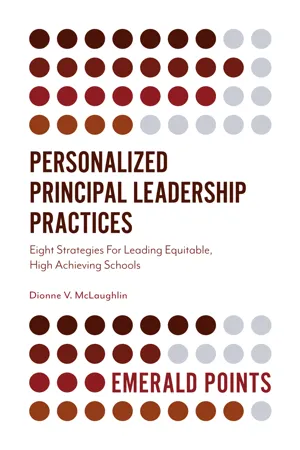
Personalized Principal Leadership Practices
Eight Strategies For Leading Equitable, High Achieving Schools
- 240 pages
- English
- ePUB (mobile friendly)
- Available on iOS & Android
eBook - ePub
Personalized Principal Leadership Practices
Eight Strategies For Leading Equitable, High Achieving Schools
About this book
Personalized Principal Leadership Practices includes practical solutions to problems principals encounter as they endeavor to solve vexing problems with the underachievement of students of color.
Information
Topic
EducationSubtopic
Education General1
Personalize the Data
What If Calvin Was Your Son?
Ms Northup, Calvin's teacher had become increasingly concerned about his performance and disruptive behavior. Since I was a school administrator, she asked me to visit her class to observe Calvin and provide her with some feedback. Calvin Malden was an imposing 10th grade African American boy who weighed almost 300 lbs. Calvin surrounded himself with a small group of disloyal friends who appeared to only befriend him to avoid incurring his wrath. Many of his classmates distanced themselves to avert any unintended provocation. In my conversations with Calvin's teachers, it quickly became apparent that many of them were intimidated by Calvin's antics, posturing and his intermittent displays of uncontrollable rage. As a result, Calvin's boisterous behavior was often overlooked and missing, or late, assignments accrued without mention. Calvin had already been retained once in the 10th grade so this was his second time taking Algebra I. Ms Northup was a young, talented White teacher who was knowledgeable about her subject matter and cared deeply about her students.
During the observation, I noted that pacing was appropriate, Ms Northup maintained an essential balance between lecture, modeling and individual opportunities for problem-solving. One lesson objective required students to find the slope of a line. Calvin raised his hand then mumbled impatiently when Ms Northup was unable to immediately attend to his inquiries. Calvin's struggles were palpable. He had not yet mastered long division, simple subtraction or negative numbers. Without these basic skills, solving these problems and attaining success in Algebra would be a formidable task. With significant gaps in Calvin's learning, it would be difficult to provide adequate scaffolding. It was not surprising that Calvin became visibly agitated and resorted to making vociferous demands when Ms Northup was not immediately available. Calvin's academic shortcomings exacerbated his behavioral responses. Students like Calvin present vexing problems. An important consideration while searching for plausible solutions to improving the achievement of students like Calvin, is to begin with the premise that Calvin is our son. We would not operate from the assumption that Calvin created his own learning gaps nor would we ascribe blame to Calvin's parents for his academic failures. Rather than getting lost in a spreadsheet of nameless numbers, individual solutions would be developed to solve Calvin's individual problems (McLaughlin, 2017).
This vignette or majoritarian counterstory about Calvin highlights personalized principal leadership practices as an effective approach for educating students of color. Personalized principal leadership practices are the relentless pursuit of equitable learning environments and academic excellence for all students by personalizing data reviews, generating student equity learning goals, getting the right teachers in classrooms, infusing highly structured interventions, utilizing student voice data as an integral part of school improvement, increasing teachers' cultural proficiency, creating academic affinity groups, and partnering with parents. This book will review thoughtful, practical solutions to problems principals encounter as they endeavor to solve vexing problems with the underachievement of students of color in their schools. In this chapter, we will explore the first of eight strategies for leading equitable, high-achieving schools. Specific data personalization strategies include amplifying student academic stories, developing well-designed database decision-making teams, conducting comprehensive academic record reviews, leading data chats using the ORID model, creating Brother 2 Brother Data Charts, reviewing incoming 9th grade and 12th grade learner profiles for advanced course placements and creating an Extra Love list for underachieving students.
Every Data Point Has a Face
“Personalizing the data is something that has made a big impact. Attaching names, pictures and their own words to the faces and names of students.” Principal Dublin.
Rather than relying solely on impersonal data reviews, data are personalized by examining individual student information to get to know students and their academic stories. We can get so used to looking at numbers and percentages and fail to remember that every data point represents a student name and is connected to a student's face. Sometimes when we talk about students, we don't talk about individuals. Personalizing the data moves an abstract conversation about numbers to a personalized discussion about the students represented by the numbers. We can't get any more personal than educating our own children so the approach to discussing and ultimately solving the challenges of educating underperforming students is to approach the discussion as if the students we are discussing are our own children.
Principal Bogner shared, “On my meeting agenda, I put a picture of one of the kids so they can see the faces. Sometimes when we talk about gaps, we don't talk about individuals.”
Data can also be personalized by printing student pictures on an index card and utilizing the cards with student photos to prompt a discussion with professional learning communities (PLCs) about individual student achievement. Data managers can assist with this process by generating the photo cards (McLaughlin, 2020). In one elementary school, a principal utilized this strategy to personalize data. Additionally, a pie chart of all of her third, fourth, and fifth graders was developed and faculty members were asked during PLC meetings to rank their students based on anticipated End of Grade (EOG) test scores. The EOG test is a state standardized assessment that includes assessments in English, Math, and Science for upper elementary age students in North Carolina. Teachers and administrators strategized about how to move students one to two levels on the EOGs which scores students from 1 to 5 (five being the highest score). In addition to linking names to pictures, principals can personalize data by attaching student words to their names, thereby amplifying the students' academic stories.
Amplify Student Academic Stories
It can be illuminating for faculty and administrators to hear students of color share their individual academic stories in their own words. In this way, student data come to life and become personalized. One of my former students shared an academic story with me. Jennifer, 12th-grade African American female, 3.59 GPA, described herself as hardworking. “I try to do my best. I am very motivated.” Jennifer shared,
When other students in the class are motivated to do well, that (also) makes me want to do well. I don't want to be the only student who doesn't do well.
For Jennifer (pseudonym), being in an academically challenging environment propelled her to work even harder. She did not want to be the only one struggling while her classmates were excelling. Jennifer added,
I used to be afraid in Precalculus to ask questions. Several of us (other students of color) didn't ask questions because we felt afraid that people (teachers or students) would label us as being stupid. I like it when teachers praise you for asking a question.
Jennifer took several Honors and Advanced Placement (AP) courses in high school in which she mentioned she was the only student of color or one of a few students of color. At times, Jennifer did not feel comfortable asking questions in those classes but added that in classroom environments where her teachers gave positive feedback, she became more comfortable asking questions. As Jennifer was reflecting on her academic story, she acknowledged that it was possible that other students in her class may have also had the same questions. In her seminal work on culturally responsive pedagogy, Geneva Gay (2010) highlighted the importance of students of color engaging in classroom discourse and she asserted that the facilitation of this engagement in discourse is an important aspect of culturally responsive instruction. From Jennifer's story, we also learn about a factor that affects her motivation and potential implications for minority student clustering.
Rather than just reviewing student data with other faculty or administrators or hypothesizing about how to improve student performance, some of our own students can provide those valuable insights about ways to help them to be more successful. We can learn about the academic stories of students of color through directed, individual conferences. Student academic stories can also be part of a data gathering process for data teams.
Student Academic Stories: Data Team Questions
What grade are you in?What do you consider to be your race or ethnicity?
Which class(es), if any, do you feel most successful in this year?
What made you feel successful?
What class, if any, do you find to be the most difficult?
What made that class difficult?
How would you describe yourself as a student? What kind of student are you?
Think about all the classes that you're taking right now. What gets you to work hard in a class?
How comfortable do you feel asking questions, responding to questions or sharing ideas in class?
What does the teacher do to show they value your voice in this class?
Do you remember an experience when a teacher treated you differently from your White peers? If yes, can you share about that experience?
If you speak Spanish or are an immigrant, do you remember an experience when you were treated differently because you spoke Spanish, English as a second language or because you are an immigrant? If yes, can you share more about that experience?
Which class(es), if any, do you feel most successful in this year?
What made you feel successful?
What class, if any, do you find to be the most difficult?
What made that class difficult?
How would you describe yourself as a student? What kind of student are you?
Think about all the classes that you're taking right now. What gets you to work hard in a class?
How comfortable do you feel asking questions, responding to questions or sharing ideas in class?
What does the teacher do to show they value your voice in this class?
Do you remember an experience when a teacher treated you differently from your White peers? If yes, can you share about that experience?
If you speak Spanish or are an immigrant, do you remember an experience when you were treated differently because you spoke Spanish, English as a second language or because you are an immigrant? If yes, can you share more about that experience?
Best Practices for Designing Data-based Decision-making Teams
Leading effective data teams can be challenging especially in schools with large numbers of underperforming students and limited release time for adults to meet together for data reviews. It may seem apropos to scan large lists of underperforming students and provide brief updates on all of them during data team meetings. However, Crone et al. (2016) stated that instead of providing updates on large numbers of students, well-designed data-based decision-making teams conduct comprehensive weekly discussions that result in actionable decisions for a limited quantity of students. It is not likely for 5–10 minute data discussions to produce substantive plans to increase student performance.
Best practices also include utilizing several sources of measurable and descriptive data from multiple settings (inside and outside of the classroom) to assist in defining the problem and generating a more complete description of each student. It is expected that data team members who are charged with presenting data reviews share a wide range of student data to augment grades, state standardized test scores, or district data. Data team sessions include talking about students, but those student talks can easily careen into gripe session about individual student shortcomings. While some degree of commiserating particularly after a challenging interaction with a student or parent can be therapeutic, in order for talking about students to be effective, more focused conversations are required. Consider these three structured levels of talking about students in a data team: identifying the problem, developing interventions, and determining how to communicate progress to faculty and staff.
Three Levels of Talking about Students
Identifying the problem sounds simple enough. In the opening story about Calvin, while addressing his behavior was clearly of utmost importance, Calvin's academic shortcomings which precipitated the behavioral concerns were an integral part of the problem. Had Calvin's academic learning gaps been successfully addressed, there would likely have been fewer, if any behavioral concerns. While it can be time consuming to identify the right problem, collaborative, structured talking about students can be instrumental in reaching a viable solution. If our objective is to treat students as if they are our own children, then an important concept to consider is that most students do not intentionally come to school to be unsuccessful. This sentiment can influence the structured talking and ultimately drive the development of ...
Table of contents
- Cover
- Title
- Copyright
- Dedication
- Contents
- Acknowledgments
- Introduction
- 1 Personalize the Data
- 2 Generate Principal-directed Student Equity Learning Goals and Promote Equitable Learning Environments
- 3 Get the Right Teachers in the Classroom and Monitor the Implementation of Culturally Proficient Instruction
- 4 Increase Teachers' Cultural Proficiency
- 5 Infuse Highly Structured Interventions
- 6 Utilize Student Voice Data as an Integral Part of School Improvement
- 7 Create Academic Affinity Groups and Scholar Support Programs for African American and Latinx Students
- 8 Partner with Parents: Best Practices for Building Strong Parent Collaboration
- Appendices
- References
- Index
Trusted by 375,005 students
Access to over 1.5 million titles for a fair monthly price.
Study more efficiently using our study tools.
Frequently asked questions
Yes, you can cancel anytime from the Subscription tab in your account settings on the Perlego website. Your subscription will stay active until the end of your current billing period. Learn how to cancel your subscription
No, books cannot be downloaded as external files, such as PDFs, for use outside of Perlego. However, you can download books within the Perlego app for offline reading on mobile or tablet. Learn how to download books offline
Perlego offers two plans: Essential and Complete
- Essential is ideal for learners and professionals who enjoy exploring a wide range of subjects. Access the Essential Library with 800,000+ trusted titles and best-sellers across business, personal growth, and the humanities. Includes unlimited reading time and Standard Read Aloud voice.
- Complete: Perfect for advanced learners and researchers needing full, unrestricted access. Unlock 1.5M+ books across hundreds of subjects, including academic and specialized titles. The Complete Plan also includes advanced features like Premium Read Aloud and Research Assistant.
We are an online textbook subscription service, where you can get access to an entire online library for less than the price of a single book per month. With over 1.5 million books across 990+ topics, we’ve got you covered! Learn about our mission
Look out for the read-aloud symbol on your next book to see if you can listen to it. The read-aloud tool reads text aloud for you, highlighting the text as it is being read. You can pause it, speed it up and slow it down. Learn more about Read Aloud
Yes! You can use the Perlego app on both iOS and Android devices to read anytime, anywhere — even offline. Perfect for commutes or when you’re on the go.
Please note we cannot support devices running on iOS 13 and Android 7 or earlier. Learn more about using the app
Please note we cannot support devices running on iOS 13 and Android 7 or earlier. Learn more about using the app
Yes, you can access Personalized Principal Leadership Practices by Dionne V. McLaughlin in PDF and/or ePUB format, as well as other popular books in Education & Education General. We have over 1.5 million books available in our catalogue for you to explore.