![]()
Chapter 1
Introduction
Jeroen A. Oskam
1. The Origins of the Current Overtourism Debate
From a simple theoretical perspective, overtourism could be seen as an unsustainable depletion of resources, not unlike overfishing or deforestation: in this case, what is depleted is the appeal to visitors of a destination, because the excessive presence of other tourists has altered its appearance or its character (Butler, 1980). If we follow this straightforward reasoning, there are indications we recently reached a tipping point. The social debate has transcended from activist protests to mainstream politics; a profusion of recent articles (for a review see Capocchi, Vallone, Pierotti, & Amaduzzi, 2019), two books titled Overtourism (Dodds & Butler, 2019; Milano, Cheer, & Novelli, 2019), plus other books dealing with the same topic (Colomb & Novy, 2017; Harrison & Sharpley, 2017) are indications of current academic interest. Maybe even more surprising, in 2016 I heard for the first time a hotel director complaining at a tourism conference that the number of tourists in his city —Málaga, Spain— was becoming a problem.
If I try to reconstruct this growing attention to the phenomenon, my first notes and press clippings were from a decade ago, at the European Tourism Futures Institute we started to discuss the topic in 2012-13, until in 2015 there was a sudden outburst of news articles and comments in different places at the same time. A policy document by the City of Amsterdam even suggests an exact moment: in 2014, the regional flower parade that opens the tulip season had been postponed from April to the third of May, coinciding with Labour Day holidays in neighbouring countries. A major traffic artery in the city centre was closed because of street works that had been delayed when the Chinese president was invited to stay in the Royal Palace during the Nuclear Summit (March 2014), but that were to be finished urgently before Memorial (4th of May) and Liberation Day (5th of May) (Gemeente Amsterdam, 2015).
This anecdotal concurrence of events may have triggered an acute crisis, but they should not distract from two deeper causes of a shift in opinion. In the first place, tourism growth had been embraced as a life raft for the problematic economies of many European cities during the financial and economic crisis of 2008–2013. When these economies started to recover, the success of promotion campaigns began to exceed expectations, and also the patience of resident populations. A second reason was that simultaneously the emergence of urban vacation rentals, and especially Airbnb, became visible with triple digit growth spurts in 2015 (Oskam, 2019). So-called ‘home-sharing’ was not the cause of overtourism, but brought it physically closer and made it extremely visible to residents, who were faced with the negative external effects of tourism streams but much less with their direct economic benefits.
It is certainly not new to complain about the unsustainable impacts of tourist development. In academic literature, studies of negative externalities —some of which with ‘an almost ideological view that tourism is bad’— have co-existed with commercially inspired studies that have overrated the economic benefits of tourism (McKercher & Prideaux, 2014, p. 21). However, the current debate also is clearly different from criticisms formulated in the past: in the first place, the annoyance at the ‘tourist gaze’ cannot be explained by the condescendence of the tourist towards the ‘Global South’; rather, it is a ‘peer-to-peer’ gaze. In the second place, the predominantly urban nature of today's overtourism is reflected in the interdisciplinary approach to the phenomenon. As a consequence, the focus of studies varies from managerial approaches to alleviate the impact of tourist streams locally, to tourism as a symptom of wider changes in the urban environment.
2. Is Overtourism a Thing?
Despite the increase in tourist numbers and the unmistakable signs of tourism weariness especially in urban destinations, the use of the term ‘overtourism’ and the corresponding debate are controversial. If it is taken to simply mean ‘excessive tourism’, a number of questions remain indeed unresolved, such as ‘How many is too many?’, ‘How can this be determined?’ or ‘Who should determine these things?’ (Wall, 2020). The latter question corresponds to a classical economic conflict: how should the cost of tourism's negative externalities be compared to the interests of a sector that e.g. generates 69,200 jobs in Amsterdam (Gemeente Amsterdam, 2019), 114,000 in the Veneto region (Datatur, 2019) and between 86,000 and 130,000 in Barcelona (Consell Econòmic i Social, 2016). 1
But the term also clearly stands for a social fact that has transcended individually experienced nuisance and that influences our behaviour. Overtourism frequently makes newspaper headlines, and has become an important political issue in local elections. In the Netherlands, a best-selling and award winning fiction novel revolved around the topic of overtourism (Pfeiffer, 2018). As anecdotal evidence, I have repeatedly witnessed how conversations between strangers in Amsterdam's public transport are no longer about the weather, but about the presence of tourists. Regardless of whether these sentiments are fair and where they come from, our conversations, books and policy measures make overtourism a ‘thing’ that impacts consumer behaviour, the development of the sector and the academic debate. In this sense, the term ‘overtourism’ does not refer to tourist numbers surpassing a certain objective threshold, but rather to their impact as perceived in tourist destinations.
The purpose of this book is to further the debate on overtourism as initiated in earlier publications. Rather than aspiring to present a panorama of case studies about places where overtourism is being discussed, the aim has been to collect a range of studies representing different perspectives in the academic debate. These perspectives concern the theoretical explanations of overtourism, the impacts on our environment and the social reactions that seek to address the phenomenon; all these elements may have a profound influence on our tourist activity, but also on the appearance of the cities in which we live.
There are some key dilemmas or contradictions that colour this debate. In the first place, the fact that increasing visitor numbers are spurred by broader social access to tourism and that, conversely, reducing overtourism seems to imply banning these new participants from tourist activities. Similarly, it could be argued that the attention to the overtourism debate can be explained by the fact that is no longer just the ‘Global South’ that is affected by the growth of tourism, but also the wealthier cities from which tourists used to proceed. Even, the anti-tourism sentiments sometimes single out certain ethnical groups, as the ‘disliked types of tourists’ in Amsterdam (see Chapter 7) seem to suggest (although these nationalities are not the traditional victims of discrimination).
In the second place, one of the central objections in the overtourism debate is against the commercial exploitation of urban spaces. But it is not quite clear who is on whose side. The marketing narrative of ‘home-sharing’ platforms presented the micropreneurial vacation rental activity in city neighbourhoods as opposed to the vested interests of the ‘big business’ of the hotel industry, and as a way for ordinary people to benefit from the tourist economy. But also, the conflict between protesters and economic interests we referred to above has sometimes been depicted in the public debate as one between more privileged social groups and those economically dependent on tourism, or even as a generational clash between ‘boomers’ and ‘fun seeking tourists’. These NIMBY (not in my backyard) protests are especially attributed to gentrified and affluent neighbourhoods.
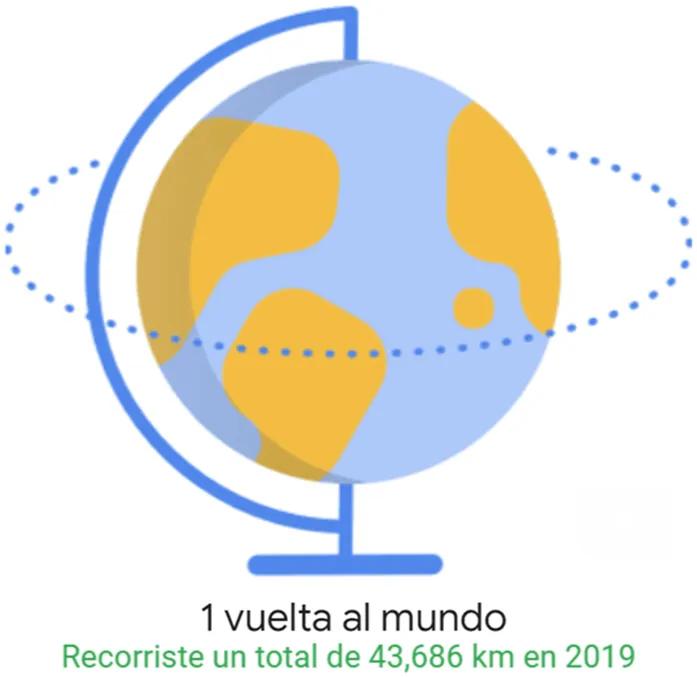
In the third place, there are no indications that experiencing overtourism has led people to change their travel habits; in other words, the ‘victims’ of the phenomenon keep reproducing overtourism elsewhere, even if they pretend to mitigate their footprint with more ‘sustainable’ behaviour. This is hardly a reproachable externalization of morality (Cluley & Dunne, 2012), as the globalisation of work and social relations unavoidably contributes to increasing international travel. This book is therefore not intended as a moral plea to stop travelling; I must confess that research related issues made me (and probably many of my co-authors) travel around the world in 2019 (Fig. 1.1).
Fig. 1.1.Google Congratulates Me with My Travel Achievement: 43,686 km, or Once around the World, in 2019 Source: Google.
Finally, in the fourth place, what for me has become one of the most puzzling contradictions of the phenomenon: that one of the drivers of the massification of travel can be found in the idea that tourism has become one of our preferred ways to express our individuality. We keep looking for an authenticity that apparently is missing in our own lives: formerly we had the illusion that that authenticity could be found in a less industrialised, more ‘primitive’ society; nowadays, Londoners hope to find authenticity in a Berlin neighbourhood, Berliners in Paris and Parisians in some London neighbourhood. This problematic relation with authenticity is one of the key issues in the overtourism debate.
3. The Debate in This Book: Tourism Demand, Protests, Urban Transformation, Measures and Impact on Natural Sites
The first section of this book looks into the demand side of tourism. Alexis Papathanassis points out that whilst measures addressing overtourism overemphasise destination level solutions, the problem itself is rooted in changes in demand. Rather than just volume growth, the author discusses demand individualisation as a ‘technology-enabled and consumer-driven shift in mass-tourism architecture’. Papathanassis therefore argues that ‘the absence of vertical capacity control inevitably results to horizontal capacity imbalances’, which can be either overtourism or undertourism.
Rasa Pranskūnienė and Dalia Perkumienė reflect on the first dilemma mentioned above as they discuss the right to travel in relation to residents' rights to their environment, and to a universal need for sustainable development. In the next chapter, my contribution discusses travel demand theories. The chapter seeks to rethink our urge to travel, which has often either been explained as an innate drive or as an individual choice; this contribution proposes a conceptual analysis of social drivers of tourism demand.
The second book section gives different perspectives to reactions of anger and protest movements against overtourism. Ian Yeoman and Una MacMahon-Beattie explain these reactions as resulting from ‘a culture of fear’ and ‘the myth of decline’; they celebrate the benefits of tourism accessible to all and the economic advantages it brings to destinations. Johannes Novy and Claire Colomb analyse protest movements against urban overtourism in the light of multiple social issues city residents face, with affordable housing and access to public spaces as symptoms of the ‘uneven and unequitable socio-spatial transformation’ that is taking place in cities. The authors find four types of policy responses to contemporary urban tourist development. First, the ‘business-as-usual’ approach, where the growth paradigm is hardly questioned, as tourism is seen as an important source of employment. Second, one where critiques are brushed aside as xenophobic or economically irresponsible. Third, managerial responses such as measures to spread tourism or influence visitors' behaviour to mitigate conflicts. Finally, a fourth type of response is the one where a radical change in policy seeks to address the issues raised by resident activist groups. Their conclusion that resident discontent is related to a broader social transformation and can therefore be seen as a ‘rise to prominence of tourism in contested cities’, concurs with the findings in our own case study —with Karoline Wiegerink— of shifting opinions among Amsterdam residents: their anger is rarely with tourists, and rather with ‘tourism’. Anti-tourism sentiments seem related to more general feelings of alienation and disempowerment about local developments, but may be triggered by specific irritations caused by the presence and the behaviour of tourists.
The third section of the book closer examines the role of tourism in the transformation of cities. Agustín Cócola-Gant, Ana Gago and Jaime Jover explore its disruptive effects in Barcelona, Lisbon and Sevilla, cities where the gentrification process is not only led by the local middle-classes, ‘but particularly [by] transnational migrants and those wanting to live in an area on a short-term basis’. Their conclusion is that tourism has become ‘monopolistic in the urban space’, and has thus become an obstacle for the establishment of social relations and the reproduction of community life. Marco Martins also studies the transformations that have taken place in Lisbon, but from a tourism perspective rather than from that of urban planning. His chapter highlights the role of real estate speculation and the corresponding emergence of urban vacation rentals in the city centre, with the risk of undermining popular support for tourist development when residents perceive an ‘unbalance in the distribution of tourism dividends’.
The next two chapters in this section discuss the issues of authenticity and commodification of urban culture. The first one of these elaborates on my earlier work about ‘home-sharing’ platforms', and in particular Airbnb's, claims to offering ‘authentic experiences’ described as ‘living like a local’. The assumption is that accommodating tourists in residential neighbourhoods —in the so-called ‘backstage’— would allow them to ‘blend in’ into mundane city life and would blur the differences between visitors and locals. This idea neglects the alterations visitors and their specific behaviour cause to their environment, which to them is a product purchased and to be consumed as the result of a commercial transaction. Javier Escalera Reyes and Macarena Hernández Ramírez provide a detailed analysis of this commodification process and the corresponding transformations in the case of a local festivity as the Feria de Sevilla.
The fourth section discusses the complications of overtourism in natural sites. Wall (2020) reminds us that the archetypical cases for carrying capacity research were found in North American national park research and management. The chapter by Fergus McLaren discusses the problematic situation where cultural and natural heritage conservation are the primary goal of National Park systems, but where investments in tourist infrastructure have been found to be the most efficient way to fund the management and maintenance of these sites. Today, US and Canadian parks do not only notoriously suffer from crowding and traffic problems, a situation that even more than in urban contexts seems at odd...