Educational development is a dynamic process that is influenced by a variety of factors such as culture, language, and individual societal needs. This book, while acknowledging that the common goal of all is to promote educational attainment for all, investigates how pedagogical approaches and processes of quality assurance differ from one country to another.
The authors offer unique and practical perspectives on different pedagogical theories and quality assurance from across the globe. Providing an overview of nine different countries from 4 continents, the scope is truly international. Each chapter showcases the leading pedagogical approach and quality assurance process that is used within a specific country, allowing readers to gain special insight into how a variety of quality assurance tools are developed and put into practice.
In an increasingly dynamic and global world, it is more important than ever that educators are equipped to respond to the needs of international student cohorts. This book is a fruitful resource for researchers, educators, pedagogics, psychologists and others, who wish to develop new approaches and educational models to contribute to the efficient process of learning.
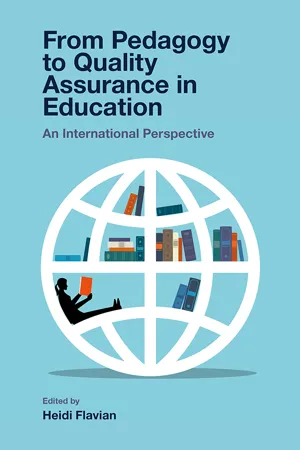
eBook - ePub
From Pedagogy to Quality Assurance in Education
An International Perspective
- 231 pages
- English
- ePUB (mobile friendly)
- Available on iOS & Android
eBook - ePub
About this book
Information
Topic
EducationSubtopic
Education GeneralPart I
Introduction
Chapter 1
From Pedagogy to Quality Assurance in Education: An International Perspective
Keywords: Pedagogy; education; special education; higher education; quality assurance; learning
The idea of writing a book that integrates different perspectives about pedagogy and quality assurance in education was developed during researchers’ meetings at international ECER (European Conference on Educational Research, which is part of the European Educational Research Association (EERA)) conferences over a number of years. These annual meetings, at which all researchers presented the quality assurance of education in their countries, led to the understanding that this knowledge should be shared with other researchers around the world. The necessity of these international perspectives is strengthened nowadays, when people are relocating from one country to another, and immigrant children need to integrate in schools all over the world. Thus, an understanding of different approaches towards quality assurance based on different pedagogical approaches has become highly significant.
As the editor of the book and co-author of one of the chapters, I believe it is unique in its integration of several approaches for quality assurance in educational systems, based on the different leading pedagogy approaches in different countries.
* * * * * *
Educational development is a dynamic process influenced by a variety of factors such as culture, language and, mostly, society’s goals. Throughout the years, educators, pedagogues, psychologists and others have developed different approaches and models in an attempt to achieve efficient and effective learning processes in their countries. At the same time, researchers develop different ways to monitor those learning processes in order to consider their quality, practical and effectiveness over the long term. Looking at the leading visions different countries have while developing their local educational processes leads to the understanding that beyond the differences, all countries share the same core goal: teaching children via a path that will allow them in the future to be an active and contributing part of the society they live in. However, what this actual path is may differ somewhat from country to country. Another common goal educators share is their wish to base educational processes on solid pedagogy theories that will afford them the highest quality of education system to promote attainment of their stated goals. Nevertheless, the cultural differences that may be evident throughout these processes are also reflected through the variety of quality assurance tools that are developed according to the sub-goals each country defines. Therefore, one cannot simply replicate educational or quality assurance processes from one culture to another without understanding the core cultural perspectives and pedagogical approach that underpin them, and then making the necessary adaptations to the other culture. Although learning from different educational processes in different countries may be seem complicated because of the dynamic social changes taking place around the world, it is essential to better recognise the differences in order to develop practical and quality educational processes that promote the understanding of different learning developments.
This book provides an overview of the variety ways researchers implement pedagogical approaches through the educational system they work in. The authors of this book hail from nine different countries and four different continents to present a unique international perspective. In each chapter, the authors present the leading updated pedagogical approach in their country, focussing on their core educational challenges, along with the quality assurance process used, in order to manage the defined educational challenge.
Generally, while conducting comparisons there is a tendency to emphasise differences and conceal the common criteria which may be efficiently used to promote programmes and processes. In this book, however, because the commonalities will be so useful, the uniqueness of the educational and quality assurance processes of each country are presented from the common perspective all authors share; that educators should learn one from another in order to further the improvement of education systems around the world. This core perspective is presented in each chapter along with three other common criteria: (1) the challenges educators face while striving to improve educational programmes and to assure the quality of their innovations, (2) the challenges educators deal with while investigating the quality of education in an era of global dynamic changes in all areas and (3) the need to keep up with the standards of quality assurance defined by policymakers.
Nevertheless, in our dynamic world, while developing new educational programmes accompanied by a variety of quality assurance processes, recognising and defining the differences is no less crucial. Throughout this book, authors refer to differences that develop from different cultural perspectives or social processes. Recognising these differences will allow appropriate and efficient quality assurance processes in education.
Quality assurance and pedagogy are the main concepts all our authors use. The practical perspectives presented in terms of these two concepts may differ, and yet, the authors developed their perceptions from the core definitions of these concepts.
Quality assurance in general is a process that seeks to guarantee that core goals, which were carefully defined before implementing a certain programme, are achieved in the most efficient ways. Quality assurance is designed to examine every factor that might contribute to the success or failure of a certain process. It should always conclude with recommendations for improvement. Due to the complexity of the process, different researchers relate to quality assurance from different perspectives. The basis for the development of these different approaches relies on the on-going debates in regard to how and why quality assurance should be conducted. Nevertheless, the variety of perspectives regarding quality assurance may be organised and recognised as a process that focusses specifically on protecting, demonstrating or enhancing quality in variety of domains.
Whereas there are different approaches to how quality assurance should be conducted, it is crucial to remember that every such process should be tailored to the specific programme being assessed, according to its specific goals. Yet, the core principles of quality assurance should be clear and maintained throughout in order to allow other people to learn from its results.
Pedagogy is the domain of teaching in general and theories and practices of learning. Pedagogy, as an academic discipline, aims to offer the knowledge of how to teach alongside consideration of the necessary teaching and learning skills for different learners and different contents. While implementing pedagogy theories, teachers also have to consider the culture in which the learning is taking place along with the social, political and psychological perspectives of all participants. Educators who use the concept of pedagogy to describe the act of teaching usually refer to the actions, judgments and teaching strategies that teachers use.
Educators who practiced teaching for many years with different population of learners began to integrate a variety of pedagogy theories while planning and conducting their teaching. Therefore, while following a variety of curricula, principles from different theories of pedagogy may look familiar, and it can be hard to recognise one specific theory within them.
Although theories of pedagogy have been developing for centuries, the understanding that teaching can be improved by integrating quality assurance began only a few decades ago. Moreover, it is essential to keep in mind that on a daily basis, the people responsible for turning those theories and visions into practice are the teachers. They are the professionals who integrate and modify the variety of pedagogy approaches with the results of the quality assurance processes, along with the dynamic changes in their society, in order to develop better curricula and learning processes for their learners. Hence, the knowledge created and accumulated from educational quality assurance processes should be shared by educators all over the world.
As mentioned earlier, through this book variety of educators from different countries share the pedagogy and quality assurance processes commonly conducted in their countries. In addition to the shared use of those two main concepts, the chapters have been organised into three main sections according to common topics the authors chose to focus on: (1) education and schools; (2) special education and (3) higher education and adult education.
Education and Schools
Although from a broad spectrum education begins with birth, when referring to formal education the focus is different. Around the world, the concept of official education is used in reference to the educational processes conducted from preschool through to academia. Thus, the first section of the book contains five chapters written about practicing education and pedagogy in schools. These authors present the current main perspectives and practices in the USA, Spain, Romania, Turkey and South Africa.
Critical thinking is one of the most challenging terms that include some of the main thinking components such as the ability to analyse, reflect, judge and strategise systematically, and solve problems. In her chapter, Critical Thinking Pedagogy and Quality Assurance in the United States, Lovegreen refers to the various definitions of the concepts along with how educators focus on how to develop them in order to promote academic achievement due to its importance in developing life-long learners. The variety of definitions, taxonomies, models and theories of critical thinking developed over the years makes a significant contribution to the pedagogical approaches to the teaching of critical thinking in the United States. Beyond the challenge of defining critical thinking, teaching it is even more challenging. Moreover, pedagogues in the USA defined the core 4Cs for learning in the twenty-first century: collaboration, communication, creativity and critical thinking. Hence, teaching of critical thinking nowadays is integrated through pedagogical approaches, including project-based learning, project-based design, e-learning and active learning and descriptions of instructional pedagogy including the general, infusion, immersion and mixed approaches. In this chapter, Lovegreen stresses that quality assurance is an essential component in ensuring that pedagogical approaches to critical thinking are effective, and discusses the contribution of core standards in the teaching of critical thinking in the United States.
While worldwide interest in educational quality has increased, many international organisations and national education systems have conducted studies on the practical meaning of quality, the various ways it can be measured and the factors that promote it as a basis for designing education reforms and rendering good practices visible. In this chapter, the authors from Spain; López-Gómez, González Fernández, Medina and Gento, explore conceptual perspectives on educational quality that are informed by various pedagogical approaches and examine the initiatives implemented in Spain to improve educational quality in non-university contexts, while analysing education legislation over the past 30 years. In their chapter, Proposals to Promote Quality of Education: A View from Spain, the authors also propose the elements they believe might further promote educational quality in non-university settings in Spain and elsewhere. These proposals revolve around the educational project, teacher training and professional development, diversity and inclusion in education and community leadership.
Following the development of quality assurance processes and their implications in Romania led the authors; Tudorache, Folostina and Michel, to write about it in their chapter, The Management and Assurance of Quality in Romanian Schools. The authors allow us to better understand the unique influences of both social and political changes on education in the country. Apparently, quality assurance was originally developed from ISO definitions, but it strengthened in 2006 after the Education Quality Assurance Law was adopted (L87/2006). This law defined the main quality of education concepts, stating a methodology related to the internal and external assurance of quality, establishing the responsibilities for quality assurance through national agencies. In addition, the law refers also to the responsibility for quality assurance at pre-university and university institutions. The leading principle for the quality assurance and the abovementioned law is that school is not only a place where we teach children to write, read and other knowledge, but also where they develop their autonomy and form their personality. Moreover, schools should have the necessary resources to remove economic, social, cultural inequity in order to offer equal chances in learning and development. Although the authors of this chapter propose a model of intervention to promote improving value for the quality assurance of education in Romania, this model may also be generalised and implemented in other countries as well.
The fourth chapter in this section was written by Çıkrıkçı, Suna and Günal who wrote about Pedagogical Approaches and Initiatives for Educational Quality Assurance in Turkey. In their chapter, they explain the mutual development of Turkish educational and institutional quality assurance, as well as the meaning of school effectiveness from the Turkish perspective. Understanding that education is widely accepted as a life-long process, school is the institution that was established to provide good quality academic education which involves complex and more abstract knowledge and ideas as well as literacy and simple numerical skills to be imparted to the students. In Turkey, education is one of the state’s basic functions that must be implemented and performed according to the constitution, under the supervision and control of the state. Accordingly, all types of educational programmes, including those conducted within higher education institutions, are supervised by the government quality assurance council. Nevertheless, educational programmes and teacher-training programmes may develop their education curricula independently as long as they follow the defined quality assurance criteria and vision.
Bantwini, from South Africa, who wrote the fifth chapter in this section, share with the readers the important discussion whether or not there is congruence between the assessment and pedagogical approaches...
Table of contents
- Cover
- Title
- Part I. Introduction
- Part II. Education and Schools
- Part III. Special Education
- Part IV. Higher Education and Adult Education
- Index
Trusted by 375,005 students
Access to over 1.5 million titles for a fair monthly price.
Study more efficiently using our study tools.
Frequently asked questions
Yes, you can cancel anytime from the Subscription tab in your account settings on the Perlego website. Your subscription will stay active until the end of your current billing period. Learn how to cancel your subscription
No, books cannot be downloaded as external files, such as PDFs, for use outside of Perlego. However, you can download books within the Perlego app for offline reading on mobile or tablet. Learn how to download books offline
Perlego offers two plans: Essential and Complete
- Essential is ideal for learners and professionals who enjoy exploring a wide range of subjects. Access the Essential Library with 800,000+ trusted titles and best-sellers across business, personal growth, and the humanities. Includes unlimited reading time and Standard Read Aloud voice.
- Complete: Perfect for advanced learners and researchers needing full, unrestricted access. Unlock 1.5M+ books across hundreds of subjects, including academic and specialized titles. The Complete Plan also includes advanced features like Premium Read Aloud and Research Assistant.
We are an online textbook subscription service, where you can get access to an entire online library for less than the price of a single book per month. With over 1.5 million books across 990+ topics, we’ve got you covered! Learn about our mission
Look out for the read-aloud symbol on your next book to see if you can listen to it. The read-aloud tool reads text aloud for you, highlighting the text as it is being read. You can pause it, speed it up and slow it down. Learn more about Read Aloud
Yes! You can use the Perlego app on both iOS and Android devices to read anytime, anywhere — even offline. Perfect for commutes or when you’re on the go.
Please note we cannot support devices running on iOS 13 and Android 7 or earlier. Learn more about using the app
Please note we cannot support devices running on iOS 13 and Android 7 or earlier. Learn more about using the app
Yes, you can access From Pedagogy to Quality Assurance in Education by Heidi Flavian in PDF and/or ePUB format, as well as other popular books in Education & Education General. We have over 1.5 million books available in our catalogue for you to explore.