The volume covers a range of ideas, beginning with a look in to new data from the sources of Swiss comparative advantage in the time of the first globalization, and of funding for investments in Russian human capital from the late imperial period to the present. A third paper turns to a newly-created database of articles published in major economic history journals from 1980-2018, demonstrating the breadth of scholars' networks and the types of questions they asked. Then, the volume pivots to North American economic development. Looking at deflators when estimating Canadian economic growth between 1870-1900, a new, more complete price index for Canada is presented which should alter scholars' views on the contributions of the country to the North Atlantic economy. Another paper expands the literature on the unusual US system of state and local banks in the early 20th century. Finally, the volume presents new estimates on the number and value of slaves entering the US during the Antebellum period.
eBook - ePub
Research in Economic History
- 312 pages
- English
- ePUB (mobile friendly)
- Available on iOS & Android
eBook - ePub
Research in Economic History
About this book
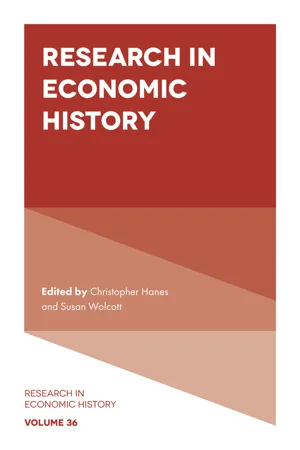
In this 36th volume of Research in Economic History, editors Christopher Hanes and Susan Wolcott assemble a cohort of experts to present new historical data, analyses of historical questions, and an investigation of historians' networks.
Information
Trends and Institutional Sources of Financing Russia's Human Capital Formation (Late Nineteenth–Early Twenty-first Centuries)
Leading Researcher, Russian Presidential Academy of National Economy and Public Administration
Abstract
This chapter sheds light on long-term trends in the level and structural dynamics of investments in Russian human capital formation from government, corporations, and households. It contributes to the literature discussing theoretical issues and empirical patterns of modernization, human development, as well as the transition from a centralized to a market economy. The empirical evidence is based on extensive utilization of the dataset introduced in Didenko, Földvári, and Van Leeuwen (2013). Our findings provide support for the view expressed in Gerschenkron (1962) that in late industrializers the government tended to substitute for the lack of capital and infrastructure by direct interventions. At least from the late nineteenth century the central government's and local authorities' budgets played the primary role. However, the role of nongovernment sources increased significantly since the mid-1950s, i.e., after the crucial breakthrough to an industrial society had been made. During the transition to a market economy in the 1990s and 2000s the level of government contributions decreased somewhat in education, and more significantly in research and development, but its share in overall financing expanded. In education corporate funds were largely replaced by those from households. In health care, Russia is characterized by an increasing share of out-of-pocket payments of households and slow development of organized forms of nonstate financing. These trends reinforce obstacles to Russia's future transition, as regards institutional change toward a more significant and sound role of the corporate sector in such branches as R&D, health care, and, to a lesser extent, education.
Keywords: Education; research and development; health care; government; enterprises; households
JEL classification: H51; H52; H75; I22; N34; O15
1. Introduction
Human capital theory was formulated in the late 1950s–early 1960s within the mainstream of economics by Schultz (1961, 1963), Becker (1962), and Mincer (1958). Their seminal works firmly established the importance of intangible capital embodied in human beings for the economic growth of nations. Initially the scholars considered education as the principal sphere of human capital formation. Some time after their focus was extended to research and development – R&D hereinafter (Machlup, 1962, 1984; Schultz, 1971), and health care (Kendrick, 1976). 1
Thereafter, the importance of education and health was voiced in the human development concept inspired by Sen (1985) and developed in Haq (1995). Although these two strands of economic literature are based on different theoretical backgrounds and epistemology, they support each other when applied to empirical research. We believe that human development stems from human capital formation and effective utilization of the available stock.
Thus, this chapter sheds light on long-term trends in the level and structural dynamics of contributions to human capital formation from various institutional sectors of the Russian economy: government, corporations, and households. The specific goal of this study is to trace the interrelations between particular sources of financing for human capital investments in the Russian case (basically, distinguishing between public vs private financing) and identify the underlying factors. The present study covers the period of modern economic growth associated with industrial development. Its onset in Russia was attributed to the 1880s in Gregory (1982, pp. 160–167) based on Kuznets (1966, pp. 63–66). Therefore, Russia was a latecomer to industrialization and many studies, following Gerschenkron (1962, 1968), have shown that capitalism in such “second-tier” (or “semi-peripheral”) countries has been more of a state capitalist type with greater emphasis on government efforts. In this perspective socialism is sometimes referred to as an extreme form of “state capitalism.”
It is argued frequently in the literature (e.g., Azariadis & Drazen, 1990 and, referring to the experience of Brazil; Lau, Jamison, Liu, & Rivkin, 1993) that for a country which is moving on the path of catch-up development it is crucial to pass a threshold in educational attainment of the population to take off and accelerate economic growth. Also, the Soviet experience was highlighted by many researchers, including those associated with the World Bank (e.g., Blumenthal & Benson, 1978), as a positive example for development policies in the educational system during the transition from agricultural to industrialized economy. Such policies required significant growth in spending on public goods which started expanding in economi...
Table of contents
- Cover
- Title
- Copyright
- Contents
- List of Contributors
- Introduction
- Specializations in Switzerland in the Nineteenth Century: Evolution of Trade Patterns and Growth Model
- Trends and Institutional Sources of Financing Russia's Human Capital Formation (Late Nineteenth–Early Twenty-first Centuries)
- The Past's Long Shadow: A Systematic Review and Network Analysis of Economic History
- Improving Deflators for Estimating Canadian Economic Growth, 1870–1900
- The Political Economy of State-chartered Banks in Early Twentieth-century Texas
- The Antebellum Slave Trade: Numbers and Impact on the Balance of Payments
Trusted by 375,005 students
Access to over 1.5 million titles for a fair monthly price.
Study more efficiently using our study tools.
Frequently asked questions
Yes, you can cancel anytime from the Subscription tab in your account settings on the Perlego website. Your subscription will stay active until the end of your current billing period. Learn how to cancel your subscription
No, books cannot be downloaded as external files, such as PDFs, for use outside of Perlego. However, you can download books within the Perlego app for offline reading on mobile or tablet. Learn how to download books offline
Perlego offers two plans: Essential and Complete
- Essential is ideal for learners and professionals who enjoy exploring a wide range of subjects. Access the Essential Library with 800,000+ trusted titles and best-sellers across business, personal growth, and the humanities. Includes unlimited reading time and Standard Read Aloud voice.
- Complete: Perfect for advanced learners and researchers needing full, unrestricted access. Unlock 1.5M+ books across hundreds of subjects, including academic and specialized titles. The Complete Plan also includes advanced features like Premium Read Aloud and Research Assistant.
We are an online textbook subscription service, where you can get access to an entire online library for less than the price of a single book per month. With over 1.5 million books across 990+ topics, we’ve got you covered! Learn about our mission
Look out for the read-aloud symbol on your next book to see if you can listen to it. The read-aloud tool reads text aloud for you, highlighting the text as it is being read. You can pause it, speed it up and slow it down. Learn more about Read Aloud
Yes! You can use the Perlego app on both iOS and Android devices to read anytime, anywhere — even offline. Perfect for commutes or when you’re on the go.
Please note we cannot support devices running on iOS 13 and Android 7 or earlier. Learn more about using the app
Please note we cannot support devices running on iOS 13 and Android 7 or earlier. Learn more about using the app
Yes, you can access Research in Economic History by Christopher Hanes, Susan Wolcott, Christopher Hanes,Susan Wolcott in PDF and/or ePUB format, as well as other popular books in Economics & Banks & Banking. We have over 1.5 million books available in our catalogue for you to explore.