The authors make the engaging argument that social justice education and inclusion should be an inherent part of the curriculum. Case studies from Africa to the USA and UK are showcased to demonstrate effective examples, from which readers benefit from a real-life model of a classroom environment supporting multi-culturalism. Ultimately, the book illustrates the importance of appropriate curriculum development involving all stakeholders and the integration of multicultural educational topics.
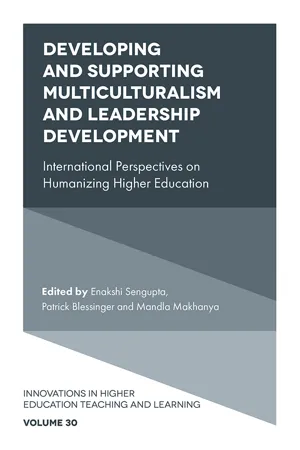
eBook - ePub
Developing and Supporting Multiculturalism and Leadership Development
International Perspectives on Humanizing Higher Education
- 238 pages
- English
- ePUB (mobile friendly)
- Available on iOS & Android
eBook - ePub
Developing and Supporting Multiculturalism and Leadership Development
International Perspectives on Humanizing Higher Education
About this book
Humanizing education, which successfully instils values that support inclusivity and equality, should be built around cultural context and experiences derived from the work of researchers and academics. This book reviews work conducted by academics globally to uncover the strategies and tools designed to facilitate better learning and integration of inclusivity.
Information
Topic
EducationSubtopic
Education Theory & PracticePART I
DIVERSITY AND INCLUSIVITY
CHAPTER 1
INTRODUCTION TO DEVELOPING AND SUPPORTING MULTICULTURALISM AND LEADERSHIP DEVELOPMENT: INTERNATIONAL PERSPECTIVES ON HUMANIZING HIGHER EDUCATION
ABSTRACT
Education needs to be viewed in a holistic manner; it does not end when one simply acquires a degree or a job. Education creates human beings, shapes them into what they are and influences their behavior and attitude toward life. It contributes to creating a long-lasting effect on people’s mind and attitude. Developing a curriculum is not an easy task as it involves various dimensions of life, and one of them is to inculcate the idea of inclusivity and multiculturalism in the minds of young learners and help them to become effective leaders in the future. The process of teaching, delivery of lessons, assessment, evaluation and various pedagogical approaches needs to be aligned to deliver multicultural education. Society’s values, beliefs and goals should be translated into a curriculum that is relevant and connects students to society. Humanizing education to instill values that supports inclusivity and equality should be built around the cultural context synthesizing opinions and facts derived from the work of researchers and academics. This book aims to review research work conducted by academics across the world. Authors argue how social justice education and inclusion should be an inherent part of the curriculum. Strategies and tools are suggested that can strengthen the learning abilities of students and create an attitude of appreciation toward inclusivity. Case studies and interventions that have been effective are cited from Africa to the USA and UK, which can help create an intentional design of a classroom environment supporting multiculturalism. The book illustrates the importance of appropriate curriculum development involving all stakeholders and the integration of multicultural education in the curriculum. Concepts such as Ubuntu and academic freedom toward leadership development have also been stressed in this book.
Keywords: Curriculum; multicultural; inclusivity; pedagogy; classroom environment; cultural context; leadership development; equality; interventions; ; intentional designs
INTRODUCTION
Creativity is considered one of the most important resources that can become the driving force for our future society. Education is changing to give way to creative thinking and enhancement of soft skills which emphasizes higher-order thinking and problem-solving skills. Curriculum, which can be viewed as a knowledge base that directs the educational setting of society, is undergoing a paradigm shift from blackboard lectures to student-centered learning that emphasizes inclusivity and multiculturalism. Education, as an extended learning community, is moving to the center of the community to align education to the needs of society. Community-based learning activities, for example, have become a key element to help humanize the curriculum to include elements that accommodate critical thinking and meaningful problem-solving abilities.
The term education has been defined by many, each giving a new meaning to it. Education needs to be holistic in nature and provides accessibility to all. Gautam and Singh (2015) defined education as a key component that enhances social, economic and political transformation in all societies. Education is considered as an integrative force in society that can be used to impart values to foster individual excellence, generate social cohesion and enhance nation-building. A curriculum has to be developed in a manner that is targeted at improving educational settings, improving teaching practices and enhancing learning activities. The curriculum is not aimed only at the students but toward faculty and staff members to develop inclusive leadership skills and an ethical and humane mindset toward developing the human potential of students.
Humanistic education needs to be holistic involving both individual and society as academics and those involved in imparting higher education need to have a sense of responsibility toward self, the learners and community at large (Blessinger, Sengupta, & Makhanya, 2019). Developing the person’s knowledge, skills, competencies and ethical habits should remain as the foremost priority of every academics no matter which stream of education they are involved in. A humanistic-oriented education that is learner centered should be the aim of a multicultural curriculum where students are capable of directly experiencing and interacting with various cultures.
Multicultural education should be capable of recognizing, understanding and sympathizing with cultural diversity that would impart a unique learning experience to students from all fields (Yun & Zhang, 2017). True experience can be achieved only when new changes are induced in the learning methods by exposing the students to concrete experiences outside the four walls of a classroom (Kim & Lee, 2001). Experiential learning is not about blindly accepting what the teacher has advocated, but rather a complete process that helps enhance the overall development of the learner (Lee, 2013).
LITERATURE REVIEW
Muacin (2017) defined the concept of multicultural education as the place that is capable of harboring the voice of a multitude in a society that is multicultural in nature and is also a place that nurtures the dreams of others. The concept of multicultural education permeates at all levels from primary school to secondary and in the field of higher education. It is not confined to developing only an inclusive curriculum but encompasses teaching methods, staff selection, policies, programs, activities and teaching methods. It ought to raise and address queries pertaining to gender, race, equality, religious tolerance, xenophobia, elitism and classism.
Multicultural education places students at the center of education and recognizes that students’ experience is paramount in building up the concept of inclusivity, which can happen when the student is exposed to real-life issues outside the classroom premises and understands and perceives a world devoid of human biasness and prejudices. Students should be encouraged to express their opinion and thoughts and should be free to analyze the prevailing oppression in society and understand the power relationship. Classroom technique should be suited to develop a multicultural context by integrating students from all quarters and having culturally competent staff who are unbiased in their freedom of thought and expression.
The concept of multiculturalism has the term equity or equality inherent in it. As Edtrustorg (2017) commented, equality can be considered synonymous with leveling the playing field, while equity is for those who need it, the ones who are vulnerable or had been maltreated in past. Multicultural education hence should include a level-playing field for those who are in need of it. The category reservation process in higher education is one such approach that gives an opportunity to those who had been oppressed in the past. Right from the admission process involving everyone in the same manner and administering a curriculum that is free of biasness can be adopted to become a step toward inducing multiculturalism and the humanistic approach toward higher education.
Sleeter and Grant (1991) advocates five approaches that can be adapted to create a multicultural education:
- (1) Teaching the culturally different: This approach when adopted helps to raise the academic achievements of students from diverse backgrounds. No segregationist policy is followed by the higher educational authorities and being inclusive in nature it treats students from all cultural and ethnic backgrounds in the same manner who are taught under the same premises inequitable manner.
- (2) Human relations approach: Social and cultural differences are identified and celebrated instead of treating “others” as somewhat superior or inferior to the outgroup. Institutional and economic power are not given any preference and students are not treated differently on the basis of such power.
- (3) The single group studies approach: Histories and contemporary issues which talks about oppression and suppression marginalization of groups in the past are explained to all in the same manner, eliminating all kinds of differences.
- (4) The multicultural education approach: Educational processes both classroom and those that are experiential in nature including instructional methods are taught to value cultural knowledge and differences.
- (5) Social reconstructionist: Students are exposed to social issues such as oppression and discrimination. With the help of creative and critical thinking students are made to realize their role in their own society as agents of social change.
Content cannot be multicultural if it is controlled by few with vested interest who purposefully ignores and demeans the culture of a particular group of people from different ethnicity. A distorted image of those who are represented in our books can even distort the multicultural perspective. Certain groups are presented in our books, mainly history books as stereotypes and their contribution trivialized, these in turn chisels the views carried by students and equitable representation of diversity is grossly ignored. Students fail to respect and understand the inclusive spirit and themselves grow up harboring biases as it is not inculcated in them.
Students require a broader understanding of world education embedded in multiculturalism without the filter imposed on them by the faculty members. Content developers are responsible for representing facts as they are way negating the filter and including material which tells the story of everyone, mainly the oppressed and the underprivileged as opposed to serving the cause of the powerful. “The manifestation of ethnicization is not limited to the domain of the political party and party system but extended to the area of economy as well” (Holst, 2012, p. 84). “An integrative approach to internationalization of curriculum is understood as the integration of inter cultural dimension into an already existing curriculum” (Joseph, 2012, p. 241).
A transformative approach to such curricula should include inclusive education, feminist pedagogies, anti-racist and post-colonial pedagogies (Joseph, 2012), which are rarely included in the curriculum of the universities. The concept of cultural diversity and inclusive pedagogy should be an important component of humanizing curricula which is often neglected by educators:
Curriculum can be enhanced by adding in or integrating different cultural perspectives and experiences. The work of an educationist is to understand power and culture as played out through identity ...
Table of contents
- Cover
- Title
- Part I. Diversity and Inclusivity
- Part II. Humanistic Pedagogy
- About the Authors
- Name Index
- Subject Index
Trusted by 375,005 students
Access to over 1.5 million titles for a fair monthly price.
Study more efficiently using our study tools.
Frequently asked questions
Yes, you can cancel anytime from the Subscription tab in your account settings on the Perlego website. Your subscription will stay active until the end of your current billing period. Learn how to cancel your subscription
No, books cannot be downloaded as external files, such as PDFs, for use outside of Perlego. However, you can download books within the Perlego app for offline reading on mobile or tablet. Learn how to download books offline
Perlego offers two plans: Essential and Complete
- Essential is ideal for learners and professionals who enjoy exploring a wide range of subjects. Access the Essential Library with 800,000+ trusted titles and best-sellers across business, personal growth, and the humanities. Includes unlimited reading time and Standard Read Aloud voice.
- Complete: Perfect for advanced learners and researchers needing full, unrestricted access. Unlock 1.5M+ books across hundreds of subjects, including academic and specialized titles. The Complete Plan also includes advanced features like Premium Read Aloud and Research Assistant.
We are an online textbook subscription service, where you can get access to an entire online library for less than the price of a single book per month. With over 1.5 million books across 990+ topics, we’ve got you covered! Learn about our mission
Look out for the read-aloud symbol on your next book to see if you can listen to it. The read-aloud tool reads text aloud for you, highlighting the text as it is being read. You can pause it, speed it up and slow it down. Learn more about Read Aloud
Yes! You can use the Perlego app on both iOS and Android devices to read anytime, anywhere — even offline. Perfect for commutes or when you’re on the go.
Please note we cannot support devices running on iOS 13 and Android 7 or earlier. Learn more about using the app
Please note we cannot support devices running on iOS 13 and Android 7 or earlier. Learn more about using the app
Yes, you can access Developing and Supporting Multiculturalism and Leadership Development by Enakshi Sengupta, Patrick Blessinger, Mandla Makhanya, Enakshi Sengupta,Patrick Blessinger,Mandla Makhanya in PDF and/or ePUB format, as well as other popular books in Education & Education Theory & Practice. We have over 1.5 million books available in our catalogue for you to explore.