Can reading literature really help our mental health? This book shows how and why - not by instruction or prescription but by emotion and exploration.
Offering case histories of individual readers and reading groups based on the work of The Reader, a charity dedicated to bringing serious literature to neglected communities, the authors showcase how a whole new demographic might get into reading, and in doing so unlock the emotional intelligence and benefits to health and wellbeing which come from our access to written human stories and imagined situations.
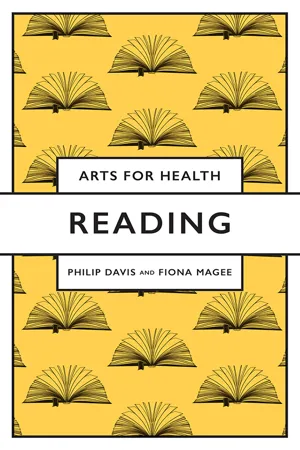
- 184 pages
- English
- ePUB (mobile friendly)
- Available on iOS & Android
eBook - ePub
Reading
About this book
Information
Topic
Medicine1
WHY READING?
The introductory question that provides our chapter title means, of course: What has reading got to do with health and well-being?
But before that lies a more aggressive version of the question: Why read at all! Why bother reading?
In the writing of Bleak House, nearly 170 years ago, Charles Dickens imagined what it was like to be Jo, the illiterate young road sweeper, living in a world in which he could never read a word, let alone a novel such as Dickens himself was writing. This concern, about the likes of Jo, was part of a reforming movement towards mass literacy in Victorian England, creating a rise in the basic ability to read and write, from just 60% in men and 40% in women in 1800 to nearly 98% across gender by 1900. It was part of a widening educational process that has been seen either as a support for democracy or to meet the threat of it: We Must Educate the Masses. There remain continuing problems of literacy throughout the modern world. Even in the United Kingdom, social inequality means that, according to the Joseph Rowntree Foundation, 5.1 million adults are functionally illiterate, having a reading age of 11 or below, and able to understand only the most straightforward short texts on familiar topics. But even with the relatively successful literacy rates in Europe and the United States, there is now a new problem and a new challenge. It is: Why do so many people who can read, not really want to? If reading and culture are supposed to be so good for you, why do those who are literate often not want to read long novels or poems?
In Poverty Safari, Darren McGarvey, a Scottish rapper who never expected to write a book, begins by describing his schooling in a large housing estate in Glasgow. He was a very bright, literate boy, who loved having words at his tongue; yet, physically, the books ‘were so crammed with words that they appeared cluttered and chaotic to my eye’: ‘Tiny lettering, coupled with tight paragraph spacing, provoked a sense of impossibility that only got worse as time went on’.1 He preferred taking in direct information from the surrounding world, like a reader without books, a reader of life. Discussion was ‘more engaging and fun’ than the ‘endurance test’ of reading on his own.
The act of reading, and indeed all forms of academic achievement, were regarded by many of my male peers as either feminine or the preserve of posh people and freaks.
That ruled out poetry, even though it did look less crammed with words on the page than did those blocks of solid prose:
It wasn’t just [poetry’s] opaque metaphors and bizarre punctuation, but also the subject matter. These poems were couched in such high language that they seemed to sneer down their noses at me.
He couldn’t believe that anyone could really understand or enjoy this soft, pretentious stuff.
But – and there was a ‘but’:
beneath my disruptive behaviour lay an aggrieved sense of rejection and exclusion, and a crushing feeling of personal failure. The realm of print felt so impossibly exclusive that I developed a fear and anxiety around books.
(McGarvey, p. xxiii)
Feeling his intelligence frustrated and excluded, he created a defensive rationale for his antipathy: he was independent-minded, free and critical; the books he was told to read were secretly no good, mainly for the snobbish arty classes, and merely imposed on people like him by the curriculum and the educational system. It was part of a story that found him increasingly alienated, his thwarted talents unfulfilled and unexpressed, and his life going off the rails.
We might be tempted to ask what is to be done for people like Darren McGarvey – but why should anything be done? It’s not the case that not-reading is a sin, a slippery slope towards mental ill-health, or a sign of moral or intellectual inferiority. But something, he himself felt, was being wasted, and the waste was having a bad effect on him.
To the young McGarvey in the 1990s, the main causes for not reading were to do with class and gender. Reading literature was a middle-class occupation, and a predominantly female thing. But now there are other, additional threats to the future of deep individual reading. Here, rightly or wrongly – and often perhaps a mixture of the two – are some of the things that people worry about:
- The failures of a narrowed educational system, with its fixed curriculum outcomes, exam targets, and league tables.
- The decline of free public libraries, both in use and availability.
- The rise of digital and visual media, of screen in preference to print – including the effects of PowerPoint, bullet-point and texting, of scrolling and scanning on-line, in decreasing the capacity for extended mental attention.
- The loss of belief in classic older works of literature, in reaction against the imposition of narrow elitist ‘standards’ as embodied in the approved canon of set texts.
- The opportunity to enjoy fantasy and escapism in imaginative forms other than conventional literature, such as gaming or graphic novels.
- The industry in mental health and self-help books which point to a genuine need but often respond to it in terms of instructive guidance insistent on enabling change through the so-called ‘positivity’ of attitude.
- The loss of the habit of reading slowly and alone, and the lack of a framework of discipline in a bustling world for bothering to find and spend time that way.
- The solitary nature of reading compared to watching tv together, even while separately looking at other screens, on phone or tablet.
- The fear of uncertainty involved in not immediately understanding a complicated meaning.
- Moods and conditions such as depression or anxiety that prevent acts of will and concentration even in those who once were readers.
- The power of social media in the coercion to conform, through the force of peer-pressure, consumer fashion, gossip, and copy-cat slogans and attitudes, substituting external appearances for individuality, and the time and separateness needed for the inner life.
Of course, there are always dismal lamentations about the current state of things. And there is plenty to be said on the other side, concerning those positive egalitarian benefits of the internet which we ourselves will point to later, such as the availability of free downloadable texts, or on-line advice and discussion. But perhaps the greatest issue here is as described by Shoshana Zuboff in The Age of Surveillance Capitalism: the threat to the individual inner life in an age of mass social media and data-driven marketing. The danger, she says, is the loss of the ‘first person response’ that we need to foster if we are to ‘begin to compose an inward sense of valid truth and moral authority’: ‘This is the reference point from which we can say, “I think,” “I feel,” “I believe”’.2 It is the development of that inner core, that personal mind, which, we believe, the reading of literature most powerfully helps stimulate and feed.
Consequently, the subject of this book is not just literacy, the basic ability to read, but the practice and habit of reading. And not just reading – for information and for knowledge – but the most intricate, moving, and imaginative form of reading, the reading of literature, poems, and novels and short stories. We claim that attentive literary reading is worth fighting for. Why? Because humans need time and attention for the sake of an inner life, and for types of thought, we’ll argue, that can only be experienced through complex literature. That is why we are not talking here about reading self-help books or books on prescription, like medicine, explicitly to meet identified problems that may cause mental ill-health. Useful as they may be at some times for some people – to help them see, in pain and loneliness, that their situation of bereavement or depression is normal and natural – they are mainly manuals prescribed for specified problems and offering directive programmes. Literature is freer than that in its mental effects, less categorical and advice-ridden, and more deeply emotional and imaginative in its re-creation of what human life is like.
In what follows, we will talk about individual literary reading but also about the practice of shared reading in small community groups. That is partly because shared group reading can reach people who would not otherwise read literature or perhaps read anything much. But it is also because shared reading can reconstruct the social and cultural conditions for the recognition of the importance of individual reading and for its serious continuation. We’ll say more about this in a moment.
*
But, first, we must acknowledge that all these concerns are not as new as they seem: the history of reading has involved arguments both for and against its value, from its very beginnings.
In the great founding library of Alexandria, planned by King Ptolemy I around 297 BCE and built by his son, it is said that above the long shelves, on which lay thousands and thousands of scrolls and texts, was inscribed one overall classification: ‘The place of the cure of the soul’.
That is why, this story tells us, you should go to the library, Darren – for ‘the cure of the soul’. Yet for the modern world, this classical claim for the value of libraries, books, and reading in human development may seem perhaps an overweening ambition. ‘Cure’ sounds physical and medical; ‘soul’ sounds supernatural and religious. Put the two together, in a realm somewhere between medicine and religion, and books become offered as a remedy or nourishment for the human spirit. Such are the imaginable origins of what is now sometimes called ‘bibliotherapy’: a creative arts therapy that sees a psychological use in the reading of books for the purposes of personal wisdom, healing, and growth. Today for better or worse, as we shall discuss later, this cultural use is most often expressed in the language of mental health and well-being.
Yet, a second story whispers: you may be right, Darren, to think there is something to be wary of in all this hype. Around 370 BCE in the Phaedrus, Plato has his philosopher-hero Socrates tell the mythic story of an earlier Egyptian king, Thamus, to whom the god Theuth brought the gift of a new invention – the art of writing. The god told the king that this great extra instrument would extend the human mind, increasing the Egyptians’ capacity for wisdom and boosting their power of memory. But Socrates has his king reply that the truth was, unhappily, the precise opposite. What was being offered here was a dangerous technology – every bit as dangerous as some now fear digital technology to be. Reading these written works, said Thamus, would offer only the appearance of learning, a borrowed vocabulary that, too easily acquired from without, would be an artificial substitute for the more direct reality of understanding through individual experience and inter-personal relationships. And furthermore, this new technology would promote greater forgetfulness, in making people trust to written notes and records instead of their own minds.
Why read? For Socrates, philosophy was first and best worked out through live thinking and speaking, the to-and-fro immediacy of on-the-spot dialogue, rather than books of secondary instruction that were comparatively lifeless and abstract. And we ourselves know that too often articulacy can try to pass itself off as intelligence, and that education can be a means of only providing ready-made words about a subject rather than being truly engaged within it. But worst of all in Plato’s eyes was the point at which this secondary medium of writing proceeded to take on a second-hand life and world of its own – going even further into the realms of unreality through the invention of imaginative literature. The art of creative writing threatened to replace the reality of life, within a shadow world of artificial fantasy.
These stories of Ptolemy and Thamus, over the 5,000 years of their existence from the first development of hieroglyphics, offer between them something of the origins of the case both for and against the benefit of reading. This is what this book must weigh up.
To avoid Socrates’ strictures against mechanical rote learning and the cheat of shortcuts, reading here means something that must be active rather than passive, that must involve thinking – interpreting and translating – consciously going on within the medium of a symbolic language, to make readers work mindfully between what is on the page and what that might mean off it. This is more than the simple acquisition of knowledge passed on by a tuitional manual – how to cook this, or how to assemble that. The wildest, riskiest venture in reading is reading literature: reading at its most intense, moving, and imaginatively speculative for the supreme task of recording and exploring human existence.
Does that seem a large claim? Here is a rudimentary example of why there must be something more than just the basic ability to read. Margaret is a volunteer who reads with Joe, a 13-year old boy in the care of the local authority, who has the reading age of a 5-year old. He has been diagnosed with attention deficit hyperactivity disorder (ADHD) and oppositional defiant disorder (ODD): it means he finds it almost impossible to concentrate and sit still, and will be likely to kick off when anyone opposes him or tells him what to do. He is, Margaret says, a young person who has a void where most children have had the experience of sitting down with mum or dad, on their knee, for a bedtime story. (Though actually according to a Children’s Book Consumer Survey, 2018, only 32% of British children under 13 are read to daily by an adult, for pleasure, 9 percentage points down on 2012; while 1 in 11 children have no books of their own at home.) Reading with Margaret began to fill that void for Joe, overcoming the restlessness and aversion, as he snuggled as close to her as he could.
She started with picture books. On one page of Shaun Tan’s The Red Tree there was a character with no features on her face, and yet the boy knew very well she was sad, he could recognise the feeling. She asked him how he knew: ‘Because they’ve drawn her head slightly tilted down and that’s what people do when they’re sad’. This was an act of reading, she said, before ever there was much actual text – especial...
Table of contents
- Cover
- Title
- Introductory Note
- 1. Why Reading?
- 2. What Helps?
- 3. Who Can Benefit?
- 4. How to Engage with Reading?
- 5. What Can Professionals Do to Help?
- 6. What are the Challenges and How to Overcome Them?
- 7. Useful Links and Further Reading
- Index
Trusted by 375,005 students
Access to over 1.5 million titles for a fair monthly price.
Study more efficiently using our study tools.
Frequently asked questions
Yes, you can cancel anytime from the Subscription tab in your account settings on the Perlego website. Your subscription will stay active until the end of your current billing period. Learn how to cancel your subscription
No, books cannot be downloaded as external files, such as PDFs, for use outside of Perlego. However, you can download books within the Perlego app for offline reading on mobile or tablet. Learn how to download books offline
Perlego offers two plans: Essential and Complete
- Essential is ideal for learners and professionals who enjoy exploring a wide range of subjects. Access the Essential Library with 800,000+ trusted titles and best-sellers across business, personal growth, and the humanities. Includes unlimited reading time and Standard Read Aloud voice.
- Complete: Perfect for advanced learners and researchers needing full, unrestricted access. Unlock 1.5M+ books across hundreds of subjects, including academic and specialized titles. The Complete Plan also includes advanced features like Premium Read Aloud and Research Assistant.
We are an online textbook subscription service, where you can get access to an entire online library for less than the price of a single book per month. With over 1.5 million books across 990+ topics, we’ve got you covered! Learn about our mission
Look out for the read-aloud symbol on your next book to see if you can listen to it. The read-aloud tool reads text aloud for you, highlighting the text as it is being read. You can pause it, speed it up and slow it down. Learn more about Read Aloud
Yes! You can use the Perlego app on both iOS and Android devices to read anytime, anywhere — even offline. Perfect for commutes or when you’re on the go.
Please note we cannot support devices running on iOS 13 and Android 7 or earlier. Learn more about using the app
Please note we cannot support devices running on iOS 13 and Android 7 or earlier. Learn more about using the app
Yes, you can access Reading by Philip Davis,Fiona Magee in PDF and/or ePUB format, as well as other popular books in Medicine & Literary Criticism History & Theory. We have over 1.5 million books available in our catalogue for you to explore.