Utilizing new and existing data, as well as theoretical and practical insights which bridge the academic and policymaking spaces, the authors frame an essential discussion about women's empowerment and public policy. Viewing SDG5 as an ethical and political responsibility, they point out the advances, scope and limitations of this ambitious goal endorsed by the international community. Each chapter contains a public policy recommendation so that readers are set to develop and act upon a key understanding of how to create change. Crucially, this volume showcases that in order to have better policies, it is necessary to evaluate achievements and failures, and understand how different strategies have had diverse impacts on women's wellbeing and empowerment.
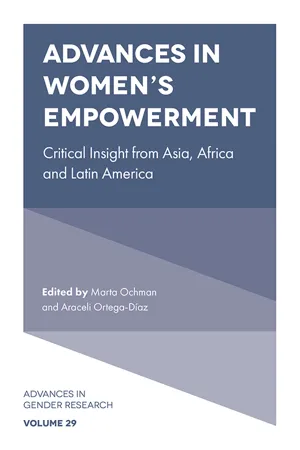
eBook - ePub
Advances in Women’s Empowerment
Critical Insight from Asia, Africa and Latin America
- 300 pages
- English
- ePUB (mobile friendly)
- Available on iOS & Android
eBook - ePub
Advances in Women’s Empowerment
Critical Insight from Asia, Africa and Latin America
About this book
The UN's Sustainable Development Goal 5 has revealed the undeniable truth that women's empowerment remains a critical challenge, and that gender inequality is an essential building block to a fair and prosperous society. But what progress has been made? This edited collection offers a critical insight and evaluation of the public policies targeted at improving the condition of women living in developing countries across Asia, Africa and Latin America.
Information
CHAPTER 1
RECENT EVIDENCE ON THE EVOLUTION OF WOMEN’S EMPOWERMENT ACROSS DIMENSIONS AND COUNTRIES: A MULTIDIMENSIONAL INDEX OF WOMEN’S EMPOWERMENT ACROSS COUNTRIES
ABSTRACT
Women’s empowerment is a multidimensional concept that encompasses different aspects such as access to education, freedom to make vital decisions, labor market access, wages, and political participation, among others. In this research, the authors construct a multidimensional index of women’s empowerment that takes into account individual resources and achievements and analyze its evolution across countries using data from the United Nations Development Programme and the United Nations for 17 gender indicators across 96 countries over the period 1995–2015. By means of exploratory and confirmatory factor analysis, the authors identify three dimensions of women’s empowerment: reproductive health, economic participation, and basic education. In addition, the authors use cluster techniques to classify countries into four groups with similar behavior patterns in the different domains of women’s empowerment: a group of countries with high levels in the domains of reproductive health and basic education but with low levels in economic participation; a group of countries with high levels in the domains of reproductive health and economic participation that should pay attention to education; a group of countries with medium levels across the three dimensions of women’s empowerment, especially in reproductive health and economic participation; and a group of countries with low levels in all the dimensions of women’s empowerment, especially in reproductive health and basic education. The comparison of these different patterns serves to highlight the aspects in which improvements have been made or, on the contrary, to highlight the obstacles that are hindering the improvement of gender equality. Finally, the results suggest that advancements in women’s empowerment improve the countries’ level of development.
Keywords: Dimensions of women’s empowerment; gender inequality; gender indicators; development; factor analysis; cluster analysis
JEL classification: J16; I15; I2; C38
1. INTRODUCTION
Achieving gender equality through women’s empowerment is currently one of the major objectives included in the 2030 Agenda for Sustainable Development (United Nations (UN), 2015). Similarly, there is a fast-growing body of research that examines women’s empowerment from a variety of perspectives. However, the main difficulty researchers must contend with is the availability of reliable and sufficient data to carry out rigorous research.
Data are necessary to better understand and overcome the challenges that women face in society, as well as to influence policy changes and measure their impact (Sell & Minot, 2018). However, in developing countries which face the greatest challenges to gender equality and women’s empowerment, there is an especially pressing need for data on this issue as well as reliable statistics. In this line, an increasing number of institutions have made significant efforts in recent years to measure different aspects of women’s position in the world, which has substantially improved the availability of data.
Nonetheless, there are still certain shortcomings in analyzing the current situation of women. For example, data are not homogeneous for all countries, since in many cases they are available only for a small number of countries, while in others they refer to different time periods, such that making any attempt at comparisons between countries is quite difficult. Some international organizations have prioritized measurements of gender equality and women’s empowerment in their statistics. In particular, the UN has taken notable steps in this direction through the United Nations Development Programme (UNDP), which introduced composite indexes of gender development (GDI) and gender inequality (GII) in 1995. Although both indexes cover broad geographic areas and time periods, they offer aggregated information, and hence do not allow studying the different dimensions behind the concept of women’s empowerment. Therefore, much research is still needed to fully understand the concept of women’s empowerment and ascertain the progress made in its different domains.
This study tries to fill this gap and contribute to the research on gender issues and social indicators by constructing composite indexes of women’s empowerment for a wide sample of countries that enable studying the different dimensions of this concept in greater depth. Specifically, we start by constructing a database which aims to standardize, organize, and synthesize the existing information on gender issues. Based on factor analysis techniques, this information allows us to identify the different dimensions of women’s empowerment and to construct individual composite indexes for each of them. The analysis of these composite indexes across time and across countries provides a more complete picture of the current reality, as not all the dimensions of women’s empowerment could be progressing at the same pace. A disaggregated study, such as the one proposed in this research, will permit us to gain a better understanding of the obstacles that each country faces in gender-related matters. In addition, we seek to establish comparisons between countries in order to offer a framework that could serve for future research to study, in greater depth, successful actions in those countries that have made the greatest advances, as well as the barriers that hinder this process in countries where progress has not been achieved at the desired pace or has yet to occur.
For the purpose of this research, the first step consists in identifying current data sources on the subject of gender. Once the gender indicators are identified, we group them by subject according to the level of temporal and geographical availability. The aim is to synthesize all these indicators in composite indexes that can be used to analyze the evolution of women’s empowerment in recent decades. To that end, we perform a factor analysis in two stages. In the first stage, we identify the specific dimensions of women’s empowerment, while in the second stage, we construct a multidimensional index of women’s empowerment (MIWE) composed of individual indexes for each domain of empowerment.
Finally, we conduct a cluster analysis that allows us to construct groups of countries according to their levels in the different dimensions of women’s empowerment. Although an in-depth study of the specific economic and social features behind women’s empowerment in each group of countries is beyond the scope of this chapter, this research aims to identify similar behavior patterns across countries. The findings could provide a working basis for policymakers to better define future policies targeted at improving women’s role in the economy and society and hence promote the progress and development of the least developed countries.
2. BACKGROUND
Women’s equality and empowerment is addressed in Goal 5 of the 17 Sustainable Development Goals. According to the UN (2017):
Women and girls, everywhere, must have equal rights and opportunity, and be able to live free of violence and discrimination. […] Gender equality is not only a fundamental human right, but a necessary foundation for a peaceful, prosperous and sustainable world. Providing women and girls with equal access to education, health care, decent work, and representation in political and economic decision-making processes will fuel sustainable economies and benefit societies and humanity at large.
In order to determine the degree to which this objective has been achieved, the first step is to be able to measure women’s empowerment. However, women’s empowerment is difficult to measure because of its abstract nature (Bishop & Bowman, 2014; Mishra & Tripathi, 2011). The seminal work of Kabeer (1999) defines women’s empowerment as “the process by which those who have been denied the ability t...
Table of contents
- Cover
- Title
- Advances in Women’s Empowerment: An Overview
- Chapter 1. Recent Evidence on the Evolution of Women’s Empowerment Across Dimensions and Countries: A Multidimensional Index of Women’s Empowerment Across Countries
- Chapter 2. Empowerment and Desired Fertility in Sub Saharan Africa
- Chapter 3. Gender Differences in Intergenerational Income Mobility in Brazil
- Chapter 4. Urban Female Labor Force Participation and Its Correlates: A Comparative Study of Slum Dwellers and Their Urban Counterparts of Three Metro Cities in India
- Chapter 5. Marital Status and Poverty with Gender Bias
- Chapter 6. The Geography of Female Homicides and the Role of Civil Organizations in Mexico
- Chapter 7. Women’s Empowerment and Grassroots Organizations: An Argument for Bounded Empowerment
- Chapter 8. There Has Been No Silent Revolution: A Decade of Empowerment for Women in Rural Tamil Nadu
- Conclusions
- Index
Trusted by 375,005 students
Access to over 1.5 million titles for a fair monthly price.
Study more efficiently using our study tools.
Frequently asked questions
Yes, you can cancel anytime from the Subscription tab in your account settings on the Perlego website. Your subscription will stay active until the end of your current billing period. Learn how to cancel your subscription
No, books cannot be downloaded as external files, such as PDFs, for use outside of Perlego. However, you can download books within the Perlego app for offline reading on mobile or tablet. Learn how to download books offline
Perlego offers two plans: Essential and Complete
- Essential is ideal for learners and professionals who enjoy exploring a wide range of subjects. Access the Essential Library with 800,000+ trusted titles and best-sellers across business, personal growth, and the humanities. Includes unlimited reading time and Standard Read Aloud voice.
- Complete: Perfect for advanced learners and researchers needing full, unrestricted access. Unlock 1.5M+ books across hundreds of subjects, including academic and specialized titles. The Complete Plan also includes advanced features like Premium Read Aloud and Research Assistant.
We are an online textbook subscription service, where you can get access to an entire online library for less than the price of a single book per month. With over 1.5 million books across 990+ topics, we’ve got you covered! Learn about our mission
Look out for the read-aloud symbol on your next book to see if you can listen to it. The read-aloud tool reads text aloud for you, highlighting the text as it is being read. You can pause it, speed it up and slow it down. Learn more about Read Aloud
Yes! You can use the Perlego app on both iOS and Android devices to read anytime, anywhere — even offline. Perfect for commutes or when you’re on the go.
Please note we cannot support devices running on iOS 13 and Android 7 or earlier. Learn more about using the app
Please note we cannot support devices running on iOS 13 and Android 7 or earlier. Learn more about using the app
Yes, you can access Advances in Women’s Empowerment by Araceli Ortega Díaz, Marta Bárbara Ochman, Araceli Ortega Díaz,Marta Bárbara Ochman in PDF and/or ePUB format, as well as other popular books in Social Sciences & Gender Studies. We have over 1.5 million books available in our catalogue for you to explore.