eBook - ePub
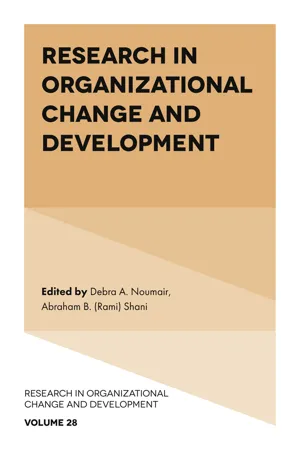
Research in Organizational Change and Development
- 336 pages
- English
- ePUB (mobile friendly)
- Available on iOS & Android
eBook - ePub
Research in Organizational Change and Development
About this book
Volume 28 of Research in Organizational Change and Development introduces thought-provoking contributions. These include: Utilizing big data and social network analysis in OD; professional identity of renowned American women in the field; the role of communities that support interpersonal learning and enhance workers ability to thrive in the emerging nature of the new world of work; technology and technological embeddedness as a change and development enabler in schools; organizational resilience as an arena for organization development work; change in tightly coupled systems and the middle management role in organization development; and strategic fitness processes and organizational dialogue. The diverse collaborative contributions by leading scholars and scholar-practitioners provide an enriching body of knowledge on contemporary challenges in organizational change and development.
Information
The Social Media Presence of Organization Development: A Social Network Analysis Using Big Data
Abstract
Organization development is often mourned as stagnant or perhaps dead, but most of these declarations seem to be insular, being supported primarily by anecdotal or survey research among organization development scholars and practitioners. This exploratory study seeks a more objective understanding of the state of organization development by examining big data from the social media platform Twitter. Drawn from over 5.7 million tweets extracted through Twitter's Application Program Interface (API) during 2 months in 2018, this research approaches the state of organization development through a quantitative, abductive study utilizing social network analyses. Organization development is examined through its characteristics as a social network on Twitter and how it relates to and interacts with other familial networks from management and organization studies. Findings show that organization development is relatively inactive as a social network on Twitter, as compared to other familial networks, and the relationships between the organization development network and these familial networks tend to be ones of inequality. Organization development references familial networks much more than any of the familial networks reference organization development. This inequality in social media presence is particularly surprising since several of these familial networks were founded from the field and principles of organization development. We locate organization development's generalist status, as compared to familial networks' specialist status, as generating this interaction disparity drawing on recent research that suggests specialized fields fare better in times of rapid change compared to generalist fields. We discuss the potential for greater specialization of organization development with a reemphasis on its process philosophy and focus.
Keywords: Organization development and change; Big data; Social network analysis; Social media; Twitter; Data analytics; Generalist vs. specialist; Process approaches; Abductive reasoning; Rejuvenating ODC
Introduction
It has become a cliché to mourn the stagnation, and perhaps death, of change in the field of change itself – organization development (OD). Some have attempted to understand its fall (Burke, 2018), meanwhile others seek to plot a new course (Bushe & Marshak, 2009; Cooperrider & Srivastva, 1987) or at least to trace its historical and current course (Cummings & Worley, 2015; Jick & Sturtevant, 2017). Some note that the spirit of OD is actually alive in spite of being declared dead (Bartunek & Woodman, 2012) while another set of views highlights the irony of OD's substantial success but inadequate recognition (Golembiewski, Yoon, Kim, & Lee, 2005). Others bemoan the loss of status for OD compared to fields such as strategy, organization theory, and organizational behavior. Although OD enjoys earlier founding roots and was the progenitor of frameworks such as Contingency Theory, Organization Design, Group Dynamics, Team Effectiveness, and Socio-Technical Systems, these frameworks have been appropriated by newer disciplines in the larger family of management and organization studies (Tenkasi, 2018; Tenkasi & Zhang, 2018).
However, aside a few exceptions such as metaanalyses of the effectiveness of OD interventions that was empirically based (Robertson, Roberts, & Porras, 1993a; 1993b), most of the assessments of the state of the field have relied on introspective and speculative opinions from OD researchers and practitioners or survey research among them (Shull, Church, & Burke, 2014). Little, if any, research has been able to reflect on the state of OD from the position of the larger community of practice who constitute a broader social network of interested parties associated with a discipline such as OD and who form a distinct subnetwork among a constellation of broader management and organization studies networks.
The explosion of social media platforms such as Twitter affords us a unique opportunity to precisely engage in such an examination (Ogle, 2019). Social media has exploded in the past decade and has allowed the creation of instantaneous social networks and movements on various domains and arenas including organization development and other management and organizational disciplines (MOS). More importantly, social media platforms such as Twitter have enabled an inclusive culture with minimal entry barriers and free and open access to any individual from any part of the world who signs up to a social media platform. This is in contrast to traditional, nonelectronic social networks of yesteryears that were limited to unique and fee-based membership in associations such as the ODC division of the AOM for researchers/academics and/or the OD network for practitioners. These organizations were for the most part regionally circumscribed.
Social media and globalization are two of the biggest trends in contemporary organizations (Church & Burke, 2017), and Twitter is an excellent reflection of current experience in global social media (Oulasvirta, Lehtonen, Kurvinen, & Raento, 2010) as almost half a billion tweets are written across the globe daily (Stricker, 2014). Twitter contemporaneously generates global big data about almost any topic including the topic of OD. We do acknowledge that Twitter users may not be a representative sample of OD scholars and practitioners, given that many may not participate in social media or may prefer platforms other than Twitter. This is clearly a limitation of our exploratory analyses. However, Twitter as one of the largest social media platforms globally allows us a reasonable chance to empirically examine questions that have plagued and divided the field in terms of the status of OD with differing assumptions regarding the contemporary relevance of the OD field (Bartunek & Woodman, 2012; Burke, 2018; Golembiewski et al., 2005; Tenkasi, 2018; Tenkasi & Zhang, 2018). Specifically, the nature of voluminous data available on Twitter enables us to examine the following research questions:
- Where does OD's social status stand relative to familial fields in the domain of management and organization studies (MOS) in terms of its social presence as defined by the volume of tweets on Twitter?
- What are the common topics discussed in OD on Twitter?
- What are the interrelationships between OD and other familial fields in the domain of management and organizational studies on Twitter? More specifically:
- – Which other MOS fields are most closely affiliated with OD?
- – What are the directions and strength of these relationships between OD and other MOS fields on Twitter?
- – What are the common topics in these interrelationships between OD and other MOS fields on Twitter?
There are three unique and pioneering contributions of this exploratory study: (1) assessing the relative social status of OD vis-a-vis other MOS fields in the Twitter social media space; (2) adding OD to the emerging trend of employing social media information to understand social phenomena, a very recent development in social studies (Kim & Hastak, 2018; Tremayne, 2014; Williams, McMurray, Kurz, & Lambert, 2015; Yang & Srinivasan, 2016); and (3) contributing methodologically in the use of social network analysis (SNA) to study Twitter network relationships between OD and other MOS fields, a method of analyses that has been underrepresented in OD research. 1
Big Data through Twitter
The term “big data” refers to extremely large datasets that may be structured or unstructured. Structured data is the type found in relational databases, but unstructured data, such as audio, images, video (Gandomi & Haider, 2015), and social media, is data not resident in fixed locations, and it is estimated to represent 80% of all big data (Freedman & Morrison, 2018). The amount of unstructured data is astronomical, the flow of social data is unending, and it approaches us as an avalanche (Beer, 2016). Our first step in dealing with this avalanche of data is to determine an accessible social media network for our research.
The largest social media networks include Twitter, Facebook, LinkedIn, Instagram, Tumblr, Reddit, and Snapchat. If we were to analyze all of them, we would find nearly 2 billion people interacting with each other (Baesens, Bapna, Marsden, Vanthienen, & Zhao, 2016). All of these interactions leave a communication trail that can be tracked and analyzed by researchers, as many social media platforms allow at least limited data retrieval. But some are more open to the general public than others with a number of platforms restricting access to their data. Twitter, in particular, tends to allow searchability in several different forms, and it is comparatively easier to research given its ease and openness of use. Its data are readily available – although not without restriction – through an Application Programming Interface (API) making it a rich platform for mining data and capturing social trends (George, Haas, & Pentland, 2014).
With its millions of tweets posted daily, Twitter is an ideal source of big data indicative of “what's happening in the world and what people are talking about right now” (Twitter, 2019) as it invites users to “spark a global conversation” (Twitter, 2019). A form of microblogging or “making the ordinary visible to others” (Oulasvirta et al., 2010), Twitter provides tremendous advantages. “The ability to observe and measure micro, individual-level data on a comprehensive scale enables us to address grand problems on a societal level with deep policy implications that go beyond the confines of a single organization” (Agarwal & Dhar, 2014, p. 445). Its contemporary impact is clearly evident in the current US presidency and social movements such as #MeToo and its boasted 321 million Monthly Active Users (MAU) in 2018 with 21% of those users in the United States and 79% located internationally (Twitter, 2018). The exact number of tweets per day is somewhat elusive since Twitter has not publicly updated this number since December 2014 when it announced the creation of more than 500 million tweets per day (Stricker, 2014).
The availability of big data on Twitter allows opportunity for the study of organiz...
Table of contents
- Cover
- Series Editor
- Title
- Copyright
- Contents
- List of Contributors
- Preface
- The Social Media Presence of Organization Development: A Social Network Analysis Using Big Data
- Constructing the Professional Identity of the Renowned American Women of Organizational Change: A Story of Their Lives
- Community in the New World of Work: Implications for Organizational Development and Thriving
- Digitalization in Schools: Four Examples of Embeddedness
- Organizational Resilience: Antecedents, Consequences, and Practical Implications – for Managers and Change Leaders
- Management Is Missing in Change Management
- Change in Tightly Coupled Systems: The Role and Actions of Middle Managers
- Why Honest Conversations are Transformative
- About the Contributors
Trusted by 375,005 students
Access to over 1.5 million titles for a fair monthly price.
Study more efficiently using our study tools.
Frequently asked questions
Yes, you can cancel anytime from the Subscription tab in your account settings on the Perlego website. Your subscription will stay active until the end of your current billing period. Learn how to cancel your subscription
No, books cannot be downloaded as external files, such as PDFs, for use outside of Perlego. However, you can download books within the Perlego app for offline reading on mobile or tablet. Learn how to download books offline
Perlego offers two plans: Essential and Complete
- Essential is ideal for learners and professionals who enjoy exploring a wide range of subjects. Access the Essential Library with 800,000+ trusted titles and best-sellers across business, personal growth, and the humanities. Includes unlimited reading time and Standard Read Aloud voice.
- Complete: Perfect for advanced learners and researchers needing full, unrestricted access. Unlock 1.5M+ books across hundreds of subjects, including academic and specialized titles. The Complete Plan also includes advanced features like Premium Read Aloud and Research Assistant.
We are an online textbook subscription service, where you can get access to an entire online library for less than the price of a single book per month. With over 1.5 million books across 990+ topics, we’ve got you covered! Learn about our mission
Look out for the read-aloud symbol on your next book to see if you can listen to it. The read-aloud tool reads text aloud for you, highlighting the text as it is being read. You can pause it, speed it up and slow it down. Learn more about Read Aloud
Yes! You can use the Perlego app on both iOS and Android devices to read anytime, anywhere — even offline. Perfect for commutes or when you’re on the go.
Please note we cannot support devices running on iOS 13 and Android 7 or earlier. Learn more about using the app
Please note we cannot support devices running on iOS 13 and Android 7 or earlier. Learn more about using the app
Yes, you can access Research in Organizational Change and Development by Debra A. Noumair, Abraham B. (Rami) Shani, Debra A. Noumair,Abraham B. (Rami) Shani in PDF and/or ePUB format, as well as other popular books in Business & Gestione delle risorse umane. We have over 1.5 million books available in our catalogue for you to explore.