![]()
Part I
Change Models
Introduction to Part I
Change management initiatives do not fail because of the lack of change management models and frameworks. Many change management models exist that are widely promoted within both the field of change management consulting and academia. Further, an examination of most models does not appear to vary significantly from that which could be expected to arise from common sense. Prior to seeking to understand why change management fails, it is useful to understand typical change management frameworks that are in existence today.
![]()
Chapter 1
A Survey of Change and Change Models
Change Management and Common Sense: Things Change Managers Would Likely Do without Models
Physics informs us that “an object at rest tends to remain at rest; whereas an object in motion tends to remain in motion.” Although the domain of organizational change management has little to do with physics, this principle does appear to readily apply. There is familiarity and comfort with adopting a routine and doing the same things in the same way over a long period of time. Changes made to the way things have always been done is uncomfortable for most employees. Discomfort leads to concern as well as uncertainty. Uncertainty about the future will always exist even when the news announcing change is apparently positive. Uncertainty then tends to fester over time and multiply as employees voice their concerns to one another in the hallways of the company and by the watercooler. Uncertainty reaches the point where it leads to fear—fear of the future and the unexpected. Fearful employees then seek to return to the comfort that they once knew, and in doing so, tend to resist the changes suggested by senior management. Change therefore tends to trigger a cycle of “routine, comfort, uncertainty, fear, and resistance.” Managers attempting to change the organization to a new operation with improved performance and improved alignment with strategy are often at a loss at deciding how to succeed at creating such change. Change will always involve breaking with routine and introducing some level of uncertainty. Change managers will therefore encounter uncertainty, fear, and resistance regardless of the nature of the proposed change. They must expect it, prepare for it, and address it in change management initiatives.
Where to Start?
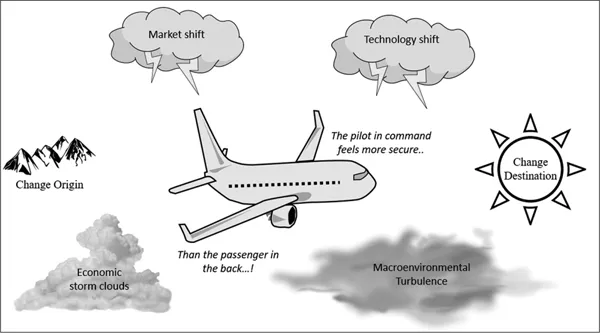
A start at creating change in the face of resistance might involve thinking about how to intervene in the negative spiral associated with the disruption of employees’ comfortable routine. Common sense would suggest that as a fundamental first step, managers should attempt to clearly communicate the rationale behind the change that may be perceived by employees to be a disruption of a previous routine. Change management understand that there is a link between the discomfort of parting with the routine of today and the uncertainty associated with the new ways of doing things. It is paramount for managers to consider how to reduce uncertainty by painting a picture of what the future will look like, and how and why this is preferred over the routine of the past. Common sense would further dictate that managers would involve employees in some way in designing the change as well as in the implementation. Asking employees to go along with plans developed by someone else is far more difficult than assigning employees to contribute to the design and development of a plan that they would now consider to “own” even in some small way. To make an analogy, an airline pilot flying through a thunderstorm would be likely feel a greater sense of security than the typical passenger in the rear of the plane who is being jostled by the uncertainty of constant turbulence. The difference between the pilot and the passenger with respect to uncertainty and fear is the sense of control over one’s own destiny. Stakeholders in change management initiatives who feel that they control their own destiny feel more like pilots than mere passengers.
In the same way that successful airline flights eventually find a way through the turbulence and land, change initiatives get carried out despite the headwinds and turbulence. Such changes are incorporated within the organization and feature revamped processes (Figure 1.1). It is at this point in the change process where the reality may not quite match the beautiful picture painted by managers. There will likely be growing pains that feature the desire to return to how things were done in the past. Once again, managers communicate on an ongoing basis the rationale behind the change, the promise that things will settle once again into routine, and that when they do, the future will be brighter than the past.
Figure 1.1 Change from the perspective of a pilot and passenger
How then does common sense inform executives and senior managers in the design and implementation of change initiatives? To summarize, it is all about effectively communicating the rationale behind the change, providing a clear description of an image of a better future, reducing uncertainty and fear by instilling employee ownership in the design and implementation of change, and finally continually reinforcing the change to ensure that employee buy-in continues. Common sense suggests that when many people will be affected by change, they should be informed and their input should be solicited. Understanding the relationship between change, uncertainty and resistance, fear, and day-to-day human behavior therefore leads to common-sense measures that work to reduce that almost automatic “push-back” from employees that is motivated by fear.
Change Management Models: What
Are They and Why Use Them?
Though common sense provides guidance to managers who have it, formal academic models exist that seek to provide guidance and direction to managers who are more comfortable with following a prescribed series of steps to alter the current course of their organizations. Further, many managers do not have the time to think through a custom methodology for implementing change. Change managers need all the help and advice they can get, and they therefore reach out to thought leaders in the field for guidance. Academic models are attempts to not only explain what has happened when successful change was carried out, but what should happen as well. Some change management models tend to be descriptive. These models do little more than attempt to describe what happens during change. Other models are prescriptive. They inform managers what, in the view of the creator of the model, what “should” be done when initiating and implementing change. Often these models are based on hard experience from both success and failed change over a period of many years. Change management frameworks are also based on collected data from change managers to inform the researcher on what was done, how it was done along with results that inform what should be done as a matter of good practice. It pays to remember that these ideas are models of reality rather than reality itself. Change management models can work, but this is no guarantee that they always do work. The same could be said for most business practices. It depends on the context, how the practice is implemented, who implements it, and how well it is managed.
The Lewin Model: Unfreeze, Change, Refreeze
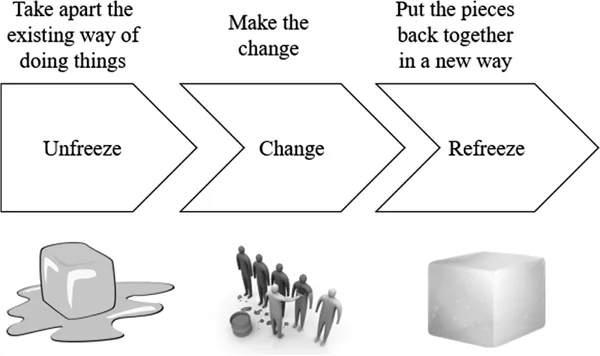
Lewin is a seminal author in the field of change management. Lewin informs us that change involves three steps—one of which—rather redundantly—is “change.” The first step in the three-step process uses a term “unfreeze.” To unfreeze an organization is to prepare it for change by breaking apart the legacy patterns of doing things. This is in effect taking “an object at rest” and giving it a push so that it is moving again. This is easier said than done given the natural uncertainty associated with change and the resulting resistance. However, common sense informs managers that a change effort cannot be completed unless it is first started, and unfreezing is starting the process. The real question is “how”? Unfreezing implies stopping something and taking a different action, for example, taking ice cubes out of the refrigerator and letting them melt.
For naturally talented leaders, the way to start is to put stakeholders at ease by sharing a vision for the future and including them in the change plan. In fact, such activity, reminiscent of unfreezing or melting ice cubes, is often referred to as “warming up.” Ideally, unfreezing should result in receptive stakeholders who understand the intended change and the underlying rationale.
The next step in Lewin’s framework is “change,” but this is a single word that speaks volumes. The “change” phase focuses on implementing new processes, new practices, and new systems. There are many ways to do this, including training, practice, role-playing, and scenario planning, to name but a few. In most cases, things get worse before they get better as stakeholders gradually work through the discomfort of doing something in a new way. Eventually, if the change is successful, performance improves. Lewin then informs the manager that the change must “refreeze” into the organization. This term is shorthand for “institutionalizing the new way of doing things” (Figure 1.2). Once the company is familiar with the new way of doing things to the point that it is no longer new, and the application of new processes and systems comes naturally, it could be said that refreeze and institutionalization of the change has occurred.
Figure 1.2 Lewin’s model of managing change
Observations on Lewin
The Lewin framework expresses what is observed in common-sense thinking about managing change. Change must begin, it must be carried out, and the change must become a way of life. While the Lewin framework provides a structured path to follow when initiating and managing change, the phases are expressed in a compact form and require elaboration by any given manager. Presumably, effective managers could successfully employ Lewin, whereas others, following the same three phases, could easily fail and often do. It appears from inspection of the process that the Lewin framework could emerge from a common-sense consideration of what ought to happen within a change management scenario. Further, the three steps in the Lewin framework could be viewed as phases or categories of activities. Change managers could take this and develop a project around it. This could be done by identifying the desired deliverables from “unfreeze,” “change,” and “refreeze” followed by populating a schedule with activities and resources.
Kotter’s Eight-Step Change Model
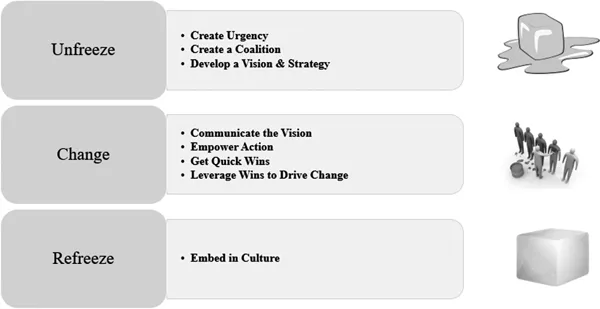
The Kotter’s change model provides detail and structure far beyond the three-phase Lewin model. The eight steps are as follows:
- Create urgency
- Create a coalition
- Develop a vision and strategy
- Communicate the vision
- Empower action
- Get quick wins
- Leverage wins to drive change
- Embed in culture
An examination of the Kotter model suggests similarity with both a common-sense approach and the Lewin model, albeit with additional detail. Steps 1 to 4 appear to relate to preparing for change, “unfreezing,” and reducing the uncertainty in the organization. Steps 5 to 7 involve carrying out the change by aiding the organization in getting things done while attempting to create a positive spiral of success. The implementation of change begins with things that can be accomplished quickly so that successes can raise the energy level and work to minimize the resistance to change. The thinking here is that resistance to change can be expected to decrease if positive results are observed by the stakeholders involved in change. Finally, new systems and processes are institutionalized by embedding the change in the culture, or in Lewin’s terminology, “refreezing.” “Embedding in culture” need not be a top-down effort from outside of the organized. Instead, it could be something that emerges from the practice of new processes, policies, and practices over time. In fact, this is known to occur in companies that exhibit an emergent strategy and culture rather than one dictated from the leadership level of the firm (Figure 1.3).
Figure 1.3 Kotter’s eight-step model
Observations on Kotter
The Kotter model provides some interesting guidance to the manager. The first key point is that of urgency. It is observed that change leads to uncertainty and resistance that must be overcome by the change manager. Kotter makes the point that managers must not only answer the question of “Why change?” but also “Why change now?” The second key point that Kotter makes that extends the Lewin framework and the common-sense approach is to seek small victories or “quick wins” in order to provide evidence for the benefits of the proposed change as well as to build some positive momentum. The Kotter model is said to
“extend” the Lewin model because although Kotter follow the general pattern of the fundamental stages of the Lewin framework, the Kotter model provides additional detail and guidance that in Lewin remains implicit.
PROSCI “ADKAR” and Three-Phase Model
PROSCI, an acronym for “professional science” is a consulting company dedicated to the art of change management. Two notable frameworks are promoted by PROSCI: the ADKAR and the three-phase change model. ADKAR is an acronym that stands for Awareness, Desire, Knowledge, Ability, and Reinforcement. The Awareness and Desire elements of ADKAR play a role in uncertainty reduction by reinforcing the need for change as well as describing the nature of the propose...