![]()
CHAPTER 1
Behavior
Simply, behavior can be defined as a reaction to a stimulus; this sounds pretty silly, because if we look at one stimulus, it can have many reactions among many people. The stimulus might be a loud sound or a complicated thought.
Scientists studied the behavior of animals and wondered why they do certain actions. One of the early animal behaviorists (Pavlov) studied what dogs can learn. Since then, animal behavior is still studied, but with an eye to comparing it with humans.
If you watch an animal (say a dog), you will see it learns new behaviors if rewarded (usually with food). But then, so do humans; advertising is an example.
Lets do a small experiment. A few years ago, a very famous actress said she would like to see Orangutans in the wild.
First they took her to an area where baby orangutans were brought when their mothers were killed.
These babies were so very cute, they climbed all over her and she laughed and laughed even when one peed on her.
After, she said she would like to see a grown male.
Because the males live a solitary life, she sat on the road waiting. All the photographers hid.
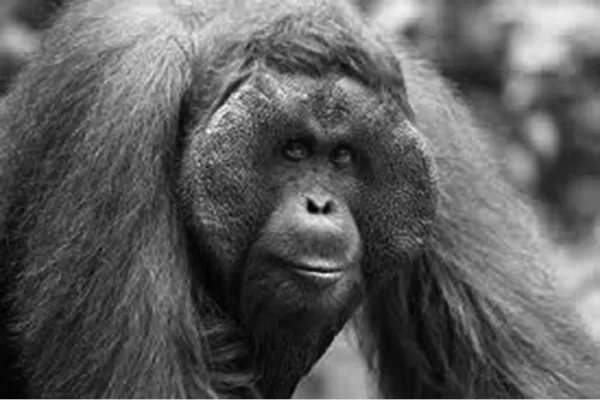
He came out on the road (see figure 1.1) and moved toward her. She stayed perfectly still as he moved toward her. He reached out his hand and touched her (she was calm), then hugged her!
The photographers ran out to pull him off her but she was calm, and so was she. What was the reason for the hug?
Does animal behavior predict what behavior humans might have?
The answer is probably. So, why are we testing on animals first?
Because we do not want to test on people, possibly because of any number of consequences, such as: side effects, lawsuits, mistakes, bad publicity, and of course, loss of revenue.
But, if you look at animals versus humans in drug testing, you can see how dangerous it can be for drug companies to skip the animal trial if something would go wrong when humans are using it.
Note: Why this is important in courts:
As humans, we feel in control of our actions, so if we lose control, we might feel angry, guilty, sorry, or happy.
![]()
CHAPTER 2
Physiology 1
In humans, behavior is controlled by the brain and spinal cord. Reflexes are a perfect example. They react quickly and protect us from more harm.
Our First Behavioral Multiple Choice Question
You walk into the kitchen and a pot is boiling over on the stove.
What do you do?
- a. Ask someone
- b. Look for clues (burner on, smell of food)
- c. Touch the pot to see if it is hot
- d. Walk away
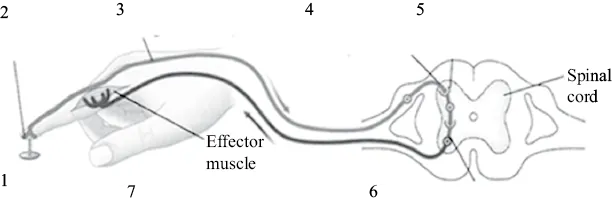
Answer: All of these might be correct, and your response may change because of your age, previous knowledge, and the word hot! If you choose c, you might be hurt, or your reflexes might kick in (see Figure 2.1).
Most of our behaviors begin with a stimulus traveling to the brain first, but not reflexes. Your reflexes tell your body, danger! The stimulus then goes to the spinal cord, which immediately sends a message to the arm muscle to contract and pull your hand away. It bypasses the brain and solves the immediate problem. Because nothing is perfect, you might still get a burn, but not as severe. Our brain will store this reflex. See Illustration 2.1.
There are two types of reflexes: the autonomic reflex, affecting inner organs, and the somatic reflex, affecting muscles.
Other reflexes: blinking, pupil opening and closing (in response to light), arm or leg responding to a pin prick (in response to pain), coughing or sneezing (response to irritants or allergens in the nasal cavity), and knee jerk (response to a blow to the knee).
Other brain functions are routed through different areas of the brain (see Illustration 2.3). Sight is a good example. When light enters the eye, it is turned into electrical impulses by passing through the retina. These impulses travel up the optic nerve into the spinal column and up to the brain.
Figure 2.1 Reflex
Reflex arch: A reflex arc is a neural pathway that controls a reflex. In vertebrates, most sensory nerves do not pass directly into the brain, but synapse in the spinal cord. Follow the steps in the following figure:
1 and 2:...