"The most comprehensive account available of the final years of the crusading military order" from the acclaimed author of
Medieval Mercenaries (
Baltische Historiche Kommission).
The Battle of Grunwald was one of the largest battles in Medieval Europe and was the most important in the histories of Poland and Lithuania.
It was fought on 15 July 1410 during the Polish-Lithuania-Teutonic War between the alliance of the Kingdom of Poland (led by King Jagiello) and the Grand Duchy of Lithuania (led by Grand Duke Vytautas) against the German-Prussian Teutonic Knights (led by Grand Master Ulrich von Jungingen) and with the assistance of Sigismund, then King of Hungary and Croatia.
The Teutonic Knights, a crusading military order, were defeated and most of their leaders were killed or taken prisoner. This defeat would mark the beginning of their decline and they would never again regain their former power.
Following the battle, the balance of power shifted in Central and Eastern Europe and so came the rise of the Polish-Lithuanian union as the dominant political and military force.
In this compelling account the action takes place in Lithuania, Poland, the Czech Republic, Hungary, Russia and Germany. There are bloody battles; fascinating characters; intrigue; betrayals; sex; unexpected twists of fate; religious heresy and a smattering of saints. There is also the monumental end of one era making way for the beginning of another.
While there has long been interest on the crusades outside of the Holy Land, this book is unique in the sheer breadth and depth of its research.
"A must-read for those seeking scholarly work on this pivotal period of European history." —
Journal of Military History
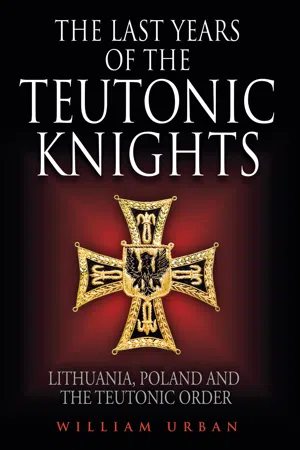
eBook - ePub
The Last Years of the Teutonic Knights
Lithuania, Poland and the Teutonic Order
- 384 pages
- English
- ePUB (mobile friendly)
- Available on iOS & Android
eBook - ePub
About this book
Information
Topic
StoriaSubtopic
Storia anticaChapter 1
The Balance of Forces in Central Europe
The Teutonic Knights in the Fourteenth Century
As the year 1350 approached, the Black Death had just struck, killing a third or more of the population of Europe; Germany and France were in such turmoil that few knights could leave home to go on crusade in Prussia. Moreover, the Lithuanian pagans were on the offensive, striking into Prussia and Poland. Even more dangerously, Tatars of the Golden Horde were crossing the steppe to attack Russia, Poland, Moldavia, and even Bulgaria and Serbia. Meanwhile, the Ottoman Turks were advancing in the Balkans against the weakened Christian kingdoms there. A working Tatar–Turkish alliance had been formed by Uzbeg (Khan Öz Beg, 1282–1341), the Tatar khan who suppressed the Buddhist and shamanist traditions in favour of Islam. He loosened the ties to the Mongol dynasty ruling China and strengthened his hold on the princes in Rus. He made his state rich from tribute and the sale of slaves.
This was the moment that the military order found its paladin, Winrich of Kniprode, the inspiring figure who would lead the Teutonic Knights to their greatest victories. During the years that Winrich governed as grandmaster, 1351–82, his military order grew in power and prestige. However, there were in fact three Landmeister at the head of the Teutonic Order: the grandmaster in Prussia, the Livonian master, and the German master. Their state was well organised – the senior officers being responsible for specific regions, their immediate subordinates commanding impressive castles, and other officers supervising native tribes and ecclesiastical properties. Careful record-keeping and regular inspections assured honesty and frugality.
The officer assigned to live with or near the native Prussians was called an advocate (Vogt). He trained the militia, saw that it had proper uniforms and weapons, and probably spoke the local language well. Advocates for larger regions were essentially governors.
The native Prussians had been reconciled to their loss of independence, partly because they retained their free status and individual farmsteads, partly because conversion to Christianity meant little except giving up polygamy and cremation, and because they had suffered from Lithuanian raids intended to force them back into paganism; the taxes and tithe were unwelcome, but they recovered some of that cost by serving as light cavalry in the armies of the Teutonic Knights.
The Teutonic Knights saw two ways that the crusade in Prussia could end victoriously. One was the total defeat of the pagans, with Lithuanians accepting their leadership for further crusades; another was that one of the pagan dukes would lead his people to baptism and then govern as a Christian monarch – that had happened before, in the thirteenth century. In fact, few nations accepted Christianity as the result of missionaries’ daring ministry alone. Conversion was a complex matter that also involved war, trade, dynastic marriages and culture; Christians also knew how to drain swamps, build windmills and collect taxes – formerly pagan rulers appreciated these skills.
A Glorious Era in Poland and Hungary
East-central Europe in the mid-1300s was dominated by two dynasties, the Angevins and the Luxemburgs, both of which had acquired power there though marriage. The head of the first family was Louis the Great of Hungary (1326–82). Well-educated, he spoke French, German and Latin, was conventionally pious, was experienced in war and diplomacy, and moderate in his habits. He became king of Poland in 1370 because his mother was the sister of the last king of the Piast dynasty, Casimir the Great (1310–70).
The head of the Luxemburgs was Charles IV (Karel, Karl, 1316–78), king of Bohemia and Holy Roman emperor. He spoke Latin, German, French and Italian; and he learned the language of his people, Czech. He was a warrior, politician, and patron of artists and architects – one still finds his name everywhere in his capital, Prague. He wrote an autobiography and was a famous lawmaker, most notably persuading the electors of the Holy Roman Empire to endorse the Golden Bull of 1356, thereby establishing a procedure for electing emperors that eliminated papal interference.
The courts of these rulers were famous for their lavish encouragement of the arts, chivalric entertainment and intellectual life. Prague (Praha) and Buda (on the right bank of the Danube River with the castle and royal residence) were filled with foreign visitors, commercial activity and the unending construction of new churches and palaces; Cracow (Kraków) was rather shabby by comparison, but growing. All three cities were populated largely by Germans and Jews, but that was of little importance, because the native peoples preferred traditional rural life to crowded and disease-ridden cities where their agricultural skills were nearly worthless. Nobles, too, preferred life in the country.
Louis and Charles governed personally, deciding even small matters in formal hearings that must have seemed interminable, and they moved constantly about their realms – partly so that no one community would be overburdened by feeding and housing the courtiers and staff, partly to see for themselves how the country was being governed in their names, and partly from boredom; they tired of hunting in the same forests day after day. The daily business of government was seldom exciting. They had to deal with self-important nobles and clergymen, alternately flattering, placating and bullying them; they occasionally met representatives of the small middle class, but expected the lower classes to pay taxes quietly and perform unremunerated services. The royal household was filled with petty jealousies, outsized ambitions, quarrels over status, and sexual intrigues. The monarch was expected to resolve them all. This was a difficult task, because everywhere local concerns outranked national ones. Governing was a long negotiation with contending parties whose ancient feuds and current ambitions were only occasionally outweighed by the common interest in curbing royal authority.
By comparison, the Teutonic Order in Prussia was visited mainly to see its magnificent army in action and to enjoy lavish banquets in primeval woods, within hearing of the angry howls of dangerous pagans. Squires from France, England and Germany hoped to be dubbed knights there, and everyone expected to bring home stories that would entertain peers for years. Other than the banquets for guests, court life in Prussia was dull. Its sister state in Livonia was even less exciting. Both survived because of the careful management of their resources, not because the lands were rich – both lands were too far north, too filled with forests and swamps, and the native peoples lacked the skills necessary to prosper in the cities visited by Hanseatic merchants. The bureaucracy, supervised personally by the grandmaster and a small group of officers, made the slender resources of Prussia turn a profit. Meanwhile, rich estates in the Holy Roman Empire helped support crusaders on their overland travel through Poland to Prussia or the sea voyage to Livonia.
This made the lands of the military order sufficiently rich to attract the attention of neighbouring monarchs, but defeating the proud army of the Teutonic Knights and taking their well-built castles would be too expensive and time-consuming. Moreover, if any ruler had proposed it, his nobles and clergymen would have objected.
But circumstances were slowly changing, and ‘the German Order’ (as contemporaries referred to the Teutonic Knights) could do little to slow developments that they could not yet perceive as threatening.
Louis the Great of Hungary and Poland
When Louis became king of Hungary in 1342, his uncle, Casimir the Great, asked for his aid in wars against Lithuania and the Tatar khan over possession of Halych (Halicz) and Volhynia; in return, the Polish king promised to name Louis as his heir. There was a territorial aspect to the agreement – Louis would allow Casimir to occupy the eastern lands they conquered, then inherit them, with the understanding that if Casimir had a male heir, he would pay Louis for the territory. Louis thought little about it – in that era promises were lightly made and easily forgotten, and he had business in Naples (to revenge the murder of his younger brother by his wife) and on his southern frontier (where another brother died falling off his horse). But this promise was kept.
Few expected Casimir to fail at producing a legitimate son – he already had several children by mistresses – but all five of his legitimate children were daughters. Moreover, his marital history was irregular: his beloved Lithuanian first wife died, then he locked the unpleasant second spouse in a distant castle and married his mistress, whom he divorced on the basis of a falsified papal dispensation, then remarried. On Casimir’s death in a hunting accident, his crown went to Louis. The union of the two kingdoms was purely personal – the nobles and clergy jealously guarded their prerogatives so that no king could become a tyrant. Louis nevertheless extended his united realm eastward and to the south, onto the steppes (modern Ukraine), into Moldavia and Wallachia (modern Romania), and down the Adriatic coast (modern Croatia). This was possible partly because he could use both Polish and Hungarian resources for every project, partly because when involved in any activity that benefited only one kingdom, he did not have to fear the other intervening.
His expansion of the frontier towards the Black Sea won the approval of the Papacy, making this reaction against Tatar attacks into a quasi-crusade. As Paul Knoll observed, it was the origin of a popular claim that Poland was the shield of Christendom against eastern paganism and Islam. But it was a difficult policy to sustain, and soon this territory came under Hungarian control, then after 1370 morphed into a new state – Moldavia – where politics were unstable and volatile.
Poland was lightly populated, and it had not been long since its provinces were essentially independent, the crown being held by the eldest member of the Piast dynasty, not its strongest. As the Oxford History of Poland–Lithuania notes, Poland was an unstable monarchy before Casimir came to the throne. Then Louis was a foreigner with foreign interests who disliked the weather in Poland and never bothered to learn the language. His wife, the famously handsome Elizabeth (1339–87), was a Bosnian, with roots even farther away, and for seventeen years their marriage was childless.
Hungary was ethnically divided – Magyars (Hungarians), Slovaks, Croats, Germans, Romanians, Vlachs. Moreover, it spread across a great plain with flooding rivers and swamps, ringed by mountains that impeded trade and travel, and with one great river, the Danube, that could not be navigated to the Black Sea because of the rapids called the Iron Gates. In this kingdom, too, Louis was widely viewed as a foreigner who paid too much attention to foreign enterprises.
These enterprises included taking the Dalmatian coast from Venice, with Genoese assistance, and forcing Venice to capitulate to his demands for easy access to Italy (and hence to Naples, which he still regarded as his ancestral home); it also included siding with Genoa and Byzantium in the Black Sea against Venice. Proposals for new crusades abounded, together with numerous minor campaigns, but Christian disunity prevented much from being achieved.
Late in life Louis still had neither son nor prospects of having one, and his health was visibly declining from a disfiguring skin disease – both leprosy and syphilis have been suggested. No longer having the energy or desire to prevent the dissolution of his united realm, he watched fearfully as events unfolded. In geopolitical terms, a division of the realm made little sense – Poland could not deal effectively with pagan Lithuanians to the east, Tatars to the south-east, or the Teutonic Order to the north; Hungary would have to fight alone against the Turks along the Lower Danube. However, self-interest disguised as national feelings almost always trumps logic. It was not as though Louis had done much for Poland. His main interest had been hunting; when he made war it was mostly for the benefit of Hungary, and even for distant Naples; the Turks were becoming a threat, but almost nobody wanted to see it.
As Norman Davies noted in God’s Playground, Louis had introduced many Hungarian customs into Poland during his short reign, and none were to be rescinded when he died. By abdicating power to the nobility, he was setting Poland on the course that would continue for centuries – a weak monarchy, a rebellious nobility and an independent church. This showed itself in the negotiations over the future of the realm.
Under the circumstances, the best that King Louis could do in his last days was to secure the Polish succession for his eldest surviving daughter, Maria (1371–95), and Hungary for the younger, Jadwiga (Hedwig, 1373/4–99). He engaged Maria to Sigismund of Luxemburg (1368–1437), the second son of Charles IV and a great-grandson of Casimir the Great; for Jadwiga he made an arrangement with Wilhelm (c. 1370–1406), the young Habsburg prince of Styria in what is today Austria – she was four at the time.
The two marriages seemed to make good geographic sense. Sigismund’s Brandenburg territory was close to Poland, and surely everyone could see the advantages of combining Styria, Hungary and Croatia to oppose aggression by the Turks or Venice. However, Sigismund was dependent on help from his brother, the king of Bohemia, and Wilhelm could not get much aid from his father, because he was involved in a losing war with his Swiss subjects. Moreover, both Poles and Hungarians were reluctant to have any German ruler – and while they recognised the validity of hereditary claims, they believed that the nation (the people, the community of nobles and commoners) was even more important. In short, the crown was superior to its wearer, and the people decided who should wear it.
Charles IV of Luxemburg
Charles had been lucky in every respect. First of all, as Holy Roman emperor and king of Bohemia, he had been immensely rich and powerful. Unlike his neighbours, who were preoccupied by fears that a succession crisis would lead to civil war, he had three sons. He promised Bohemia to the eldest son, by his first marriage (Wenceslaus), Brandenburg to the next (Sigismund), by his second marriage, and held the third (Johann) in reserve, giving him the strategic northern territory of Görlitz that included a part of the Neumark. Secondly, Charles was better able to tap into the patriotic instincts of his German subjects by the reforms he made in the Holy Roman Empire, by limiting the opportunities for popes to interfere in the electoral process, and by giving lip service to national institutions such as the German Order.
His brother was given Moravia, the beautiful rolling country between Silesia, Little Poland and Lower Austria. He passed it on to his son Jobst (1354–1411), a now forgotten figure who had become powerful by marrying the daughter of a Piast prince who had been one of Louis the Great’s closest associates – Ladislas Opole (Władysław Opolczyk, 1332–1401).
Once Charles became emperor, he did not continue his youthful participation in the military order’s crusades against Lithuanian pagans, but he encouraged others to do so. Perhaps he would have been more active if he had possessed even greater financial resources, but Charles was too cautious a manager to waste anything; this ability to discern priorities among possibilities may have been the secret to his political successes.
When Charles IV died in 1378, Wenceslaus was elected first king of Bohemia, then Holy Roman emperor. In 1381 he sent Sigismund to Cracow to learn Polish and to become acquainted with the land and its people, anticipating that he would become king of Poland as had two previous Bohemian monarchs; he gave him Neumark to facilitate communication between Brandenburg and Poland.
The Teutonic Order in Prussia
Through these years the Teutonic Order was greatly assisted by these rulers in their crusades against Samogitia and Lithuania, crusades which appeared to be leading to the conversion of those pagan societies. But that story has already been well told by numerous scholars. Our narrative commences with the rise of three monarchs whose long lives intertwined with the history of the military order in the years of its greatness and its long decline.
Sigismund
Few of the plans for the succession in Poland and Hungary worked as hoped. Right from the beginning, Sigismund was arrogant and greedy. These characteristics, which one might expect of a fourteen-year-old, became habits that would bedevil the politics of east-central Europe for more than five decades. Even so, he might have got away with it if he had shown real skill at dissimulation, but there was a child-like quality to Sigismund even when he was an aged and very jaded monarch. When the Polish nobles asked the child-candidate for Maria’s hand to promise that he would reside in Poland if his wife became their monarch, he refused. If he did that, he would lose all hope of adding the Hungarian crown to his wife’s inheritance, thereby maintaining the union of the two kingdoms. He might also have given some indications that he was hoping to succeed his half-brother Wenceslaus as king of Bohemia, because Wenceslaus was already showing signs of his alcoholism and poor judgement. Once he passed on, Sigismund was likely to become Holy Roman emperor. But Sigismund had a tendency to speak before he thought. Sometimes he did not even think after he spoke, so that he could repair the damage.
Neither the Poles nor the Hungarians were enthusiastic about becoming a minor partner in a great empire. Though their lands were important in their own right, everyone understood that the centre of European population and wealth was the Holy Roman Empire, and therefore they feared that Sigismund would give that region, especially Germany and Bohemia, undue attention. Sigismund does not seem to have made significant efforts to calm Polish and Hungarian fears that their interests would be neglected. But, then, he was only fourteen.
On the positive side, Sigismund possessed remarkable energy. He was even somewhat manic, always on the move, always looking for new diversions. In the realms of politics and sex Sigismund never seemed to flag. He dreamed boldly and put into words magnificent visions. A master of many languages, he rarely needed an interpreter, and he unfailingly charmed his audience, whether assemblies of nobles, gatherings of clergy, other monarchs in private meetings, or women looking for adventure.
The Poles were already tired of being the afterthought in their monarchs’ plans, but that was nothing compared to what Sigismund might do. Already in 1376 they had forced the first of three regents to resign – Louis’s mother, Elisabeth (1305–80), the sister of Casimir the Great, after the Polish garrison in Cracow had killed 160 of her Hungarian guards in a riot. The Poles then rejected the succession plans, arguing that Sigismund was a German and that Maria was a name which should be reserved for the Mother of God; they renounced their oaths to Sigismund and Maria, and began looking for somebody more suitable as a monarch; unfortunately for their plans, the Silesian Piasts were too intimidated by Sigismund’s strength to offer themselves as candidates, and so were the Piast dukes of Masovia.
This led the youthful Sigismund and his advisers to believe that they could wear any opposition down. Hostility to foreigners was nothing new in Poland or anywhere else; indeed, the last Bohemian king who had dared to wear the Polish crown had been assassinated. Even at this early age Sigismund exhibit...
Table of contents
- Cover
- Title
- Copyright
- Contents
- List of Plates & Maps
- Preface
- A Note on Names
- Introduction
- Chapter 1: The Balance of Forces in Central Europe
- Chapter 2: Piracy, Saintly Visions, and Challenges from Germany
- Chapter 3: The Samogitian Revolt
- Chapter 4: The Battle of Tannenberg
- Chapter 5: The Peace of Thorn
- Chapter 6: The Council of Constance
- Chapter 7: New Crises
- Chapter 8: The Old Order Passeth
- Chapter 9: Hussite Invasions and Internal Dissent
- Chapter 10: The Thirteen Years War, 1450-1463
- Chapter 11: Lithuania, Poland and the Teutonic Order in the Late 1400s
- Chapter 12: The Reformation
- Chapter 13: What Did It All Mean?
- Recommended Reading
- Plate section
Trusted by 375,005 students
Access to over 1.5 million titles for a fair monthly price.
Study more efficiently using our study tools.
Frequently asked questions
Yes, you can cancel anytime from the Subscription tab in your account settings on the Perlego website. Your subscription will stay active until the end of your current billing period. Learn how to cancel your subscription
No, books cannot be downloaded as external files, such as PDFs, for use outside of Perlego. However, you can download books within the Perlego app for offline reading on mobile or tablet. Learn how to download books offline
Perlego offers two plans: Essential and Complete
- Essential is ideal for learners and professionals who enjoy exploring a wide range of subjects. Access the Essential Library with 800,000+ trusted titles and best-sellers across business, personal growth, and the humanities. Includes unlimited reading time and Standard Read Aloud voice.
- Complete: Perfect for advanced learners and researchers needing full, unrestricted access. Unlock 1.5M+ books across hundreds of subjects, including academic and specialized titles. The Complete Plan also includes advanced features like Premium Read Aloud and Research Assistant.
We are an online textbook subscription service, where you can get access to an entire online library for less than the price of a single book per month. With over 1.5 million books across 990+ topics, we’ve got you covered! Learn about our mission
Look out for the read-aloud symbol on your next book to see if you can listen to it. The read-aloud tool reads text aloud for you, highlighting the text as it is being read. You can pause it, speed it up and slow it down. Learn more about Read Aloud
Yes! You can use the Perlego app on both iOS and Android devices to read anytime, anywhere — even offline. Perfect for commutes or when you’re on the go.
Please note we cannot support devices running on iOS 13 and Android 7 or earlier. Learn more about using the app
Please note we cannot support devices running on iOS 13 and Android 7 or earlier. Learn more about using the app
Yes, you can access The Last Years of the Teutonic Knights by William Urban in PDF and/or ePUB format, as well as other popular books in Storia & Storia antica. We have over 1.5 million books available in our catalogue for you to explore.