eBook - ePub
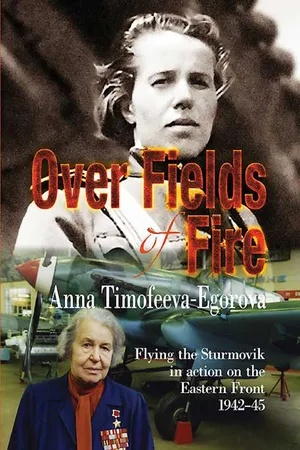
Over Fields of Fire
Flying the Sturmovik in Action on the Eastern Front 1942–45
- 208 pages
- English
- ePUB (mobile friendly)
- Available on iOS & Android
eBook - ePub
Over Fields of Fire
Flying the Sturmovik in Action on the Eastern Front 1942–45
About this book
During the 1930s the Soviet Union launched a major effort to create a modern Air Force. That process required training tens of thousands of pilots. Among those pilots were larger numbers of young women, training shoulder to shoulder with their male counterparts. A common training program of the day involved studying in 'flying clubs' during leisure hours, first using gliders and then training planes. Following this, the best graduates could enter military schools to become professional combat pilots or flight navigators. The author of this book passed through all of those stages and had become an experienced training pilot when the USSR entered the war. Volunteering for frontline duty, the author flew 130 combat missions piloting the U2 biplane in a liaison squadron. In the initial period of the war, the German Luftwaffe dominated the sky. Daily combat sorties demanded bravery and skill from the pilots of the liaison squadron operating obsolete, unarmed planes. Over the course of a year the author was shot down by German fighters three times but kept flying nevertheless. In late 1942 Anna Egorova became the first female pilot to fly the famous Sturmovik (ground attack) plane that played a major role in the ground battles of the Eastern Front. Earning the respect of her fellow male pilots, the author became not just a mature combat pilot, but a commanding officer. Over the course of two years the author advanced from ordinary pilot to the executive officer of the Squadron, and then was appointed Regimental navigator, in the process flying approximately 270 combat missions over the southern sector of the Eastern Front initially (Taman, the Crimea) before switching to the 1st Belorussian Front, and seeing action over White Russia and Poland. Flying on a mission over Poland in 1944 the author was shot down over a target by German flak. Severely burned, she was taken prisoner. After surviving in a German POW camp for 5 months, she was liberated by Soviet troops. After experiencing numerous humiliations as an 'ex-POW' in 1965 the author finally received a top military award, a long-delayed 'Golden Star' with the honorary title of 'Hero of the Soviet Union'. This is a quite unique story of courage, determination and bravery in the face of tremendous personal adversity. The many obstacles Anna had to cross before she could fly first the Po-2, then the Sturmovik, are recounted in detail, including her tough work helping to build the Moscow Metro before the outbreak of war. Above all, Over Fields of Fire is a very human story - sometimes sad, sometimes angry, filled with hope, at other times with near-despair, abundant in comradeship and professionalism – and never less than a large dose of determination!
Information
1
Led astray by a rainbow
I’d made my choice – I was going to be a professional pilot! Nothing else would do! One cannot split oneself into two halves, one can’t give one’s heart to two passions at once. And the sky has a special claim on one, completely engaging all one’s emotions…
I remember the send-off as a bright sunny festival, although the day was quite likely to have even been overcast. But…my friends’ smiles, laughter and jokes – all this so dazzled me and so turned my head, and my joy, overfilling me, so fogged my vision…When the train had taken off I, by now on the carriage platform, stared ahead for a long time, blinking with half-shut eyes, failing to make anything out…
In Ulyanovsk, I rushed straight from the train station to the Venets1 – the highest spot above the Volga. And such an inconceivable space opened up before me from up there, such an expanse that it took my breath away! Here it was before me – the mighty Russian river that had given Russia the bogatyrs2…And what a wonder, above the Volga covered by young December ice, a rainbow began to shine. It threw its multicoloured yoke from one bank to the other across the whole blue sky – and this in the wintertime? Yet maybe I had just imagined it? But I was already laughing loudly, sure that it was a rainbow, and that it was a sign of luck. Again just like back at the Kazan train station in Moscow, waves of joy were coming from my chest and their splashes were curtaining the horizon with a rainbow mist. It had been no easy ride – exams passed brilliantly, approval given by a nitpicking medical board – and I had been enrolled as a flying school cadet!
…We had already been issued with uniforms: trousers, blouses with blue collar patches, boots with leggings. It seemed I had never worn a better outfit in my life although it was obviously a bit big for me. In a word I liked everything in the school from reveille and the physical exercises up to marching with a song before bedtime. We studied a lot. I did well in the classes. But once…I still see that day as a terrible dream.
“Cadet Egorova! The school commander’s calling you.”
When I entered the office and reported as one should, everyone sitting at the table met me with silence and just stared at me gloomily. I remember standing at attention and waiting.
“Do you have a brother?” I heard someone’s voice, and answered:
“I have five brothers.”
“And Egorov Vasiliy Alexandrovich?”
“Yes, he’s my elder brother.”
“So why have you concealed the fact that your brother is an enemy of the people3?”
For a moment I was taken aback.
“He’s not an enemy of the people, he’s a Communist!” I shouted in anger, wanted to say something else, but my throat dried up straightaway and only a whisper came out. I could no longer see the faces of those sitting in the office and heard little – only my heart throbbing stronger and stronger inside my chest. It seemed that my brother was in trouble and I knew nothing about it…From somewhere I heard, like a sentence:
“We are expelling you from the school!”
I don’t remember leaving the office, changing into my civilian clothes in the cloakroom, the gates of the flying school shutting behind me. They had taken the sky away from me…That rainbow had led me astray…I hadn’t found happiness…And again I found myself on a steep river bank, but this time not up on the Venets but far out of town. I searched through my pockets, found my passport, Comsomol4 membership card, a small red certificate with the Metro emblem on the front – the Government’s token of appreciation for my participation in the first stage of the Moscow Metro construction. That was all I had.
In agonising torment and anxiety I decided to go to see my mother in the village. There, in my native land of Tver I would be always understood and supported. But I suddenly thought: I haven’t even got a kopeck – not even enough for a passage ticket. And then I headed for the City Comsomol Committee…
2
My native land
Basically our village of Volodovo, lost in woodland between Ostashkovo and ancient Torzhok, had only one street. By 1930 it had only 45 houses. In summer everyone went to pick mushrooms and berries in the forests and coppices of Glanikha and Mikinikha, in Zakaznik and up on Sidorova Hill. But the main occupation of many generations in our land was flax. When it was in blossom it was impossible to tear your eyes away from the blue sea, and when it ripened it would become a sea of gold! And what great air there was in the many-grassed fields and meadows! And how crystal clear the springs were in Veshnya and Pestchanka, Lotky and Yasenitsa!
After I finished year four of the Sidorovskaya village school my mother decided to send me away to Torzhok and enroll me in a gold-embroidery school. But in a week I began to ask to go home for I understood that I would be unable to sit all day long over embroidery. I had understood even with my child’s mind that one has to have to have a vocation for such a craft. They didn’t make a gold embroiderer of me. But there was no place to continue my education, for there was no secondary school in our area and my elder brother decided to take me to Moscow.
I liked it at my brother’s, especially the warm arms of one-year old Yurka. He wouldn’t let me away from him day or night, and if I chanced not to be next to him he would begin crying so, that he awoke everyone in the apartment. I didn’t go to school for I had a headstart on studies by two months. I went for walks with Yurka, with children from our courtyard in Kourbatovskiy Lane, helped at home, and ran to the bakery to buy bread.
In the winter they set up a skating rink in our courtyard. With home-made wooden skates tied with strings to our valenki1 we managed to trace out some kind of figures on the ice. I happened to be at the circus when Grandfather Dourov2 performed in person. My brother took me once to the Bolshoi Theatre. I remember that the opera Prince Igor was on and I remembered Prince Igor’s aria for the rest of my life.
Looking ahead somewhat I recall that once I would have to listen to this aria as a POW of the Germans. An Italian POW named Antonio would sing it until he was shot dead by the Hitlerites…Years later when my second son was born I would call him Igor…
Thus, with all the variety, discoveries and delights of early teenage life my first Moscow winter went by. The next summer Yurka and I were sent to the village. It turned out that at long last they had opened a seven-year school in Novo village and it was decided that I would go there to study. The new school was a seven-year CYS3 and I entered Year 5 there. Seven kids from our village went there. Every day we had to cover five kilometres there and five kilometres back – in frost, under rain, on roads covered by snow and through impassable mud. Only two of us stayed on till year 6: Nastya Rasskazova and I.
Nastya and I went to the graduation ball dressed “to kill” as they said in our village. We wore black skirts made of ‘devil’s skin’4, white calico blouses with sailor collars and white socks and rubber-soled shoes on our feet. We sang, recited poetry and danced at the ball. They entreated me and Nastya – would-be sailors – to dance to Yablochko5 and we joyfully kicked up our heels with all our might.
Along with our graduation certificates we all received recommendations for further studies. Guryanov and I were recommended for teachers’ college, Nastya Rasskazova for agricultural school. Nikitina, Mila, Lida Rakova were recommended for 9-year school and to continue studying at university.
3
The underground
The papers were calling us to the 5-year-plan construction sites and almost all of our graduating class left for different places. Everyone wanted, as it was said back then, to take part in the ‘industrialisation of the country’. We were eager to work and to study.
That summer my brother Vasiliy spent his vacation in our village. He helped mother mow hay for the cow and stocked firewood for the winter. He told us a lot about Moscow, construction sites, and about the underground railroad – the Metro – which was to be built in Moscow.
“What for?”, mother asked.
“To get to work faster”, Vasya1 answered. “In many developed countries Metros were built even in the middle of last century, in London, New York, Paris…”
We were all were surprised by my brother’s knowledge and most of all by the fact that a Metro would be built in Moscow. This word had not been heard before! I had already decided for myself that I would go with my brother and try to find a job on this mysterious construction. But when I advised mother of this she began to object, and lamented “I’ve brought my kids up and now they all are going to fly away from their native nest and I’ll be left alone”. Vasya convinced mother I would definitely keep studying in Moscow and on that we left.
Upon arrival in the capital the first thing I did was to go and look for a district Comsomol committee. I gingerly entered the building and began to guess which door I should knock on.
“What are you looking for, young lady?” a man dressed in overalls asked me.
“I want to work for Metrostroy2!”
“Are you a Comsomol member?”
“Yes!”
“Write your application”, the chap suggested, and asked a passing girl: “Where shall we send her?”
“And what can she do?”
“Nothing yet” he answered for me.
“Then send her to the Metrostroy Construction School FZU”3
“Alright!”
And right there in the corridor, on the window sill, the man immediately wrote me the school’s address on a piece of paper: 2, Staropetrovskj-Razumovskiy Passage.
And off I went. In the FZU during the entrance examination I was told that the Metrostroy badly needed fitters. I didn’t know what fitting was or what it was for but answered firmly, “Alright, I’ll be a fitter!”
The Metrostroy was a Comsomol construction site and everyone was supposed to choose not the job he wanted but the one for which there was a demand. Three and a half thousand Communists, fifteen thousand Comsomol members in overalls, hard hats and metrokhodkas4 were the vanguard of this remarkable construction effort. And this would ensure its success: in a short period – three years – the first stage of the underground was ready. The work was hard but no one was disheartened and the girls didn’t want to lag behind the blokes in anything. The doctors didn’t want to let us work underground but we kept getting permission for it anyway.
But so far, I kept studying at the Metrostroy FZU. We had four hours of practical work and four hours of theory dai...
Table of contents
- Front Cover
- Title
- Copyright
- Contents
- 1. Led astray by a rainbow
- 2. My native land
- 3. The underground
- 4. Out of the pit and into the sky
- 5. Getting ready
- 6. My first flight
- 7. I’m a pilot!
- 8. Fate plays with human life
- 9. ‘Kokkinaky’
- 10. This is war, girls!
- 11. Closer to the front
- 12. “Is it natural flair or is it all God-given?”
- 13. See you after the victory
- 14. The Greenhorn
- 15. A fellow native
- 16. The Katyushas
- 17. A hooligan on the road
- 18. Pandemonium
- 19. “You want to go to a penal company?”
- 20. “Not a woman, a combat pilot”
- 21. Dropping bombs through a ‘bast-shoe’
- 22. Wingtip to wingtip
- 23. The skies over Taman
- 24. Tit, Petr and the rest
- 25. The Blue Line
- 26. My comrades-in-arms
- 27. Frogmarched to training
- 28. The aerial gunner and the technicians
- 29. A heroic place
- 30. Off the front
- 31. Fighting after a lull
- 32. Poland
- 33. “She died a hero’s death”
- 34. The infirmary
- 35. The SMERSh
- 36. The Colonel’s suit
- 37. Where are you now? My regimental comrades
- Photographs
- Notes
- eBooks published by Helion & Company
Trusted by 375,005 students
Access to over 1.5 million titles for a fair monthly price.
Study more efficiently using our study tools.
Frequently asked questions
Yes, you can cancel anytime from the Subscription tab in your account settings on the Perlego website. Your subscription will stay active until the end of your current billing period. Learn how to cancel your subscription
No, books cannot be downloaded as external files, such as PDFs, for use outside of Perlego. However, you can download books within the Perlego app for offline reading on mobile or tablet. Learn how to download books offline
Perlego offers two plans: Essential and Complete
- Essential is ideal for learners and professionals who enjoy exploring a wide range of subjects. Access the Essential Library with 800,000+ trusted titles and best-sellers across business, personal growth, and the humanities. Includes unlimited reading time and Standard Read Aloud voice.
- Complete: Perfect for advanced learners and researchers needing full, unrestricted access. Unlock 1.5M+ books across hundreds of subjects, including academic and specialized titles. The Complete Plan also includes advanced features like Premium Read Aloud and Research Assistant.
We are an online textbook subscription service, where you can get access to an entire online library for less than the price of a single book per month. With over 1.5 million books across 990+ topics, we’ve got you covered! Learn about our mission
Look out for the read-aloud symbol on your next book to see if you can listen to it. The read-aloud tool reads text aloud for you, highlighting the text as it is being read. You can pause it, speed it up and slow it down. Learn more about Read Aloud
Yes! You can use the Perlego app on both iOS and Android devices to read anytime, anywhere — even offline. Perfect for commutes or when you’re on the go.
Please note we cannot support devices running on iOS 13 and Android 7 or earlier. Learn more about using the app
Please note we cannot support devices running on iOS 13 and Android 7 or earlier. Learn more about using the app
Yes, you can access Over Fields of Fire by Anna Timofeeva-Egorova in PDF and/or ePUB format, as well as other popular books in History & Military Biographies. We have over 1.5 million books available in our catalogue for you to explore.