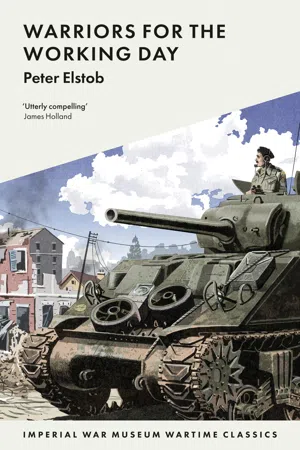
Based on Peter Elstob's own wartime experiences, Warriors for the Working Day follows one tank crew as they proceed from the beaches of Normandy into newly liberated Western Europe, brilliantly evoking the claustrophobia, heat and intensity of tank warfare.
- 320 pages
- English
- ePUB (mobile friendly)
- Available on iOS & Android
eBook - ePub
Warriors for the Working Day
About this book
Information
Subtopic
World War IIIndex
HistoryBOOK ONE
FIRST LIGHT
First Light: When it is possible to distinguish between and black and white
ONE
AS SOON AS the tanks stopped, Sergeant Donovan pulled the earphones off his head and rubbed his ears. The crackling of the wireless had given him a headache, and the pressure of the headset had made his ears ache too. He hung the headset from the open hatch, turning the earpieces towards him so that he could hear if his code letters were called. At the moment there was a lot of waffling going on between the colonel and his squadron leaders, and the regiment had come to a standstill with the tanks spread over the sandy common.
Donovan settled himself comfortably on the small saddle-like seat and propped his feet up on the circle of armour-piercing shells running round the inside of the turret. He lit a cigarette and listened for a few moments to the confusion on the wireless.
He decided there was just time for tea. ‘Better get a brew on, Taffy,’ he said to his driver.
He watched, as always with amusement and admiration, the swift, efficient way the four members of his crew worked together to make tea inside the tank. The petrol stove was lit and the big messtin filled with water, the tinned milk and the tea and sugar mixture were got out from the box that was supposed to hold spare wireless valves, the battered tin mugs were swilled out and wiped round with cleaning rag. Then the gunner spun the wheel to depress the gun fully, thus raising the breech inside the turret, to give them as much room as possible.
Sergeant Donovan absently watched the heavy gun-barrel go down until it was lying almost on top of the co-driver’s escape hatch. He remembered suddenly quite clearly the time his tank was hit at Alam Halfa. He, the gunner and the wireless operator had got out of the turret all right and had waited for the driver and co-driver. The seconds had dragged by, then he had seen the hole right in front of the driver’s place and at the same moment noticed that the gun was lying across the co-driver’s hatch, stopping it from coming up more than three or four inches. The co-driver’s arm had come out, trying to push the gun away, just before the ammunition exploded… He shut his eyes tightly.
‘Traverse right!’ he snapped, almost before he realised it.
Hogg, the gunner, was busy spreading cheese on biscuits, but his reaction was automatic and he spun the wheel which raised the gun and began to revolve it to the right.
‘Steady… on,’ Donovan said when it was pointing straight ahead, and the traversing stopped. ‘All right, carry on.’ He ignored the questioning look in Hogg’s eyes, and after a moment the youngster went back to his cheese and biscuits.
He was pleased with the speed of Hogg’s reaction. He’d got the gun traversing smoothly like an old-timer. By God, it might be possible to get these green kids sharp enough for the invasion yet – so that at least they’d stay alive through the first two or three actions. If they could do that, they stood a good chance. But this was the middle of May, and he knew there wasn’t much time left.
‘Isn’t that brew ready yet?’ he asked testily.
Taffy passed his mug up to him. ‘Here you are, Paddy,’ he said.
Taffy was one of the old hands from the desert days – the only one in his crew, and the only one allowed to call him Paddy. The other three were still too inexperienced to understand all that was implied by the old soldiers phrase ‘On parade, on parade: off parade, off parade’ – and Donovan didn’t believe in rushing these things.
‘What about some burgoo?’ said Taffy.
Donovan gulped some of the hot, sweet liquid, warming his hands on the metal mug. ‘All right,’ he said. ‘Have a go at it if you like, but be ready to pack it up in a hurry if we have to move.’
Taffy set about instructing the others in the niceties of making burgoo, which consisted of a mass of army biscuits dissolved in tinned milk, slowly heated in a mess-tin with treacle or plain sugar.
Donovan scanned the country around him slowly and carefully with his field-glasses, purely from habit; he knew that the Hussars, who had been the enemy on the day’s scheme, were down on the Farnborough road out of sight waiting for the umpires’ decision. As automatically as a sailor notices the wind and the weather, he picked out likely anti-tank gun positions and his best approach to the far ridge.
The crew were arguing about the value of the French as allies.
‘You’re bloody daft, mate, that’s what you are – orf yer rocker,’ said Geordie, the co-driver. He sat below, next to Taffy, and could only make his point to the others in the turret by twisting round and gesticulating from under their boots. ‘If they was so brave,’ he said, ‘why did they pack up so quick in 1940, then?’
Brook, the wireless operator, started to reply. ‘They were betrayed by their leaders – ’
Geordie jeered.
‘Betrayed by my Aunt Fanny,’ he said. ‘They was windy – that’s what they was – windy. They seen a few Jerry tanks, and they said “Oo la la we’ve ’ad it”, and they scarpered orf ’ome.’
‘Now wait a minute,’ Brook protested ‘What about the holding action they fought so we could get away at Dunkirk?’
‘What ’olding action? I never heard of no French fighting at Dunkirk!’
‘Well that, I suggest, is because you haven’t read the authoritative reports,’ said Brook crushingly.
Brook, as a very new lance-corporal, was going to have to drop that superior tone, Donovan decided: that sort of tone was always resented. But all in all, Donovan was not dissatisfied with any of his own tank crew, nor with any of the others in his troop of four tanks. Most of the men were untried, but they were keen, and there was a good leavening of experienced men like Taffy. Lieutenant Grimshaw, the troop officer, was a good, steady officer who would do more than his share and look after his men – he wasn’t after medals or promotion, and he and Sergeant Donovan understood each other.
‘Don’t blind us with science, Brookie boy,’ Geordie was jeering. ‘Put all them big words back.’
There was rather more annoyance in Geordie’s voice than the argument warranted, and Donovan suspected it had something to do with Brook’s recent promotion to acting unpaid lance-corporal. Donovan knew well that every soldier secretly hoped to find his own name in each new list of promotions. Geordie had done his basic training in the infantry, but had not been up to the required physical fitness. He had been sent to one of the new special training battalions for building up and then to the Tank Corps – so he had had longer in the army than the other new lads.
The wireless, which had been spluttering quietly in the background, cut into the talk with a call to all tanks.
Donovan replied with the conventional phrase that acknowledged both that he was listening and that he could hear clearly. The next tank to reply should have been Smudger Smith, his troop corporal, but Smudger didn’t reply, and after a pause the rest of the tanks carried on. Donovan hoisted himself up and looked over towards the troop corporal’s tank. Smudger was sprinting towards it holding something in his hand – eggs perhaps. Scrounging in England within a couple of miles of Aldershot barracks! – it was typical of Smudger.
There were more delays from other unwary tank commanders, and when the major came up on the air again he was fuming.
‘Hello all stations George Able Baker – that was Christ bloody awful! Now get your fingers out and keep on your toes! I want you all – repeat all – reported in ninety seconds, next time! Now – Orders – there will be a Tank Commanders’ conference at R.H.Q. in figures ten. The jeeps will be round to collect you all, so leave your boys where they are. All stations George Able Baker… Over.’
This time they were all waiting for it, and the replies snapped back.
‘One minute and fifty seconds – that’s better. Wireless silence from now – all stations George Able Baker – Out.’
The jeep from H.Q. arrived in a few minutes. It picked up the other three tank commanders, and then came for Donovan.
‘You’re in command of the Troop, Corporal Brook,’ said Lieutenant Grimshaw.
‘Yes, sir,’ Lance-Corporal Brook replied smartly. He remembered he ought to salute, but the jeep was gone while he hesitated.
He had been acting unpaid lance-corporal for only a week, and except for a fatigue detail and twice on the barrack square he had never commanded anybody. His former close friends had not yet been able to make up their minds whether he was going to be an easy-going N.C.O. who would try not to allow the promotion to make any difference, or would move over to their side and so put an end to his old relationships. Brook himself was hardly conscious of the need to make such a choice; he thought his old, easy relations would continue, that he would be obeyed because he was liked.
‘How about the B.B.C., Brookie? If there’s wireless silence no one will call us up,’ Hogg suggested.
‘We’re probably all right for the next fifteen minutes or so,’ said Brook. He switched the ‘A’ set to the B.B.C. frequency, and they all settled back to listen to a Forces record programme.
Brook moved across the turret and climbed up to the commander’s place, and sat there unconsciously imitating Donovan. God, how lucky he was to be in this tank, he told himself again. He had nearly burst with pride when Major ‘Tommy’ Johnson had sent for him after Eagle scheme and told him he was pleased with his showing and was making him wireless operator to the legendary Sergeant Donovan with the double M.M. Brook had written a long letter to his parents about it. His father had said it was a jolly good show, and Brook hoped it had made up a little bit for their disappointment when his application for a commission had been turned down. His father had been commissioned immediately in the First World War, but Brook felt that things must have been different then.
He knew the invasion would come in a few weeks now, and he wished he could discover some clues to his ability to stand up to it: Whether I am a coward, he said to himself, using the actual word deliberately. Up until now there had been few opportunities for him to find out. He remembered the fight during his last year at school, and how his fear had left him after the first punch on the nose, and how he had felt ill when it was all over. He wondered what would happen if he panicked completely. He couldn’t get out of the tank without pushing Donovan out of the way – and that, somehow, didn’t seem feasible. For a moment he pictured himself lying on the floor of the turret in sheer terror, unable to move... jamming the traverse... screaming... He pushed the scene away from him quickly.
He pulled the earphones off his head. ‘I’m just going for a Jimmy Riddle – take over, will you, Hogg?’ He dropped off the tank and walked towards a clump of young silver birch.
Hogg watched him go. The lance-jack tape had gone to his head, Hogg thought bitterly. If he was so damned clever why wasn’t he an officer? Hogg was pretty sure that if it hadn’t been for Brook with his accent and his public school, he himself would have been promoted. He’d even let his girl think he was going to be, on his last leave. Well, roll on the invasion – perhaps Brook would get killed, and he, Hogg, would get promoted. There was no limit to what could happen in action. He watched Brook sit down under the trees – dozy, that’s what he was. Hogg picked up Donovan’s field-glasses and scanned the hills, imagining himself coolly knocking out one German tank after another.
Vera Lynn was singing on the wireless, and they all joined in unmelodiously.
The late afternoon sun warmed the tank, and Geordie opened his hatch and climbed out to sit with his back to the turret. He scratched the scar on his forehead where the army doctors had cut his bump out. Funny now to think of how he hadn’t wanted to let them do it. The medical officer had told him that it wouldn’t hurt, but it hadn’t been the thought of the pain that had made him refuse – for he had been beaten often enough by his mother’s blokes in his time. He had known he could never tell the M.O. what his grandmother had told him about his bump. He knew it was barmy, of course – she’d said that all his brains were in it and that if he ever lost it he’d go loopy – and he couldn’t explain that to the M.O., or to anyone: because he knew it couldn’t be so… But just the same there was always the possibility that it was true. In the end the M.O. had bullied him into consenting to the operation, and he had gone down to the hospital in Aldershot in a state of terror. It had got progressively worse, until at the end he had fought like a wildcat against the anaesthetic. When he came round, his hand went up to his forehead and felt a flat bandage in place of the egg-sized growth he had had for so many years. Even when they took the banda...
Table of contents
- Cover
- Title
- Copyright
- About the Author
- Introduction
- Book One First Light
- Book Two Last Light
Trusted by 375,005 students
Access to over 1.5 million titles for a fair monthly price.
Study more efficiently using our study tools.
Frequently asked questions
Yes, you can cancel anytime from the Subscription tab in your account settings on the Perlego website. Your subscription will stay active until the end of your current billing period. Learn how to cancel your subscription
No, books cannot be downloaded as external files, such as PDFs, for use outside of Perlego. However, you can download books within the Perlego app for offline reading on mobile or tablet. Learn how to download books offline
Perlego offers two plans: Essential and Complete
- Essential is ideal for learners and professionals who enjoy exploring a wide range of subjects. Access the Essential Library with 800,000+ trusted titles and best-sellers across business, personal growth, and the humanities. Includes unlimited reading time and Standard Read Aloud voice.
- Complete: Perfect for advanced learners and researchers needing full, unrestricted access. Unlock 1.5M+ books across hundreds of subjects, including academic and specialized titles. The Complete Plan also includes advanced features like Premium Read Aloud and Research Assistant.
We are an online textbook subscription service, where you can get access to an entire online library for less than the price of a single book per month. With over 1.5 million books across 990+ topics, we’ve got you covered! Learn about our mission
Look out for the read-aloud symbol on your next book to see if you can listen to it. The read-aloud tool reads text aloud for you, highlighting the text as it is being read. You can pause it, speed it up and slow it down. Learn more about Read Aloud
Yes! You can use the Perlego app on both iOS and Android devices to read anytime, anywhere — even offline. Perfect for commutes or when you’re on the go.
Please note we cannot support devices running on iOS 13 and Android 7 or earlier. Learn more about using the app
Please note we cannot support devices running on iOS 13 and Android 7 or earlier. Learn more about using the app
Yes, you can access Warriors for the Working Day by Peter Elstob in PDF and/or ePUB format, as well as other popular books in History & World War II. We have over 1.5 million books available in our catalogue for you to explore.