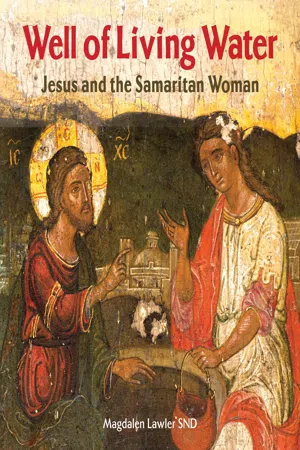
Magdalen Lawler discovered this icon of the Woman at the Well many years ago. She has used it ever since as the inspiration for innumerable retreats and conferences. Its appeal to her is that it seems to span the traditions of West and East with its lyrical beauty and its deep theology. The icon has encouraged Magdalen to study the gospel passage in detail and to research many accounts of life in first century Palestine. Now her research and retreats are brought together in this beautifully illustrated series of reflections on the Samaritan Woman at the Well.
- 56 pages
- English
- ePUB (mobile friendly)
- Available on iOS & Android
eBook - ePub
About this book
Information
Topic
ArtSubtopic
Religious ArtCHAPTER 1
Sacred Art and Sacred Space
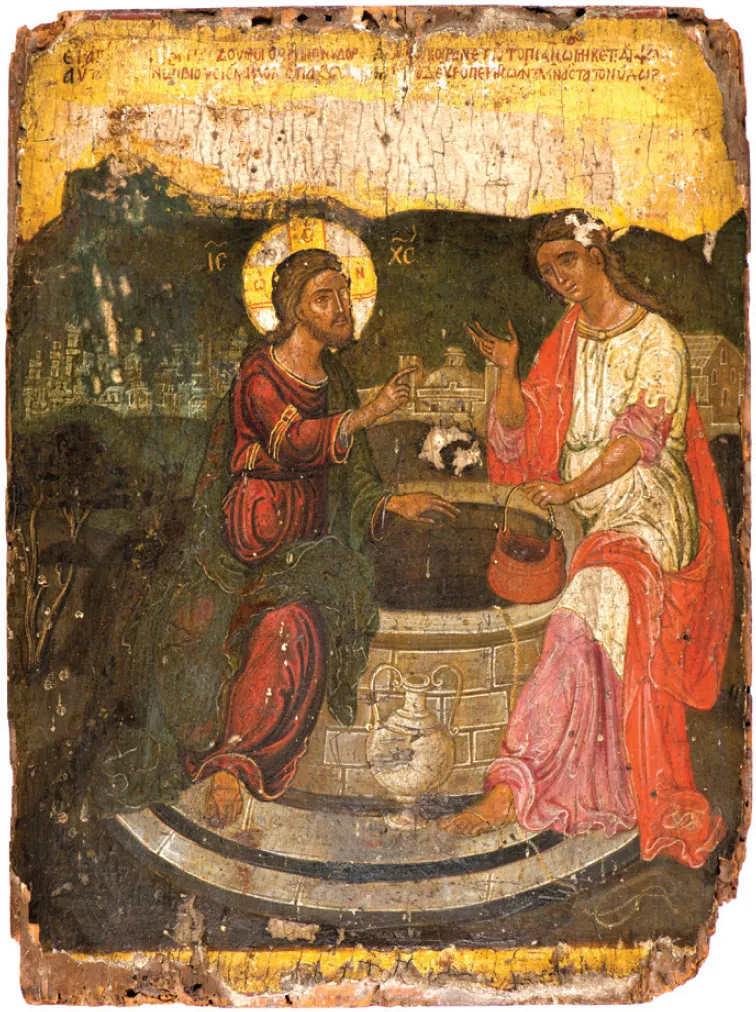
THIS ICON of the Woman at the Well is held in a private collection by the British Province of the Society of Jesus. Its provenance is unknown although it is thought to be Greek in origin, partly because of the classical proportions of the figures and the grace of their gestures. It is hard to date the icon without expert advice, but it is surmised that it is from the early nineteenth century. There are only two figures visible in this icon: those of Jesus and the woman, and that fact draws our attention to the dialogue taking place between them. The economy of persons leads to a beautifully balanced and unique image of this particular episode in the life of Jesus. The palette is dark but subtle, so the figures glow with inviting warmth.
The figure of Christ wears his customary dark red/purple royal tunic, representing his humanity, but the heavenly blue of his mantle, conferring divinity, has faded with age. His halo is inscribed with a cross and the inscription reads, ‘HO ON’ ‘The One Who Is’, a direct reference to his later revelation to the woman, ‘I Am – the One who is speaking with you’ (Jn 4:26). The nimbus itself is clearly surrounded by ‘IC XC’ the Greek abbreviation for ‘Jesus Christ’. The hand of Christ is raised in a teaching gesture as he enters into conversation with the woman.
The woman sits higher than Jesus at the well-head; an unusual feature, as Jesus would normally be the one who is seated in the more prominent position. She is unveiled and is robed in the white of innocence and the brighter red that often signifies humanity, but also resurrection. Her features are classical and regular and her hand is raised and outspread in a gesture of intense dialogue with Jesus. Her other hand holds the leather bucket that she uses to fill the vessel she will carry to her home. The depth of the well is suggested by the dark interior, which draws our gaze. The well is central to the image and is large and imposing, reminding Christians of the centrality of baptism.
In the distance the town of Sychar is seen, taking a central place also. There is a significant building, which may suggest the alternative site on Mt Gerizim where the Samaritans were known to worship. Jews worshipped in the Temple in Jerusalem.
The icon is damaged with age and so the egg tempera colour* and gesso ground* are missing in some places, most notably in the left eye of Jesus and in the hair of the woman. It is also missing in the centre of the picture, between the figures and around the edges, especially in the inscription. The wood panel is damaged at the edges, but none of this detracts from the fact that this is an exceptionally beautiful depiction of this theological conversation between Jesus and a woman of Samaria. The Samaritan woman was honoured in the earliest Church and to this day is remembered in the Eastern and Orthodox churches as Photine, and as ‘equal to the apostles’. She is believed to have been martyred by Nero, along with her family, and her feast day is celebrated on 20 February/March, differing in certain Eastern Churches. Her name derives from the Greek word for light and many young girls are still given her name. We can also associate her name with familiar names in our own cultures like ‘Fiona’ in Scotland, ‘Fionn’ in Ireland and ‘Svetlana’ in Russia. ‘Chiara’ and ‘Claire’ are associated with her as are ‘Lucy’ and many others.
Let us meet her now and try to discover what her important message is, revealed to her by Jesus himself. We will be drawn to more deeply understand Jesus through her influence.
When Jesus spoke to the people again, he said:
‘I am the Light of the world; anyone who follows me will not be walking in the dark. They will have the light of life.’ (Jn 8:12)
PRAYER
We wait at your threshold, Most Holy One, and ask to enter your presence by means of the Gospel and the image of your only Son. May we use our gift of sight to encounter you more fully and begin to know Jesus with inner understanding and inner sight. He is the water that sustains our life and the One Who Is. Through the intercession of your Samaritan apostle, Photine, may we also reach a deeper understanding of ourselves and of the joy of your Good News.
IGNATIAN PRAYER
I ask God, our Lord, for what I want and desire, in keeping with the subject of my prayer. In this instant I ask for joy at the gift of Living Water and I ask for zeal to spread the good news of Christ as did the woman at the Well of Jacob (based on The Spiritual Exercises [SE], 48).
* A pigment mixed with egg yolks to give greater endurance and depth to the colours.
* A surface coating of animal glue mixed with white pigment and chalk to prepare the wood for painting.
CHAPTER 2
Praying with an Icon: A Glimpse beyond the Veil
And the Veil of the Temple was torn in two, from the top to the very bottom. And seeing that Jesus expired in this way, the centurion who stood by, over against him, said, ‘Truly this man was Son of God’. (Mk 15:38–39)
THE SACRED SPACE of an icon is in its message and its invitation to enter into the divine presence. It is as though a veil is drawn apart and we see the divine, as if through a window or a mirror. The reference to the rending of the temple veil reveals the Holy One to us and to all humanity in a unique way. No longer is the divine deeply hidden and accessible only to a certain race or rank within the temple ministry. Jesus, through his death, has passed through the torn temple veil (Lk 23:45) and God is revealed to anyone who opens their gaze to the mystery of the divinity, as did the centurion in Mark’s Gospel. At the baptism of Jesus, the heavens were split open. They were opened up and the Holy Spirit appeared (Mk 1:10). Likewise, the revelation of Jesus’ transfiguration to the disciples in the Gospels of Matthew, Mark and Luke show us that God will be revealed to each of us in all the divine glory-presence or Shekinah (Mt 17:1–8, Mk 9:2–8, Lk 9:28–36). One can gaze through the icon, as it were, and see or experience the divine as though present to the viewer, focusing on the mystery there depicted. One can also gaze as though at a mirror, so that we see ourselves as God sees us. There is no attempt at reality in an icon; there are no shadows to create an illusion of space and the icon simply gazes at us and invites our gaze in return.

It is best to stand or sit before an icon, being aware of the sacred nature of the space, having familiarised oneself with the gospel story it depicts (Jn 4: 1–42). We then wait for the icon to reveal itself to us, allowing the eye to rove across it until it rests on the natural focus. It is difficult sometimes for Western viewers to look at an icon in this way, becaus...
Table of contents
- Cover
- Title
- Copyright
- Contents
- INTRODUCTION
- CHAPTER 1: Sacred Art and Sacred Space
- CHAPTER 2: Praying with an Icon: A Glimpse beyond the Veil
- CHAPTER 3: How Well I Know that Fountain!
- CHAPTER 4: You Sought Me, Seated Wearily (by the Well)
- CHAPTER 5: There Comes a Woman from Samaria
- CHAPTER 6: Give Me a Drink
- CHAPTER 7: A Dialogue of Hands
- CHAPTER 8: The Betrothal
- CHAPTER 9: Preaching in the Market Place
- APPENDIX
Trusted by 375,005 students
Access to over 1.5 million titles for a fair monthly price.
Study more efficiently using our study tools.
Frequently asked questions
Yes, you can cancel anytime from the Subscription tab in your account settings on the Perlego website. Your subscription will stay active until the end of your current billing period. Learn how to cancel your subscription
No, books cannot be downloaded as external files, such as PDFs, for use outside of Perlego. However, you can download books within the Perlego app for offline reading on mobile or tablet. Learn how to download books offline
Perlego offers two plans: Essential and Complete
- Essential is ideal for learners and professionals who enjoy exploring a wide range of subjects. Access the Essential Library with 800,000+ trusted titles and best-sellers across business, personal growth, and the humanities. Includes unlimited reading time and Standard Read Aloud voice.
- Complete: Perfect for advanced learners and researchers needing full, unrestricted access. Unlock 1.5M+ books across hundreds of subjects, including academic and specialized titles. The Complete Plan also includes advanced features like Premium Read Aloud and Research Assistant.
We are an online textbook subscription service, where you can get access to an entire online library for less than the price of a single book per month. With over 1.5 million books across 990+ topics, we’ve got you covered! Learn about our mission
Look out for the read-aloud symbol on your next book to see if you can listen to it. The read-aloud tool reads text aloud for you, highlighting the text as it is being read. You can pause it, speed it up and slow it down. Learn more about Read Aloud
Yes! You can use the Perlego app on both iOS and Android devices to read anytime, anywhere — even offline. Perfect for commutes or when you’re on the go.
Please note we cannot support devices running on iOS 13 and Android 7 or earlier. Learn more about using the app
Please note we cannot support devices running on iOS 13 and Android 7 or earlier. Learn more about using the app
Yes, you can access Well of Living Water by Magdalen Lawler in PDF and/or ePUB format, as well as other popular books in Art & Religious Art. We have over 1.5 million books available in our catalogue for you to explore.