- 80 pages
- English
- ePUB (mobile friendly)
- Available on iOS & Android
eBook - ePub
About this book
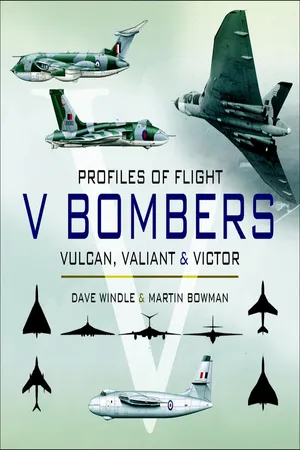
Britain's desire to stay at the leading edge in the design and development of modern jet powered aircraft was born in the later stages of World War Two. The RAF sent requests to the leading aircraft manufactures for a variety of specifications, amongst which was one for a long-range heavy bomber. Three designs were accepted and eventually went into production – these became the V-Bomber Force. The first to enter service was the Vickers Valliant, a high swept-wing four engine aircraft. This type was used to test-drop Britain's first H-Bomb in the Christmas Islands and then was tasked with delivering our deterrent during the early years of the Cold War. It saw action in a non-nuclear role during the Suez Crisis and then went on to serve as a flight refueling tanker until withdrawn with metal fatigue problems. The delta-wing Avro Vulcan then carried our latest nuclear weapon until the Royal Navy took over the deterrent task with the Polaris submarine fleet. This aircraft entertained rapt audiences at air displays around the world as its powerful engines, later to power Concorde, allowed this large bomber to fly like a fighter. Its most famous and only wartime service came during the Falklands Conflict for which it is now legendary for bombing Port Stanley, having flown thousands of miles with countless air-to-air refueling link-ups en route. The crescent-winged Handley Page Victor was the most durable of the trio and continued in service as a tanker into the twenty-first century. In practice it was probably the most successful of the three designs. It flew higher and faster than the Vulcan and Valliant and was remarkably robust – even into old age. This book contains the world famous color profiles created by Dave Windle of all three types in different operational modes, configurations and color schemes. Martin Bowman has written detailed descriptions and photographs to create the perfect enthusiasts reference.
Information
V BOMBERS
With the dawning of the atomic age in August 1945 it was obvious to military strategists that any future bomber to deliver a nuclear weapon would have to be jet powered and of advanced aerodynamic design. In the late 1940s and early 1950s the threat of a nuclear war spurred nations to develop fleets of long-range four-engine jet bombers capable of carrying such a nuclear payload. Towards the end of the Second World War Sir Frederick Handley Page, A. V. Roe and Vickers, who had provided the aircraft for RAF Bomber Command in over five years of war, had already begun thinking in terms of large jet-propelled bombers. In 1946 discussions of their proposals were made with the Air Staff and they resulted in specification B.35/46 being finalised by the end of the year. The Royal Air Force Staff requirements for such an aircraft were covered in specification B.35/46 and this was issued to the aircraft industry on New Years Day 1947. The specification for a medium-range bomber with a range of 3,500 nautical miles, which was capable of carrying a 10,000lb bomb to its target was issued to seven aircraft constructors and tenders requested. Of those submitted the two selected to go ahead were from Handley Page and A.V. Roe. At Shorts of Belfast meanwhile, work had begun on the Sperrin S.A.4, a shoulder-wing monoplane design with four 6,000lb s.t. Avon R.A.2 engines mounted on the wings. Only two Sperrins were built, the first flying on 10 August 1951. Though the Sperrin enjoyed the distinction of becoming the first of the British four-jet bombers, a month later a new specification was issued to cover the production of the Vickers Type 660, which would become the Nation’s first four-jet bomber to enter production as the Valiant. Specifications for a more advanced design than the Sperrin were issued to elicit proposals from Handley Page, A. V. Roe and Vickers, who, following their wartime experience with the Halifax, Lancaster and Wellington respectively, were proven specialists in bomber development. While the Handley Page and Avro jet bomber projects were of an advanced nature their design was such that a vast amount of research was needed to ensure their ultimate success. At the time, the requirements of B35/46 were very advanced and far-reaching and Handley Page expected that it would take until 1952 before a prototype could be flown.

Handley Page Victor K.1 tanker and Avro Vulcan refuelling. (MoD)
Such were the advanced requirements of the B.35/46 specification that the Air Staff had decided on an ‘insurance’ design for an aeroplane of more conventional nature which might guarantee earlier availability for RAF service. Vickers’ interim V-Bomber design complied with a slightly less demanding (B.9/48) specification and on 2 February 1949 the company received an order for two prototypes: the Type 660 with four 6,500lb s.t. Avon R.A.3s and the Type 667 powered by four Sapphires. At Vickers George R. Edwards and his design team evolved a bomber with wings which embodied compound sweepback in two degrees on the leading edge, the engines being concealed entirely within the centre-section and mounted adjacent to each other close to the fuselage. The tailplane was raised well above turbulence from the wings and the jet efflux by installing it towards midway on the fin. The Valiant prototype made its maiden flight on 18 May 1951 but it was destroyed during a test flight over Hampshire on 12 January 1952. (A second was built and flew for the first time on 11 April that same year). On 5 September 1951 a new requirement was issued to start production of the Valiant B.Mk.1. The first of five pre-production aircraft flew at Brooklands on 22 December 1953.
Handley Page Victor B.1 taxiing at Changi, Singapore in 1965. In the background are Avro Shackletons of No.205 Squadron and Hawker Siddeley Argosys of No.215 Squadron. (Jerry Cullum)

At Avro meanwhile, the design team led by Roy Chadwick had originally decided on a conventional layout with swept wings but by progressively shortening the fuselage and then removing the tailplane, a delta-wing planform emerged. This was a bold step by the designers because little was known about delta aerodynamics at this time and the concept of the ‘flying triangle’ of these proportions was a daunting prospect. By March 1947 Chadwick had made a firm decision to go ahead with this configuration. Research into delta-wing aircraft had also been conducted by the Royal Aircraft Establishment (RAE) at Farnborough and the combined results of this programme and that of the Avro team brought about a number of changes in the design. The wing became thinner, with the engines buried inside and their intakes built into the wing-roots, and wing-tip fins were deleted in favour of a large central fin. The Avro 698 design was submitted to the Air Ministry in May 1947 by which time the triangle design had grown a nose with large engine intakes at each side. That summer the Ministry of Supply received the tender for the Avro 698 but the Avro team suffered a grievous loss with the death of Roy Chadwick who was killed in the crash of the Tudor 2 prototype at Woodford on 23 August. It was feared that Chadwick’s death might cause the Ministry to lose confidence in the new delta but the Ministry had accepted Avros proposals on 23 July. Assistant Chief Designer S. D. Davies who had survived the accident now took over design leadership of the delta programme. The order covering two Avro 698 prototypes was received in January 1948 and work commenced immediately. To investigate the practically unknown characteristics of the delta design it was decided that a series of one-third scale research-aircraft would be built and these were designated the Avro 707s with the design work commencing in May of that year.
The first Avro 707 was a fairly simple aeroplane with an unusual engine air intake built into the top of the fuselage behind the cockpit. To speed construction the aircraft utilised the cockpit and nose-wheel leg of a Gloster Meteor and the main undercarriage of an Avro Athena. This aircraft was flown for the first time on 4 September 1949 by Avro test pilot S. E. ‘Red’ Else, who two days later flew it to Farnborough where it appeared in the famous Air Show, but on 30 September it crashed near Blackbushe and Else was killed. In all, five small Avro 707 series deltas of varying designs were constructed, each powered by a 3,500lb s.t. Rolls Royce Derwent engine and they provided valuable research to the Avro 698 programme before the bomber prototype flew in 1952. The last of the Avro deltas flew in 1953, by which time the prototype 698 (VX770) had made its maiden flight (on 30 August 1952 in the capable hands of Avro’s chief test pilot Wing Commander R. J. ‘Roly’ Falk). The chosen power plant, the 9,750lb s.t. Bristol Olympus B. E. 10, was not yet ready when the Avro 698 was approaching completion and four Rolls-Royce 6,500lb s.t. Avon R.A.3s powered the prototype at the time of its first flight. In January 1953 the name Vulcan was chosen for the Avro 698, the first bomber in the world to adopt the delta wing planform. this completed the famous RAF V-Bomber trio of Valiant, Victor and Vulcan. Later, VX770 was powered by Armstrong Siddeley Sapphires before the second prototype (VX777) made its initial flight on 3 September 1953 with four Bristol Olympus 101 engines (the aircraft crashed at RAF Syreston during the 14 September 1958 Battle of Britain display with the loss of all four crew). The 6,500lb thrust Rolls-Royce Avons were fitted as standard to all the production Vulcans, the first of which made its maiden flight on 4 February 1955. Despite its enormous size the Vulcan could demonstrate almost fighter-like manoeuvrability at very low altitudes. At the Farnborough Air Show in September 1955 test pilot Roly Falk caused a sensation by slow-rolling the aircraft during its flyby.
At Handley Page meanwhile, Reginald S. Stafford designed the HP 88 to meet Specification B.35/46 issued to meet the requirements of the Valiant and Vulcan. The company adopted the same approach as Avro had done by using a small flying scale model to test the design concept. In 1948 the HP 88 single-seat research aircraft was built by Blackburn as the Y.B.2 with a one-quarter-scale version of the proposed shape of the wings and the tail unit of the Victor. The HP 80 flew on 21 June 1951 but it crashed at Stansted later that same year, killing its pilot D. J. P. ‘Duggie’ Broomfield. Stafford’s HP 80 design included wings incorporating three successively decreasing degrees of sweepback from roots to tips in what became known popularly as the crescent wing. It was anticipated that the resulting reduction of drag would enable a high critical-Mach number to be reached at a constant value across the span and at the same time the crescent wing of high aspect-ratio was thought to offer excellent range and extreme operational altitude. It was hoped that the first HP 80 would be flying by the time of the SBAC (Society of British Aircraft Constructors) Show in September 1952. But the HP 80 was not ready to fly until a few days before Christmas and when it was ready the weather prevented the first flight from taking place until Christmas Eve. After Christmas, test flying continued at Boscombe Down until mid-February 1953, by which time the HP 80 had been given the name ‘Victor’ and it then returned to Radlett where a runway extension had been completed. Flight testing during the remainder of 1953 and the first half of 1954 demonstrated generally good handling qualities up to an altitude of 50,000 feet and an IMN (Indicated Mach Number) of 0.925. ‘The only real problem’, recalled test pilot John Allam OBE FRAeS, ‘was with insufficient directional stability resulting in an undesirable Dutch-roll, which the pilot could control but this prevented him from ever relaxing’. Disaster struck on 14 July 1954 when the first prototype [WB771] was undertaking position-error calibration tests at Cranfield. During what was to be the final run at low altitude along the Cranfield runway the tail plane separated from the top of the fin and the aircraft crashed killing the crew. At this time the second prototype was almost ready to fly but its first flight was delayed while the cause of the accident was investigated and modifications made to its tail plane/fin attachments. It eventually flew on 11 September 1954 and made its second flight that day flying in the 1954 SBAC Show.

Avro Vulcan B.2s XH658 (nearest) and XH657 of No. 101 Squadron over Ballistic Missile Early Warning System(BMEWS), Fylingdales, Yorkshire. (MoD)
Avro Vulcan B.2 XM606. (MoD)

The Valiant was the first of the V Class four-jet bombers to enter RAF service, replacing the Canberras and Lincolns of 3 Group Bomber Command in 1955 and all 104 Valiant production aircraft had been delivered by the end of 1957 when they equipped nine squadrons. Powered by four 10,000lb thrust Rolls-Royce Avons, they were able to carry a 10,000lb nuclear bomb on a 3,500-mile sortie, cruising at 0.76 mach at 35−40,000 feet. In June 1955 No.232 Operational Conversion Unit(OCU) formed at Gaydon to train Valiant aircrews and initially, ground crews. The first course became the nucleus of 138 Squadron, which transfe...
Table of contents
- Title Page
- Copyright Page
- Table of Contents
- ACKNOWLEDGEMENTS
- V BOMBERS
- V-BOMBER PRODUCTION AND SERIAL BLOCKS
- V-BOMBER UNITS
- PROFILES OF FLIGHT - V BOMBERS
- PROFILES OF FLIGHT - VULCAN
- PROFILES OF FLIGHT - VALIANT
- PROFILES OF FLIGHT - VICTOR
Trusted by 375,005 students
Access to over 1.5 million titles for a fair monthly price.
Study more efficiently using our study tools.
Frequently asked questions
Yes, you can cancel anytime from the Subscription tab in your account settings on the Perlego website. Your subscription will stay active until the end of your current billing period. Learn how to cancel your subscription
No, books cannot be downloaded as external files, such as PDFs, for use outside of Perlego. However, you can download books within the Perlego app for offline reading on mobile or tablet. Learn how to download books offline
Perlego offers two plans: Essential and Complete
- Essential is ideal for learners and professionals who enjoy exploring a wide range of subjects. Access the Essential Library with 800,000+ trusted titles and best-sellers across business, personal growth, and the humanities. Includes unlimited reading time and Standard Read Aloud voice.
- Complete: Perfect for advanced learners and researchers needing full, unrestricted access. Unlock 1.5M+ books across hundreds of subjects, including academic and specialized titles. The Complete Plan also includes advanced features like Premium Read Aloud and Research Assistant.
We are an online textbook subscription service, where you can get access to an entire online library for less than the price of a single book per month. With over 1.5 million books across 990+ topics, we’ve got you covered! Learn about our mission
Look out for the read-aloud symbol on your next book to see if you can listen to it. The read-aloud tool reads text aloud for you, highlighting the text as it is being read. You can pause it, speed it up and slow it down. Learn more about Read Aloud
Yes! You can use the Perlego app on both iOS and Android devices to read anytime, anywhere — even offline. Perfect for commutes or when you’re on the go.
Please note we cannot support devices running on iOS 13 and Android 7 or earlier. Learn more about using the app
Please note we cannot support devices running on iOS 13 and Android 7 or earlier. Learn more about using the app
Yes, you can access V Bombers by Martin W. Bowman,Dave Windle in PDF and/or ePUB format, as well as other popular books in History & Military & Maritime History. We have over 1.5 million books available in our catalogue for you to explore.