eBook - ePub
Available until 23 Dec |Learn more
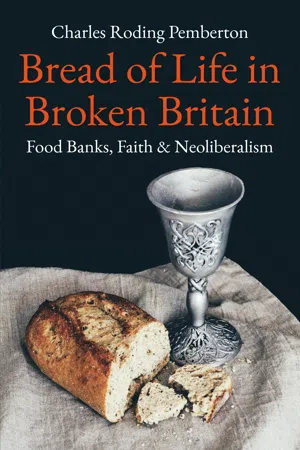
Bread of Life in Broken Britain
Foodbanks, Faith and Neoliberalism
This book is available to read until 23rd December, 2025
- 224 pages
- English
- ePUB (mobile friendly)
- Available on iOS & Android
eBook - ePub
Available until 23 Dec |Learn more
About this book
Charles Pemberton draws on interviews with foodbank users and volunteers to defend and advance a Christian vision of welfare beyond emergency food provision. He suggests that behind the day-to-day struggles of those using foodbanks there are wider much concerns about loneliness, marginalisation and the wholesale fragmentation of society.
Frequently asked questions
Yes, you can cancel anytime from the Subscription tab in your account settings on the Perlego website. Your subscription will stay active until the end of your current billing period. Learn how to cancel your subscription.
No, books cannot be downloaded as external files, such as PDFs, for use outside of Perlego. However, you can download books within the Perlego app for offline reading on mobile or tablet. Learn more here.
Perlego offers two plans: Essential and Complete
- Essential is ideal for learners and professionals who enjoy exploring a wide range of subjects. Access the Essential Library with 800,000+ trusted titles and best-sellers across business, personal growth, and the humanities. Includes unlimited reading time and Standard Read Aloud voice.
- Complete: Perfect for advanced learners and researchers needing full, unrestricted access. Unlock 1.4M+ books across hundreds of subjects, including academic and specialized titles. The Complete Plan also includes advanced features like Premium Read Aloud and Research Assistant.
We are an online textbook subscription service, where you can get access to an entire online library for less than the price of a single book per month. With over 1 million books across 1000+ topics, we’ve got you covered! Learn more here.
Look out for the read-aloud symbol on your next book to see if you can listen to it. The read-aloud tool reads text aloud for you, highlighting the text as it is being read. You can pause it, speed it up and slow it down. Learn more here.
Yes! You can use the Perlego app on both iOS or Android devices to read anytime, anywhere — even offline. Perfect for commutes or when you’re on the go.
Please note we cannot support devices running on iOS 13 and Android 7 or earlier. Learn more about using the app.
Please note we cannot support devices running on iOS 13 and Android 7 or earlier. Learn more about using the app.
Yes, you can access Bread of Life in Broken Britain by Charles Roding Pemberton in PDF and/or ePUB format, as well as other popular books in Theology & Religion & Christian Theology. We have over one million books available in our catalogue for you to explore.
Information
1. Food Bank Lives
Introduction
James tells me that if he had the time and money he would like to start the Durham Liberation People’s Front. I tell him that I only believe in the work of the People of Durham’s Front of Liberation and we exchange smiles in mutual appreciation of Monty Python’s Life of Brian and the problematic piety of the politically rebellious. We are in the church hall of the United Reformed Methodist Church on Waddington Street, Durham. We’ve been talking for about 20 minutes already, about food banks, and work, and James’ life and health. He’s in his early fifties and hasn’t worked since 2009. He’s frustrated today that the Job Centre have sent him on another mandatory numeracy and literacy test which cuts into the time he’d like to be spending learning the programming language C#.
I used to be a PC programmer, my last work was in January 2009, then I was off with illness, a prolapsed disc. Now my skills are out of date, I’m unmarketable.
During his days he works at the Durham Library teaching himself current computer sciences but has limited time and resources. His ability to educate himself is held back by the routine begging trail that has been made his lot. He holds a hand two feet above the table, ‘If this is the breadline, what you need to live, then this’, holding a second hand halfway between the first hand and the table, ‘is what you get on the current benefits.’ Because of his government-sponsored poverty, James is forced to conduct a daily tour of Durham’s charitable services and institutions. He is ‘having to spend a lot of time getting food’ and goes through a standard day with me: Sanctuary 21 for breakfast, library at 9.30 for job searches, lunch at County Durham Foodbank or Waddington drop-in, evening meals from Foodcycle when they’re open. You have to work hard for your poverty in twenty-first-century Britain.
The food that I get from these charities and groups I wouldn’t eat normally. Cake, bread, pasta and pork, you know, lots of ham sandwiches, they’re bad for my health because I have diabetes, HbA1c. I’m eating too much sugar and starch. There’s fruit on offer, grapes and bananas, it’s what they have but it isn’t good to me. Eating like this, I know it’s costing me the length of my life.
A hot drink off to his right, he rolls a small piece of card between his thumb and forefinger and places it into a coarse-cut tobacco cigarette, the cheap stuff from the marketplace, he says. He continues:
Globalization, offshoring. They have blown my career away. My career was stolen by an undemocratic process. I don’t think any government has the remit from its people to offshore employment … There aren’t jobs for life now, not any longer. That’s changed as well. People are seen as a resource. ‘HR’, that’s what it means, right? Managers see people as a resource, one that can be picked up and discarded. I’ve got to be available for any kind of job, whatever. I’m filling in forms for being a cleaner or a caretaker.
This chapter is about the lives of those who are using County Durham Foodbank. Like James, many of those I interviewed had histories of precarious and unreliable work in the post-industrial economy of the north-east of England. When out of work, they wrestle with a benefits system that is slow, unsympathetic and experienced as punitive and intrusive. The everyday stresses faced by these individuals whether in or out of work are often related to or exacerbate existing health conditions, or health conditions in loved ones. A proportionate response to the issue of food insecurity in the UK needs to be furnished from an accurate description of the problem, one that this chapter seeks to provide. Included in this description and the chapter’s conclusion is a review of recent writings on the idea of ‘precariousness’: the transition that has been imposed on James and people like him of a new, globalized economy in which country competes with country to drive down corporate tax rates and loosen worker protections in order to attract big business. The experiences of those using our food banks pose questions to us about welfare and its reforms and also of the larger employment and economic context: stagnant wages, decline of manufacturing, rising food prices, employment insecurity and reduced bargaining power for labour.
Part One: life for food bank users
Like James, a significant number of those I interviewed in County Durham faced overlapping difficulties, often labour marginality combined with demanding caring roles and ill health. The most extensive investigation of the lives of food bank users is Rachel Loopstra and Doireann Lalor’s Financial Insecurity, Food Insecurity, and Disability: The Profile of People Rreceiving Emergency Food Assistance from The Trussell Trust Foodbank Network in Britain. Working with the Trussell Trust,1 Loopstra and Lalor used volunteers to collect data from food bank users between October and December 2016 at sites across the UK. They conducted this investigation with the aim of describing the socio-economic situation of food bank users, their degrees of access (or lack of) to social security, the prevalence and severity of ‘recent short-term income and expenditure shocks’ food bank users may have experienced, the degrees of health and disability challenges food bank users face and the ‘chronicity’ of household food insecurity experienced by food bank users. Eighteen sites participated in the survey, including my food bank in Durham County, and over 400 food bank users answered an extensive self-complete questionnaire.
What was found in the study? The findings of the study were that ‘households using food banks face extreme financial vulnerability’.2 Second, that 78% of households were ‘severely food insecure’, which means having skipped meals, gone without food, sometimes for days, in the last 12 months.3 For the majority, experiencing hunger was the case every month, or almost every month, of the last year. Third, while single male households were the most common household type receiving help from the food bank, it was lone parents with children that constitutes the largest number of people in aggregate.4 Fourth, one in five food bank users were homeless people and of those who did have a house 50% were unable to heat it.5
Food bank users face what Loopstra and Lalor call ‘multiple forms of destitution’.6 Half of those who completed the questionnaires had not only low but unreliable incomes. One in three were awaiting a benefit payment, and Loopstra and Lalor describe the groups of people accessing Trussell Trust food banks as often the ‘most affected by recent welfare reforms’.7
The question of money was one of the most recurring issues in the interviews I conducted. Talking with a woman in her late thirties in the Durham drop-in centre, the difficulties for those who come to food banks are clear. Jane, who used to be a nurse and is about to start an occupational therapy job in the next few weeks, has been to the food bank twice already. After being forced to sell her flat when the husband of her child left her, she lost her job and now she is caught in debt. She is struggling to pay the bills and provide enough food for her and her child, even with the support she receives.
I’m overdrawn £800. I’ve got one child and get JSA and child tax credits, and I have a hardship loan and Durham County Council are paying 70% of my rent but I still struggle. I felt embarrassed, ashamed at coming [to the food bank], but the price of food … so any help I’ll take.
The stress caused by these life shocks has had adverse effects on her health. She tells me she has anxiety, has been taking antidepressant medication and has been thinking about suicide. She told this to the Job Centre when she went for her meeting but she tells me that they’ve refused to give her more extensive help or lighten her burden by transitioning her onto Employment and Support Allowance (ESA, welfare for those who have a health problem or disability which affects how much they can work) and relieving her of the task of constantly searching for new work at a vulnerable time.
They won’t give me ESA, it was rejected and instead they gave me a budgeting loan, the benefits system is crazy.
Other food bank clients I spoke with made similar links between benefits, work, insecurity and health. Miriam, a woman in her fifties, tells me why she’s come to the food bank today, showing me the locations of her injuries as she runs through them one by one.
Hardship, I got sanctioned, they stopped my ESA. I’ve been on it since 2015. I have COPD (Chronic Obstructive Pulmonary Disease). I’m struggling with liver, and got arthritis in my knee and back. I use my sticks to help walk, compensate for my ankle. But I do struggle to walk a long way, I can’t get far. ESA was just enough to cover a fortnight, just. 6 November, 2017 I had a health check, told them about my medical conditions like I told you. They ask you questions about what you can or can’t do, I said that I could walk to the shop, I told them that I’m drink dependent. After the check, the interviewer said, ‘after this I thin...
Table of contents
- Copyright information
- Contents
- Acknowledgements
- Prologue
- Introduction
- 1. Food Bank Lives
- 2. International Growth of Food Banks
- 3. Food, Faith, Food Banks
- 4. Coincidences of the Neoliberal and the Food Banks
- 5. Political, Ecclesial and Personal Participation
- Conclusion
- Bibliography