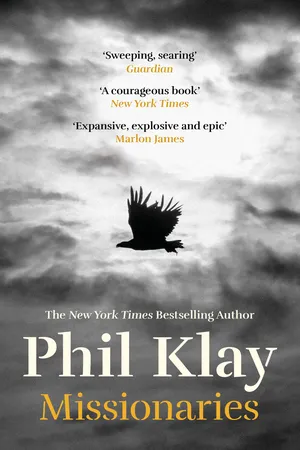
'Expansive, explosive and epic' Marlon James
'A courageous book' New York Times Book Review
A BARACK OBAMA BOOK OF THE YEAR 2020
Neither Mason, a US Special Forces medic, nor Lisette, a foreign correspondent, has emerged from America's long wars in Iraq and Afghanistan unscathed. Yet, for them, war still exerts a terrible draw – the noble calling, the camaraderie, the life-and-death stakes. Where else in the world can such a person go?
All roads lead to Colombia, where the US has partnered with the local government to stamp out a vicious civil war and keep the predatory narco gangs at bay. Mason is ready for the good war, and Lisette is more than ready to cover it.
eBook - ePub
Missionaries
About this book
Information
III
If I must die, I would like my body to be mixed in with the clay of the forts like a living mortar, spread by God between the stones of the new city.
—Álvaro Ulcué Chocué
1
Nine months before the dinner party, before they’d smoked cigars and discussed the Mil Jesúses and the intelligence they were giving the Colombian military, Mason had been invited to watch Juan Pablo kill a man. He’d just arrived in country and though the raid seemed unimportant—the Colombians were taking out a midlevel narco who by all rights should have been the police’s business and not the army’s—Mason decided to go. He wanted to be collegial.
And so, he’d flown to Tolemaida Air Base and there had shaken hands with Juan Pablo for the first time. He’d received a quick overview on the man they were tracking—El Alemán, a criminal associated both with the Urabeños and with a splinter faction of the ELN—and was then brought into the operations center. There, on the screen, a video feed from a U.S.-supplied ScanEagle drone eight hundred miles away tracked the progress of a medium-size white truck.
“What’s in the truck?” Mason had asked.
And with the utmost seriousness, Juan Pablo had replied, “A giant teddy bear.”
The bear, he learned, was two meters tall. It was pink. It had a white heart in the center of its chest. It had been tied with a pink bow and placed inside a giant pink box that was then tied with another, larger bow that was, of course, pink.
“We got a tip,” Juan Pablo said. Today was El Alemán’s girlfriend’s birthday. Which meant a party, and a special-ordered present that, once the military had been tipped off, was easy to track. Months later, Mason would realize the tip had undoubtedly come from the Jesúses, and that Juan Pablo had undoubtedly been the conduit. Not knowing that, or the chain of events the raid would set in motion, Mason had merely accepted the information and, with more than a little boredom, watched the slow and painstaking process by which targets are eliminated in modern warfare.
Mason watched the truck navigate mountain roads. He watched the truck arrive at a luxurious finca with a high exterior wall and three separate structures. He watched the debate break out among those in the operations center whether to have a team fly to the X and fast-rope down into the compound, or leave the helicopters on the far side of the mountain and walk to the objective. Hours later, he watched the arrival of El Alemán himself, who came not from the road but from a path in the mountains, riding a mule.
El Alemán had gold chains and emeralds glittering across his chest. They’d later find a 30-million-peso watch on his right wrist and a 40-million-peso watch on his left. He was not nearly as fat as his last known photo, so at first the Colombians were not sure it was him. He’d gotten a gastric balloon, they knew that. They were expecting a skinnier man. But this guy, clip-clopping in, complaining about the pain in his ass to his nearest security guard, was maybe forty kilos lighter. A gastric balloon, yes, and also weeks trudging through the mountains, negotiating with the ELN to secure new coca routes to Venezuela.
Later that evening, El Alemán’s girlfriend and other guests arrived. The drones watched their arrival. They watched the dancing and the eating and the drinking. They watched the ceremony of the bear, the untying of one pink ribbon after the next. They watched as the party moved into the early hours of morning, and they watched as El Alemán’s girlfriend danced with the bear for El Alemán’s amusement, grinding into the fuzzy white heart. They watched as the party wound down, and people went to sleep, and people left the party. One of the drones peeled off to follow a partygoer, an unknown figure who seemed to be, alongside El Alemán, a locus of attention. And then they watched as El Alemán retired with his girlfriend to a room in the northern corner of the finca.
During this, Juan Pablo sat in the back corner of the operations center at Tolemaida, observing but letting his principals run their op, not interfering. The mark of a good officer, Mason thought. The only times Mason had seen him on a radio or phone was when he was talking to higher, running interference on whatever pressures or demands were coming from the full colonels and generals. Juan Pablo trusted his men and trusted their training.
“Wait until the sniper team is ready,” a Colombian major said into a headset, his eyes fixed on the screens. “Wait.”
Three squads of eight soldiers were deployed, one that would breach the finca, another held in reserve, and the remaining squad split into teams of four, positioned on the northwest and southeast corners of the finca to block and isolate.
“When you’re ready.”
On the feed, Mason saw small figures racing to a side wall of the compound, the images oddly endearing, a child’s action toys brought to life. They were lifting a lightweight ladder to the side of the eastern exterior wall of the finca, and then one sped up the ladder, dropped down inside, and placed an explosive charge on the side door.
A voice came on the net: “Movement.”
On “Kill TV,” Mason saw two figures moving along the wall, probably guards who’d heard the assault team moving into position.
“Three, two, one.”
The explosive charges went off as the sniper team opened fire. One large flash and a cluster of smaller ones. The two figures fell down. The assault squad streamed into the finca.
On screen, it wasn’t so different from a U.S. raid, the choreography of men trained over and over to not simply execute a task, but to rapidly adapt to the changes and surprises an enemy compound can throw at you. Speed and violence of execution were key. Mason figured that, with a compound this size, forty-five seconds was a fair estimate of how long a group of U.S. special operators might take, and he began counting to himself.
One-one-hundred. Two-one-hundred. Three-one-hundred.
A machine gun opened up on the roof, a terrified urabeño with limited weapons training firing ineffectual bullets into the night, his burst serving no other purpose than to alert the snipers. They adjusted fire. The machine gun stopped. Three figures squirted out a side door, muzzle flashes lit up from the blocking squad’s position, and the three fell scattered across the ground, doll limbs all akimbo.
Eleven-one-hundred. Twelve-one-hundred.
The assault team rolled out of the first structure and into the building where El Alemán had retired with his girlfriend. Flashes of gunfire appeared on the feed, but the eye-in-the-sky couldn’t tell who was firing inside the building, and at whom.
Nineteen-one-hundred. Twenty-one-hundred.
The team rolled out into the final building, laying down heavy fire as they crossed quickly out into the open.
Twenty-six-one-hundred. Twenty-seven-one-hundred.
Inside the final building, the squad leader turned into a bedroom, a younger soldier with a light machine gun following behind. There were two figures under sheets in a bed, both sitting up, holding each other.
The squad leader ordered them to put their hands up. Neither did. The squad leader repeated the order, and the man’s hands moved down into the folds of the sheet across his lap. The squad leader’s finger had been straight and off his trigger, but now it hovered above his trigger, now it barely touched his trigger, now it exerted the slightest pressure as he decided what to do.
Thirty-five-one-hundred. Thirty-six-one-hundred.
The squad leader squeezed the trigger, punching a line of bullet holes in the man’s chest like the buttons on a dress shirt, and then the woman threw herself on the man, and the young soldier with the light machine gun opened fire as well, the bullets splitting the woman’s head open. They rolled out and into the hallway.
Forty-two-one-hundred. Forty-three-one-hundred.
A voice came on the net stating that the objective had been cleared. Mason stopped his counting and revised his earlier estimate. A U.S. team could have done it in thirty seconds. Juan Pablo, at a far corner of the room, turned from the drone feed to the other officers and warrant officers and enlisted manning the operations center and permitted himself a smile. Then his eyes briefly met Mason’s, allowing him to share in the victory before he turned back to the screens.
At the time, Mason had no sense of the significance of the raid, or the events that would result from it. In fact, he consciously tried not to overestimate the meaning of the affair. In ungoverned spaces, killing drug dealers tended to lead not to more law and order but to violent power grabs among the criminals lower down in the food chain. Intellectually, he knew this killing wouldn’t change much in Norte de Santander. But still, in that room, it was hard to resist the feeling of a momentous victory. A cleanly executed raid is always deeply satisfying to watch. There is something beautiful about the operation of a perfectly engineered machine.
The first doctor knew who Jefferson was and delivered the news fearfully, uncertainly. The manner of delivery was, at first, more irritating to Jefferson than the news itself, and he took a certain pleasure in letting the doctor know.
“If you’re going to tell a man he will die,” Jefferson said, “have some balls while you do it.” He decided he needed a second opinion.
The second doctor was more professional, and spoke in rapid, clipped words about the necessity of “palliative care.”
“What’s important now is quality of life,” the doctor said.
“I have never given any importance to quality of life,” Jefferson told him. “I’m not going to start now.”
The doctor paused. “I’m talking about managing what could be, without significant intervention, a significant amount of pain,” he said.
Jefferson, who had never shied from pain, found that funny. “I don’t give a damn for any man who can’t handle pain. The more pain, the better. That’s life.”
“Yes . . . but . . .” the now somewhat flustered doctor said, before pausing and collecting himself. Then he proceeded to explain how the tumors would grow and expand and begin to press on the organs, how Jefferson would feel it, and how it would begin to inhibit every aspect of his life unless interventions were made to limit their size. And then, delicately, he began to discuss psychological care. Jefferson silenced that talk with a look.
As the man left, Jefferson told him, “If you mention my condition to anyone, I’ll cut your dick off and fuck you with it.” The doctor nodded gravely, as if this were a normal way of speaking.
Over the next couple of days, Jefferson made no significant changes. The possibility of death was always a part of the business he had spent his entire life engaged in. What did it matter if it was a disease or a bullet, a tumor or a bomb? Natural causes are, of course, crueler. Slower than even the worst tortures he’d inflicted on men over the years. But Jefferson felt no particular fear. He’d never been able to excite himself in that way, with that strange emotion he’d observed so often in other people. It could, he knew, reduce men to paralysis in the face of coming death. Loose their bowels, make them cry out, betray themselves and all they imagined they were. It was a curious thing, and he didn’t have it.
What did develop, slowly, was nostalgia. He found himself thinking of the great days in Cesar, where he had risen through the ranks. Of the trust they’d conferred on him when they sent him to Norte de Santander. Of the network he’d built across the border in Venezuela.
He was made for great things, it was clear. And if he had less time left on this earth than expected, that was no problem. It was merely a spur to action.
And it was in the midst of these thoughts that he heard about the death of El Alemán.
When she bought the plane tickets, it had made sense. Bob had told her, just between the two of them, that there’d be an opening in Bogotá soon. It wasn’t for five months, but, she told him over Skype, that was perfect. “I want time to write something a bit more long-form.”
Just looking at Bob’s face, she could tell, even through the grainy, stuttering video feed, that he did not think that was perfect.
“Long-form? Oh, fuck me. Et tu, Liz?”
Lisette shrugged, tried to play it off. “I just want to—”
“I know what you want,” he said. “You want eight thousand words in The New Yorker. Fuck you. I hope you get a listicle in BuzzFeed.”
“What’s wrong with—”
“Eighteen Totally Empowering Ways to Brew Coffee, by Lisette Marigny. I can’t wait.”
Lisette sighed. She’d known he wouldn’t approve. And she didn’t need his approval. But still.
“BuzzFeed does great reporting. And what the fuck would be so wrong with eight thousand words in The New Yorker?”
The video stalled, jerked forward, like cheap animation with too few frames to connect the movement of the characters, making Bob’s voice disembodied, and, oddly, more authoritative.
“You don’t know anything about Colombia. I let you stretch a bit here because you’d put the work in. What, you think just because you can write a good sentence you deserve an opinion? You haven’t earned opinions yet.”
Then he went off on a rant she’s heard before, one of Bob’s old-man, oh-the-kids-these-days rants, about how too many young journalists thought the work they did was just a stepping-stone. How they think j...
Table of contents
- I
- II
- III
- IV
- Acknowledgments
Trusted by 375,005 students
Access to over 1.5 million titles for a fair monthly price.
Study more efficiently using our study tools.
Frequently asked questions
Yes, you can cancel anytime from the Subscription tab in your account settings on the Perlego website. Your subscription will stay active until the end of your current billing period. Learn how to cancel your subscription
No, books cannot be downloaded as external files, such as PDFs, for use outside of Perlego. However, you can download books within the Perlego app for offline reading on mobile or tablet. Learn how to download books offline
Perlego offers two plans: Essential and Complete
- Essential is ideal for learners and professionals who enjoy exploring a wide range of subjects. Access the Essential Library with 800,000+ trusted titles and best-sellers across business, personal growth, and the humanities. Includes unlimited reading time and Standard Read Aloud voice.
- Complete: Perfect for advanced learners and researchers needing full, unrestricted access. Unlock 1.5M+ books across hundreds of subjects, including academic and specialized titles. The Complete Plan also includes advanced features like Premium Read Aloud and Research Assistant.
We are an online textbook subscription service, where you can get access to an entire online library for less than the price of a single book per month. With over 1.5 million books across 990+ topics, we’ve got you covered! Learn about our mission
Look out for the read-aloud symbol on your next book to see if you can listen to it. The read-aloud tool reads text aloud for you, highlighting the text as it is being read. You can pause it, speed it up and slow it down. Learn more about Read Aloud
Yes! You can use the Perlego app on both iOS and Android devices to read anytime, anywhere — even offline. Perfect for commutes or when you’re on the go.
Please note we cannot support devices running on iOS 13 and Android 7 or earlier. Learn more about using the app
Please note we cannot support devices running on iOS 13 and Android 7 or earlier. Learn more about using the app
Yes, you can access Missionaries by Phil Klay in PDF and/or ePUB format, as well as other popular books in Literature & Literature General. We have over 1.5 million books available in our catalogue for you to explore.