- 240 pages
- English
- ePUB (mobile friendly)
- Available on iOS & Android
eBook - ePub
About this book
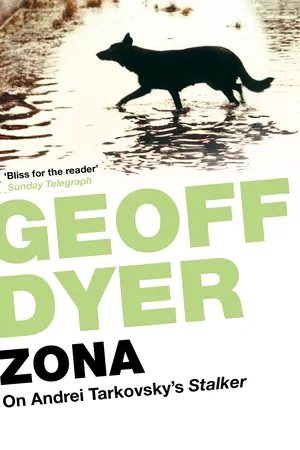
In this spellbinding book, the man described by the Daily Telegraph as 'possibly the best living writer in Britain' takes on his biggest challenge yet: unlocking the film that has obsessed him all his adult life. Like the film Stalker itself, it confronts the most mysterious and enduring questions of life and how to live.
Information
Subtopic
Film History & CriticismTWO

GLAD OF THE BREAK? Of course you are. Any kind of respite is always welcome: the end of a section or a chapter, even a double space break; at a push, just a paragraph. Henry Fielding likened these interludes to stops at taverns in the course of the long journey of the novel. Even if there are no scheduled chapter stops, even if the whole thing is one long, uninterrupted paragraph (i.e., even if you’re reading Thomas Bernhard), you can put the book aside and do something else for a couple of minutes, hours or days.
With concerts and plays the intermission often proves a bit of a dilemma. Yes, you can stretch your legs, but there’s nothing worse than scrumming for drinks at the bar only to find that by the time you’ve got your bottle of Grolsch (a drink you would never order in normal circumstances) the bell is ringing to tell you that the second part will begin in three minutes. How many times have you looked at your friends and your unfinished drinks and unanimously decided that, yes, the first half was great but, frankly, we’ve had enough of that (the music, the play) and could do with a few more of these (lagers)?
In the case of films, with double or triple bills, a break is an unavoidable necessity. Personally I no longer have the stamina (though, unusually for a man of my age, I do have the time) for the Bergman doubles and Bresson triples I used to be able to chug down in my twenties, so am rarely confronted with this problem of intermissions and whether to stay on for the second half of whatever it was that I’d paid good money to see. In the case of Stalker there is no intermission, not even time to go to the toilet, just a rather abrupt end to the first part, a few seconds’ pause, and then we’re off again with Part 2. But those few seconds are enough to break the spell and make one suspect that there’s been a continuity error, that something—even if only a frame or two—has gone missing. For a start it all looks a bit darker, as if several hours have gone by and the long day has waned somewhat. We’ve adjusted to the pace of the film—walking pace, the pace of three men trudging—and suddenly it seems as if we’ve had a jump cut, a jump forwards in time. Strangely, and uniquely for a Tarkovsky film, we’re struggling to keep up, to get on the bus! There is Stalker with his bandages and nuts, scampering through the abruptly darker forest, but then he’s outside some kind of building, calling to the other two to come over.
They’re taking it easy outside another building or another part of the same building. Either way, how did they get to wherever they are? Again there is that strange collusion between what is experienced by the people on-screen and us in the audience: it’s as if they too have taken a break. They seem to have internalised exactly the reluctance to persevere with Part 2 that can assail members of the audience during intermissions. Writer is stretched out on a moderately comfy bit of stone and Professor has found a nice place to sit. They look like they’ve just woken up, are actually looking forward to a bit of a lie-in. If Stalker has achieved anything so far it is to have united them in their fed-up-ness. I sometimes think this is the real purpose of guides: to serve as a source of bonding for sightseers obliged to follow and listen to them. My dominant memory of the last time I was at the mercy of a guide—explaining the intricacies of Native American rock art near Cedar Mesa, Utah—is of my companion and me chorusing ‘Wow!’ in increasingly desultory and unwowed tones. From the point of view of prospective clients an obvious drawback of the Zone is that you can go there only with a guide, that you will have to listen to him trot out the same stories and the same gags that he’s been trotting out ever since he got the job. With Stalker, though, it’s not a job, it’s a calling, and it’s not gags and joking (as Writer grumbles), it’s all sermons and sermonising.
Professor, looking really tired and stiff, steps down from his perch into what sounds like a huge puddle. But no. We cut away to what looks like a reflection of a giant grey moon, smashed apart by a rock or stone—and slowly reassembling itself while Stalker intones some verses by Tarkovsky’s father, Arseny. So far the narrative has been strictly linear, following them step by step: border, trolley, walking through the Zone. Tarkovsky himself ‘wanted it to be as if the whole film had been made in a single shot.’ But now, in Part 2, we seem to have reverted to the loose, associative structure of Mirror, which made much use of the poetry of the director’s father’s. What’s happening?26
STALKER’S POETIC VOICE-OVER continues as the unexplained pale silver-grey circle sways and settles. It is still going on as he lowers himself through the hole in a wall—an abandoned window—and squeezes round the edge of the wall, clinging to it as though on a narrow ledge over a thousand-foot drop. There’s a touch of Nosferatu about his expression, the teeth-bared concentration with which he traverses the decrepit remains of what might once have been a half-decent climbing wall. Strength is a terrible thing, we hear, weakness is a great thing. Hmm. In Enter the Dragon, a film seen by everyone at my school, we heard that the proud civilisations—Sparta, Rome, the Samurai—all worshipped strength because it was strength that made all other values possible, a counterstatement of belief that was later sampled by the Thievery Corporation on their track ‘The Foundation’. Needless to say, Stalker’s apparent weakness is insignificant compared with the faith that Tarkovsky believed made him ‘invincible’. And Stalker, presumably, draws strength from the memory of the so-called ‘beautiful souls’ of Russia in the late 1830s and 1840s, men whose personal and political weaknesses seemed intrinsic to their intellectual and moral purity. The obligations of election laid down by one such soul read like a passage from a training manual for the craft of the Stalker: ‘You are distinguished from the mass of ordinary souls, and heavenly powers educate and guide you invisibly. For without a certain mood of the soul our science is in vain and our searching unfruitful.’
Stalker comes to an echoey tunnel where he meets the others. They’re making good progress, apparently, are ready to go on. Professor is not happy. He didn’t realise they were actually continuing their expedition; he thought Stalker wanted to show them one of the local sights—a side trip as they say in the tourism world—and has not brought his knapsack. He has to go back to get it. You can’t go back, Stalker tells him. There’s no going back, he says, going back to a point made earlier. Professor is insistent. He wants his knapsack. (It so happens that, right now, I identify absolutely with Professor’s desire to be united with his rucksack. Six years ago my wife came back from a trip to Berlin with one of those Freitag bags made out of recycled truck tarps and seat belts. Unlike some Freitag bags it was rather plain—plain grey in fact—and initially I was a little disappointed. Over time, though, I came to see that she had made the wisest possible choice and I came to love that bag absolutely. And then, ten days ago in Adelaide, in the course of a long, multifaceted, multi-drinks evening, I lost it, either in a restaurant, at a party, in a taxi or at the gardens of the Arts Festival. No one handed in my bag. It was gone—and is not identically replaceable. Freitag bags now come with a hip fastener, though I could get a reasonably exact match. But it’s my one I want, that I want back. At this moment, in fact, if I found myself in the Room, my deepest wish is that I could be reunited with my Freitag bag. There is a parable—or maybe it’s just part of a stand-up routine—that at the end of your life you are reunited with all the things that you have lost in your life. This lovely idea turns out be a terrible disappointment as you are faced with thousands and thousands of pens and umbrellas, each one a metaphor, I suppose, for the worthlessness of the things by which you set so much value. But it would be nice if, at the end of your life, the locations of where you lost your most beloved ten or twenty possessions could be revealed to you, if you could see a film that showed your younger self walking away from the table at the festival in Adelaide, slightly drunk, while the Freitag bag, discreetly stylish in grey, sat there neglected, unnoticed and mute, incapable of calling out ‘Vergissmeinnicht’. ‘So that’s what happened’ you would say to yourself, shaking your head in astonishment, at the simple but profound mystery of loss, on the brink of the most profound and mysterious loss of all, that of your life. And who knows—maybe the revelation of how we lost those treasured things would reconcile us to that other loss in ways that religion no longer can.)
Stalker asks Professor, Why are you so worried about your knapsack? You’re going to the Room, where all of your wishes will come true. If that’s what you want it will drown you in knapsacks. Good point—though people have set their hearts on stranger, more trivial things. That, in fact, is a version of the good life we are encouraged to pursue, in the misguided belief that an abundance of knapsacks—or iPads or cars or Armani suits—will bring us happiness. (In the case of my Freitag bag, though, it’s not that I believed it would bring me happiness; it was happiness, I realise now, or a component of my happiness, and not having it now is a source of unhappiness.) Still, one sympathises with Stalker: these clients have got into that complaint-disappointment loop. Everything is turning out badly. Nothing is good enough for them. Especially Writer; ever since he bottled it going towards the Room he’s stopped grumbling to Stalker’s face and has contented himself with going all hangdog and generally dragging his feet. They are not in the Room yet but they are realising that one of mankind’s deepest wishes is the need to complain, to moan, to be disappointed. Perhaps that’s why gods were invented, so you could moan at them for the way things turned out, for things not happening, even, at that relatively late stage of human development (as personified by Thomas Hardy), for not existing. Professor asks, How far is it, this Room? In the context of their immediate dispute this could be taken as meaning something along the lines of Exactly how long will I have to wait till I get all these knapsacks? More generally, it’s a huge and multilayered question, absolutely central to the film. If you go straight, says Stalker, about two hundred metres, but, as we all know, there’s no going straight. And the usual measurements of space and distance—miles and kilometres, hectares, acres—are irrelevant. All that matters here is cinematic space. The camera moves forward in what we assume is a linear fashion only for us to discover that we are back where we started. ‘The single most important force in Tarkovsky’s construction of space,’ writes Robert Bird, ‘is the motion of the camera.’
Same with time. As one of the characters in Roadside Picnic says, ‘There really is no time in the Zone.’ Stalker and his clients seem to be there for just a day, but once they start taking naps and their dreams merge into the depiction of the actual journey—which is, in any case, all but indistinguishable from a less literal, spiritual journey—time dissolves.27
They prepare to get going, Writer first, followed by Stalker. They’re perched, a little precariously, above what seems less like a river than a flow of molten water, polluted by something that makes it more beautiful to look at than simple, natural running water.28 The next time we see Writer he is wherever it was they were headed to, bedraggled, mud-smeared and looking more than a little bewildered. He moves off-screen to the right, leaving his plastic bag behind. To our eyes this is an unpardonable bit of littering. The Zone is full of junk: rusting bits and pieces of civilisation and warfare but, as they rot and rust, they add to the beauty of the place, whereas this notoriously unbiodegradable plastic bag really is an eyesore. No wonder the camera does not dwell on it but instead drifts right, in Writer’s wake, past partly tiled walls, hanging light fixtures and rotting archways through which can be seen—and heard—a brown torrent of falling water. We assume we are progressing but we end up back with Writer again, barely a few feet from where we last saw him. There is no verifiable link—to go back to a point made a few paragraphs ago—between the amount of ground the camera has covered and how far or where it has actually gone. Quaintly, this spot is called the Dry Tunnel, according to Stalker. Very droll. Certainly, by now, the very idea of keeping dry seems laughable as they wade knee deep through running water and make their way through the pouring waterfall. Professor has gone missing—he’s gone back for his stupid knapsack, which means he’s as good as dead. The other two press on. Impossibly, in the midst of all this watery dampness, the ground pulses with glowing embers as though we are getting close to the burning centre of the soggy earth. Through the swaying water the camera gazes down at the tiled, mossy floor, littered with the soaked, handwritten pages of a notebook or ledger, a rusted machine gun, a syringe.
Freshish out of university, when I first saw Stalker, I scanned these objects in the frustrated assumption that their significance—their place in the symbolic scheme of things—would be revealed. But it wasn’t. They never mean more than what they are, these things; they are just things—a machine gun, pages, a syringe—lying there while the film of water washes over them and the film of them and the water washing over them washes over us.29
HERE’S A LUCKY BREAK. Professor has not been gobbled up by the Zone. As Writer announces with unfeigned delight, he’s here, waiting for them, reunited with his beloved knapsack, munching cake, drinking warm coffee from his thermos and, relatively speaking, dry as a bone. He’s even built a wan little fire. But how did he get here ahead of them, how did he overtake them? What do you mean? Professor wants to know. He just came back here for his knapsack. It’s true. They’ve ended up where they were before all that white-water rafting (without the raft)! T. S. Eliot’s overquoted lines about the end of all exploring, how we end where we begin but know the place for the first time, have been proved true in an incredibly short space of time and space (insofar as space and time mean anything in the Zone). Actually that’s not quite true, because they don’t know the place for the first time, not even Stalker, who looks around amazed, as if he can’t believe what he’s seeing—especially since the nut he threw to show the way ahead is here, back where they started. And not just the nut: unless I’m mistaken, that’s Writer’s plastic bag waiting for him. Suddenly the film is all about men being reunited with their bags, either cherished or disposable. (If only my Freitag bag were here too!) Stalker, though, has more important things on his mind, is struggling to process this latest, deeply perplexing bit of data: the fact that they’re back where they were however long ago it was that they were last here, wherever that is. The Zone has turned into Thomas Mann’s Magic Mountain, where ‘the then is constantly repeated in the now, the there in the here.’ My god, it’s a trap, Stalker realises. Porcupine must have put the nut there to trip them up, to trap them. It’s too much to take in. He won’t take another step, he says, stepping away from them, until he’s fathomed out what’s happening. By fathomed out he means take a rest. According to conventional standards of hiking this seems a singularly inappropriate place to camp: there’s hardly a dry spot to be seen. Writer finds a mossy mound surrounded by water, Professor wedges himself on a bit of high ground and Stalker beds down on the edge of what looks like a soaking wet foxhole in a quiet corner of Stalingrad. (No wonder he’s coughing.) Writer’s delight at finding Professor again is short-lived, or at least it turns quickly to derision at what he perceives as the Professor’s motives in coming here, as suggested by what he guesses is in that much-coveted knapsack. Professor is here to measure the Zone, to measure a place whose defining quality is its immeasurability, to conduct scientific tests on miracles, to reduce it all to the predictable and quantifiable procedures of science. Writer is one of those people whose default relation to others is to get on their wrong side, to rub them up the wrong way. Snuggled up comfortably enough, Professor responds with a few retaliatory jibes of his own: Writer is a blabbermouth, fit only to daub stuff on public walls. At one level they are now having a more conventional three-men-in-a-Zone-type outing, getting down to the true stuff of male friendship: goading and taking the piss, the British discourse known as banter—albeit in the slightly unusual mode of quasi–pillow talk in which the pillow is a lump of soaking earth and the bed as dank as a riverbed. Their hearts are not really in it, they’re all drifting into sleep, slipping into a dream on the fringes of which a black dog comes paddling along the murky river with its linger of mist. The dog stands and looks at us, like it’s bearing an important doggy message from the unconscious. We slip briefly into swampy monochrome but they’re not quite asleep, not yet. Writer asks Stalker—or Chingachgook as he’s now taken to calling him—what other people have wanted from the Zone. Happiness, he guesses, looking surprisingly comfortable given where he’s lying. Writer says he’s never known a happy man in all his life. Stalker might have replied that it takes one to know one but instead, brow more furrowed than ever, concedes, no, neither has he. A strange point to agree on and a little hard to believe—unless this apparent inability to be happy is a distinctly Russian or Soviet indisposition. John Updike reckoned that America was a vast conspiracy to make people happy. Soviet Russia was perhaps its equally vast antithesis. Writer keeps on: Has Stalker never wanted to visit this Room? Obeying the first principle of drug dealers in any and all films—don’t get high on your own supply—Stalker says no. Initially, in keeping with Roadside Picnic, Stalker was ‘some kind of drug dealer or poacher’ but, as the film evolved—especially when its very existence was jeopardised by the catastrophe of the ruined footage—he became ‘a slave, a believer, a pagan of the Zone’. So he’s fine as he is, thank you, has nothing to ask of the Room in which he believes so passionately, on whose power he has staked his life. He’s just tired, whereupon the nice black doggy—so black he is never more than a dog-eared silhouette—comes and sits with him. Writer still wants to talk. What if he returns a genius? Writing comes out of torment, self-doubt. If he returns knowing he’s a genius, what incentive is there to write? This is what might be called the Prozac tradeoff or at least a version of the argument often heard in the blissful dawn of the Prozac era, when it seemed likely that Prozac was the formula for universal happiness: surely this would lead to the extinction of the urge to create. Professor begs...
Table of contents
- Cover
- About the Author
- Also by Goeff Dyer
- Title page
- Copyright Page
- Dedication
- Epigraph
- Contents
- One
- Two
- Films By Tarkovsky
- Bibliography
- Notes
- Acknowledgments
- Endnotes
- Read on for a preview of Another Great Day at Sea...
- 1
- Also by Geoff Dyer
- Also by Geoff Dyer
- Also by Geoff Dyer
- Also by Geoff Dyer
- Also by Geoff Dyer
- Also by Geoff Dyer
- Also by Geoff Dyer
- Also by Geoff Dyer
- Also by Geoff Dyer
- Also by Geoff Dyer
Trusted by 375,005 students
Access to over 1.5 million titles for a fair monthly price.
Study more efficiently using our study tools.
Frequently asked questions
Yes, you can cancel anytime from the Subscription tab in your account settings on the Perlego website. Your subscription will stay active until the end of your current billing period. Learn how to cancel your subscription
No, books cannot be downloaded as external files, such as PDFs, for use outside of Perlego. However, you can download books within the Perlego app for offline reading on mobile or tablet. Learn how to download books offline
Perlego offers two plans: Essential and Complete
- Essential is ideal for learners and professionals who enjoy exploring a wide range of subjects. Access the Essential Library with 800,000+ trusted titles and best-sellers across business, personal growth, and the humanities. Includes unlimited reading time and Standard Read Aloud voice.
- Complete: Perfect for advanced learners and researchers needing full, unrestricted access. Unlock 1.5M+ books across hundreds of subjects, including academic and specialized titles. The Complete Plan also includes advanced features like Premium Read Aloud and Research Assistant.
We are an online textbook subscription service, where you can get access to an entire online library for less than the price of a single book per month. With over 1.5 million books across 990+ topics, we’ve got you covered! Learn about our mission
Look out for the read-aloud symbol on your next book to see if you can listen to it. The read-aloud tool reads text aloud for you, highlighting the text as it is being read. You can pause it, speed it up and slow it down. Learn more about Read Aloud
Yes! You can use the Perlego app on both iOS and Android devices to read anytime, anywhere — even offline. Perfect for commutes or when you’re on the go.
Please note we cannot support devices running on iOS 13 and Android 7 or earlier. Learn more about using the app
Please note we cannot support devices running on iOS 13 and Android 7 or earlier. Learn more about using the app
Yes, you can access Zona by Geoff Dyer in PDF and/or ePUB format, as well as other popular books in Media & Performing Arts & Film History & Criticism. We have over 1.5 million books available in our catalogue for you to explore.