Does the light just go out and that's that - the million-year nap? Or will some part of my personality, my me-ness, persist? What will that feel like? What will I do all day? Is there a place to plug in my laptop?"
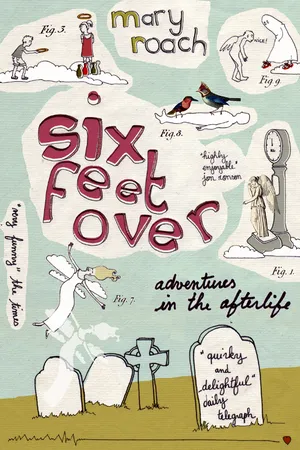
Mary Roach trains her considerable humour and curiosity on the human soul, seeking answers from a varied and fascinating crew of contemporary and historical soul-searchers: scientists, schemers, engineers, mediums, all trying to prove (or disprove) that life goes on after we die.
Along the way she encounters electromagnetic hauntings, out-of-body experiences, ghosts and lawsuits: Mary Roach sifts and weighs the evidence in her hilarious, inimitable style.
- 300 pages
- English
- ePUB (mobile friendly)
- Available on iOS & Android
eBook - ePub
About this book
Trusted by 375,005 students
Access to over 1.5 million titles for a fair monthly price.
Study more efficiently using our study tools.
Information
1
You Again
A visit to the reincarnation nation
I DON’T RECALL my mood the morning I was born, but I imagine I felt a bit out of sorts. Nothing I looked at was familiar. People were staring at me and making odd sounds and wearing incomprehensible items. Everything seemed too loud, and nothing made the slightest amount of sense.
This is more or less how I feel right now. My life as a comfortable, middle-class American ended two nights ago at Indira Gandhi International Airport. Today I am reborn: the clueless, flailing thing who cannot navigate a meal or figure out the bathrooms.
I am in India spending a week in the field with Kirti S. Rawat, director of the International Centre for Survival (as in survival of the soul) and Reincarnation Researches. Dr. Rawat is a retired philosophy professor from the University of Rajasthan, and one of a handful of academics who think of reincarnation as something beyond the realm of metaphor and religious precept. These six or seven researchers take seriously the claims of small children who talk about people and events from a previous life. They travel to the child’s home—both in this life and, when possible, the alleged past life—interview family members and witnesses, catalogue the evidence and the discrepancies, and generally try to get a grip on the phenomenon. For their trouble, they are at best ignored by the scientific community and, at worst, pilloried.
I would have been inclined more toward the latter, had my introduction to the field not been in the form of a journal article by an American M.D. named Ian Stevenson. Stevenson has investigated some eight hundred cases over the past thirty years, during which time he served as a tenured professor at the University of Virginia and a contributor to peer-reviewed publications such as JAMA and Psychological Reports. The University of Virginia Press has published four volumes of Stevenson’s reincarnation case studies and the academic publisher Praeger recently put out Stevenson’s two-thousand-word opus Biology and Reincarnation. I was seduced both by the man’s credentials and by the magnitude of his output. If Ian Stevenson thinks the transmigration of the soul is worth investigating, I thought, then perhaps there’s something afoot.
Stevenson is in his eighties and rarely does fieldwork now. When I contacted him, he referred me to a colleague in Bangalore, India, but warned me that she would not agree to anything without meeting me in person first—presumably in Bangalore, which is a hell of a long way to go for a get-acquainted chat. A series of unreturned e-mails seemed to confirm this fact. At around the same time, I had e-mailed Kirti Rawat, whom Stevenson worked with on many of his Indian cases in the 1970s. Dr. Rawat happened to be in California, an hour’s drive from me, visiting his son and daughter-in-law. I drove down and had coffee with the family. We had a lovely time, and Dr. Rawat and I agreed to get together in India for a week or two while he investigated whatever case next presented itself.
The Kirti Rawat who met me at the airport was in a less contented state. He had been arguing with management over the room service at the hotel where I had booked us. The next morning, we packed up our bags and moved across Delhi to the Hotel Alka (“The Best Alternative to Luxury”), where he and Stevenson used to stay. The carpets are clammy, and the toilet seat slaps you on the rear as you get up. The elevator is the size of a telephone booth. But Dr. Rawat likes the vegetarian dinners, and the service is attentive to the point of preposterousness. Bellhops in glittery jackets and curly-uppy-toed slippers flank the front doors, opening them wide as we pass, as though we’re foreign dignitaries or Paris Hilton on a shopping break.
It is 9 a.m. on the first day of our travels. A driver waits outside. This is less extravagant than it sounds. The car is a 1965 Ambassador with one functioning windshield wiper. Dr. Rawat seems not to mind. The most I could get out of him on the subject of aged Ambassadors was that they are “beginning to be outmoded.” What he likes best about this particular car is the driver. “He is submissive,” Dr. Rawat says to me as we pull away from the curb. “Generally, I like people who are submissive.”
Oh, dear.
This week’s case centers on a boy from the village of Chandner, three hours’ drive from Delhi. Dr. Rawat is using the drive time to fill me in on the particulars of the case, but I’m finding it hard to pay attention. We are stuck in traffic just outside Delhi. There are no real lanes, just opposing currents of vehicles, chaotic and random, as though they’d been scooped up in a Yahtzee cup and tossed haphazardly onto the asphalt. Every few feet, a cluster of cows has seemingly been Photoshopped into the mix: sauntering mid-lane or lying down in improbably calm, sleepy-eyed pajama parties on the median strips. We enter a lurching, kaleidoscopic roundabout. In the eye of the maelstrom, a traffic cop stands in a concrete gazebo, waving his hand. I cannot tell whether he is directing traffic or merely fanning himself.
I wonder aloud where all these people are going. “Everyone is going to his own destination,” comes the reply. This is a highly Dr. Rawat thing to say. One of Rawat’s two master’s degrees and his doctorate are in philosophy, and it remains one of his passions—along with Indian devotional music and poetry. He is the dreamiest of scientists. Last night, in the midst of a noisy, hot, polluted cab drive, he leaned over and said, “Are you in a mood to hear one of my poems?”
Dr. Rawat is telling me that the case we are investigating is fairly typical. The child, Aishwary, began talking about people from a previous existence when he was around three. Ninety-five percent of the children in Stevenson’s cases began talking about a previous existence between the ages of two and four, and started to forget about it all by age five.
“Also typical is the sudden, violent death of the P.P.”
“Sorry—the what?”
“The previous personality.” The deceased individual thought to be reincarnated. “We say ‘P.P.’ for short.” Possibly they shouldn’t.
Aishwary is thought by his family to be the reincarnation of a factory worker named Veerpal, several villages distant, who accidently electrocuted himself not long before Aishwary was born. Dr. Rawat opens his briefcase and takes out an envelope of snapshots from last month, when he began this investigation. “Here is the boy Aishwary at the birthday party of his ‘son.’” Aishwary is four in the photograph. His “son” has just turned ten. Just in case the age business isn’t sufficiently topsy-turvy, the elastic strap on the “son’s” birthday hat has been inexplicably outfitted with a long, white beard. This morning, while leafing through a file of Dr. Rawat’s correspondences, I came across a letter that included the line: “I am so glad you were able to marry your daughter.” I am reasonably, but not entirely, sure that the correspondent meant “marry off.”
“Now, here is the boy with Rani.” Rani is the dead factory worker’s widow. She is twenty-six years old. In the photo, the boy stares fondly—lustfully, one might almost say, were one to spend too much time in India with reincarnation researchers—at his alleged past-life wife. This strikes me as the most improbable, chimerical thing I’ve ever seen, and then I look out the car window, where an elephant plods down a busy Delhi motorway.
Living in California, where alleged reincarnations tend to spring from royalty and aristocracy, a reincarnated laborer is something of a novelty for me. Dr. Rawat says that this is typical here: “These are ordinary people remembering ordinary lives.” Though there are exceptions. At last count, he has met six bogus Nehru reincarnates and eight wannabe Gandhis.*
In the case of the boy Aishwary, the alleged previous personality hails from a family just as poor as his own. In Dr. Rawat’s estimation, this strengthens the case, as financial gain wouldn’t be a motive for fraud. Poor families have been known to fabricate a rebirth story in the hope that the “previous personality’s” family—they’ll target a wealthy one—will feel financially beholden to their dead relative’s new family. Dr. Rawat told me about another creative application of ersatz reincarnation: escaping an unpleasant marriage. Years back, he investigated the case of a woman who fell ill and claimed to have momentarily died—and then been revived with a different soul. Now that she had been reborn as someone new, she argued, she couldn’t possibly be expected to live or sleep with her old husband. (Divorce retains a weighty social stigma in India.) Dr. Rawat interviewed the doctor who examined her. “He wasn’t a doctor at all. He was a compounder.” A bone-setter. And she wasn’t dead. “He told me, ‘Well, her pulse was down.’”
While Dr. Rawat catnaps, I page through a copy of his book Reincarnation: How Strong Is the Scientific Evidence? Let’s set aside “strong” for a minute and talk about “scientific.” Like most psychological and philosophical theories, reincarnation can’t be proved in a lab. You can’t see it happen, and no biological framework exists to explain how it might work. The techniques of reincarnation researchers most closely match those of police detectives. It’s an exhausting, exacting search for independently verifiable facts. Researchers contact the parents of the child and then travel to the village or town. They ask the parents to recall exactly what happened: word for word, detail by detail, what the child said when he first began speaking about people or places from a past that clearly didn’t correspond to the life he now lives. They look for credible witnesses to the child’s utterances, and they interview them, too.
By the time the researcher arrives on the scene, the family has usually found a likely candidate for the child’s former incarnation. Most Indian villagers accept reincarnation as fact, and word of a child remembering a past life travels quickly to neighboring villages. The previous personality can’t be interviewed, because he’s dead, but his family members can. If the child is said to have recognized his home from his past life or features of the town or members of his past-life family, the researcher interviews witnesses who saw the meetings and the purported recognitions.
The strongest cases are those in which the parents have written down the child’s statements when he or she first began talking about a past life—before they’ve met any family or friends from that life. (These are rare: Among Stevenson’s cases, only about twenty include any written record.) Without a written record, researchers must work from the parents’ memories of what the child said. This makes for wobbly evidence—not because villagers are dishonest, but because human memory is deeply fallible. It’s unreliable and easily tweaked by its owner’s beliefs and desires. Did the boy say what he said about electrocution before his parents began talking about Veerpal’s death, or did he perhaps overhear them talking about it first? Did he really say he was killed by an electrical current, or has his mom, once she learned the facts, reinterpreted something ambiguous? Perhaps the boy referred to a cord. He meant a rope, but the mother, having heard about the accident, pictures an electrical cord. That sort of thing.
Most of Ian Stevenson’s case write-ups include a chart summarizing the allegedly reborn child’s statements about a past life and about people he or she recognizes. For each of these statements and recognitions, Stevenson lists a witness, if there is one, and the comment of the witness. Typically the chart marches on for eight or ten pages, wearing down your skepticism with the grinding accumulation of names and tiny type. If you take the work of Ian Stevenson at face value, it would be hard to reach any conclusion other than this: Reincarnation happens.
The skeptics tend to dismiss Stevenson’s work a priori; few have taken him on case by case. One who tried was Leonard Angel, then a humanities professor at Douglas College in British Columbia. He chose the case of a Druze boy from Lebanon, Imad Elawar, a case Stevenson has referred to as one of his strongest. Of all the cases in which there is written documentation from the time before the suspected previous personality was located, this is the only one in which Stevenson himself wrote the statements down—thus precluding a fraudulent after-the-fact jotting. Angel complains that Stevenson nowhere sets forth these statements as they were worded by the boy or the parents. Stevenson simply writes that the parents “believed [the boy] to have been one Mahmoud Bouhamzy of Khriby who had a wife called Jamilah [Mahmoud and Jamilah were the names the boy spoke first and most often] and who had been fatally injured by a truck after a quarrel with the driver.”
Stevenson traveled with the family for their first visit to Khriby. He couldn’t find a suitable Mahmoud Bouhamzy; however, upon asking around, he found an Ibrahim Bouhamzy with a mistress named Jamilah. Ibrahim was not run over by a truck, but his relative Said was, though no quarrel was involved. Stevenson concludes that the boy’s parents had made wrong inferences based on his words—though since his write-up does not give the boy’s exact words, it’s hard to know what to think. There’s no explanation of why the name most commonly uttered by the boy would be Mahmoud. The glass slipper fit Ibrahim, and Stevenson proceeded from there.
But I was never in Khriby, and neither was Leonard Angel. Something served to convince Stevenson that the case of Imad Elawar strongly suggested reincarnation. Whether it was the facts of the case or a blind eye born of bias, I can’t say.
So I’ve come to India for answers. I want to get inside one of these cases, meet the families involved, hear the things they say, watch them interact.
In India, I’m finding, the answers do not always fit the questions. This morning at the hotel, I asked the waiter what kind of cheese is in the masala omelette.
“Sliced,” he said.
I hope to do better than that.
THE TRAFFIC JAM has dissolved, leaving our driver free to proceed in the manner he enjoys. This entails driving as fast as possible until the rear end of the car in front is practically in his mouth, then laying on the horn until the car pulls into the other lane. If the other car won’t move over, he veers into the path of oncoming traffic—for sheer drama, an approaching semi truck is best—and then back, at the last possible instant. Livestock and crater-sized potholes materialize out of nowhere, prompting sudden James-Bond-style swervings and brakings. It’s like living inside a video game.
“Why doesn’t he just get into the fast lane and stay there?”
“There isn’t a fast lane, as such,” says Dr. Rawat. He gazes calmly out his window, as goats and a billboard for Relaxo footwear flash past. “The lanes are both the same. Whoever is slower pulls over.” He speaks in a neutral, narrative tone, as though describing a safe and civilized code of the road. Aggressive honking and light-flashing is considered good manners: You’re simply alerting the driver ahead of your presence. (Rearview mirrors are apparently for checking your hairdo. Likewise, the driver’s-side mirror currently registers a clear and unobstructed view of the dashboard.) Exhortations to BLOW HORN PLEASE and USE DIPPER are painted on the backs of most trucks, so that even the most laid-back driver goes along honking and flashing his lights like his team has just won the World Cup. I am finding it hard to relaxo.
In India, everywhere you look, people are calmly comporting themselves in a manner that we in the States would consider a terrible risk, a beseeching of death with signal flare and megaphone. Women in saris perch sidesaddle, unhelmeted, on the backs of freeway-fast Vespas. Bicyclists weave through clots of city traffic, breathing diesel fumes. Passengers sit atop truck cabs and hang off the sides like those acrobat troupes that pile onto a single bicycle. Trucks overladen with bulbous muffin-top loads threaten to topple and bury nearby motorists under illegal tonnages of cauliflower and potatoes. (ACCIDENT PRONE AREA, the signs say, as though the area itself were somehow responsible for the carnage.) People don’t seem to approach life with the same terrified, risk-aversive tenacity that we do. I’m beginning to understand why, religious doctrine aside, the concept of reincarnation might be so popular here. Rural India seems like a place where life is taken away too easily—accidents, childhood diseases, poverty, murder. If you’ll be back for another go, why get too worked up about the leaving?
A bus blasts its horn and bullies ...
Table of contents
- Cover
- Title Page
- Dedication
- Contents
- Introduction
- Chapter One: You Again
- Chapter Two: The Little Man Inside The Sperm, Or Possibly The Big Toe
- Chapter Three: How To Weigh A Soul
- Chapter Four: The Vienna Sausage Affair
- Chapter Five: Hard To Swallow
- Chapter Six: The Large Claims Of The Medium
- Chapter Seven: Soul In A Dunce Cap
- Chapter Eight: Can You Hear Me Now?
- Chapter Nine: Inside The Haunt Box
- Chapter Ten: Listening To Casper
- Chapter Eleven: Chaffin V. The Dead Guy In The Overcoat
- Chapter Twelve: Six Feet Over
- Last Words
- Acknowledgments
- Bibliography
- Also By Mary Roach
- Credits
- About the Author
- Copyright
Frequently asked questions
Yes, you can cancel anytime from the Subscription tab in your account settings on the Perlego website. Your subscription will stay active until the end of your current billing period. Learn how to cancel your subscription
No, books cannot be downloaded as external files, such as PDFs, for use outside of Perlego. However, you can download books within the Perlego app for offline reading on mobile or tablet. Learn how to download books offline
Perlego offers two plans: Essential and Complete
- Essential is ideal for learners and professionals who enjoy exploring a wide range of subjects. Access the Essential Library with 800,000+ trusted titles and best-sellers across business, personal growth, and the humanities. Includes unlimited reading time and Standard Read Aloud voice.
- Complete: Perfect for advanced learners and researchers needing full, unrestricted access. Unlock 1.5M+ books across hundreds of subjects, including academic and specialized titles. The Complete Plan also includes advanced features like Premium Read Aloud and Research Assistant.
We are an online textbook subscription service, where you can get access to an entire online library for less than the price of a single book per month. With over 1.5 million books across 990+ topics, we’ve got you covered! Learn about our mission
Look out for the read-aloud symbol on your next book to see if you can listen to it. The read-aloud tool reads text aloud for you, highlighting the text as it is being read. You can pause it, speed it up and slow it down. Learn more about Read Aloud
Yes! You can use the Perlego app on both iOS and Android devices to read anytime, anywhere — even offline. Perfect for commutes or when you’re on the go.
Please note we cannot support devices running on iOS 13 and Android 7 or earlier. Learn more about using the app
Please note we cannot support devices running on iOS 13 and Android 7 or earlier. Learn more about using the app
Yes, you can access Six Feet Over by Mary Roach in PDF and/or ePUB format, as well as other popular books in Biological Sciences & Science General. We have over 1.5 million books available in our catalogue for you to explore.