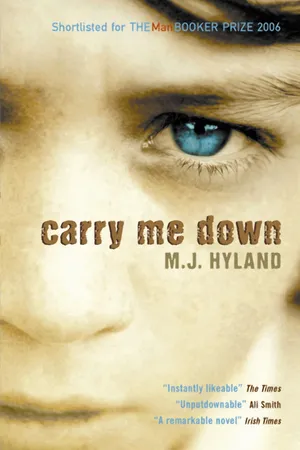
Ireland, 1971, John Egan is a misfit, 'a twelve year old in the body of a grown man with the voice of a giant who insists on the ridiculous truth'. With an obsession for the Guinness Book of Records and faith in his ability to detect when adults are lying, John remains hopeful despite the unfortunate cards life deals him.
During one year in John's life, from his voice breaking, through the breaking-up of his home life, to the near collapse of his sanity, we witness the gradual unsticking of John's mind, and the trouble that creates for him and his family.
- 336 pages
- English
- ePUB (mobile friendly)
- Available on iOS & Android
eBook - ePub
Carry Me Down
About this book
Information
1
It is January, a dark Sunday in winter, and I sit with my mother and father at the kitchen table. My father sits with his back to the table, his feet pressed against the wall, a book in his lap. My mother sits to my right and her book rests on the table. I sit close to her, and my chair, which faces the window, is near the heat of the range.
There is a pot of hot tea in the middle of the table and we each have a cup and plate. There are ham and turkey sandwiches on the plates and, if we want more to eat or drink, there is plenty. The pantry is full.
From time to time we stop reading to talk. It is a good mood, as though we are one person reading one book – not three people apart and alone.
These kinds of days are the perfect ones.
Through the small, square window I can see the narrow country road that leads to the town of Gorey and, beyond the road, a field of snow. Beyond the field of snow, although I cannot see it now, is the tree I pass every morning and two miles beyond the tree is Gorey National School, where I will return at the end of the Christmas holiday.
On the corner of the road, to the left of the front gate, there is a post with a sign pointing to Dublin and another, smaller sign beneath it, pointing to the cemetery. For two more days we will be together, the three of us, and that’s what I want. I don’t want anything different.
* * *
When I see that my mother is near the last page of her book, I take a pack of playing cards and move it towards her elbow. Soon, she will put her book down and offer me a game. I look at her face and wait.
Suddenly, she closes her book and stands.
‘John,’ she says, ‘please come with me.’ She is taking me out to the hallway, away from my father. She is taking me out of his sight as though I am the rubbish. ‘Come now and leave your book behind,’ she says.
We stand at the base of the steep and narrow stairs that lead up to my parents’ loft-bedroom – the only room upstairs – and she leans against the banister with her arms folded across her chest, the skin on her hands cold and white like chalk.
‘Do I look different today?’ she asks.
‘No. Why?’
‘You were staring again. You were staring at me.’
‘I was only looking,’ I say.
She moves away from the banister and puts her hands on my shoulders. She is 5 feet 10 inches tall and, even though I am only one and a half inches shorter, she bears down on me until I sink lower. Her body hunches over and her bottom pokes out.
‘You were staring at me, John. You shouldn’t stare like that.’
‘Why can’t I look at you?’
‘Because you’re eleven now. You’re not a baby any more.’
I am distracted by the cries of our cat, Crito, who is locked in the cupboard under the stairs with her new kittens. I want to go to her. But my mother presses harder.
‘I was only looking,’ I say.
I want to say that there is nothing babyish about looking at things, but my body shakes beneath the weight of her arms and I am trembling too much to speak.
‘Why?’ she asks. ‘Why do you have to stare at me like that?’
She is hurting my shoulders and her weight is surprising. She looks lighter and smaller and more beautiful when she’s sitting at the table or at the end of my bed, talking to me, making me laugh. I’m angry with her now, for being tall, for being so big, so heavy and for making me so big, far too big for my age.
‘I don’t know why. I just like it,’ I say.
‘Maybe you should get out of the habit.’
‘Why?’
‘Because it’s unnerving. Nobody can relax when you stare at them like that.’
‘Sorry,’ I say.
She stands up straight now and releases me. I lean across and kiss her near the mouth.
‘All right then,’ she says.
I kiss her a second time, but when I put my arms around her neck to pull her in closer so that we can hug, she pulls away. ‘Not just now,’ she says. ‘It’s cold out here.’
She turns and I follow her back into the kitchen.
My father’s dark, curly hair is messy and his fringe has fallen down over his eyes. ‘Shut the door,’ he says, without looking up from his book.
‘It’s already shut,’ I say.
‘Good,’ he says. ‘Keep it shut.’
He smiles in the direction of his book: Phrenology and the Criminal Cranium.
My father hasn’t worked for three years, for as long as we’ve lived here, in his mother’s cottage. Before we moved in with my grandmother, he worked as an electrician in Wexford, but he hated his job, and said so every night when he got home. Now, instead of going to work, he reads. He says he is preparing for the entrance exam at Trinity College, and that he shouldn’t have too much trouble passing because last year he sat the Mensa test and passed with flying colours.
‘Look out the window,’ I say to my mother. ‘It’s snowing sideways.’
‘So it is,’ she says. ‘Doesn’t it look like flour coming through a sieve?’
‘Flour doesn’t go sideways through a sieve,’ I say.
Her tongue comes out to lick the corner of her mouth and it stays out. I lean across the table to touch it.
‘Your tongue is cold,’ I say.
My father looks at us, and my mother’s lips clamp shut.
‘I’m like a lizard,’ she says.
She smiles at me, and I smile back.
‘A strange pair,’ says my father.
Crito is quiet now. She’s probably glad to hear us talking and to know we are near by.
I return to reading the Guinness Book of Records, my favourite book. I own every edition with the exception of the 1959 edition and it is one of my Christmas presents every year.
I have a few pages left to read of the new edition for 1972, and I have almost finished reading the Human World section for the fourth time. The Guinness Book of Records is full of wonders, like the Chinese priest who holds the record for the longest fingernails. It took him twenty-seven years to grow nails twenty-two inches long and in the photograph they are black and curled, like a ram’s horns.
Best of all are the escape artists and men like Blondin, who crossed Niagara Falls on a high wire, and Johann Hurlinger, who walked on his hands for more than fifty days. He walked for 871 miles on his hands.
One day I will be in the Guinness Book of Records, along with all the other people who do not want to be forgotten or ignored. I will break an important record or do a remarkable thing. I don’t see the point of living unless there is something I can do better than anyone else can or unless I can do something that nobody else can do.
I fold the picture of the shortest woman in the world so that she’s up against the tallest man. His name was Robert Pershing Wadlow, and he was 8 feet 11.1 inches. By the age of eleven he was already 6 feet 7 inches tall.
I used to wonder if his voice started to break early the way mine has. I used to wonder whether I would become a giant. I still worry about these things but less now that I have decided that I won’t end up in the Guinness Book of Records for being a freak. I will get in there for a much better reason.
The shortest woman was Pauline Musters, and she was 1 foot 11.2 inches. When I fold her picture against the tallest man, she looks like something that has fallen from his pocket, not like a person at all: a person does not stand next to another person and reach the bottom of that person’s knees.
‘Look,’ I say to my mother. ‘This midget looks like an ormamint.’
I already know what she is going to say.
‘Ornament,’ she says.
‘Don’t bend your book,’ says my father.
‘OK,’ I say.
‘And you’ve hardly touched your sandwich,’ he says.
‘I don’t want to touch it,’ I say.
My mother taps my hand. ‘Did you leave half your sandwich uneaten just so you could say that?’
‘No.’
‘Then eat it.’
But the bread is stale now and it’s six o’clock, time for tea. My mother stands up and looks out the window. The snow has stopped falling. She wipes her hands on her jumper and puts a pot of water on the range. She opens the fridge and removes a package.
‘Do you want this?’ she asks my father.
He rubs his chin and doesn’t answer. He shaved his beard off yesterday and his shaving has revealed a dimple; a dark vertical slot in the flesh on his chin. He has been rubbing at it all day as though he hopes to flatten the crease.
‘Michael, do you want this for tea or not?’
He looks at the package. ‘No,’ he says. ‘I’d prefer kippers.’
‘We have none,’ says my mother. ‘We have no kippers.’
My mother hates to cook.
‘Then I’ll have that fish ’n a bag,’ he says.
‘That you will, then,’ she says.
They smile at each other, with a smile that is different from the one they use for me. What my father calls fish ’n a bag is a meal cooked in boiling water: a square piece of fish in a clear plastic bag full of white sauce.
‘Can I hold it?’ I ask.
‘If you really want to,’ says my mother.
I take the bag from her and squish the plastic, which is soft, like wet felt. ‘It feels like that goldfish I won at Butlins,’ I say.
‘Come here to me,’ says my father, and he hugs me, but his arms are pressing hard against my neck, and his grip is too tight.
‘Stop hugging my neck,’ I say. ‘It hurts.’
‘Give the bag of fish here,’ he says.
I give him the fish ’n a bag and he fondles it. ‘I’m going to have to disagree with you,’ he says. ‘This bag feels more like a bag of snot than a goldfish.’
My father laughs, and I laugh, although I don’t like it that he has compared my dinner to snot.
My mother confiscates the fish and puts it in a pot of water. I face my father.
‘Da, can you tell me a story?’
‘What kind of story?’
‘Any kind.’
My father clears his throat and sits up taller in his seat before he begins. ‘Very well. Here’s the story of Tantalus, who was sentenced by the gods to stand in water up to his waist. In winter the water was cold and in summer it was too warm. When Tantalus got thirsty and his mouth was very dry, he bent down to the water to drink and the water evaporated, and when he got hungry and reached up to the branches which were laden with delicious fruit, the branches lifted the fruit, and both food and water remained out of his grasp. And this happened to Tantalus for …’
‘A few days,’ says my mother, ‘as punishment for not washing his hands before tea, and then he sat down to a feast of roast chicken and chocolate ice-cream and he never went hungry or thirsty again.’
He smiles and says, ‘Wash your hands.’
As I wash my hands I see Tantalus licking his lips as he reaches down for the water. On the way back to the kitchen I go to the big bookshelf in the living room where my father keeps his reference and textbooks. I look in the encyclopaedia until I find the pages I need. There is Si...
Table of contents
- Cover
- Praise
- Also By M.J. Hyland
- Title Page
- Copyright
- Dedication
- Table of Contents
- Chapter One
- Chapter Two
- Chapter Three
- Chapter Four
- Chapter Five
- Chapter Six
- Chapter Seven
- Chapter Eight
- Chapter Nine
- Chapter Ten
- Chapter Eleven
- Chapter Twelve
- Chapter Thirteen
- Chapter Fourteen
- Chapter Fifteen
- Chapter Sixteen
- Chapter Seventeen
- Chapter Eighteen
- Chapter Nineteen
- Chapter Twenty
- Chapter Twenty-One
- Chapter Twenty-Two
- Chapter Twenty-Three
- Chapter Twenty-Four
- Chapter Twenty-Five
- Chapter Twenty-Six
- Chapter Twenty-Seven
- Chapter Twenty-Eight
- Chapter Twenty-Nine
- Chapter Thirty
- Chapter Thirty-One
- Chapter Thirty-Two
- Chapter Thirty-Three
- Chapter Thirty-Four
- Chapter Thirty-Five
- Chapter Thirty-Six
- Chapter Thirty-Seven
- Acknowledgements
Trusted by 375,005 students
Access to over 1.5 million titles for a fair monthly price.
Study more efficiently using our study tools.
Frequently asked questions
Yes, you can cancel anytime from the Subscription tab in your account settings on the Perlego website. Your subscription will stay active until the end of your current billing period. Learn how to cancel your subscription
No, books cannot be downloaded as external files, such as PDFs, for use outside of Perlego. However, you can download books within the Perlego app for offline reading on mobile or tablet. Learn how to download books offline
Perlego offers two plans: Essential and Complete
- Essential is ideal for learners and professionals who enjoy exploring a wide range of subjects. Access the Essential Library with 800,000+ trusted titles and best-sellers across business, personal growth, and the humanities. Includes unlimited reading time and Standard Read Aloud voice.
- Complete: Perfect for advanced learners and researchers needing full, unrestricted access. Unlock 1.5M+ books across hundreds of subjects, including academic and specialized titles. The Complete Plan also includes advanced features like Premium Read Aloud and Research Assistant.
We are an online textbook subscription service, where you can get access to an entire online library for less than the price of a single book per month. With over 1.5 million books across 990+ topics, we’ve got you covered! Learn about our mission
Look out for the read-aloud symbol on your next book to see if you can listen to it. The read-aloud tool reads text aloud for you, highlighting the text as it is being read. You can pause it, speed it up and slow it down. Learn more about Read Aloud
Yes! You can use the Perlego app on both iOS and Android devices to read anytime, anywhere — even offline. Perfect for commutes or when you’re on the go.
Please note we cannot support devices running on iOS 13 and Android 7 or earlier. Learn more about using the app
Please note we cannot support devices running on iOS 13 and Android 7 or earlier. Learn more about using the app
Yes, you can access Carry Me Down by M.J. Hyland in PDF and/or ePUB format, as well as other popular books in Literature & Literature General. We have over 1.5 million books available in our catalogue for you to explore.