Charles Mingus, bassist, composer and bandleader, was one of the towering figures of American twentieth-century music. In this acclaimed memoir, Mingus documents his childhood on an Army base in Arizona, his difficult teenage years in Watts and his musical education from the likes of Louis Armstrong, Duke Ellington and Charlie Parker. In a unique and lyrical voice, his story charts the highs and lows of a life lived to the full.
Beneath the Underdog is also a portrait of life in the forties and fifties, and of ideas of identity and race in America. Above all, it is a powerful tale told through the eyes of an inspiring, anguished and extraordinary musician.
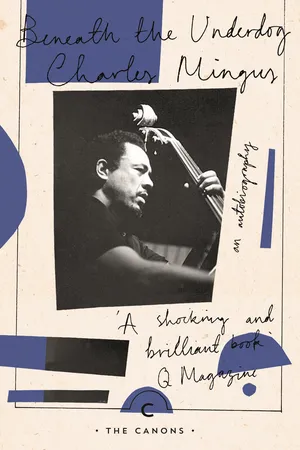
- 320 pages
- English
- ePUB (mobile friendly)
- Available on iOS & Android
eBook - ePub
Beneath The Underdog
About this book
Information
Subtopic
Music Biographies1
‘In other words I am three. One man stands forever in the middle, unconcerned, unmoved, watching, waiting to be allowed to express what he sees to the other two. The second man is like a frightened animal that attacks for fear of being attacked. Then there’s an over-loving gentle person who lets people into the uttermost sacred temple of his being and he’ll take insults and be trusting and sign contracts without reading them and get talked down to working cheap or for nothing, and when he realizes what’s been done to him he feels like killing and destroying everything around him including himself for being so stupid. But he can’t –he goes back inside himself.’
‘Which one is real?’
‘They’re all real.’
‘The man who watches and waits, the man who attacks because he’s afraid, and the man who wants to trust and love but retreats each time he finds himself betrayed. Mingus One, Two and Three. Which is the image you want the world to see?’
‘What do I care what the world sees, I’m only trying to find out how I should feel about myself. I can’t change the fact that they’re all against me – that they don’t want me to be a success.’
‘Who doesn’t?’
‘Agents and businessmen with big offices who tell me, a black man, that I’m abnormal for thinking we should have our share of the crop we produce. Musicians are as Jim-Crowed as any black motherfucker on the street and the ... the ... well, they want to keep it that way.’
‘Charles, I know who you mean by they, and that’s ironic. Because don’t you remember saying you came to me not only because I’m a psychologist but also because I’m a Jew? And therefore could relate to your problems?’
‘Haw haw! You’re funny, doctor.’
‘Ah, you’re crying again. Here, dry your eyes, Mingus, and don’t bullshit me.’
‘Haw! Now I got you cursing!’
‘You’ve got no exclusive on cursing. Don’t bullschitt me. You’re a good man, Charles, but there’s a lot of fabrication and fantasy in what you say. For instance, no man could have as much intercourse in one night as you claim to have had.’
‘The hell he couldn’t! Maybe I did exaggerate some things like the weight-lifting and all that ’cause I really don’t know how much those bar bells weighed but only two other guys could pick ’em up and their feet sank into the ground!’
‘You’re changing the subject, my friend. I was asking about the Mexican girls. Why are you obsessed with proving you’re a man? Is it because you cry?’
‘I am more of a man than any dirty white cocksucker! I did fuck twenty-three girls in one night, including the boss’s wife! I didn’t dig it – I did it because I wanted to die and I hoped it would kill me. But on the way back from Mexico I still felt unsatisfied so I stopped and...’
‘Go on ... are you ashamed?’
‘Yes because it felt better when I did it to myself than with all those twenty-three dirty-ass whores. They don’t love men, they love money.’
‘How can you know what they love, Charles? Here. Dry your eyes.’
‘Schitt. Fuck it. Even you just dig money!’
‘Then don’t pay me.’
‘Oh, I dig your psychology! You know saying that makes me want to pay you double.’
‘Nope, I don’t want your money. You’re a sick man. When the time comes that you feel I’ve helped you, buy me a tie or something. And I won’t call you a prevaricator again. What matters is that you stop lying to yourself. Now, earlier you said you were a procurer. Tell me about it. How did you get into that?’
‘Why don’t you ever let me lie on the couch, doctor?’
‘You always choose the chair.’
‘I feel you don’t want me on the couch ’cause I’m coloured and your white patients might be bugged.’
‘Oh, Charles Mingus! You can lie on it, kick it, jump on it, get on it, get under it, turn it over, break it – and pay for it.’
‘Man, you’re crazy! I’m gonna save you.’
‘You’re not trained to save. I am.’
‘I can save you. Do you believe in God?’
‘Yes.’
‘As a bogie man?’
‘We’ll get around to that later. Back to the subject, your one-time ill-famed profession.’
‘Well, it’s true I tried to be a pimp, doctor, but I wasn’t really making it ’cause I didn’t enjoy the money the girls got me. I remember the first one I knew – Cindy. She had all this bread under her mattress. Bobo laughed at me ’cause I didn’t take it –he said I didn’t know how to keep a whore.’
‘If you didn’t want the money, what was it you wanted?’
‘Maybe just to see if I could do what the other pimps did.’
‘Why?’
‘That’s almost impossible to explain – how you feel when you’re a kid and the king pimps come back to the neighbourhood. They pose and twirl their watchchains and sport their new Cadillacs and Rollses and expensive tailored clothes. It was like the closest thing to one of our kind becoming president of the USA. When a young up-and-coming man reaches out to prove himself boss pimp, it’s making it. That’s what it meant where I come from – proving you’re a man.’
‘And when you proved it, what did you want?’
‘Just play music, that’s all.’
‘I’ve been reading about you in a magazine. You didn’t tell me you were such a famous musician.’
‘That don’t mean schitt. That’s a system those that own us use. They make us famous and give us names – the King of this, the Count of that, the Duke of what! We die broke anyhow – and sometimes I think I dig death more than I dig facing this white world.’
‘We’re making progress, Charles, but perhaps we’ve done enough for today.’
‘I wanted to tell you about Fats – I dreamed about him again last night.’
‘Fine. Keep it on ice till next time. Good-bye, Chazz.’
‘So long, doctor.’
2
Baby had just turned two, on 22 April 1924, out at 1621 East One Hundred and Eighth Street in the city of Watts in Los Angeles County in the State of California.
He was done for – his head split wide open on the corner of a Goodwill-store old-fashioned second-hand-me-down white-folks’ bedroom-set dresser. I hadn’t realized how important the little fellow was. Everybody got so upset. I found myself outside him for the first time since he was born, standing beside him with Mama and his older sisters, Grace and Vivian. Grace was screaming, ‘Baby’s dead! Baby’s dead! Oh, Lord Jesus! My baby brother’s gone!’
Here comes Daddy! He’s looking down at poor, unconscious Baby. Everything will be all right now. But even Daddy cries out, ‘Oh my God, he’s dying! Mama, get some ice, fold it in a clean cloth, wrap him up good, hold his head up high so he won’t bleed no faster, we gotta get him to the hospital! Pray, Vivian! Grace! Mama! All of us gotta pray! Oh Lord, save my boy!’
Daddy drove the Chevrolet sedan as fast as he could to the clinic at One Hundred and Third Street in downtown Watts. On the way, they all prayed and cried and pleaded with God to please save Baby. Nurse took one look and rushed him to the operating room. ‘I’ll do my best, Mr and Mrs Mingus,’ the doctor said, ‘but he’s going fast.’
‘God help us! Oh Lord, not now!’
But though they had so much faith in this guy named God, Baby wouldn’t respond. I decided to go back inside and take over until he could get himself together. No one seemed to notice as I climbed up on the white table where Baby was laid out and materialized myself into the big hole over his left eye. Just to console everybody, I breathed deep and exhaled and Baby let out his first scream since early that morning when Grace had tickled his stomach till it hurt.
The doctor took the bows and credit. ‘Don’t worry, a week or so and he’ll be as good as new. He’s lost a lot of blood and we’ll need X-rays, of course, there may be a fracture or concussion. Come back in the morning.’
I started to leave again when the family did but Baby had hold of me now and was hanging on for dear life, so I stayed with him and I’ve been with him ever since.
Baby was so little, but big-jointed, with oversized shoulders and hips. Pigeon-toed and bow-legged, running and playing all day, he was the boy they’d longed for in the family. He’d have his tantrums, falls, thrills – Sunday wading in the tides at Santa Monica, carefully watched, yelled at not to go out too far. The big picnic basket on the grass, the cold chicken a little sandy and tasting so much better than at home. He had a few toys, liked water bugs, and kept ants in bottles. And all – not some but all – of the pretty little girls he saw he loved instantly.
Yet I felt sorry for the little fellow. They all loved him, they said, but they loved him like a puppy. He was becoming a person and no one took notice. They’d poke at him and say, ‘What cute dimples!’ He’d blush browner and feel frustrated that he couldn’t ask serious questions because he didn’t know how to talk yet. Still, he was so well protected from the world at large that if he was left alone one second outside his big backyard fence he was completely befuddled.
One day I saw that Baby had a brain. One of the neighbours, a cranky old night-watchman named Mr Davis, had often complained about Baby’s beloved dog Buster sniffing round his terrier bitch. One terrible day Mr Davis called across the fence to Mama and said, ‘Your dog just got run over! Better come and get him.’ I was proud of my boy. He had seen Daddy shoot birds out of the sky with his rifle and somehow he knew, he knew, that Mr Davis had shot Buster. He was enraged – he wanted to get Daddy’s rifle and kill Mr Davis’s she-dog! But I calmed him and told him to remain silent and that when Daddy came home somehow justice would be done. So Baby waited to see if Daddy would take his rifle and go shoot Mr Davis. But Daddy didn’t even seem to notice the bullet hole in poor Buster’s neck. He dug a nice grave in the backyard and Baby put flowers on it and that was the last of his little dirty white male poodle. Baby cried, but Daddy only said, ‘Son, God will take care of it all.’
Hear that name ‘God’ again, Baby? Oh, yes. Baby silently prayed that God would handle Mr Davis in some drastic way. But Baby grew bigger and older and nothing happened to Mr Davis, nothing at all – except he seemed to become aware of the hatred and contempt Baby felt and he began to watch my boy resentfully and never missed a chance to wisecrack about his being so big and clumsy and dumb. My boy said nothing but often while he practised his music four or five hours a day he thought about Mr Davis. Much later when he was fourteen and reading a book in the library about a man named Sigmund Freud, he wondered if Freud had known a Mr Davis in his childhood.
My boy was four years old and he felt pretty strange on his first day of school, clinging to Mama’s hand, trotting along on his bow-legs, stumbling over his pigeon-toes, headed for the principal’s office. Here went a brown baby with complexes, off to kindergarten to develop more. The kids all laughed as they passed and he didn’t know if it was at him or his mother, who had taken off her work clothes and put on her Sunday go-to-meetin’s for this occasion. He had overheard Daddy saying, ‘Take that damned snuff out of your mouth! And don’t dress so damn sloppy. You ain’t fit for a pig to come home to!’ It had to be true, Daddy was next to God and even sometimes told God what to do: ‘God damn it!’ he’d say when he got good and angry.
Weekdays Mama ploughed the back yard, planted the corn, tomatoes, string beans and onions, cleaned the chicken pens that held over a hundred hens and roosters, gathered eggs, mended the fence, cut and watered the grass, scrubbed and mopped the house, cooked and washed dishes, patched the children’s clothes, made the girls’ dresses and covered their ungodly asses with big black bloomers gathered with elastic just above the knee.
Were these strange little people really laughing at his mother? He thought she looked beautiful. He was confused by the yelling and fighting and screaming all round him but he hung on to her and didn’t cry.
Mrs Corick, the big fat white lady principal was less than five feet tall and wore a short, neat little dress that flowered out to expose her legs, shaped like oversize country-fair blue-ribbon hams. She had bosoms like two strapped-down white winter melons. She looked bigger than a cow! Her face was fat like Santa’s, bursting with joy, and she blushed continuously for no apparent reason. My boy wondered if she was rosy all over.
So Charles had entered school and his problems with the outside world began. I wanted him to know that he was not alone, that I was with him for a lifetime, so after this day I tried harder to communicate with him. It seemed difficult – maybe I had waited too long and he’d already developed a thinking pattern of his own.
One day he stole. He’d eaten his lunch on the way to school and at recess he went to the cloakroom and I saw him eating a sandwich that wasn’t his. At noon another little kid began to cry and I looked closely at Charles’s guilty face. I scolded him for that, and he heard. He promised he’d never take anything again as long as he lived.
It was about this time he heard himself called a strange name. Playing in the sandbox he was pouring nice hot sand down inside his pants because it felt so good. He was yanked from the box by a teacher. ‘SEX PERVERT!’ she said. He didn’t know what it meant but he soon heard more on the subject. The little girl was Beulah Clemmons and Charles hadn’t even noticed her that day, let alone looked up her dress. Besides, at home he’d seen his sisters in the bathtub and what could Beulah have under her dress different from Grace and Vivian? He was sitting on a bench at lunchtime, peeking around a...
Table of contents
- Cover
- Title Page
- Copyright
- Table of Contents
- Acknowledgements
- Introduction
- Chapter One
- Chapter Two
- Chapter Three
- Chapter Four
- Chapter Five
- Chapter Six
- Chapter Seven
- Chapter Eight
- Chapter Nine
- Chapter Ten
- Chapter Eleven
- Chapter Twelve
- Chapter Thirteen
- Chapter Fourteen
- Chapter Fifteen
- Chapter Sixteen
- Chapter Seventeen
- Chapter Eighteen
- Chapter Nineteen
- Chapter Twenty
- Chapter Twenty-One
- Chapter Twenty-Two
- Chapter Twenty-Three
- Chapter Twenty-Four
- Chapter Twenty-Five
- Chapter Twenty-Six
- Chapter Twenty-Seven
- Chapter Twenty-Eight
- Chapter Twenty-Nine
- Chapter Thirty
- Chapter Thirty-One
- Chapter Thirty-Two
- Chapter Thirty-Three
- Chapter Thirty-Four
- Chapter Thirty-Five
- Chapter Thirty-Six
- Chapter Thirty-Seven
- Chapter Thirty-Eight
- Chapter Thirty-Nine
Trusted by 375,005 students
Access to over 1.5 million titles for a fair monthly price.
Study more efficiently using our study tools.
Frequently asked questions
Yes, you can cancel anytime from the Subscription tab in your account settings on the Perlego website. Your subscription will stay active until the end of your current billing period. Learn how to cancel your subscription
No, books cannot be downloaded as external files, such as PDFs, for use outside of Perlego. However, you can download books within the Perlego app for offline reading on mobile or tablet. Learn how to download books offline
Perlego offers two plans: Essential and Complete
- Essential is ideal for learners and professionals who enjoy exploring a wide range of subjects. Access the Essential Library with 800,000+ trusted titles and best-sellers across business, personal growth, and the humanities. Includes unlimited reading time and Standard Read Aloud voice.
- Complete: Perfect for advanced learners and researchers needing full, unrestricted access. Unlock 1.5M+ books across hundreds of subjects, including academic and specialized titles. The Complete Plan also includes advanced features like Premium Read Aloud and Research Assistant.
We are an online textbook subscription service, where you can get access to an entire online library for less than the price of a single book per month. With over 1.5 million books across 990+ topics, we’ve got you covered! Learn about our mission
Look out for the read-aloud symbol on your next book to see if you can listen to it. The read-aloud tool reads text aloud for you, highlighting the text as it is being read. You can pause it, speed it up and slow it down. Learn more about Read Aloud
Yes! You can use the Perlego app on both iOS and Android devices to read anytime, anywhere — even offline. Perfect for commutes or when you’re on the go.
Please note we cannot support devices running on iOS 13 and Android 7 or earlier. Learn more about using the app
Please note we cannot support devices running on iOS 13 and Android 7 or earlier. Learn more about using the app
Yes, you can access Beneath The Underdog by Charles Mingus in PDF and/or ePUB format, as well as other popular books in Media & Performing Arts & Music Biographies. We have over 1.5 million books available in our catalogue for you to explore.