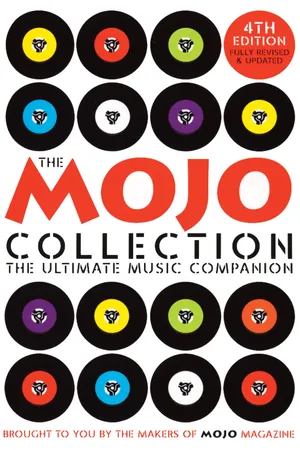
Organised chronologically and spanning seven decades, The MOJO Collection presents an authoritative and engaging guide to the history of the pop album via hundreds of long-playing masterpieces, from the much-loved to the little known.
From The Beatles to The Verve, from Duke Ellington to King Tubby and from Peggy Lee to Sly Stone, hundreds of albums are covered in detail with chart histories, full track and personnel listings and further listening suggestions. There's also exhaustive coverage of the soundtrack and hit collections that every home should have.
Like all collections, there are records you listen to constantly, albums you've forgotten, albums you hardly play, albums you love guiltily and albums you thought you were alone in treasuring, proving The MOJO Collection to be an essential purchase for those who love and live music
- 1,200 pages
- English
- ePUB (mobile friendly)
- Available on iOS & Android
eBook - ePub
About this book
Information
Subtopic
MusicThe 1970s
Simon & Garfunkel
Bridge Over Troubled Water
A generation-defining, multi-platinum farewell to the ’60s.
By the time Simon & Garfunkel came to make Bridge Over Troubled Water, they were drifting apart. Art was preoccupied with his acting career and, consequently, Paul felt he was no longer pulling his weight.
‘It was a tough album to make,’ Garfunkel has admitted, ‘but tough is one of the words that leads to great results.’ That it still stands as their definitive statement is a measure of Simon’s tendency to shine brightest in adversity.
According to Simon, ‘I knew the minute I wrote, “Like a bridge over troubled water I will lay me down,” that I had a very clear image. The whole verse was set up to hit that melody line. With certain songs you just know it.’ Even so, he remembers the original demo as ‘a much less grandiose thing than the record. In fact, it wasn’t grandiose at all. It was a humble, little gospel hymn song with two verses and a simple guitar behind it.’ Embellished with a Spector-ish production and a staggering arrangement, it has since made its presence felt in virtually every poll of best-ever singles.
The Boxer emerges as another astonishing achievement and, in some ways, a more satisfying song than Bridge, with its rippling guitar soaring into the ‘lie-la-lie’ hook (written because Simon couldn’t think of any words) set against Roy Halee’s brilliantly engineered percussion effects (the signature explosive snare crack was recorded in an echoing CBS stairwell, one night when the building had been vacated), rising towards the haunting, primitive, synthesizer solo, climaxing with celestial strings and synth-bass drones before fading finally into Simon’s lonesome acoustic picking.
Fellow musicians were blown away. ‘It’s a great record,’ declared Sandy Denny, ‘fantastically produced.’ Some critics, however, were less perceptive. ‘Their music has gotten stale,’ opined Rolling Stone’s Gregg Mitchell. ‘Everything they play, someone else has played before.’ Joe Public disagreed. On February 21, 1970, the album entered the UK chart at Number 1, a position it held for a staggering 35 weeks, topping both UK and US charts. Ironically, just as the duo had split before their first hit Sounds Of Silence in 1965, by the time Bridge Over Troubled Water scooped six Grammys, on March 16, 1971, Paul Simon was a solo artist.
The Band
The Band
The definitive Americana classic.
A consistently high scorer in polls of the greatest albums of all time – especially amongst fellow musicians – The Band’s second album had the peculiar quality of sounding as if it had existed for decades, the very first time you heard it. This impression was partly due to the richly-textured arrangements, which employed mandolin, fiddle, accordion and various arcane wind instruments alongside the group’s basic instrumentation; partly to the distinctive vocal harmonies, whose soulful bluegrass intervals contravened the smooth West Coast close-harmony style of the times; and partly to the evocative lyrics, which seemed to traverse the entire course of American history in a dozen songs, relating events through the voices of ordinary working-class folk at work, rest, play and war.
Relocating to Los Angeles in February 1969 to record the songs they had been developing since their debut Music From Big Pink, the group rented Sammy Davis Jr’s house in the Hollywood Hills, living in the various suites and converting the pool house into a studio. When Capitol Records were a month late installing the recording equipment, the band used what Richard Manuel called ‘them high-school fat-girl diet pills’ to help them meet the tight schedule, though they still had to finish three songs back in New York. Levon Helm found a set of drums with wooden rims in a Hollywood pawnshop – ‘old-fashioned instruments, but they read well on the microphones’ – which added their own distinctive flavour to the album, and Garth Hudson was as diligent as ever in his search for the appropriate sound, frequently staying late ‘sweetening’ the tracks with extra layers of horns, keyboards, ‘whatever was needed to make that music sing’.
Flashy solos were a rarity, each instrumental part being sublimated to a song’s overall feel. They made an even bigger break with the era’s virtuosic tendencies by swapping instruments around amongst themselves and making a virtue of their limitations. Rag Mama Rag – a Top 20 UK hit in 1970 – featured the drummer playing mandolin, the pianist playing drums, the bassist playing fiddle, the organist playing piano and co-producer John Simon playing tuba (for the first time in his life!). Rarely has an album been greeted with quite as much acclaim as The Band, as critics marvelled at its musical depth and range of styles, with the Village Voice claiming it was ‘beyond anything in rock except some of The Beatles’ best work.’
Syd Barrett
The Madcap Laughs
Pink Floyd’s usurped front-man makes his first solo album. Somehow.
Listening to The Madcap Laughs is like watching a man fooling around on a cliff-edge. Evidence of Barrett’s original musical genius and exquisite painterly lyricism (‘Pussy willow that smiled on this leaf’) is shaded by evidence of his impending mental collapse (‘My head touched the ground/I was half the way down’). This makes for some distinctly uneasy, at times voyeuristic, listening.
The album was painstakingly put together in three stages. Floyd manager Peter Jenner produced the first sessions between May and July 1968, which were largely fruitless. Silas Lang, Swan Lee and Lanky weren’t pursued further, Clowns And Jugglers became Octopus, a wonderfully off-kilter attempt to emulate Green Grow The Rushes O. Syd frittered away the next few months, occasionally turning up unannounced backstage at Top Of The Pops, where he liked to hang out. Finally Harvest’s head Malcolm Jones appointed himself producer in April 1969 and drafted in Soft Machine to help out on No Good Trying, but Syd was beginning to lose his grip. ‘Every time he played a tune through, the bars before the chord change were different,’ says Soft Machine’s keyboard player Mike Ratledge. ‘You had to watch his hands. It was the only way you could follow what was going on.’
Exasperated, Jones asked Dave Gilmour and Roger Waters to help out in June 1969. They finished the album in a matter of days. The haste of those sessions is exemplified by the sequence of She Took A Long Cold Look, Feel and If It’s In You which include Syd’...
Table of contents
- Cover
- Title Page
- Table of Contents
- The Album Is Dead!? Long Live The Album!
- What Have We Here?
- The Beginning
- The 1950s
- The 1960s
- The 1970s
- The 1980s
- The 1990s
- The 2000s
- Mojo Miscellaneous
- The Easy Life
- The Single Life
- 100 Great Soundtracks
- The Best Of The Best Ofs
- Index
- Acknowledgements
- Copyright
Trusted by 375,005 students
Access to over 1.5 million titles for a fair monthly price.
Study more efficiently using our study tools.
Frequently asked questions
Yes, you can cancel anytime from the Subscription tab in your account settings on the Perlego website. Your subscription will stay active until the end of your current billing period. Learn how to cancel your subscription
No, books cannot be downloaded as external files, such as PDFs, for use outside of Perlego. However, you can download books within the Perlego app for offline reading on mobile or tablet. Learn how to download books offline
We are an online textbook subscription service, where you can get access to an entire online library for less than the price of a single book per month. With over 1.5 million books across 990+ topics, we’ve got you covered! Learn about our mission
Look out for the read-aloud symbol on your next book to see if you can listen to it. The read-aloud tool reads text aloud for you, highlighting the text as it is being read. You can pause it, speed it up and slow it down. Learn more about Read Aloud
Yes! You can use the Perlego app on both iOS and Android devices to read anytime, anywhere — even offline. Perfect for commutes or when you’re on the go.
Please note we cannot support devices running on iOS 13 and Android 7 or earlier. Learn more about using the app
Please note we cannot support devices running on iOS 13 and Android 7 or earlier. Learn more about using the app
Yes, you can access The Mojo Collection by Various Mojo Magazine,Jim Irvin in PDF and/or ePUB format, as well as other popular books in Media & Performing Arts & Music. We have over 1.5 million books available in our catalogue for you to explore.