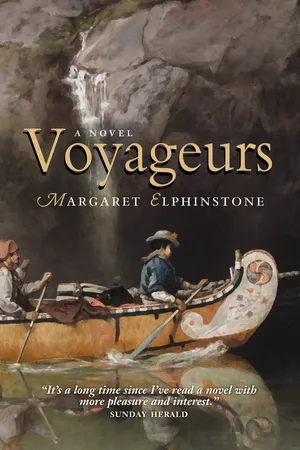
In the early 1800s, Rachel Greenhow, a young Quaker, goes missing in the Canadian wilderness. Unable to accept the disappearance, her brother Mark leaves his farm in England, determined to bring his sister home.
What follows is a gripping account of Mark's odyssey and his travels with the voyageurs - the men who canoe Canada's fur-trade route.
As adventure and discovery propel the plot forward, Elphinstone takes the reader back in time and intertwines the story with enduring themes of love, war and family ties.
- 480 pages
- English
- ePUB (mobile friendly)
- Available on iOS & Android
eBook - ePub
Voyageurs
About this book
Information
CHAPTER 1

Sixth Month, 1839
WHERE TO BEGIN? WHEN I LOOK AT THAT FIRST LETTER now, the paper is soft with much folding, and the ink is beginning to turn brown. Aunt Judith has crossed her lines, and her script betrays signs of the moiderment under which she laboured. It is no matter; I have her words by heart, almost, and it is the work of a few moments to transcribe them:
From the house of Thomas Nolan
Ste Marie du Sault
Upper Canada
12th day of Ninth Month, 1809
To my sister Susan at Highside, Mungrisdale, in Cumberland,
This follows within a week of my last letter to thee, my dear sister, and if God wills it the ill news will overtake the good. Little did I think, when I described to thee our voyage from Niagara to York, and thence by the far-flung Quaker Meetings of Upper Canada to the Lake called Huron, where we visited several Indian villages upon the islands, and thence to this far outpost at the rapids of St Mary’s, that I should have such terrible news to communicate to thee.
I told thee in my last how the lad got off the sloop, and how when Rachel saved him the Scotchman stopped the fight and got her safe away to the house of a man called Ermatinger until the hue and cry died down, and how he saw us safe back across the river. Would that that were all the story! Oh, my dear sister, what am I to say to thee? She has been so tender a companion, she seemed so clear in the Light, so zealous in our ministry.
Susan, I did not know she was meeting him. He came to our third meeting, and I thought the Truth had reached him. I knew nothing of the gatherings at the Johnston house. I knew there was dancing and singing, for we heard it even at the Nolans’ when we lay in our beds at night, but I knew not that our very own ewe lamb was led astray into the wilderness, beguiled by that wolf in sheep’s clothing.
What can I say to thee? She left me a note, with her direction. They have gone south into the Michigan Territory, which is a part of the United States, in name anyway, for it is far beyond the settled frontier, peopled only by military outposts, trading stations and savage Indian tribes. The direction she gives is: La Maison de Madame Framboise, Mackinac Island, the Michigan Territory. She says she will be married before a priest at Mackinac. She says it is not possible that we should understand. I do not feel called upon to follow her.
In Peace and with much sorrow,
Thy loving sister, Judith Scott
It was I that fetched this letter from the receiving office in Keswick, and brought it home to my mother. My heart leapt when the clerk passed me the letter, for we had heard nothing of our travellers for almost a year. (The letter Judith mentions had never reached us, and we had no notion what she meant by the lad from the sloop, and it was the first we had heard of the Scotchman altogether.) My mother was chopping rhubarb at the kitchen table when I came in, and I remember how she slit the wafer open with the sticky knife, not even pausing to wipe it. Her hands were trembling. A year is a long time, and one cannot help but fear for those called upon to minister in the wilderness.
When our first grief was spent, I wrote to Rachel more than once, but there was never any reply. She was indeed lost to us. About three months after Judith’s first letter came, she sent another, enclosing a copy of the Minute that recorded my sister’s disownment from our Religious Society. Judith says,
Friends here have asked me to send thee this copy of the Minute from our Monthly Meeting here at Yonge Street, disowning thy daughter, my beloved niece Rachel, no longer in unity with us since she was married with a priest, contrary to the rules of our Religious Society, to the Scotchman named Alan Mackenzie, an employee of the North West Company. Thee would know, if thee was familiar with these parts, that the North West enjoys a monopoly of the fur trade from here almost, so I believe, to the Pacific shore, to the detriment of all sober independent traders. Its clerks, like its owners, are mostly Highland Scotchmen, and notorious for their ungodly manner of life. It is more usual, indeed, for them to take women among the Indians, in the heathen fashion, and not to be doing with any kind of marriage at all. How it was that Rachel should have been persuaded to elope by this young man I could not have conceived, had I not met him. But – and perhaps this will be some small comfort to thee in thy distress – I did meet him, on the occasion of the brawl that was fought on the jetty at the Soo, when Rachel … but I recounted that incident in my last, and would not have thee pay an extra sixpence for me to repeat myself (assuming that my first letter did reach thee). His conduct on that occasion perhaps explains the predilection shown by Rachel for his society, and indeed I was not myself unmoved by his kind goodwill towards us, although I cannot condone the violent means he used to scatter our adversaries.
There was little comfort in this, but my parents bore all courageously. Only sometimes my mother would say, ‘But why does Rachel not write to us, Mark? Why can she not write?’ I had no answer to give. We prayed for Rachel every day, and gradually I stopped looking eagerly for a letter every time I went to the Receiving Office in Keswick.
But when the third letter from Aunt Judith came more than a year later, I realised when I read it that I had been living in hope after all. I have that letter before me now:
In the care of Yonge Street Meeting
Beman’s Corners
Province of Upper Canada
21st day of Eleventh Month, 1810
To my sister Susan at Highside, Mungrisdale (and my good-brother Caleb Greenhow),
I had thought the letter I had writ thee in eighth month of last year would be the hardest it were ever my ill-fortune to pen. I have not heard from thee again, so cannot even be sure that thee received my last. But – Oh, my poor Susan – the news I have now to relate is infinitely worse than the blow I had to inflict upon thee a twelvemonth since. Our dear daughter was lost to us then, out of unity with us by her own act. But at least we might hope she would find a measure of worldly happiness with the man she had chosen, even though she had cast off her family and her Religious Society, indeed, all that she had ever had, to place herself at his side. But now a circumstance has occurred more appalling than anything we might have conceived of. I enclose the young man’s letter to me.
She is lost, Susan! She has vanished beyond the pale of the known world! And yet she lives, perhaps. We cannot know. I can tell thee no more than Alan Mackenzie’s letter tells me. Here it is, for what it is worth.
My heart goes out to thee, my dear sister (and to my good brother too). I pray for thee, and remember thee among our Friends in the Meeting here in Yonge Street. If there be any thing I may do to comfort thee, tell me of it, but indeed I know there is nothing. We all mourn her. She was much loved, thee knows, among all the Friends whom we visited. Her ministry was a comfort and a shining light to many. If her fall was great, we must not let it obscure the truth of her witness; she did much good. For myself, I mourn a beloved niece and a courageous travelling companion, one who in the greatest discomfort and adversity could yet make me smile. I miss her. And for thee, who have lost a cherished daughter, the loss is so much more. My thoughts are with thee, sister. I cannot say more, and indeed there is no more space on this sheet.
In Friendship and in Love,
Judith Scott
It must indeed have been a hard letter to write. Through the open window I hear the little beck that tumbles by our house; having heard it all my life I am seldom aware of it, but sometimes, as now, I am aware of it accompanying my thoughts, its moods changing as mine do.
Alan’s letter is quite unlike Judith’s. Alan’s letters, even under the duress of emotion, are always inscribed in the fairest copperplate – he was a clerk, one must remember, as well as an adventurer – and sometimes (though not, of course, on this occasion) illustrated by neat little pen sketches of such subjects as particularly take his fancy. When I first laid eyes on this letter, I knew nothing of Alan. It seemed to me a cruel letter, and the lovely writing was like a twist of the knife in the wound, that he should be so collected about what he had to say. I hated him – if that be a sin let me confess it – which all goes to show how wrong an impression a scrap of writing can give. It tells thee what thee must know, but there is no reaching the living man through the dead words on the paper. I read Alan’s letter when it arrived enclosed in Judith’s – in fact it was my task to read it to my parents, and I relished it not – and I learned nothing of Alan in it. I saw a cold man of words who had not even loved my sister, which, if he had done, might begin to excuse what he had done to her.
Alan’s letter has travelled further than Judith’s. At one time it has got damp. The paper is very soft and like to tear at a touch. I smooth it out very gently. Outside the shower has passed and the spring sun illuminates the page. I glance up, and the grey mist has gone from Grasmoor. The hills look very near. I read Alan’s letter to my Aunt Judith once again.
Montreal Michilimackinac Company
Mackinac Island
October 30th, 1810
Dear Mrs Scott,
It is with a sad heart I write. Although I ran away with your niece Rachel it was done with the best will in the world. I loved her, and I would have married her before you all, if your absurd rules had not forbidden it. There was nothing underhand in what we did. I told you that before.
Rachel had a child, but he was born dead. She was not the same after: quite mazed, in fact, so far away in her unhappiness I could not comfort her. We had been trading in the country of the Ottawa, and were on our way north by the lake Michigan. We camped on the south island of Manitou. She wandered off at twilight; it was the way she was at that time. There was no reaching her.
She did not come back. Not that night, nor the next, nor the one after that. It is a big island, but we searched it as well as we could. There were some Indians preparing to leave their summer village and go back to the mainland. They did not have her, I know that, and they helped us to search. There had been no one else ashore so far as I know. People come and go in the summer. There’s no way to tell.
We stayed for her as long as we could. Winter was coming, and I could not have kept my voyageurs there any longer. If she were still in the woods she must have perished with cold and hunger by the time we left, but we searched and searched, and I am sure she was not there.
Either she went into the lake herself – she was very unhappy. She was not like herself at all after the child died. It was like living with a stranger – or she was taken. That is all I know. I am very sorry, Mrs Scott, to have to tell you this. We left the island four days ago, and came back into Mackinac last night.
No doubt you will tell her family in England. I know she has a brother, she spoke of him a great deal in our early days – no matter, I am out of your life now.
Alan Mackenzie
The first time I read that letter in this house, my father put his head down on his arms and grat, and my mother with set face said to me, ‘Let me see the man’s letter.’
I handed her Alan’s letter, and looked awkwardly away from my father. I loved him well, but I had never seen him weep, and I did not know what to do other than to ignore it.
‘He says he loved her,’ my mother said presently. ‘Does thee think that what he writes is the truth?’
‘That he loved her?’
‘Any of it. I know not.’ My mother turned away, and drew her arm across her face. ‘It is the not knowing. Caleb, how do we bear not knowing?’
I took Alan’s letter back, and her control broke. She stretched out both her arms to my father, ‘Caleb, Caleb …’
I stepped outside and shut the door upon them. They could comfort one another better than I could, I supposed. There was still a little slairy snow lying in a corner of the garth, and the chickens huddled against the barn door out of the teeth of the wind. I went into the barn and sat down on the edge of the hay where we’d been taking out the winter fodder. I read Judith’s letter again, and then Alan’s letter, twice. I thought about what my mother said, about not knowing, not ever knowing. I sat and thought so long that a little mouse went back to scuttering in and out over the stone doorstep carrying grains from the floor to her hole behind the haystack. At last a gust of wind sent the barn door banging back against the wall. I roused myself, and realised I was freezing where I sat. But I had thought out what I must do.
My parents were still in the kitchen. My father sat in his place at the head of the table, and my mother, red-eyed but composed, was laying out porridge bowls and bread and cheese for the evening meal. When my father saw me he held out his hand to me. I took it, and said to him, so my mother could hear too...
Table of contents
- Cover
- Title Page
- Dedication
- Contents
- Editor’s preface
- Chapter One
- Chapter Two
- Chapter Three
- Chapter Four
- Chapter Five
- Chapter Six
- Chapter Seven
- Chapter Eight
- Chapter Nine
- Chapter Ten
- Chapter Eleven
- Chapter Twelve
- Chapter Thirteen
- Chapter Fourteen
- Chapter Fifteen
- Chapter Sixteen
- Chapter Seventeen
- Chapter Eighteen
- Chapter Nineteen
- Chapter Twenty
- Chapter Twenty One
- Chapter Twenty Two
- Chapter Twenty Three
- Chapter Twenty Four
- Chapter Twenty Five
- Chapter Twenty Six
- Chapter Twenty Seven
- Editor’s afterword
- Acknowledgements
- About the Author
- Also by Margaret Elphinstone
- Copyright
Trusted by 375,005 students
Access to over 1.5 million titles for a fair monthly price.
Study more efficiently using our study tools.
Frequently asked questions
Yes, you can cancel anytime from the Subscription tab in your account settings on the Perlego website. Your subscription will stay active until the end of your current billing period. Learn how to cancel your subscription
No, books cannot be downloaded as external files, such as PDFs, for use outside of Perlego. However, you can download books within the Perlego app for offline reading on mobile or tablet. Learn how to download books offline
Perlego offers two plans: Essential and Complete
- Essential is ideal for learners and professionals who enjoy exploring a wide range of subjects. Access the Essential Library with 800,000+ trusted titles and best-sellers across business, personal growth, and the humanities. Includes unlimited reading time and Standard Read Aloud voice.
- Complete: Perfect for advanced learners and researchers needing full, unrestricted access. Unlock 1.5M+ books across hundreds of subjects, including academic and specialized titles. The Complete Plan also includes advanced features like Premium Read Aloud and Research Assistant.
We are an online textbook subscription service, where you can get access to an entire online library for less than the price of a single book per month. With over 1.5 million books across 990+ topics, we’ve got you covered! Learn about our mission
Look out for the read-aloud symbol on your next book to see if you can listen to it. The read-aloud tool reads text aloud for you, highlighting the text as it is being read. You can pause it, speed it up and slow it down. Learn more about Read Aloud
Yes! You can use the Perlego app on both iOS and Android devices to read anytime, anywhere — even offline. Perfect for commutes or when you’re on the go.
Please note we cannot support devices running on iOS 13 and Android 7 or earlier. Learn more about using the app
Please note we cannot support devices running on iOS 13 and Android 7 or earlier. Learn more about using the app
Yes, you can access Voyageurs by Margaret Elphinstone in PDF and/or ePUB format, as well as other popular books in Literature & English Literature. We have over 1.5 million books available in our catalogue for you to explore.