- 48 pages
- English
- ePUB (mobile friendly)
- Available on iOS & Android
eBook - ePub
The Epistle of Paul the Apostle to The Romans
About this book
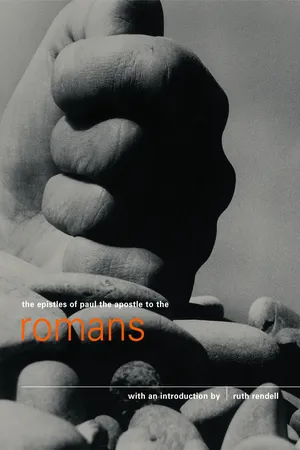
Paul was the most influential figure in the early Christian church. In this epistle, written to the founders of the church in Rome, he sets out some of his ideas on the importance of faith in overcoming mankind's innate sinfulness and in obtaining redemption. With an introduction by Ruth Rendell.
Information
Topic
Teología y religiónSubtopic
Bibliasintroduction by ruth rendell
Ruth Rendell is the author of more than forty novels, among them the Inspector Wexford series, and six volumes of short stories. She also writes under the pseudonym Barbara Vine. Many of her books have been adapted for television and feature films based on her work have been made by Claude Chabrol and Pedro Almodovar. She has received numerous fiction prizes, including the Arts Council’s National Book Award for Genre Fiction, four Gold Daggers from the Crime Writers’ Association, the Edgar Allan Poe Award and the Angel Award for Fiction. Ruth Rendell received a CBE in 1996 and in the following year was made a Life Peer. Her latest novel is A Sight for Sore Eyes.
The Road to Damascus is a phrase which has entered our language and our literature, becoming a metaphor for the sort of life-changing experience which strikes with suddenness and leaves its object transformed. It first happened to Paul the Apostle whose course of life, beliefs and objectives were all overturned by what happened to him on that actual road to that actual city.
He is believed to have been born in Tarsus, now part of Turkey, and was a Roman Citizen, a useful status which conferred certain judicial privileges, including that of appellatio, appeal to Caesar himself. He spoke Greek as his mother tongue, but in his letters he refers to his Jewishness – he had been a rabbinical student. Yet by profession he was a tentmaker, a trade somewhat frowned upon by strict Judaic orthodoxy. It will be seen that there were inconsistencies in his early life which modern scholars cannot account for and mysteries they cannot solve.
What is beyond doubt is that he was initially at the forefront of those who persecuted the Christians of Jerusalem. He might have been a temple guard and may possibly have been present at the arrest and crucifixion of Jesus. Certain it is that he played a significant part in the stoning of Stephen, a devout and active Christian. Stephen died and Paul ‘made havoc of the [Christian] church, and entering every house and haling men and women, committed them to prison’ (Acts 8:3). He asked the high priest for letters to the synagogues of Damascus, there to root out trouble-makers and bring them back as prisoners to Jerusalem. It was on this journey that the event took place which so immediately and entirely converted him.
Here, at one moment, we have a rabid oppressor and man of violence, ‘breathing out threatenings and slaughter against the disciples of the Lord’ (Acts 9:1), at the next the most obedient and devout of those disciples and an undoubted founder of the Christian religion. It is rather as if a camp guard suddenly became merciful to the inmates of Auschwitz and survived to become a great philosopher.
What happened to Paul on his Road to Damascus? Was he an epileptic, as some say, and this his first seizure? Had he been overworking and become, as we might put it today, ‘stressed-out’? Or did he really hear the bidding of God? Acts says and he says himself that he saw a bright light and fell down, heard a voice call him by name and ask him, ‘Why persecutest thou me?’ (Acts 9:4) Paul inquired who this was and the voice replied he was Jesus and said, ‘It is hard for thee to kick against the pricks.’ The metaphor, of course, is that of the ass or ox kicking against the stings of the goad and the meaning that the speaker understood Saul’s difficulties and the promptings of his conscience. From that moment, Saul now called Paul, saw himself as appointed to bear Christ’s name ‘before the Gentiles, and kings, and the children of Israel’ (Acts 8:3).
He was somewhere between twenty and thirty years old, a small hook-nosed, bandy-legged man, humble and proud, brave and meek, the prisoner, as he joyfully (and sometimes with anguish) called himself, of Jesus Christ. Although he would have preferred everyone to be as he was, celibate and unencumbered by a family, he advocated marriage as ‘honourable to all’. After his conversion he became a missionary and he wrote his epistles, thus becoming one of the greatest letter-writers the world has ever known and propounding principles and precepts of a startling originality. Of these the letter he wrote to the Romans, meaning to the Christians or ‘church’ of Rome, is generally thought the finest and perhaps the only one of whose sole and consistent authorship we can be certain.
Paul wrote this letter while staying in Corinth, capital of the Greek province of Achaia, during the cold months of the year, very probably a winter in the late fifties AD. When it was finished he appointed a woman called Phebe to carry it to Rome. In the final chapter, he asks its recipients to receive Phebe in a way becoming to them and to give her whatever assistance she may ask for, thus somewhat weakening the arguments of those critics who down the ages have called him a misogynist and despiser of women. Phebe must have travelled to Rome by sea, bringing to the beleaguered servants of the Roman church a foundation document of the faith.
Only by reading Romans in the knowledge of the kind of world Paul lived in can his letter be more fully understood. The Roman dominance of the known world was one of the most oppressive tyrannies nations have ever lived under. A huge proportion of the population was enslaved and few Romans, if any, thought of slavery as wrong. Punishment for any offences in the area of sedition was draconian. The Emperor Claudius had expelled the Jews from Rome and in a few years’ time Titus was to sack Jerusalem, destroy the Temple and scatter the people of Israel. It was a superstitious world where sorcerers abounded, where signs and portents were part of everyday life, where cults of all kinds flourished, and where great religious ceremonies centred on blood sacrifice.
Today to believers, agnostics and atheists alike, crucifixion is a word both awesome and commonplace and one that brings to mind a single event: the execution of Jesus Christ. The sign of the cross is indicative of Christianity, and the idea of the cross is ineluctably bound up with Christ’s death. But if we think about that death at all, even the most indifferent to the faith it gave rise to, think of it as honourable, a unique martyrdom. Anyone who travelled the Roman Empire at that time would have seen crosses on which the dead or dying hung, comparable perhaps to roadside gallows bearing their decaying corpses in mediaeval Britain. And to everyone, including Paul himself, crucifixion was a disgraceful manner of death, so that it is all the more extraordinary that he could write as he does in his letter to the Galatians, ‘God forbid that I should glory save in the cross of our Lord Jesus Christ’ (Galatians 6:14).
But perhaps the most important fact readers of this letter should know before they begin it, is how early it appears in the scheme of writings which form the New Testament. Most assume, and understandably, that the Gospels come first, then the Acts of the Apostles and after that the Epistles of Paul. Thus, Paul would have been writing with the Gospels as his source material. But none of those books existed when he set down his knowledge and beliefs. The earliest of the Gospels, that of Mark, cannot have been composed much before 70 AD, and by that time Paul’s literary output was over and he was most probably dead. If readers today find a number of his precepts familiar, this is because they...
Table of contents
- The Epistle of Paul the Apostle to the Romans
- Title Page
- Table of Contents
- a note about pocket canons
- introduction by ruth rendell
- the epistle of paul the apostle to the romans
- 2
- 3
- 4
- 5
- 6
- 7
- 8
- 9
- 10
- 11
- 12
- 13
- 14
- 15
- 16
- Copyright
Trusted by 375,005 students
Access to over 1.5 million titles for a fair monthly price.
Study more efficiently using our study tools.
Frequently asked questions
Yes, you can cancel anytime from the Subscription tab in your account settings on the Perlego website. Your subscription will stay active until the end of your current billing period. Learn how to cancel your subscription
No, books cannot be downloaded as external files, such as PDFs, for use outside of Perlego. However, you can download books within the Perlego app for offline reading on mobile or tablet. Learn how to download books offline
Perlego offers two plans: Essential and Complete
- Essential is ideal for learners and professionals who enjoy exploring a wide range of subjects. Access the Essential Library with 800,000+ trusted titles and best-sellers across business, personal growth, and the humanities. Includes unlimited reading time and Standard Read Aloud voice.
- Complete: Perfect for advanced learners and researchers needing full, unrestricted access. Unlock 1.5M+ books across hundreds of subjects, including academic and specialized titles. The Complete Plan also includes advanced features like Premium Read Aloud and Research Assistant.
We are an online textbook subscription service, where you can get access to an entire online library for less than the price of a single book per month. With over 1.5 million books across 990+ topics, we’ve got you covered! Learn about our mission
Look out for the read-aloud symbol on your next book to see if you can listen to it. The read-aloud tool reads text aloud for you, highlighting the text as it is being read. You can pause it, speed it up and slow it down. Learn more about Read Aloud
Yes! You can use the Perlego app on both iOS and Android devices to read anytime, anywhere — even offline. Perfect for commutes or when you’re on the go.
Please note we cannot support devices running on iOS 13 and Android 7 or earlier. Learn more about using the app
Please note we cannot support devices running on iOS 13 and Android 7 or earlier. Learn more about using the app
Yes, you can access The Epistle of Paul the Apostle to The Romans by Ruth Rendell in PDF and/or ePUB format, as well as other popular books in Teología y religión & Biblias. We have over 1.5 million books available in our catalogue for you to explore.