Is science the only path to knowledge?
In this sparkling and provocative book Jonah Lehrer, author of The Decisive Moment, explains that when it comes to understanding the brain, art got there first. Taking a group of celebrated writers, painters and composers, Lehrer shows us how artists have discovered truths about the human mind - real, tangible truths - that science is only now rediscovering.
We learn, for example, how Proust first revealed the fallibility of memory; how George Eliot understood the brain's malleable nature; how the French chef Escoffier intuited umami (the fifth taste); how Cézanne worked out the subtleties of vision; and how Virginia Woolf pierced the mysteries of consciousness. It's a riveting tale of art trumping science, again and again.
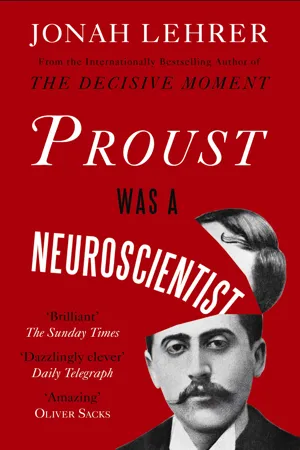
- 256 pages
- English
- ePUB (mobile friendly)
- Available on iOS & Android
eBook - ePub
Proust Was a Neuroscientist
About this book
Information
Chapter 1
Walt Whitman
The Substance of Feeling
The poet writes the history of his own body.
— Henry David Thoreau
FOR WALT WHITMAN, the Civil War was about the body. The crime of the Confederacy, Whitman believed, was treating blacks as nothing but flesh, selling them and buying them like pieces of meat. Whitman’s revelation, which he had for the first time at a New Orleans slave auction, was that body and mind are inseparable. To whip a man’s body was to whip a man’s soul.
This is Whitman’s central poetic idea. We do not have a body, we are a body. Although our feelings feel immaterial, they actually begin in the flesh. Whitman introduces his only book of poems, Leaves of Grass, by imbuing his skin with his spirit, “the aroma of my armpits finer than prayer”:
Was somebody asking to see the soul?
See, your own shape and countenance …
Behold, the body includes and is the meaning, the main
Concern, and includes and is the soul
Whitman’s fusion of body and soul was a revolutionary idea, as radical in concept as his free-verse form. At the time, scientists believed that our feelings came from the brain and that the body was just a lump of inert matter. But Whitman believed that our mind depended upon the flesh. He was determined to write poems about our “form complete.”
This is what makes his poetry so urgent: the attempt to wring “beauty out of sweat,” the metaphysical soul out of fat and skin. Instead of dividing the world into dualisms, as philosophers had done for centuries, Whitman saw everything as continuous with everything else. For him, the body and the soul, the profane and the profound, were only different names for the same thing. As Ralph Waldo Emerson, the Boston Transcendentalist, once declared, “Whitman is a remarkable mixture of the Bhagvat Ghita and the New York Herald.”
Whitman got this theory of bodily feelings from his investigations of himself. All Whitman wanted to do in Leaves of Grass was put “a person, a human being (myself, in the later half of the Nineteenth Century, in America) freely, fully and truly on record.” And so the poet turned himself into an empiricist, a lyricist of his own experience. As Whitman wrote in the preface to Leaves of Grass, “You shall stand by my side to look in the mirror with me.”
It was this method that led Whitman to see the soul and body as inextricably “interwetted.” He was the first poet to write poems in which the flesh was not a stranger. Instead, in Whitman’s unmetered form, the landscape of his body became the inspiration for his poetry. Every line he ever wrote ached with the urges of his anatomy, with its wise desires and inarticulate sympathies. Ashamed of nothing, Whitman left nothing out. “Your very flesh,” he promised his readers, “shall be a great poem.”
Neuroscience now knows that Whitman’s poetry spoke the truth: emotions are generated by the body. Ephemeral as they seem, our feelings are actually rooted in the movements of our muscles and the palpitations of our insides. Furthermore, these material feelings are an essential element of the thinking process. As the neuroscientist Antonio Damasio notes, “The mind is embodied … not just embrained.”
At the time, however, Whitman’s idea was seen as both erotic and audacious. His poetry was denounced as a “pornographic utterance,” and concerned citizens called for its censorship. Whitman enjoyed the controversy. Nothing pleased him more than dismantling prissy Victorian mores and inverting the known facts of science.
The story of the brain’s separation from the body begins with René Descartes. The most influential philosopher of the seventeenth century, Descartes divided being into two distinct substances: a holy soul and a mortal carcass. The soul was the source of reason, science, and everything nice. Our flesh, on the other hand, was “clock-like,” just a machine that bleeds. With this schism, Descartes condemned the body to a life of subservience, a power plant for the brain’s light bulbs.
In Whitman’s own time, the Cartesian impulse to worship the brain and ignore the body gave rise to the new “science” of phrenology. Begun by Franz Josef Gall at the start of the nineteenth century, phrenologists believed that the shape of the skull, its strange hills and hollows, accurately reflected the mind inside. By measuring the bumps of bone, these pseudoscientists hoped to measure the subject’s character by determining which areas of the brain were swollen with use and which were shriveled with neglect. Our cranial packaging revealed our insides; the rest of the body was irrelevant.
By the middle of the nineteenth century, the promise of phrenology seemed about to be fulfilled. Innumerable medical treatises, dense with technical illustrations, were written to defend its theories. Endless numbers of skulls were quantified. Twenty-seven different mental talents were uncovered. The first scientific theory of mind seemed destined to be the last.
But measurement is always imperfect, and explanations are easy to invent. Phrenology’s evidence, though amassed in a spirit of seriousness and sincerity, was actually a collection of accidental observations. (The brain is so complicated an organ that its fissures can justify almost any imaginative hypothesis, at least until a better hypothesis comes along.) For example, Gall located the trait of ideality in “the temporal ridge of the frontal bones” because busts of Homer revealed a swelling there and because poets when writing tend to touch that part of the head. This was his data.
Of course, phrenology strikes our modern sensibilities as woe-fully unscientific, like an astrology of the brain. It is hard to imagine its allure or comprehend how it endured for most of the nineteenth century.* Whitman used to quote Oliver Wendell Holmes on the subject: “You might as easily tell how much money is in a safe feeling the knob on the door as tell how much brain a man has by feeling the bumps on his head.” But knowledge emerges from the litter of our mistakes, and just as alchemy led to chemistry, so did the failure of phrenology lead science to study the brain itself and not just its calcified casing.
Whitman, a devoted student of the science of his day,† had a complicated relationship with phrenology. He called the first phrenology lecture he attended “the greatest conglomeration of pretension and absurdity it has ever been our lot to listen to…. We do not mean to assert that there is no truth whatsoever in phrenology, but we do say that its claims to confidence, as set forth by Mr. Fowler, are preposterous to the last degree.” More than a decade later, however, that same Mr. Fowler, of the publishing house Fowler and Wells in Manhattan, became the sole distributor of the first edition of Leaves of Grass. Whitman couldn’t find anyone else to publish his poems. And while Whitman seems to have moderated his views on the foolishness of phrenology — even going so far as to undergo a few phrenological exams himself* — his poetry stubbornly denied phrenology’s most basic premise. Like Descartes, phrenologists looked for the soul solely in the head, desperate to reduce the mind to its cranial causes. Whitman realized that such reductions were based on a stark error. By ignoring the subtleties of his body, these scientists could not possibly account for the subtleties of his soul. Like Leaves of Grass, which could only be understood in “its totality — its massings,” Whitman believed that his existence could be “comprehended at no time by its parts, at all times by its unity.” This is the moral of Whitman’s poetic sprawl: the human being is an irreducible whole. Body and soul are emulsified into each other. “To be in any form, what is that?” Whitman once asked. “Mine is no callous shell.”
Emerson
Whitman’s faith in the transcendental body was strongly influenced by the transcendentalism of Ralph Waldo Emerson. When Whitman was still a struggling journalist living in Brooklyn, Emerson was beginning to write his lectures on nature. A lapsed Unitarian preacher, Emerson was more interested in the mystery of his own mind than in the preachings of some aloof God. He disliked organized religion because it relegated the spiritual to a place in the sky instead of seeing the spirit among “the common, low and familiar.”
Without Emerson’s mysticism, it is hard to imagine Whitman’s poetry. “I was simmering, simmering, simmering,” Whitman once said, “and Emerson brought me to a boil.” From Emerson, Whitman learned to trust his own experience, searching himself for intimations of the profound. But if the magnificence of Emerson was his vagueness, his defense of Nature with a capital N, the magnificence of Whitman was his immediacy. All of Whitman’s songs began with himself, nature as embodied by his own body.

An engraving of Walt Whitman from July 1854. This imageserved as the frontispiece for the first edition of Leaves of Grass.
And while Whitman and Emerson shared a philosophy, they could not have been more different in person. Emerson looked like a Puritan minister, with abrupt cheekbones and a long, bony nose. A man of solitude, he was prone to bouts of selfless self-absorption. “I like the silent church before the service begins,” he confessed in “Self-Reliance.” He wrote in his journal that he liked man, but not men. When he wanted to think, he would take long walks by himself in the woods.
Whitman — “broad shouldered, rough-fleshed, Bacchus-browed, bearded like a satyr, and rank” — got his religion from Brooklyn, from its dusty streets and its cart drivers, its sea and its sailors, its mothers and its men. He was fascinated by people, these citizens of his sensual democracy. As his uncannily accurate phrenological exam put it,* “Leading traits of character appear to be Friendship, Sympathy, Sublimity and Self-Esteem, and markedly among his combinations the dangerous fault of Indolence, a tendency to the pleasure of Voluptuousness and Alimentiveness, and a certain reckless swing of animal will, too unmindful, probably, of the conviction of others.”
Whitman heard Emerson for the first time in 1842. Emerson was beginning his lecture tour, trying to promote his newly published Essays. Writing in the New York Aurora, Whitman called Emerson’s speech “one of the richest and most beautiful compositions” he had ever heard. Whitman was particularly entranced by Emerson’s plea for a new American poet, a versifier fit for democracy: “The poet stands among partial men for the complete man,” Emerson said. “He reattaches things to the whole.”
But Whitman wasn’t ready to become a poet. For the next decade, he continued to simmer, seeing New York as a journalist and as the editor of the Brooklyn Eagle and Freeman. He wrote articles about criminals and abolitionists, opera stars and the new Fulton ferry. When the Freeman folded, he traveled to New Orleans, where he saw slaves being sold on the auction block, “their bodies encased in metal chains.” He sailed up the Mississippi on a side-wheeler, and got a sense of the Western vastness, the way the “United States themselves are essentially the greatest poem.”
It was during these difficult years when Whitman was an unemployed reporter that he first began writing fragments of poetry, scribbling down quatrains and rhymes in his cheap notebooks. With no audience but himself, Whitman was free to experiment. While every other poet was still counting syllables, Whitman was writing lines that were messy montages of present participles, body parts, and erotic metaphors. He abandoned strict meter, for he wanted his form to reflect nature, to express thoughts “so alive that they have an architecture of their own.” As Emerson had insisted years before, “Doubt not, O poet, but persist. Say ‘It is in me, and shall out.’”
And so, as his country was slowly breaking apart, Whitman invented a new poetics, a form of inexplicable strangeness. A self-conscious “language-maker,” Whitman had no precursor. No other poet in the history of the English language prepared readers for Whitman’s eccentric cadences (“sheath’d hooded sharp-tooth’d touch”), his invented verbs (“unloosing,” “preluding,” “unreeling”), his love of long anatomical lists,* and his honest refusal to be anything but himself, syllables be damned. Even his bad poetry is bad in a completely original way, for Whitman only ever imitated himself.
And yet, for all its incomprehensible originality, Whitman’s verse also bears the scars of his time. His love of political unions and physical unity, the holding together of antimonies: these themes find their source in America’s inexorable slide into the Civil War. “My book and the war are one,” Whitman once said. His notebook breaks into free verse for the first time in lines that try to unite the decade’s irreconcilables, the antagonisms of North and South, master and slave, body and soul. Only in his poetry could Whitman find the whole he was so desperately looking for:
I am the poet of the body
And I am the poet of the soul
I go with the slaves of the earth equally with the masters
And I will stand betwee...
Table of contents
- Cover
- Title Page
- Dedication
- Contents
- epigraph
- Prelude
- 1. Walt Whitman The Substance of Feeling
- 2. George Eliot The Biology of Freedom
- 3. Auguste Escoffier The Essence of Taste
- 4. Marcel Proust The Method of Memory
- 5. Paul Cézanne The Process of Sight
- 6. Igor Stravinsky The Source of Music
- 7. Gertrude Stein The Structure of Language
- 8. Virginia Woolf The Emergent Self Coda
- Acknowledgments
- Notes
- Bibliography
- Index
- Also by Jonah Lehrer
- Copyright Page
Trusted by 375,005 students
Access to over 1.5 million titles for a fair monthly price.
Study more efficiently using our study tools.
Frequently asked questions
Yes, you can cancel anytime from the Subscription tab in your account settings on the Perlego website. Your subscription will stay active until the end of your current billing period. Learn how to cancel your subscription
No, books cannot be downloaded as external files, such as PDFs, for use outside of Perlego. However, you can download books within the Perlego app for offline reading on mobile or tablet. Learn how to download books offline
Perlego offers two plans: Essential and Complete
- Essential is ideal for learners and professionals who enjoy exploring a wide range of subjects. Access the Essential Library with 800,000+ trusted titles and best-sellers across business, personal growth, and the humanities. Includes unlimited reading time and Standard Read Aloud voice.
- Complete: Perfect for advanced learners and researchers needing full, unrestricted access. Unlock 1.5M+ books across hundreds of subjects, including academic and specialized titles. The Complete Plan also includes advanced features like Premium Read Aloud and Research Assistant.
We are an online textbook subscription service, where you can get access to an entire online library for less than the price of a single book per month. With over 1.5 million books across 990+ topics, we’ve got you covered! Learn about our mission
Look out for the read-aloud symbol on your next book to see if you can listen to it. The read-aloud tool reads text aloud for you, highlighting the text as it is being read. You can pause it, speed it up and slow it down. Learn more about Read Aloud
Yes! You can use the Perlego app on both iOS and Android devices to read anytime, anywhere — even offline. Perfect for commutes or when you’re on the go.
Please note we cannot support devices running on iOS 13 and Android 7 or earlier. Learn more about using the app
Please note we cannot support devices running on iOS 13 and Android 7 or earlier. Learn more about using the app
Yes, you can access Proust Was a Neuroscientist by Jonah Lehrer in PDF and/or ePUB format, as well as other popular books in Biological Sciences & Science General. We have over 1.5 million books available in our catalogue for you to explore.