This extraordinary work is at one and the same time an account of a personal spiritual crisis and a hilarious spoof on academic learning, early Victorian values and materialism. In Sartor Resartus ('the tailor retailored') a fictitious editor retells the theories of an equally fictitious German professor who has come to the conclusion that human institutions and morals are only clothes to shield us from nothingness, clothes that can be changed as the whims of the age or fashion dictate.
This radically deconstructive vision reveals the very highest symbols of belief for what they are - merely symbols. How to believe in anything after such an insight is a question even more acute today than it was in Carlyle's time, when he first asked it in this masterpiece of invention, parody and profound laughter.
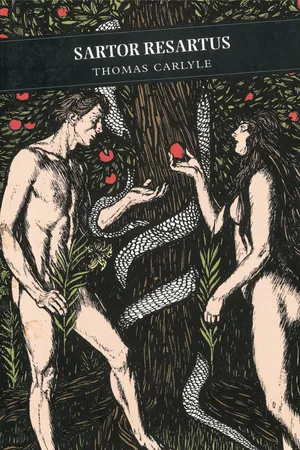
This Canongate Classics edition incorporates illustrations by Edmund Sullivan, reproduced as they appeared in the 1898 edition of the text. Also included is the notable Emerson preface to the original American edition and an incisive, specially commissioned introduction from Alasdair Gray.
- 360 pages
- English
- ePUB (mobile friendly)
- Available on iOS & Android
eBook - ePub
Sartor Resartus
About this book
Information
Book Two
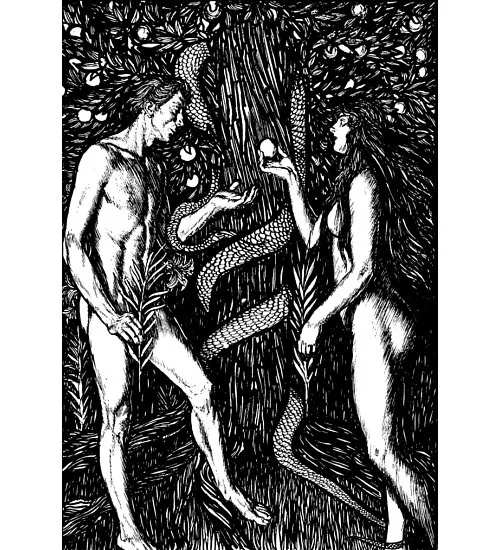
THE OLD ADAM AND EVE
CHAPTER 1
Genesis
IN a psychological point of view, it is perhaps questionable whether from birth and genealogy, how closely scrutinised soever, much insight is to be gained. Nevertheless, as in every phenomenon the Beginning remains always the most notable moment; so, with regard to any great man, we rest not till, for our scientific profit or not, the whole circumstances of his first appearance in this Planet, and what manner of Public Entry he made, are with utmost completeness rendered manifest. To the Genesis of our Clothes-Philosopher, then, be this First Chapter consecrated. Unhappily, indeed, he seems to be of quite obscure extraction; uncertain, we might almost say, whether of any: so that this Genesis of his can properly be nothing but an Exodus (or transit out of Invisibility into Visibility); whereof the preliminary portion is nowhere forthcoming.
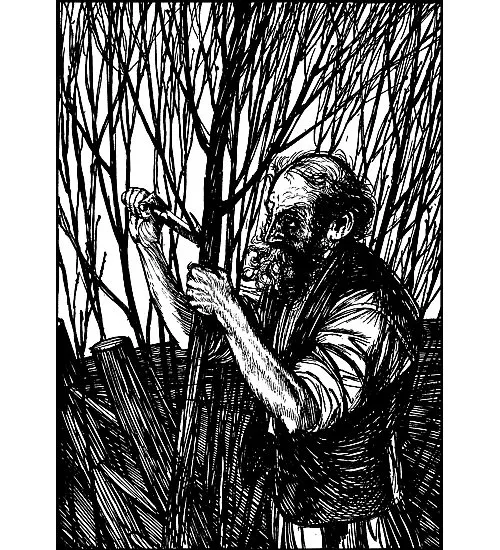
‘In the village of Entepfuhl,’1 thus writes he, in the Bag Libra, on various Papers, which we arrange with difficulty, ‘dwelt Andreas Futteral and his wife; childless, in still seclusion, and cheerful though now verging towards old age. Andreas had been grenadier Sergeant, and even regimental Schoolmaster under Frederick the Great; but now, quitting the halbert and ferule for the spade and pruning-hook, cultivated a little Orchard, on the produce of which he, Cincinnatus-like, lived not without dignity. Fruits, the peach, the apple, the grape, with other varieties came in their season; all which Andreas knew how to sell: on evenings he smoked largely, or read (as be seemed a regimental Schoolmaster), and talked to neighbours that would listen about the Victory of Rossbach; and how Fritz the Only (der Einzige) had once with his own royal lips spoken to him, had been pleased to say, when Andreas as camp-sentinel demanded the pass-word, Schweig Du Hund (Peace, hound!) before any of his staff-adjutants could answer. “Das nenn’ ich mir einen König, there is what I call a King,” would Andreas exclaim: “but the smoke of Kunersdorf was still smarting his eyes.”
‘Gretchen, the housewife, won like Desdemona by the deeds rather than the looks of her now veteran Othello, lived not in altogether military subordination; for, as Andreas said, “the womankind will not drill (wer kann die Weiberchen dressiren):” nevertheless she at least loved him both for valour and wisdom; to her a Prussian grenadier Sergeant and Regiment’s-Schoolmaster was little other than a Cicero and Cid: what you see, yet cannot see over, is as good as infinite. Nay, was not Andreas in very deed a man of order, courage, downrighteness (Geradheit); that understood Büsching’s Geography, had been in the victory of Rossbach, and left for dead in the camisade of Hoch-kirch? The good Gretchen, for all her fretting, watched over him and hovered round him, as only a true housemother can: assiduously she cooked and sewed and scoured for him; so that not only his old regimental sword and grenadier-cap, but the whole habitation and environment where, on pegs of honour, they hung, looked ever trim and gay: a roomy painted Cottage, embowered in fruit-trees and forest-trees, evergreens and honeysuckles; rising many-coloured from amid shaven grass-plots, flowers struggling in through the very windows; under its long projecting eaves nothing but garden-tools in methodic piles (to screen them from rain), and seats, where, especially on summer nights, a King might have wished to sit and smoke and call it his. Such a Bauergut (Copyhold) had Gretchen given her veteran; whose sinewy arms, and long-disused gardening talent, had made it what you saw.
‘Into this umbrageous Man’s-nest, one meek yellow evening or dusk, when the Sun, hidden indeed from terrestrial Entepfuhl, did nevertheless journey visible and radiant along the celestial Balance (Libra), it was that a Stranger of reverend aspect entered; and, with grave salutation, stood before the two rather astonished housemates. He was close-muffled in a wide mantle; which without farther parley unfolding, he deposited therefrom what seemed some Basket, overhung with green Persian silk; saying only: Ihr lieben Leute, hier bringe ein unschätz-bares Verleihen; nehmt es in aller Acht, sorgfältigst benützt es: mit hohem Lohn, oder wohl mit schweren Zinsen, wird’s einst zurückgefordert, ‘Good Christian people, here lies for you an invaluable Loan; take all heed thereof, in all carefulness employ it: with high recompense, or else with heavy penalty, will it one day be required back.’ Uttering which singular words, in a clear, bell-like, forever memorable tone, the Stranger gracefully withdrew; and before Andreas or his wife gazing in expectant wonder, had time to fashion either question or answer, was clean gone. Neither out of doors could aught of him be seen or heard; he had vanished in the thickets, in the dusk; the Orchard-gate stood quietly closed: the Stranger was gone once and always. So sudden had the whole transaction been, in the autumn stillness and twilight, so gentle, noiseless, that the Futterals could have fancied it all a trick of Imagination, or some visit from an authentic Spirit. Only that the green-silk Basket, such as neither Imagination nor authentic Spirits are wont to carry, still stood visible and tangible on their little parlour-table. Towards this the astonished couple, now with lit candle, hastily turned their attention. Lifting the green veil, to see what invaluable it hid, they descried there, amid down and rich white wrappages, no Pitt Diamond or Hapsburg Regalia, but in the softest sleep, a little red-coloured Infant! Beside it, lay a roll of gold Friedrichs,1 the exact amount of which was never publicly known; also a Taufschein (baptismal certificate), wherein unfortunately nothing but the Name was decipherable; other document or indication none whatever.
‘To wonder and conjecture was unavailing, then and always thenceforth. Nowhere in Entepfuhl, on the morrow or next day, did tidings transpire of any such figure as the Stranger; nor could the Traveller, who had passed through the neighbouring Town in coach-and-four, be connected with this Apparition, except in the way of gratuitous surmise. Meanwhile, for Andreas and his wife, the grand practical problem was: What to do with this little sleeping red-coloured Infant? Amid amazements and curiosities, which had to die away without external satisfying, they resolved, as in such circumstances charitable prudent people needs must, on nursing it, though with spoon-meat, into whiteness, and if possible into manhood. The Heavens smiled on their endeavour: thus has that same mysterious Individual ever since had a status for himself, in this visible Universe, some modicum of victual and lodging and parade-ground; and now expanded in bulk, faculty, and knowledge of good and evil, he, as HERR DIOGENES TEUFELSDRöCKH, professes or is ready to profess, perhaps not altogether without effect, in the new University of Weissnichtwo, the new Science of Things in General.’
Our Philosopher declares here, as indeed we should think he well might, that these facts, first communicated, by the good Gretchen Futteral, in his twelfth year, ‘produced onthe boyish heart and fancy a quite indelible impression. Who this reverend Personage,’ he says, ‘that glided into the Orchard Cottage when the Sun was in Libra, and then, as on spirit’s wings, glided out again, might be? An inexpressible desire, full of love and of sadness, has often since struggled within me to shape an answer. Ever, in my distresses and my loneliness, has Fantasy turned, full of longing (sehnsuchts-voll), to that unknown Father, who perhaps far from me, perhaps near, either way invisible, might have taken me to his paternal bosom, there to lie screened from many a woe. Thou beloved Father, dost thou still, shut out from me only by thin penetrable curtains of earthly Space, wend to and fro among the crowd of the living? Or art thou hidden by those far thicker curtains of the Everlasting Night, or rather of the Everlasting Day, through which my mortal eye and outstretched arms need not strive to reach? Alas! I know not, and in vain vex myself to know. More than once, heart-deluded, have I taken for thee this and the other noble-looking Stranger; and approached him wistfully, with infinite regard: but he too must repel me, he too was not thou.
‘And yet, O Man born of Woman,’ cries the Autobiographer, with one of his sudden whirls, ‘wherein is my case peculiar? Hadst thou, any more than I, a Father whom thou knowest? The Andreas and Gretchen, or the Adam and Eve, who led thee into Life, and for a time suckled and pap-fed thee there, whom thou namest Father and Mother; these were, like mine, but thy nursing-father and nursing-mother: thy true Beginning and Father is in Heaven, whom with the bodily eye thou shalt never behold, but only with the spiritual.’
‘The little green veil,’ adds he, among much similar moralising, and embroiled discoursing, ‘I yet keep; still more inseparably the Name, Diogenes Teufelsdröckh. From the veil can nothing be inferred: a piece of now quite faded Persian silk, like thousands of others. On the Name I have many times meditated and conjectured; but neither in this lay there any clue. That it was my unknown Father’s name I must hesitate to believe. To no purpose have I searched through all the Herald’s Books, in and without the German Empire, and through all manner of Subscriber-Lists (Pränumeranten), Militia-Rolls, and other Name-catalogues; extraordinary names as we have in Germany, the name Teufelsdröckh, except as appended to my own person, nowhere occurs. Again, what may the unchristian rather than Christian “Diogenes” mean? Did that reverend Basket-bearer intend, by such designation, to shadow forth my future destiny, or his own present malign humour? Perhaps the latter, perhaps both. Thou ill-starred Parent, who like an Ostrich must leave thy ill-starred offspring to be hatched into self-support by the mere sky-influences of Chance, can thy pilgrimage have been a smooth one? Beset by Misfortune thou doubtless hast been; or indeed by the worst figure of Misfortune, by Misconduct. Often have I fancied how, in thy hard life-battle, thou wert shot at and slung at, wounded, hand-fettered, hamstrung, browbeaten and bedevilled, by the Time-Spirit (Zeitgeist) in thyself and others, till the good soul first given thee was seared into grim rage; and thou hadst nothing for it but to leave in me an indignant appeal to the Future, and living speaking Protest against the Devil, as that same Spirit not of the Time only, but of Time itself, is well named! Which Appeal and Protest, may I now modestly add, was not perhaps quite lost in air.
‘For indeed as Walter Shandy often insisted, there is much, nay almost all, in Names. The Name is the earliest Garment you wrap round the Earth-visiting Me; to which it thenceforth cleaves, more tenaciously (for there are Names that have lasted nigh thirty centuries) than the very skin. And now from without, what mystic influences does it not send inwards, even to the centre; especially in those plastic first-times, when the whole soul is yet infantine, soft, and the invisible seed-grain will grow to be an all overshadowing tree! Names? Could I unfold the influence of Names, which are the most important of all Clothings, I were a second greater Trismegistus. Not only all common Speech, but Science, Poetry itself is no other, if thou consider it, than a right Naming. Adam’s first task was giving names to natural Appearances: what is ours still but a combination of the same; be the Appearances exotic-vegetable, organic, mechanic, stars, or starry movements (as in Science); or (as in Poetry) passions, virtues, calamities, God-attributes, Gods? – In a very plain sense the Proverb says, Call one a thief and he will steal; in an almost similar sense, may we not perhaps say, Call one Diogenes Teufelsdröckh and he will open the Philosophy of Clothes.’
‘Meanwhile the incipient Diogenes, like others, all ignorant of his Why, his How or Whereabout, was opening his eyes to the kind Light; sprawling out his ten fingers and toes; listening, tasting, feeling; in a word, by all his Five Senses, still more by his Sixth Sense of Hunger, and a whole infinitude of inward, spiritual, half awakened Senses, endeavouring daily to acquire for himself some knowledge of this strange Universe where he had arrived, be his task therein what it might. Infinite was his progress; thus in some fifteen months, he could perform the miracle of – Speech! To breed a fresh Soul, is it not like brooding a fresh (celestial) Egg; wherein as yet all is formless, powerless; yet by degrees organic elements and fibres shoot through the watery albumen; and out of vague Sensation, grows Thought, grows Fantasy and Force, and we have Philosophies, Dynasties, nay Poetries and Religions!
‘Young Diogenes, or rather young Gneschen, for by such diminutive had they in their fondness named him, travelled forward to those high consummations, by quick yet easy stages. The Futterals, to avoid vain talk, and moreover keep the roll of gold Friedrichs safe, gave out that he was a grand-nephew; the orphan of some sister’s daughter, suddenly deceased, in Andreas’s distant Prussian birth-land; of whom, as of her indigent sorrowing widower, little enough was known at Entepfuhl. Heedless of all which, the Nurseling took to his spoon-meat, and throve. I have heard him noted as a still infant, that kept his mind much to himself; above all, that seldom or never cried. He already felt that Time was precious; that he had other work cut out for him than whimpering.’
Such, after utmost painful search and collation among these miscellaneous Paper-masses, is all the notice we can gather of Herr Teufelsdröckh’s genealogy. More imperfect, more enigmatic it can seem to few readers than to us. The Professor, in whom truly we more and more discern a certain satirical turn, and deep undercurrents of roguish whim, for the present stands pledged in honour, so we will not doubt him: but seems it not conceivable that, by the ‘good Gretchen Futteral,’ or some other perhaps interested party, he has himself been deceived? Should these Sheets, translated or not, ever reach the Entepfuhl Circulating-Library, some cultivated native of that district might feel called to afford explanation. Nay, since Books, like invisible scouts, permeate the whole habitable globe, and Tombuctoo itself is not safe from British Literature, may not some Copy find out even the mysterious Basket-bearing Stranger, who in a state of extreme senility perhaps still exists; and gently force even him to disclose himself; to claim openly a son, in whom any father may feel pride?
1 Entepfuhl: duck-pond
1 Friedrichs: Prussian gold coins
CHAPTER 2
Idyllic
‘HAPPY season of Childhood!’ exclaims Teufelsdröckh: ‘Kind Nature, that art to all a bountiful mother; that visitest the poor man’s hut with auroral radiance; and for thy Nurseling hast provided a soft swathing of Love and infinite Hope, wherein he waxes and slumbers, danced-round (umgaukelt) by sweetest Dreams! If the paternal Cottage still shuts us in, its roof still screens us; with a Father we have as yet a prophet, priest and king, and an Obedience that makes us Free. The young spirit has awakened out of Eternity, and knows not what we mean by Time; as yet Time is no fast-hurrying stream, but a sportful sunlit ocean; years to the child are as ages: ah! the secret of Vicissitude, of that slower or quicker decay and ceaseless downrushing of the universal World-fabric, from the granite mountain to the man or day-moth, is yet unknown; and in a motionless Universe we taste, what afterwards in this quick-whirling Universe is forever denied us, the balm of Rest. Sleep on, thou fair Child, for thy long rough journey is at hand! A little while, and thou too shalt sleep no more, but thy very dreams shall be mimic battles; thou too, with old Arnauld, must say in stern patience: “Rest? Rest? Shall I not have all Eternity to rest in?” Celestial Nepenthe! though a Pyrrhus conquer empires, an...
Table of contents
- Cover
- Title Page
- Copyright Page
- Summary of Contents
- Thomas Carlyle
- Introduction
- Letter of Introduction from the Illustrator
- List of Illustrations
- Testimonies of Authors
- Book One
- Book Two
- Book Three
- Index
Trusted by 375,005 students
Access to over 1.5 million titles for a fair monthly price.
Study more efficiently using our study tools.
Frequently asked questions
Yes, you can cancel anytime from the Subscription tab in your account settings on the Perlego website. Your subscription will stay active until the end of your current billing period. Learn how to cancel your subscription
No, books cannot be downloaded as external files, such as PDFs, for use outside of Perlego. However, you can download books within the Perlego app for offline reading on mobile or tablet. Learn how to download books offline
We are an online textbook subscription service, where you can get access to an entire online library for less than the price of a single book per month. With over 1.5 million books across 990+ topics, we’ve got you covered! Learn about our mission
Look out for the read-aloud symbol on your next book to see if you can listen to it. The read-aloud tool reads text aloud for you, highlighting the text as it is being read. You can pause it, speed it up and slow it down. Learn more about Read Aloud
Yes! You can use the Perlego app on both iOS and Android devices to read anytime, anywhere — even offline. Perfect for commutes or when you’re on the go.
Please note we cannot support devices running on iOS 13 and Android 7 or earlier. Learn more about using the app
Please note we cannot support devices running on iOS 13 and Android 7 or earlier. Learn more about using the app
Yes, you can access Sartor Resartus by Thomas Carlyle in PDF and/or ePUB format, as well as other popular books in Literature & Classics. We have over 1.5 million books available in our catalogue for you to explore.