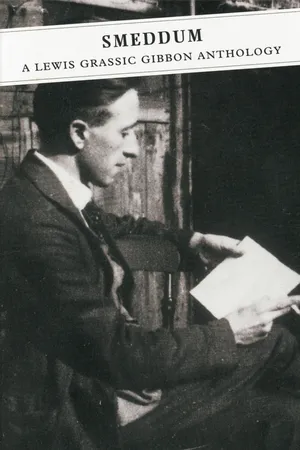
This selection of Lewis Grassic Gibbon's writing brings together old favourites and new material for the first time. There are all his lively contributions to Scottish Scene (co-written by Hugh MacDiarmid) including the unforgettable lilt and flow of his short stories 'Smeddum', 'Clay', 'Greendenn', 'Sim' and 'Forsaken'. The anthology ends with the full text of his last novel, The Speak of the Mearns, unpublished in his lifetime.
Valentina Bold has also included a collection of poems, 'Songs of Limbo', taken from typescripts in the National Library of Scotland, and a selection of Grassic Gibbon's articles and short fiction, with work done for The Cornhill Magazine along with book reviews and essays on Diffusionism, ancient American civilization and selected studies from his book on the lives of explorers, Nine Against the Unknown.
A Lewis Grassic Gibbon Anthology provides an indispensable supplement to Canongate's edition of A Scots Quair, and it also offers further insight into the wide-ranging interests and the lyrical, historical and political writing of the greatest and best-loved Scottish novelist of the early twentieth century.
- 992 pages
- English
- ePUB (mobile friendly)
- Available on iOS & Android
eBook - ePub
Smeddum: A Lewis Grassic Gibbon Anthology
About this book
Information
I
SCOTTISH SCENE
or The Intelligent Man’s Guide to Albyn
Curtain Raiser
MR LEWIS GRASSIC GIBBON proposed the scheme of this book to Mr Hugh MacDiarmid. Then they drew up a synopsis and went their separate ways, each to write his separate sections – one wrote the most of his in a pleasant village near London, the other in the sound of the running seas by the Shetlands. They believed that distance from the Scottish Scene would lend them some clarity in viewing it.
But – though they agree in many matters – their views of that scene are conditioned by many other factors than those of separate geographical focus. The standpoint of the one in controversial matters – and what matters in modern Scotland are not controversial?—is not necessarily that of the other. The one (as these pages will make plain) is seldom a convert to the other’s entire beliefs. Yet perhaps this is rather advantage than disadvantage. Viewing the Scottish Scene from such different angles, cultural and geographical, may give the better composite picture.
L. G. G.
H. MACD.
1934
The Antique Scene
THE HISTORY OF Scotland may be divided into the three phases of Colonisation, Civilisation, and Barbarisation. That the last word is a synonym for Anglicisation is no adverse reflection upon the quality of the great English culture. Again and again, in the play of the historic forces, a great civilisation on an alien and lesser has compassed that alien’s downfall.
Few things cry so urgently for rewriting as does Scots history, in few aspects of her bastardised culture has Scotland been so ill-served as by her historians. The chatter and gossip of half the salons and drawing-rooms of European intellectualism hang over the antique Scottish scene like a malarial fog through which peer the fictitious faces of heroic Highlanders, hardy Norsemen, lovely Stewart queens, and dashing Jacobite rebels. Those stage-ghosts shamble amid the dimness, and mope and mow in their ancient parts with an idiotic vacuity but a maddening persistence. Modern research along orthodox lines balks from the players, or renames them shyly and retires into footnotes on Kaltwasser.
Yet behind those grimaces of the romanticised or alien imagination a real people once lived and had its being, and hoped and feared and hated, and was greatly uplifted, and loved its children, and knew agony of the patriotic spirit, and was mean and bestial, and generous, and sardonically merciful. Behind the posturings of those poltergeists are the lives of millions of the lowly who wiped the sweats of toil from browned faces and smelt the pour of waters by the Mull of Kintyre and the winds of autumn in the Grampian haughs and the sour, sweet odours of the upland tarns; who tramped in their varying costumes and speeches to the colour and play of the old guild-towns; who made great poetry and sang it; who begat their kind in shame or delight in the begetting; who were much as you or I, human animals bedevilled or uplifted by the play of the forces of civilisation in that remote corner of the Western world which we call Scotland.
All human civilisations originated in Ancient Egypt. Through the accident of time and chance and the cultivation of wild barley in the Valley of the Nile, there arose in a single spot on the earth’s surface the urge in men to upbuild for their economic salvation the great fabric of civilisation. Before the planning of that architecture enslaved the minds of men, man was a free and happy and undiseased animal wandering the world in the Golden Age of the poets (and reality) from the Shetlands to Tierra del Fuego. And from that central focal point in Ancient Egypt the first civilisers spread abroad the globe the beliefs and practices, the diggings and plantings and indignations and shadowy revilements of the Archaic Civilisation.
They reached Scotland in some age that we do not know, coming to the Islands of Mist in search of copper and gold and pearls, Givers of Life in the fantastic theology that followed the practice of agriculture. They found the Scots lowlands and highlands waving green into morning and night tremendous forests where the red deer belled, where the great bear, perhaps, had still his tracks and his caverns, where wolves howled the hills in great scattering packs, where, in that forested land, a danker climate than today prevailed. And amid those forests and mountain slopes lived the Golden Age hunters – men perhaps mainly of Maglemosian stock, dark and sinewy and agile, intermixed long ages before with other racial stocks, the stock of Cro-Magnard and Magdalenian who had followed the ice-caps north when the reindeer vanished from the French valleys. They were men naked, cultureless, without religion or social organisation, shy hunters, courageous, happy, kindly, who stared at the advent of the first great boats that brought the miners and explorers of the Archaic Civilisation from Crete or Southern Spain. They flocked down to stare at the new-comers, to offer tentative gifts of food and the like; and to set on their necks the yoke under which all mankind has since passed.
For the Archaic Civilisation rooted in Scotland. Agriculture was learned from the Ancient Mariners and with it the host of rites deemed necessary to propitiate the gods of the earth and sky. Village communities came into being, the first peasants with the first overlords, those priestly overlords who built the rings of the Devil Stones on the high places from Lewis to Aberdeenshire. And the ages came and passed and the agricultural belts grew and spread, and the smoke of sacrifice rose from a thousand altars through the length and breadth of the land at the times of seedtime and harvest, feast and supplication. They buried their dead in modifications of the Egyptian fashion, in Egyptian graves. There came to them, in the slow ebb of the centuries, a driftage of other cultural elements from that ferment of civilisation in the basin of the Mediterranean. They learned their own skill with stick and stone, presently with copper, and at last with bronze. But, until the coming of the makers of bronze that Archaic civilisation in Scotland, as elsewhere, was one singularly peaceful and undisturbed. Organised warfare had yet to dawn on the Western World.
How it dawned is too lengthy a tale to tell here in any detail: how bands of forest-dwellers in the Central European areas, uncivilised, living on the verge of the great settlements of the Archaic communities and absorbing little but the worst of their practices, fell on those communities and murdered them was the first great tragedy of pre-Christian Europe. The ancient matriarchies of the Seine were wiped from existence and in their place (and presently across the Channel) came swarming the dagger-armed hosts of a primitive who, never civilised, had become a savage. This was the Kelt.
We see his advent in the fragments of sword and buckler that lie ticketed in our museums; but all the tale of that rape of a civilisation by the savage, far greater and infinitely more tragic than the rape of the Roman Empire by the Goth, is little more than a faint moan and murmur in the immense cañons of near-history. In Scotland, no doubt, he played his characteristic part, the Kelt, coming armed on a peaceful population, slaying and robbing and finally enslaving, establishing himself as king and overlord, routing the ancient sunpriests from the holy places and establishing his own devil-haunted, uneasy myths and gods through the efforts of the younger sons. From Berwick to Cape Wrath the scene for two hundred years must have been a weary repetition, year upon year, of invasion and murder, inversion and triumph. When Pytheas sailed the Scottish coasts it is likely that the Kelt had triumphed almost everywhere. By the time the Romans came raiding across the English Neck Scotland was a land of great barbaric Kelt tribes, armed and armoured, with a degenerate, bastardised culture and some skill in war and weapon-making. It was as capable of producing a ferocious soldiery and a great military leader like Calgacus as it was incapable of a single motif in art or song to influence the New Civilisation of the European World.
Yet of that culture of those Picts or Painted Men, those Caledonians whom the Romans encountered and fought and marvelled upon, it is doubtful if a single element of any value had been contributed by the Kelt. It is doubtful if the Kelts ever contributed a single item to the national cultures of the countries miscalled Keltic. It is doubtful for the best of reasons: There is no proof that the Kelts, invading Britain, came in any great numbers. They were a conquering military caste, not a people in migration: they imposed their language and their social organisation upon the basic Maglemosian-Mediterranean stock; they survived into remoter times, the times of Calgacus, the times of Kenneth MacAlpin, as nobles, an aristocracy on horseback. They survive to the present day as a thin strand in the Scottish population: half Scotland’s landed gentry is by descent Normanised Kelt. But the Kelts are a strain quite alien to the indubitable and original Scot. They were, and remain, one of the greatest curses of the Scottish scene, quick, avaricious, unintelligent, quarrelsome, cultureless, and uncivilisable. It is one of the strangest jests of history that they should have given their name to so much that is fine and noble, the singing of poets and the fighting of great fights, in which their own actual part has been that of gaping, unintelligent audition or mere carrion-bird raiding.
The first serious modification of the basic Pictish stock did not occur until towards the end of the sixth Christian century, when the Northumbrian Angles flowed upwards, kingdom-building, as far as the shores of the Firth of Forth. They were a people and nation in transit; they exterminated or reduced to villeinage the Kelt-led Picts of those lands: they succeeded in doing those things not because they were braver or more generous or God-inspired than the Pictish tribes, but because of the fact that they were backed by the Saxon military organisation, their weapons were better, and apparently they fronted a congeries of warring tribes inanely led in the usual Keltic fashion – tribes which had interwarred and raided and murdered and grown their crops and drunk their ale unstirred by alien adventures since the passing of the Romans. The Angle pressed north, something new to the scene, bringing his own distinctive culture and language, his own gods and heroes and hero-myths. About the same time a tribe of Kelt-led Irish Mediterraneans crossed in some numbers into Argyllshire and allied themselves with, or subdued the ancient inhabitants. From that alliance or conquest arose the kingdom of Dalriada – the Kingdom of the Scots. Yet this Irish invasion had no such profound effect on the national culture as the coming of the Angles in the South: the Irish Scots were of much the same speech and origin as the Argyllshire natives among whom they settled.
With the coming of the Angles, indeed, the period of Colonisation comes to a close. It is amusing to note how modern research disposes of the ancient fallacies which saw Scotland overrun by wave after wave of conquering, colonising peoples. Scotland was colonised only twice – once fairly completely, once partially, the first time when the Maglemosian hunters drifted north, in hunting, happy-go-lucky migration; the second time, when the Angles lumbered up into Lothian. The Kelt, the Scot, the Norseman, the Norman were no more than small bands of raiders and robbers. The peasant at his immemorial toil would lift his eyes to see a new master installed at the broch, at the keep, at, later, the castle: and would shrug the matter aside as one of indifference, turning, with the rain in his face, to the essentials of existence, his fields, his cattle, his woman in the dark little eirde, earth-house.
The three hundred years after that almost simultaneous descent of Scot and Angle on different sectors of the Scottish scene is a tangle of clumsy names and loutish wars. Kings bickered and bred and murdered and intrigued, armies marched and counter-marched and perpetrated heroisms now dust and nonsense, atrocities the dried blood of which are now not even dust. Christianity came in a number of guises, the Irish heresy a chill blink of light in its coming. It did little or nothing to alter the temper of the times, it was largely a matter of politics and place-seeking, Columba and John Knox apart there is no ecclesiastic in Scots history who does not but show up in the light of impartial research as either a posturing ape, rump-scratching in search of soft living, or as a moronic dullard, hag-ridden by the grisly transplanted fears of the Levant. The peasant merely exchanged the bass chanting of the Druid in the pre-Druid circles for the whining hymnings of priests in wood-built churches; and turned to his land again.
But presently, coastwise, north, west, and east, a new danger was dragging him in reluctant levies from his ancient pursuits. This was the coming of the Norsemen.
If the Kelts were the first great curse of Scotland, the Norse were assuredly the second. Both have gathered to themselves in the eyes of later times qualities and achievements to which the originals possessed no fragment of a claim. The dreamy, poetic, God-moved Kelt we have seen as a mere Chicagoan gangster, murderous, avaricious, culturally sterile, a typical aristocrat, typically base. The hardy, heroic Norseman uncovers into even sorrier reality. He was a farmer or fisherman, raiding in order to supplement the mean livelihood he could draw from more praiseworthy pursuits in the Norwegian fjords. The accident of his country lying at the trans-Baltic end of the great trans-Continental trade-route had provided him with the knowledge of making steel weapons in great number and abundance. Raiding Scotland, he was in no sense a superior or heroic type subduing a lowly or inferior; he was merely a pirate with a good cutlass, a thug with a sudden and efficient strangling-rope. Yet those dull, dyspeptic whey-faced clowns have figured in all orthodox histories as the bringers of something new and vital to Scottish culture, as an invigorating strain, a hard and splendid ingredient. It is farcical that it should be necessary to affirm at this late day that the Norseman brought nothing of any permanence to Scotland other than his characteristic gastritis.
Yet that cutlass carved great sections from the Scottish coasts: presently all the Western Isles had suffered a profound infiltration of the thin, mean blood of the northern sea-raiders. In the east, the attacks were almost purely burglarious. The hardy Norseman, with his long grey face so unfortunately reminiscent of a horse’s, would descend on that and this village or township, steal and rape and fire, and then race for his ships to escape encounter with the local levies. On such occasions as he landed in any force, and met the Picts (even the idiotically badly-led, Kelt-led Picts) in any force, he would, as at the Battle of Aberlemno, be routed with decision and vigour. Yet those constant raidings weakened the Eastern kingdom of the Picts: in ad 844 the Scot king, Kenneth MacAlpin, succeeded to the Pictish throne – it was evidently regarded as the succession of a superior to the estates of an inferior. Thereafter the name Pict disappears from Scottish history, though, paradoxically immortal, the Pict remained.
From 1034, when Duncan ascended the Scottish throne, until 1603, when James VI ascended the English throne, Scotland occupied herself, willy-nilly, in upbuilding her second (and last) characteristic civilisation. Her first, as we have seen, was that modification of the Archaic Civilisation which the Kelts overthrew; this second which slowly struggled into being under the arrow-hails, the ridings and rapings and throat-cuttings of official policy, the jealous restraints of clerical officialdom, was compounded of many cultural strands. It was in essentials a Pictish civilisation, as the vast majority of the inhabitants remained Picts. But, in the Lowlands, it had changed once again its speech, relinquishing the alien Keltic in favour of the equally alien Anglo-Saxon. The exchange was a matter of domestic policy, a febrific historical accident hinged on the bed-favours wrung from his consort by the henpecked Malcolm Canmore.
The third of the name of Malcolm to rule in Scotland, his speech, his court, and his official pronunciamentos were all Keltic until he wedded the Princess Margaret, who had fled from the Norman invasion of England. A great-niece of Edward the Confessor, Margaret was a pious daughter of the Church and greatly shocked at the Keltic deviations from Roman dates and ceremonial incantations. She devoted her life to bringing the usages of the Scottish Church into harmony with orthodox Catholicism. She bred assiduously: she bred six sons and two daughters, and in return for the delights of the shameful intimacies which begat this offspring, the abashed Malcolm refrained from any hand in their christening. They were al...
Table of contents
- Cover
- Title Page
- Table of Contents
- Introduction
- Chapter I: Scottish Scene
- Chapter II: Songs Of Limbo
- Chapter III: Polychromata
- Chapter IV: One Man With A Dream
- Chapter V: The Glamour Of Gold
- Chapter VI: In Brief
- Chapter VII: Speak Of The Mearns
- Notes
- Glossary
- Acknowledgements
- About the Author
- Copyright
Trusted by 375,005 students
Access to over 1.5 million titles for a fair monthly price.
Study more efficiently using our study tools.
Frequently asked questions
Yes, you can cancel anytime from the Subscription tab in your account settings on the Perlego website. Your subscription will stay active until the end of your current billing period. Learn how to cancel your subscription
No, books cannot be downloaded as external files, such as PDFs, for use outside of Perlego. However, you can download books within the Perlego app for offline reading on mobile or tablet. Learn how to download books offline
We are an online textbook subscription service, where you can get access to an entire online library for less than the price of a single book per month. With over 1.5 million books across 990+ topics, we’ve got you covered! Learn about our mission
Look out for the read-aloud symbol on your next book to see if you can listen to it. The read-aloud tool reads text aloud for you, highlighting the text as it is being read. You can pause it, speed it up and slow it down. Learn more about Read Aloud
Yes! You can use the Perlego app on both iOS and Android devices to read anytime, anywhere — even offline. Perfect for commutes or when you’re on the go.
Please note we cannot support devices running on iOS 13 and Android 7 or earlier. Learn more about using the app
Please note we cannot support devices running on iOS 13 and Android 7 or earlier. Learn more about using the app
Yes, you can access Smeddum: A Lewis Grassic Gibbon Anthology by Lewis Grassic Gibbon in PDF and/or ePUB format, as well as other popular books in Literature & Classics. We have over 1.5 million books available in our catalogue for you to explore.