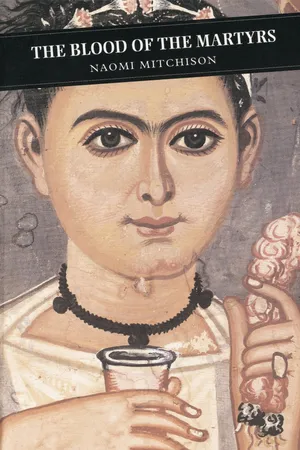
Set in Rome during Nero's reign of terror, The Blood of the Martyrs is a disciplined historical novel tracing the destruction of one cell of the early church. With a cast of slaves, ordinary Roman people, exiles and entertainers, it is thorough in its historical interpretation and in its determination to make the past accessible and readable.
Written in 1938-9, the novel contains many symbolic parallels to the rise of European fascism in the 1930s and the desperate plight of persecuted minorities such as the Jews and the left-wing activists with whom Naomi Mitchison personally campaigned at the time. With the invasion of Britain a real possibility, she felt compelled to write a testament to the power of human solidarity which, even faced with death, can overcome the worst that human evil can achieve.
The Blood of the Martyrs is the least autobiographical of Mitchison's major works of fiction, yet, with its implicit credo, is her most passionately self-revealing.
- 432 pages
- English
- ePUB (mobile friendly)
- Available on iOS & Android
eBook - ePub
The Blood Of The Martyrs
About this book
Information
Topic
LiteraturaSubtopic
ClásicosPart One
Is it a God or a king that comes?
Both are evil, and both are strong.
Both are evil, and both are strong.
LYALL
CHAPTER I
Beric
In the hot afternoon, Beric who was no longer a child, had been with Flavia, who was no longer a child either. She had amused herself, but it was beginning to be dangerous. Supposing Beric came clear out of the dream in which he stroked and kissed her, in which he did what she wanted and no more? Well, there would soon be something better to think about than Beric: by no means a dream this time, but real. But Beric did not know. It was no business of the Briton’s to whom she was betrothed; she was more than certain that her father had not mentioned it in his presence so far. It would be funny when he knew. And suddenly she was bored with his light wavy hair and the red sunburn on his neck and shoulders, and his fingers merely repeating an old story. She sat up sharply, saying that she must dress. His hands slipped on her, he tried to hold her, but she pushed him off, and he, as his dreams subsided, remembered that he had to see to his arrangements for the dinner party that evening. He would have liked to kiss her gently goodbye, but she, suddenly brisk, would have none of it, shoved him impatiently, so that he knocked over a basket of grapes from the little table. He would have picked them up, but now she couldn’t bear him in the room one moment longer. ‘Let the slaves!’ she said, stamping. ‘What are they there for! And go quietly, you big ox!’
When he went out, she trod her toes into one of the fallen grape bunches; the juice was warm and sticky and a lovely colour on her instep; she paddled it about a little on the tiled floor, then clapped her hands. Little Persis came running in, with anxious eyes on her mistress, who was now slipping off her short sweaty muslin shift, dropped it, one hem in the grape juice, as Persis saw with half an eye of worry, and called for powder.
As Persis powdered her all over, Flavia stretched again and again, and stuck her fingers into her brown hair, pulling it back in crisp hot masses from her cheeks and neck. Her face was the right kind of face for a sixteen year old Roman aristocrat; her small breasts which the girl was powdering would certainly grow. She had enjoyed herself so far; she was going to enjoy herself much more when she left home. She had not yet made anyone do what she wanted except the slaves and Beric, but that was going to happen too.
The other slaves came in to dress her and admire her and brush her hair, the old woman who was supposed to be so good, but whom Flavia didn’t trust an inch, and the round-faced Italian maid who giggled. Persis was the youngest and newest and easiest to hurt. She began to clear up the squashed grapes. Her sleek black head bent to the floor; there was a tempting patch of brown shoulder. Flavia tiptoed and gave it a quick pinch; Persis jumped and squealed; the other two slaves laughed, applauding their mistress and wondering what she was going to try on them. She looked round idly and viciously for something to do or throw or hurt; the Italian girl ran and brought in her pet monkey, hoping she would tease it instead of teasing them.
In the meantime the dinner party had to be arranged. The food, of course, had been ordered days before; both the head cook and Beric had been to the market, though actually most of the meat, poultry, vegetables, fruit and cheese had come in from Flavius Crispus’s country estate, a pleasant little place to which old Domina Aelia, the grandmother, had retired. The flowers for the garlands had come from there too, but in this heat it was difficult to keep the roses from dropping. As for the entertainment, Beric had put the two dancing boys through a rehearsal of their new mime: Ulysses and the Cyclops—with the gouging out of the eye done as realistically as possible. Phaon was a tiresome, temperamental little brat, but the dancing boys were bound to be rather spoilt. He had been born in the house; his mother, Eunice, had been freed five years back, and now ran a little bakery. Sometimes she brought in some extra fancy rolls—there would be some today, shaped like swans and butterflies. Phaon was fifteen and his legs were pretty enough to—eat. He knew that all right, and half the time he was showing off like a regular Greek, which was what the guests liked, and then suddenly he’d go queer and sullen, as if he hated the kind of life he was leading, which was stupid and ungrateful of him; not many slaves were as well treated and as well trained as Flavius Crispus’s dancing boys.
The other was a young Jew, Manasses, older than Phaon and with much more experience; in fact, it was he who had taught Phaon; he was easier to deal with, and his dark curls and dark sidelong eyes made him a good contrast with the little Greek. But Beric didn’t like him much. Jews were a nuisance in a household anyhow, with all the different kinds of food they refused to eat, and their praying, and trying to sneak off from work one day a week. In the Jewish Quarter in Rome you could go there one day and there wouldn’t be a soul about, not so much as chopping wood or drawing water. Of course, there were certain things which he, Beric, did not eat—goose, for instance; naturally, no Britons ate goose! It always made him feel uncomfortable to see the Romans actually enjoy eating it, especially Flavia; it made him feel squirmy, as though he didn’t want to touch her for an hour or two afterwards. But everybody knew that pork was one of the best foods there is! He remembered helping in a great game one day when the rest of the household made the Jew slaves eat it—held them down and jammed it into their mouths. Most of them were sick afterwards. It was all in fun, of course, and the rest of them had laughed like anything.
Some of the others had manhandled Manasses a bit that time; the rest of the slaves were always jealous of the dancing boys, and, on the whole, Beric saw the point of that. Of course, all the dining-room slaves had a better time; they had the pick of what was left over—they were supposed not to, but neither Beric nor Crispus were going to be hard on them; when there were no guests they often talked to the slaves who were waiting on them; naturally they were more intelligent and trustworthy—and better-looking than the rest, too! They were mostly Greeks, Lamprion, Sannio, Argas, Mikkos, and the rest.
By now Beric did most of the running of the household, thus, as he sometimes said to himself, saving the price and keep of an overseer. Today, for instance, he had hired a professional dancing girl entirely on his own; well, as a matter of fact, Flavius Crispus had seen her somewhere when he was dining out, but it was Beric who had found out her name and where she lived. Sometimes he wondered what was going to happen to him later on, when he was a man grown, with a great brown moustache like his father. Not that he wasn’t big and strong enough now; they all said so at the gymnasium; he could throw most of his friends. But—later on? Some day soon he must ask Flavius Crispus.
Thirteen years ago, the British king, Caradoc, son of Cymbeline, had been chased out of Essex by the legions, west along the Thames valley and into Wales. There had been fighting there, the usual betrayal of barbarians by one another, and in the end Caradoc and his wife and children had been taken to Rome, where the old Emperor Claudius had, on one of his good days, seen and pardoned them—not, of course, to go back to Britain, but to live on as clients in Rome. And the youngest boy was given to Flavius Crispus to be brought up with his own motherless little girl. Beric had howled and kicked at first, but it was all a long time ago. Caradoc and his wife were dead years back, and Beric had not grieved much; he had never tried to get in touch with his brothers, who were probably somewhere in Italy; nor did he think of himself as the son of a king except sometimes with Fla Flavia. When they were quite little, she had made him crowns out of anything that came to hand, and pretended to do him homage. And again this last year it seemed to heighten everything for her; she had whispered it at him, king’s son, king’s son, making him do this or that, touch her or not touch her, thinking of new games to play with him as the afternoons burned and blazed from winter into July, and inside the shutters the square, dusky, rose-scented room was her practice ground where she would make him follow and beg or cry with rage or laugh low with delight. The slave girls whispered to one another sometimes that he was a king’s son, but he didn’t know or care about that. He wasn’t interested in slave girls, though last year at Saturnalia he had given special presents to Flavia’s maids: but not for what they said—only for what they left unsaid.
Now he went along to see if there were any more directions for the dinner party. He found Crispus quite worried, and indeed it was a rather awkward party. Beric had never bothered much about Roman politics, but even he couldn’t help knowing that no senator could enjoy having the present Praefect of the Praetorians to dinner. He was sorry and worried that Crispus should have to do it, sorry from affection and worried because—well, Crispus had never held any important office of State, had never been involved in any kind of scandal or conspiracy, but still … Even Beric felt uneasy when he thought about what had been happening in Rome lately.
Beric knew most of the other guests already, old friends of the family: a second cousin, Flavius Scaevinus; Aelius Balbus, a cousin on the other side of the family; Junius Gallio, the ex-Proconsul of Achaea: and Gallio’s nephew, young Annaeus Lucan, the poet: also Aelius Candidus, Balbus’s son, who had just exchanged out of one of the less distinguished City Corps and taken a commission in the Praetorians. Hence Ofonius Tigellinus, the Praefect. There was one other guest whom Beric did not know, Erasixenos, an Alexandrian, exceedingly rich; he was to sit next to Tigellinus; they were said to have tastes in common—Crispus coughed a little over this—and Beric was to see, above all, that they were to have everything they wanted in the way of entertainment.
Beric did not always come to the dinner parties, only when he was wanted to make up numbers, and he usually sat at the lowest end of the third couch, where he could supervise the service; often he didn’t get much conversation, and he knew he wouldn’t tonight, as his neighbour would be Lucan, who was sure to be bored anyhow and would probably leave early. He said soothingly to Crispus that he was quite sure the dinner would be a success: the partridges especially were sure to be delicious; he had got hold of the recipe for that new stuffing and had just been down to the kitchen to taste it himself. Crispus began to say something to him about Aelius Candidus and then stopped. He patted Beric on the shoulder. ‘You’re a good boy,’ he said.
Beric found the dinner party as dull as he had expected. There were awkward moments, too; none of the aristocrats liked sitting at the same table as Tigellinus. Flavius Scaevinus was positively rude and left early. That was stupid of him; times had changed and it was no use supposing one was living under Augustus. Even Beric knew that. The partridges, however, were a great success, though Tigellinus had rather a coarse way of biting out the breast and throwing the rest on to the floor. Lucan, who affected plain living and high thinking, and had come in a plain green tunic with darns in several places, talked to Beric for a few minutes. Apparently he had an idea that because Britain was damp, foggy, full of unpleasant wild animals and without central heating, it was also the home of freedom and nobility.
Beric agreed enthusiastically, trying to look the part, but when Lucan began talking across the table to Erasixenos about some new Alexandrian religion, he couldn’t help remembering the way his father, King Caradoc, and his big brothers, Prince Rudri and Prince Clinog, had spoken and thought about the peasants and servants and men at arms: not the tall, fair Britons whom Lucan was thinking of, the conquerors, the sea-goers, the ones that fetched the big prices on the slave market, but the ordinary, middle-height, middle-coloured countrymen who were there all the time, however much their huts were burnt and their beasts stolen, and they themselves kicked and prodded and made to fight behind the palisades, half armed, while the long-haired warriors ramped round and sang war songs. Freedom? That was how King Caradoc had been able to speak up in front of the Divine Claudius; he wasn’t afraid; he was free and noble and all that, just right for the Stoics to make up stories about, and he, Beric, he could look handsome and strong and free. But it wasn’t the whole story about Britain. Well, who cared. Suddenly he began to feel sad and wished it were true, wished Britain had been a kind of Stoic paradise. He wanted something—he didn’t know what—something real.
Erasixenos was talking about Egyptian religions; Lucan apparently had been, or was going to, write one of his poems about Egypt. Beric had an idea that Lucan’s notions about Egypt were as cock-eyed as his ideas about Britain. Probably Egypt was full of ordinary stupid men and women, and the ghosts and devils were a different shape, but you had to get rid of them the same sort of way. For that matter he had seen a crocodile with his own eyes in the arena. Why were the Romans always so interested in new kinds of gods? They had plenty of gods of their own, only they weren’t—what was it?—they weren’t active, not in people’s real lives. Not any longer. So the Romans had to go somewhere else to get rid of the devils and spirits and bits of bad luck that were always floating round. They had to go somewhere else to get that feeling you do get out of the gods when you know they are there, the way they had been when he was a child. But the Romans had killed the Druids; and if he saw a Druid now he wouldn’t look twice.
Beric watched the slaves clearing away the empty sea-urchins, and fish-bones, the half-eaten hams and roast boar and ducks and sucking pig, the pie-crust and broken rolls and blobs of honey—it would all get finished up in the kitchen—the walnut shells and fruit rinds. Everyone had eaten much too much, of course, but what was the use of being rich if you weren’t going to have as much as possible of everything. It was sweaty weather though, even between the water-cooled marble walls. A slave went round to each diner with wet towels, fans, a nice little earthenware pot amusingly and appropriately painted, and fresh cushions to lie on.
Then the two boys began dancing their mime, all dressed up with the new masks and stiff short tunics. The pretty little round bottom of Phaon as a rather frivolous Ulysses flipped up now and then, and once Tigellinus reached over and pinched it. Tigellinus, also, watched with interest the mimed gouging out of the Cyclops’s eye; it seemed to be the kind of thing he knew about. The Stoics, naturally, found it boring, but Aelius Candidus liked it. At the end, the boys pulled their masks off and bowed. Tigellinus clapped and beckoned Phaon to come over. Phaon didn’t want to, but Beric caught his eye and glared at him to do what he was told. Tigellinus wasn’t going to eat him, after all, spoiled little brat!
The garlands were brought round by some of the girls; Tigellinus had a little fun with his, at any rate he went to a party to enjoy himself, which was more than the Stoics did! Lucan insisted on a garland of plain leaves, though he didn’t go quite so far as to ask for poetic bays. Aelius Balbus was appointed toast-master and everybody shifted a bit and settled down to the drinking, beginning with the Emperor of course. Unfortunately this started Tigellinus and Erasixenos off on several new stories about the doings of the Divine Nero, and, as one of them was about a girl who happened to be the niece of Gallio’s sister-in-law, it was all rather a pity. In any case Gallio was in a bad temper; however, he would probably get better when the wine had warmed him up a little. Poor old Crispus really disliked hearing that kind of story about the Emperor; he tried hard to disbelieve them. Aelius Candidus obviously thought them grand, but was a little shy, with his father there, of telling any himself.
After that there were drinks and compliments all round the table, not to Beric, of course, except from his neighbour Lucan, who was really drinking to Freedom, even if she had fled to the barbarians. Beric wasn’t sure if he liked being called a barbarian. He always rather hated it when he was explained away to guests, as that tin soldier Aelius Candidus was doing now at the far side of the table to Tigellinus, who got it a bit wrong and said loudly that it must be awkward having one of these Germans about the place, especially if there was a pretty daughter.
At that Beric shut himself away, closing himself against everything but his own dream. As the toasts went round he drank more deeply than usual. The slaves refilled his cup, but he did not notice their hands on the heavy jugs. It was as though he were back in the room Fla with Flavia. Circles of...
Table of contents
- Cover
- Title Page
- Dedication
- Table of Contents
- Introduction
- People In The Book
- Part One
- Part Two
- Part Three
- About the Author
- Copyright
Trusted by 375,005 students
Access to over 1.5 million titles for a fair monthly price.
Study more efficiently using our study tools.
Frequently asked questions
Yes, you can cancel anytime from the Subscription tab in your account settings on the Perlego website. Your subscription will stay active until the end of your current billing period. Learn how to cancel your subscription
No, books cannot be downloaded as external files, such as PDFs, for use outside of Perlego. However, you can download books within the Perlego app for offline reading on mobile or tablet. Learn how to download books offline
We are an online textbook subscription service, where you can get access to an entire online library for less than the price of a single book per month. With over 1.5 million books across 990+ topics, we’ve got you covered! Learn about our mission
Look out for the read-aloud symbol on your next book to see if you can listen to it. The read-aloud tool reads text aloud for you, highlighting the text as it is being read. You can pause it, speed it up and slow it down. Learn more about Read Aloud
Yes! You can use the Perlego app on both iOS and Android devices to read anytime, anywhere — even offline. Perfect for commutes or when you’re on the go.
Please note we cannot support devices running on iOS 13 and Android 7 or earlier. Learn more about using the app
Please note we cannot support devices running on iOS 13 and Android 7 or earlier. Learn more about using the app
Yes, you can access The Blood Of The Martyrs by Naomi Mitchison in PDF and/or ePUB format, as well as other popular books in Literatura & Clásicos. We have over 1.5 million books available in our catalogue for you to explore.