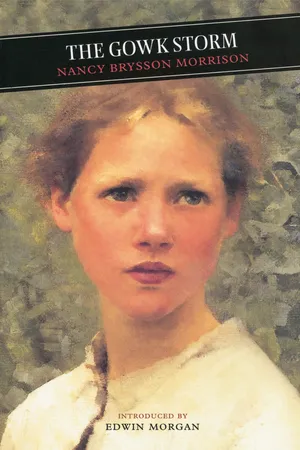
A 'gowk storm' is an untimely fall of snow in early Spring - a fitting symbol for the anguished story that unfolds. Nearly a hundred years ago, three girls were born to a minister and his wife in a remote Highland manse; the rigid patriarchal structure of the timesis set against their approaching womanhood and growing awareness of life beyond the safety of home.
After the disposal by marriage of the eldest, the sisters' lives reach a new level of intensity. Emmy, the middle sister, finds to her horror that she is falling in love with her best friend's fiancée. The unfortunate couple become estranged and a tragic outcome seems inevitable in the brooding symbolism of this disturbing story.
The Gowk Storm, published in 1933, was one of many award-winning books written by Nancy Brysson Morrison. It was a Book Society Choice, went into eight impressions and was successfully dramatised.
- 178 pages
- English
- ePUB (mobile friendly)
- Available on iOS & Android
eBook - ePub
The Gowk Storm
About this book
Information
Book Two
BOOK TWO. CHAPTER ONE
Summer thickened the trees, beat in the warming earth, hummed on the wing of bee and dragonfly, and swelled the birds’ clamorous song. And with the summer came the Stratherns who returned, as they did every year, to spend several months in their country home.
I had gone to have my lessons from the dominie for some weeks, so that now they had become part of my usual life. Julia sometimes accompanied me and would sit listening to the little summer wind that mourned round the low building while the dominie sat beside me, prompting and correcting. The faded map of Africa looked down on us, flies buzzed drowsily at the window-pane, and the faraway crow of a cock or low of a cow grazing on a distant hill would be borne in on the still air.
One afternoon in August when we returned from Barnfingal we found Emmy had washed her hair and was sitting, a towel over her shoulders, with her back to the parlour fire, for even in summer mamma had to have a fire. Emmy had not Julia’s long dark hair, hers scarcely fell beyond her shoulders, but was so fine it shone like silk in the firelight. She had newly brushed it and it sprang, crackling, round her face; each hair seemed to have a separate life of its own and waved about like a thread seeking the eye of a needle.
‘I’ve been thinking, Julia,’ she said when we came in, ‘that we should give our picnic soon.’
Julia took off her hat and, still holding it in her hand, sat down on the sofa.
‘Oh, Emmy,’ she asked in a voice that almost entreated, ‘do you think we should give it?’
‘Of course I do,’ Emmy said indignantly; ‘it’s the smallest thing we could do in return for all the Stratherns’ goodness to us. Why, it was you who suggested it.’
‘Yes, yes, I know, but that was in winter when summer seemed so distant. Now the thought of it fatigues me; all the preparations and planning, trysting the ferryman to take us there, Nannie in a speechless ferment baking for it, and then, after all, it will probably be wet.’
‘We will tell them it’s a picnic and not to come if it’s wet. You know Nannie loves baking and Lisbet and I can tryst the ferryman if you are as exhausted as all that. Now, whom shall we ask? Christine, of course, and the father and Nicholas and Martin.’
‘Martin always makes me feel so arch. Yes, we’ll have to ask them all,’ sighed Julia.
‘But not Aunt Bertha. I refuse to go on a picnic with Aunt Bertha.’
‘We’ll have to ask her,’ said Julia, suddenly laughing, ‘but she won’t come—I can vouch for that.’
‘And who else?’ questioned Emmy, her hand stroking her hair on one side while she brushed it on the other.
‘There’s no one else,’ said Julia.
‘What about Stephen Wingate?’
‘Oh, yes, I quite forgot about him—he’s arriving next week, of course. We had better have him too or the day will be spoiled for Christine. We’ll have to mix the sets or there won’t be enough china to go round.’
We planned the picnic to take place a week on Thursday and engaged the ferryman for the whole of that day. He was very strong, but so thin his skin merely webbed his bones; it was as though he had hollowed himself with so much rowing. I felt even after life had left him his hands would still work automatically with the oars and no one would notice he was dead.
He rowed us over to the little island in the morning, and we set out the china on the cloth, turning the cups upside down in case anything fell into them, and building a fire to boil the kettle on. It all looked very pretty after we had finished, with posies covering the stones at each corner of the cloth, and flowers and leaves and ferns twining amongst the dishes. Above, the foliage of the silver birches swam more than blew in the gentle breeze, like trees seen in water.
They arrived about three that afternoon and mamma and papa came to the loch’s edge to see us into the boat. I trailed my hand through the cool water, while Julia sat in the stern and Christine in the prow with her arm round Emmy’s waist. They were all in the highest, most festive spirits, particularly Edwin Strathern, who was almost excited, speaking more than any one and so quickly that his words must have outpaced his thoughts. He insisted on taking an oar and rowed so vigorously that Stephen Wingate and Duguid Wands had trouble to keep in stroke with him.
Mamma’s and papa’s pleasant voices thinned into the distance and they dwindled rapidly from view until the trees behind them seemed to swoop to the loch’s edge and hide them altogether. As we moved farther and farther from shore, with all its familiar rustlings, flutterings and bestir- rings, we seemed to float into another land where sound drifted, light rippled and time glided.
The boat grated on the ground when we neared the island; Nicholas helped us to disembark and to light the fire on which to boil the kettle.
‘You must excuse our harlequin china,’ Julia smiled as she began to pour out tea.
‘It’s all beautiful,’ said Edwin Strathern, ‘it’s a fairy feast—I feel we ought to have wings and sit on toadstools before we are allowed to partake of it.’
Stephen Wingate’s glance lighted on Martin’s portly figure and his lips twitched.
‘You would think of that, Wingate,’ Martin observed witheringly. He stood back on a twig and nearly capsized. We all laughed most unkindly. ‘I nearly killed myself,’ he remarked gravely; ‘what would you have said to that, Miss Emmy?’
‘They would find me with a hairpin through my heart,’ she promised him.
I saw Stephen Wingate’s blue eyes turn to and dwell on her as she spoke. She was leaning forward, her pink dress dappled by the shadows of the trees above, but no shade fell on her uplifted face. Her eyebrows were slightly raised on each temple, which gave her face a winged, uncommon look. He opened his mouth as if to speak, and I did not think somehow that it was going to be anything particularly pleasant, but evidently he thought better of it for he remained silent.
I sat beside the tall watchful Nicholas. Already I was conscious in an overwhelming degree of his presence. I longed to be brilliant like Julia or unconsciously provocative like Emmy, neither of whom ever had to hesitate for an answer. But I could only punctuate his conversation with monosyllables, feeling very stupid and that he must think so too.
Edwin Strathern began to make up a bouquet of wild flowers for Julia, to say to her, he declared, what he dared not say himself, but he found the island lacking in all the flowers he most wanted.
‘I would need a garden all to myself where spring and autumn, summer and winter flowers grow at one and the same time,’ he said. ‘You know, this is rather a sad little island although it is so sunshiny, for the only things that seem to grow here are forget-me-not, and the spruce fir, which means farewell.’
‘And the dandelion, which says depart,’ laughed Emmy.
It was then I saw Stephen Wingate stoop and present her with a spray of spiderwort twisted round a sprig of broom, and I heard him say to her with exaggerated concern in his lowered voice, ‘I’m so sorry, there should be some parsley amongst it.’ I do not think any one else noticed, but I watched what she would do with her ‘flower-letter’ which I knew was supposed to read ironically, ‘Your humility has won my esteem.’ She did not even glance round at him but sat looking at the two sprigs in her hand as though she wondered how they had come there; then she threw the spiderwort away, twirled the broom between her finger and thumb as if she did not know what to do with it, smelt it and let it follow the spiderwort over her left shoulder.
We spent a long time over the picnic, and after we had eaten we went to the other side of the tiny island where a ghostly echo lived, and let it play with our voices. Edwin Strathern’s deep challenge came floating back to him over the water thin and wailing, Julia’s low voice returned full of merriment, Emmy’s glad tones startled us by echoing back sad and haunting, and Christine’s voice, which had little timbre, broke into pieces in the air, like an hysterical woman’s laughter.
Afterwards Edwin Strathern took Julia out in the boat. The rippleless loch, merging from silver to grey and from grey to blue, glittered in the sun like the scales of a fish. I became dazzled looking after them and shut my eyes, only to see bright silver lights, shooting like comets behind my closed lids.
When I opened them again, everything was a little dimmer than I expected, and it was a few seconds before I found the boat. Julia had her head turned away both from us and Edwin Strathern, while he had let one oar slip and was leaning over the other as though beseeching with her.
BOOK TWO. CHAPTER TWO
‘She is a sweet pretty little thing,’ mamma remarked after they had all gone. ‘Of course everything has been done for her.’
‘Yes,’ Emmy agreed, a little sadly, ‘and she has done everything she’s wanted—I mean she has done nothing, which is just what she has wanted.’
‘When is she to be married?’ asked mamma.
‘Her father doesn’t approve of early marriages and wants her to wait until she is at least eighteen,’ replied Emmy.
‘If I were she,’ said Julia, ‘I would let Stephen do a little of the adoring—she watched every mouthful he took as though it were a miracle to see him swallow.’
‘They are all nice, the father in particular,’ mamma pronounced, veering the conversation round to what she wanted to discuss, ‘but the picnic must have tired him, for he was so quiet and flat after it compared to what he was when you all set out. You shouldn’t have allowed him to row.’
‘Nonsense, mamma,’ Emmy exclaimed heatedly, ‘that man is far more active than either of his sons. We can’t start treating him as though he were bordering on senility.’
Mamma glanced up as Julia suddenly rose and left the room.
‘You know, Emmy,’ she pursued placidly, ‘you must begin to talk more when you are in company. You left the conversation entirely with Julia.’
‘But one is much more popular, mamma,’ Emmy informed her, ‘if one does all the listening and lets one’s company do the talking, particularly if the company is male.’
‘I saw the eldest son so like his father,’ said mamma, ‘but I never tell relations they are like each other as I notice they never seem to take it as a compliment. What a pity the Martin one is so stout, for it’s not as though he had the pronounced type of features that can command stoutness.’
‘When he laughs,’ said Emmy, ‘he looks so like the Toby jar on the mantelpiece that Nannie keeps her tapers in.’
‘Did they make any arrangement when you were to meet them again?’ mamma asked with interest.
Emmy was standing at the window, her opened hand pressed against the pane. She lifted it and watched the five-fingered blur it had made contract into nothingness.
‘No,’ she said, without looking round, ‘they didn’t.’
‘They’ll write probably,’ conjectured mamma, holding her work away from her that she might see it the better.
But when Christine wrote it was to tell her dearest Emmy that they were leaving for abroad within a week and this was only the merest note to bid good-bye to her and her own dear Juley.
Mamma was upset at their premature departure. ‘It seems such a pity,’ she confided, sighing, to me, ‘when they were all agreeing so amiably together. I hope whenever a man begins to show an interest in Julia, she is not going to chill simultaneously. I was so like that,’ she said more brightly, as though warmed at the glowing memory of herself years ago. ‘I am sure I noticed your father long before he noticed me—it was at the Allardyces’, I remember. And I thought what a nice straight nose that young man has. When he grew really interested in me, I felt my interest in him cooling, until he became desperate, and then I didn’t see how I could very well refuse him. He was always asked to people’s houses, you know, for he used to be such good company and full of verve. I did really think, if I married him, he would give me all my own way. But I can remember him warning me the night before our wedding that manse mice were even poorer than their church brothers. Strange, the mistakes you make, and if you had your life to live all over again, you would make them just the same. But Julia seemed not to want to meet the Stratherns this time, just when I was beginning to wonder which was the particular one, and it’s not as though she could possibly have met any one else.’
The weeks that followed passed dully for Emmy and me, perhaps because we had been unsettled by the excitement the Stratherns always brought with them, and Julia was so bound by her own thoughts to be uncompanionable. Sometimes she would not hear us when we spoke to her, and if she answered it was as though she had had to bring herself back to us from afar. ‘Never fall in love,’ she said darkly to me, and one morning I heard her, with uncharacteristic sharpness, tell Emmy, who was making her bed, to stop singing, ‘If that one ship went down at sea, The poorest soul on earth I’d be.’
She seemed to have great difficulty in making up her mind whether or not she would accompany me when I went to have my Latin lesson, and usually she came when she had stated she would stay at home, and remained when she had said most decidedly she would be coming. After my lessons, the dominie went with us first to the end of the playground, then to the ferryman’s cottage, then to the little knoll, until finally he walked with us the two miles to the manse gate.
When we had said good-bye, Julia would take my hand and run between the trees. If a golden leaf fell on us, she would tell me that meant a happy hour, and start to sing at the top of her voice as though it had come already. When a hay-cart came towards us along the road, we would stand aside to let it pass and wish. Julia, whose desires were always so intense they were fraught with anxiety, would cover her eyes with her hands and I would see her lips moving as she wished, as though in prayer.
BOOK TWO....
Table of contents
- Cover
- Title Page
- Dedication
- Table of Contents
- Introduction
- Prologue
- Book One
- Book Two
- Book Three
- Book Four
- Book Five
- Epilogue
- About the Author
- Copyright
Trusted by 375,005 students
Access to over 1.5 million titles for a fair monthly price.
Study more efficiently using our study tools.
Frequently asked questions
Yes, you can cancel anytime from the Subscription tab in your account settings on the Perlego website. Your subscription will stay active until the end of your current billing period. Learn how to cancel your subscription
No, books cannot be downloaded as external files, such as PDFs, for use outside of Perlego. However, you can download books within the Perlego app for offline reading on mobile or tablet. Learn how to download books offline
Perlego offers two plans: Essential and Complete
- Essential is ideal for learners and professionals who enjoy exploring a wide range of subjects. Access the Essential Library with 800,000+ trusted titles and best-sellers across business, personal growth, and the humanities. Includes unlimited reading time and Standard Read Aloud voice.
- Complete: Perfect for advanced learners and researchers needing full, unrestricted access. Unlock 1.5M+ books across hundreds of subjects, including academic and specialized titles. The Complete Plan also includes advanced features like Premium Read Aloud and Research Assistant.
We are an online textbook subscription service, where you can get access to an entire online library for less than the price of a single book per month. With over 1.5 million books across 990+ topics, we’ve got you covered! Learn about our mission
Look out for the read-aloud symbol on your next book to see if you can listen to it. The read-aloud tool reads text aloud for you, highlighting the text as it is being read. You can pause it, speed it up and slow it down. Learn more about Read Aloud
Yes! You can use the Perlego app on both iOS and Android devices to read anytime, anywhere — even offline. Perfect for commutes or when you’re on the go.
Please note we cannot support devices running on iOS 13 and Android 7 or earlier. Learn more about using the app
Please note we cannot support devices running on iOS 13 and Android 7 or earlier. Learn more about using the app
Yes, you can access The Gowk Storm by Nancy Brysson Morrison,Nancy Brysson Morrisson in PDF and/or ePUB format, as well as other popular books in Literature & Classics. We have over 1.5 million books available in our catalogue for you to explore.