Madame tells the story of a self-absorbed Polish teenager as he pursues intellectual maturity, and the woman of his dreams, his French teacher 'Madame', in the communist-dominated Warsaw of the early 1970s.
Libera paces his exuberant young hero's fulminations, fantasies and discoveries beautifully, building a remarkably subtle characterisation of a free mind in a repressive culture. This is one of those rare novels which reminds us why we love books. A consummate literary entertainment.
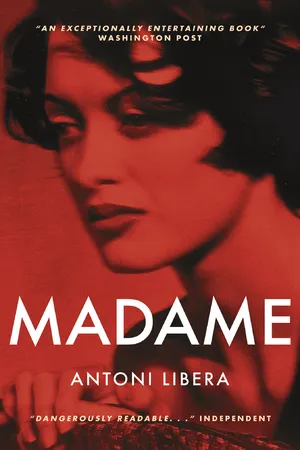
- 448 pages
- English
- ePUB (mobile friendly)
- Available on iOS & Android
eBook - ePub
About this book
Information
THREE
What is the Meaning of the Word ‘Philology’?
It was exactly five o’clock when I pressed the white porcelain knob of the pre-war bell in its decorative surround recessed in the right frame of the door. The door was opened by Constant, in his usual tweed jacket with leather elbow-patches, a pale blue shirt, a small, elegant red-spotted bow tie, dark-green trousers of good thick corduroy and a leather belt with a chrome buckle. On his feet he wore a pair of highly polished brown lace-ups, neatly tied. The left lapel of his jacket bore the purple satin rosebud of the Légion d’honneur.
‘Swiss punctuality,’ he observed, looking at his watch (a gold Longines).
‘I’m told it’s not done to be too punctual,’ I objected, sparing a melancholy thought for the poor Ruhla. ‘Apparently the proper thing is to be a few minutes late.’
‘That depends,’ said Constant, ‘on where you’re going and why. If it’s a party of some kind, then yes, you might indeed arrive a little late. But if you’re going to see someone you’ve already had occasion to visit, especially on business, then punctuality is nothing to be ashamed of. On the contrary, it’s a sign of the best habits.’
From the sitting-room to the right a slim man with a smooth and gloomy face slowly emerged. His hair was brushed flat, with a visible parting, and beneath his shirt collar he wore a carefully tied cravat of wine-coloured silk.
‘And here is your expert,’ said Constant. ‘The Professor. Freddy, that is. Let me introduce you.’
Freddy approached and, piercing me with an intense look, clasped my hand firmly. ‘How verrry nice to meet you,’ he said in a melodious voice. His rs were guttural, rolled in his throat the French way.
‘How do you do. Good evening.’ I shook his hand, a delicate hand with long, agile fingers.
So that’s what he’s like, I thought, searching for a resemblance to Constant but not seeing one. An overbred fogey? A spoilt dandy? A blasé neurotic? What had he been like ten years ago, when he’d studied with Madame?
‘Let’s go in here,’ commanded Constant, turning right into the room from which Freddy had just emerged.
The curtains on the tall windows, which gave onto the courtyard, were already drawn, and the interior of the room was dim. The gloom was dispelled only by a faint yellowish light that came from two small bracket-lamps on the wall above the two armchairs. Between the armchairs stood a low bow-legged table.
‘Sit down,’ said Constant, indicating the armchair on the right, while he himself sank comfortably into the other. Freddy, meanwhile, had vanished silently into the kitchen. ‘How are your parents? Everything all right?’ He crossed his legs, revealing dark plum-coloured socks, smooth over his calves.
‘They’re fine, thank you,’ I said with a polite smile and a slight inclination of the head, conveying that I appreciated his question not merely as the usual gesture of courtesy but as a sign of his loyalty to me: he had kept my request to himself, as I’d asked.
‘Freddy knows all about it,’ he said. ‘But don’t worry, I didn’t give him any instructions. I was a completely neutral, entirely loyal intermediary. I simply told him that you’re about to finish school, are thinking of Romance languages as one of your options, and would like some advice.’
‘Thank you, I appreciate it. And did you happen to mention, by any chance, that I’d also be grateful for some stories from his own days as a student?’
‘No, I didn’t mention that.’
Damn, I thought, clenching my teeth. With a hint of regret I said, ‘Oh . . . that’s too bad. It’s important to me,’ and, thinking that there might still be time to accomplish something before Freddy returned from the kitchen, began to elaborate on the theme. ‘You’ve known me for a long time, and you know how much importance I attach to tradition – to an awareness of what came before, as a point of reference for the present. In fact, to some extent you’re responsible for it. After all,’ I said, with a note of teasing defiance, ‘you’re the one who really awoke in me this tendency to be always . . . testing things against the past.’
‘Testing things against the past?’
‘How else can I put it?’ I looked up at the high ceiling, seeking inspiration there. ‘I mean that whenever you undertake something, you want to know what it was like before. So that you can see yourself against that background, and know where and at what point you’re making your entry on the scene; so that you can judge whether things are on an upswing or a downswing, whether you’re entering some kind of golden age or a twilight of the gods, a period of rebirth or one of decline. Think of our mountain expeditions, when you used to talk about what climbing was like in the past and what modern tourism had done to it. That was an important lesson for me. It made me realise I was living in poor, miserable times and in a rotten world. So I had no illusions, and that meant I couldn’t be disappointed. But you have to look at these things on different scales. The post-war period – especially here, in this country – seems to be a time of decline, regress and degeneration compared to the pre-war world. But even the bottom isn’t entirely flat: there are bumps and concavities, hills and dales. Surely there’s a difference between the dark night of Stalinism, a time of real terror, and what we have now, which is just grey and bleak and miserable? That was the “great purge”; this is “our little stabilisation”. It may be nasty and brutish, but it’s liveable. It’s a normality of sorts. And when I think of this, it occurs to me that now, for the first time, I may have a chance of surpassing the past. Your son, if I’m not mistaken, began university in ’53 – the declining days of the “cult of the individual”. That was a terrible time: draconian laws, informers, denunciations, police surveillance – a nightmare. And they had another way of getting at you – blackmail about your personal life. I’ve heard dozens of stories about how lives were wrecked because of things they ferreted out, poking about in people’s private affairs. Today at least there’s none of that. But I’d like to hear some reminiscences from those days, a few stories – and the gloomier the better. It sounds strange, I know, but it would encourage me. Because it would make me feel that I’m starting from a better position, that for once, “now” is better than “then”. And that would be precious.’
‘It’s funny, what you say,’ said Constant after a moment of silence. ‘But I still don’t quite understand what it is you want to know. What sort of stories?’
My God, I thought, why is he doing this to me? I would have thought I’d made myself clear. ‘Well, you know . . . just stories . . . from his student days, about his friends, what they were like . . . what they did, how they spent their time . . . their social life . . . you know, that kind of thing.’
‘Oh, that!’ He laughed, throwing back his head. ‘Of course, you can ask him. I’m sure he’ll tell you about it, but I doubt whether it’ll be what you seem to want to hear. As far as I know, his memories of those days are quite pleasant. It was a difficult time, of course, but for him it was a happy one. He was soaring then. Everything went well for him in every way, academically and otherwise. The troubles and disappointments came later. Now he’s disillusioned and complains all the time, but then . . . no, things were different then. But if it interests you, go ahead, ask him. I don’t see why not.’
I was about to say, ‘Couldn’t you do it for me?’ when Freddy appeared in the doorway, holding a tray with a porcelain teapot, two cups and a silver sugar bowl with a little lock. This put me off my stride.
‘I don’t suppose you . . .?’ I muttered, but trailed off lamely in mid-sentence, for Constant no longer seemed to be listening. He leapt energetically to his feet, cleared some odds and ends off the little table, extracted from a drawer a large, white, starched linen napkin, and arranged it with fastidious care on the shining mahogany.
‘Voilà!’ he pronounced. Brushing an invisible speck of dust from the napkin, he moved back a step to make room for Freddy, who, balancing his tray on the edge of the table, transferred the objects on the former to the linen-covered surface of the latter. Among them, in addition to teapot, cups and sugar bowl, were two small, delicate Meissen china plates which held, respectively, nuts and French biscuits, and a dainty little jug (also Meissen) with milk. Constant relieved him of the empty tray, put it under his arm and made for the door.
‘Well, now, I’ll leave the two of you alone,’ he said. ‘I wish you a fruitful discussion.’ He sketched an imperial gesture of farewell to the assembled crowds and was gone.
In silence, Freddy poured out tea and offered sugar.
‘Thank you, no sugar,’ I whispered.
‘Ah, you like bitterrness, then,’ he remarked, turning the bowl towards him and plunging the sugar spoon into its depths. ‘I used to like it myself, once.’ He took two heaped spoonfuls of sugar and stirred abstractedly, gazing lugubriously into his cup.
I sat motionless, observing him. A strange man. I couldn’t figure him out. Was this some sort of act put on for my benefit? Was he playing some kind of part? Or was this what he was really like? Gloomy, shut up within himself, with an absent gaze? I didn’t know what to do – charge ahead regardless and try to break through his defences? Offer him something, sacrifice a pawn, in the hope that it might speed things up and allow me to manoeuvre myself into a better position? Or wait, and leave the field to him? Let him speak, let him expose himself? I chose the defensive strategy.
‘So,’ he said finally, taking a sip of tea, ‘you say you’d like to study Rrromance languages. Rrromance philology.’ He looked at me. ‘In our splendid deparrtment.’ His voice dripped with irony and his face contorted into an elaborate scowl of disgust.
‘I’m thinking about it,’ I said evenly.
‘And may I ask why?’ he pursued, still scowling.
It was hardly a difficult question, but I couldn’t seem to find a quick answer. ‘Well, how shall I put it . . .?’ I tried desperately to gather my thoughts.
‘Brriefly and simply would be best,’ he advised.
I shrugged. ‘I like French. I’m fairly fluent. You may find it hard to believe, but in our school the standard is quite high –’
‘You misunderstand me,’ he interrupted wearily. ‘I don’t mean why do you want to study in that deparrtment, I mean to what end?’
‘How do you mean, to what end?’
‘I mean, what do you want to do with it? What are your plans for the future?’
Once again he had me backed into a corner. (‘As early as the fourth move Alekhin is already taking Capablanca by surprise,’ I thought, remembering the commentary on one of the tournament games in which the great José had lost his world title.) Good God, man, I groaned inwardly, have a heart! I didn’t come here to be interrogated, I came to find out something about that woman!
‘I can’t answer a question put like that,’ I said finally. ‘I can only tell you what I’m interested in and what I’d like to learn more about.’
‘Very well,’ he agreed with long-suffering reluctance. ‘Go on.’
‘Well, French culture, generally speaking. Literature, theatre and also philosophy – especially the intellectual current that began with Sartre’s existentialism. You know: Les Temps modernes, Aux Deux Magots, the café at Saint-Germain-des-Prés, L’Imaginaire, Le Mur’ – I threw out the first titles, names and catchwords that came to mind – ‘Les Chemins de la liberté, Camus’s Mythe de Sisyphe, L’Homme révolté, La Chute, the theatre of the absurd, Genet, the nouvelle vague in film . . . that whole legendary intellectual and artistic world, which Simone de Beauvoir describes in such detail in her autobiography. And, since I’ve mentioned her . . . I might, for instance, do a study of her manifesto about the liberated woman, Le Deuxième sexe. For some reason it hasn’t been translated into Polish yet, and as far as I know no serious study of it has ever been undertaken here – except perhaps in university seminars, or in a lecture . . . or someone might have written a thesis on it . . .’
Your move, I thought, and took a sip of tea. If you know something, now’s the time to speak. Take the damn pawn! Accept the sacrifice! And bring out your queen!
Unfortunately he did no such thing. Instead he clicked his tongue disapprovingly three times, frowned and shook his head. ‘That’s bad. That’s verry bad.’
‘Bad?’ I put down my cup, missing the saucer and hitting the edge of the table. ‘What’s bad about it?’
‘Everything, my frriend, everything, from start to finish.’
‘I give up, in that case. Tell me.’ I nibbled a few nuts from the Meissen plate. ‘Tell me why I’m wrong.’
‘You’re wrong for a number of reasons. Let’s start with the simplest.’ He sat up in his armchair and clasped his hands together like an opera singer before an aria. ‘Why is it, when you have so many fine, worthwhile, prrecious things to choose from, that you insist on the tawdry and the shoddy? Tinsel and glitter and plastic jewellery, when you could have genuine pearls and diamonds? You don’t look completely uncivilised, so why, with the whole rrich, glorious trreasury of Frrench culture open before you, overflowing with trrue masterpieces and rreally splendid achievements, do you choose kitsch, junk, the rrotten frruit of decline? Si-mone-de-Beau-voir, I ask you!’ He raised his hands in shocked disbelief. ‘You couldn’t do worse! You’ve hit bottom with that! The drregs! Don’t you feel it? Can’t you see it? Can you tell me just what it is that you see in her? I don’t understand how you can even rread the stuff!’
I felt myself ...
Table of contents
- Cover
- About the Authors
- Title Page
- Copyright
- Dedication
- Contents
- One
- Two
- Three
- Four
- Five
- Six
- Seven
- Postscript
Trusted by 375,005 students
Access to over 1.5 million titles for a fair monthly price.
Study more efficiently using our study tools.
Frequently asked questions
Yes, you can cancel anytime from the Subscription tab in your account settings on the Perlego website. Your subscription will stay active until the end of your current billing period. Learn how to cancel your subscription
No, books cannot be downloaded as external files, such as PDFs, for use outside of Perlego. However, you can download books within the Perlego app for offline reading on mobile or tablet. Learn how to download books offline
Perlego offers two plans: Essential and Complete
- Essential is ideal for learners and professionals who enjoy exploring a wide range of subjects. Access the Essential Library with 800,000+ trusted titles and best-sellers across business, personal growth, and the humanities. Includes unlimited reading time and Standard Read Aloud voice.
- Complete: Perfect for advanced learners and researchers needing full, unrestricted access. Unlock 1.5M+ books across hundreds of subjects, including academic and specialized titles. The Complete Plan also includes advanced features like Premium Read Aloud and Research Assistant.
We are an online textbook subscription service, where you can get access to an entire online library for less than the price of a single book per month. With over 1.5 million books across 990+ topics, we’ve got you covered! Learn about our mission
Look out for the read-aloud symbol on your next book to see if you can listen to it. The read-aloud tool reads text aloud for you, highlighting the text as it is being read. You can pause it, speed it up and slow it down. Learn more about Read Aloud
Yes! You can use the Perlego app on both iOS and Android devices to read anytime, anywhere — even offline. Perfect for commutes or when you’re on the go.
Please note we cannot support devices running on iOS 13 and Android 7 or earlier. Learn more about using the app
Please note we cannot support devices running on iOS 13 and Android 7 or earlier. Learn more about using the app
Yes, you can access Madame by Antoni Libera, Agnieszka Kolakowska in PDF and/or ePUB format, as well as other popular books in Literature & Literature General. We have over 1.5 million books available in our catalogue for you to explore.