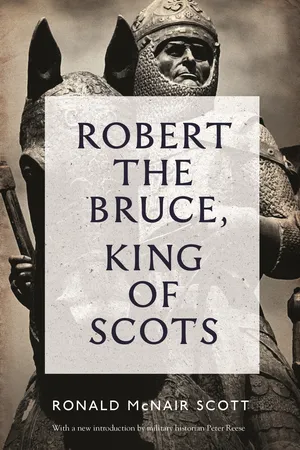
Robert the Bruce had himself crowned King of Scots at Scone on a frozen March morning in 1306. After years of struggle, Scotland had been reduced to a vassal state by Edward I of England and its people lived in poverty. On the day he seized the crown Bruce renewed the fight for Scotland's freedom, and let forth a battle cry that would echo through the centuries.
Using contemporary accounts, Ronald McNair Scott tells the story of Scotland's legendary leader, and one of Europe's most remarkable medieval kings. It is a story with episodes as romantic as those of King Arthur, but also one which belongs in the annals of Scottish History, and has shaped a nation.
- 288 pages
- English
- ePUB (mobile friendly)
- Available on iOS & Android
eBook - ePub
Robert The Bruce: King Of Scots
About this book
Information
PART ONE
1285–1306
Our nation lived in freedom and quietness until Edward, King of England, under colour of friendship and alliance, attacked us, all unsuspecting, when we had neither King nor Head and our people were unacquainted with wars and invasions.
Scottish Declaration of Arbroath, 1320
1
On 14 October 1285 Alexander III, King of Scotland, married as his second wife Yolande of Dreux, descended from Count Robert I of Dreux, a son of Louis VI of France.1 It was a marriage welcomed by his subjects. His first wife Margaret, daughter of Henry III of England, had died in 1275 having borne for her husband a daughter and two sons, Margaret, Alexander and David. But within the space of three years all were dead: the younger son in 1281 unmarried, the elder in 1284 without issue and in 1283 the daughter, who was married to Erik II, King of Norway, died in childbirth leaving as heir to the Scottish and Norwegian thrones a sickly infant Margaret, the Maid of Norway.2 The succession stood in jeopardy.
Alexander III was of a sanguine temperament and during his ten years as a widower, as the Lanercost Chronicle sourly reports, ‘he used never to forbear on account of season or storm, nor for perils of flood or rocky cliffs but would visit none too creditably matrons and nuns, virgins and widows by day or by night as the fancy seized him, sometimes in disguise, often accompanied by a single follower.’3
His marriage to the young Frenchwoman, it might be expected, would concentrate his attentions and give promise of a male heir to the throne.
For over two hundred years, since Birnam Wood came to Dunsinane and the forces of Malcolm III had defeated and slain Macbeth, the House of Canmore had been the rulers of Scotland. During the reigns of eight succeeding kings of that blood, by conquest or by treaty, the realm had been enlarged so that when Alexander wed Yolande she became the queen of a kingdom which differed little in extent from the Scotland of the present day.
But the population was much smaller. The inhabitants numbered fewer than 500,000. The majority were Celts, mainly north of the Forth and Clyde and in the southwest. There were Norsemen in Caithness, Sutherland and the Western Isles, Anglo-Saxons in Lothian; and along the east coast in ports that sound like a drum roll– Inverness, Elgin, Aberdeen, Perth, Montrose, Dundee, Edinburgh, Berwick – were colonies of foreign merchants: Germans from the Hanseatic towns, Scandinavians from the kingdom of Norway, Frenchmen from Gascony and, more numerous than the rest, Flemings from the Low Countries. Aberdeen was virtually a Flemish enclave and in Berwick they had their own headquarters, ‘the Red Hall’, held directly from the Crown on condition that they would always defend it against the King of England.4
The country too was infinitely wilder. Vast forests of the native Scottish pine abounded, dark and impenetrable, in which wolves and the wild boar still roamed and wide wastes of moor and bog, mountain and water covered much of the land. Apart from the king’s highway, the via regis, few roads were capable of carrying wheeled traffic except in a dry summer. Transport was mostly by pack horse along tracks which might become impassable in winter. Bridges were few and far between. Within little more than a decade the great forests and deep ravines, the mist-hung hillsides and rugged tracks were to become the salvation and refuge of desperate men.
But in the year of Alexander III’s wedding Scotland was still at peace: a prosperous and settled kingdom. For nearly a hundred years her English neighbours, torn by internal feuds and continental wars, had little leisure to turn a predatory eye northwards and Norway, having launched a formidable armada against the west coast in 1263, had seen her ships tossed and scattered by a violent storm and the stragglers who landed in Ayrshire easily defeated at the battle of Largs. In 1266 by the Treaty of Perth the Norwegians ceded the Isle of Man and the Western Isles, except the Orkneys and Shetlands, to Scotland in return for a monetary tribute and a growing collaboration between the two countries was cemented by the marriage of Alexander’s daughter to the Norwegian King.5
Thus for the thirty-six years that he had reigned Alexander III and his people had enjoyed a period of tranquillity unparalleled by any other western kingdom at that time. In this fostering climate of peace, agriculture and trade made steady progress. Under the lead of the Scottish Church, which had been strengthened and enlarged by many royal grants of land, improvements had been made in the art of tillage and the management of livestock. New clearings and new grazings had been brought into production by the joint efforts of landlord, thane and peasant. An expanding export trade in wool, hides, timber and fish with England, the Low Countries, the Hanseatic towns and Scandinavia had brought an increased flow of riches to the merchants and landowners which percolated throughout the whole society. The eastern ports hummed with activity. Berwick, at one extremity, was described by a contemporary English writer as ‘a city so populous and of such trade that it might justly be called another Alexandria, whose riches were the sea and the water its walls.’6 At the other extremity Inverness was a shipyard for mighty vessels.7
But affluence without security is a cause more for anxiety than for comfort. It is because the turbulent elements among the Scottish people had, by the reign of Alexander III, been brought under control by the network of a feudal organization that trade flourished, the traveller could ride unharmed, the peasant could reap his crops and the craftsmen and purveyors clustered in the royal burghs could pursue their avocations without one hand upon their swords.
The feudal system was based on the concept that all land belonged to the king and that he leased large provinces to his leading noblemen as tenants-in-chief in return for their oath of fealty and their pledge to bring to his aid, in time of war, a stipulated number of armed knights. In like manner, in a descending gradation of sub-tenure, these vassals of the Crown divided the land which the king had granted to them into smaller estates which they leased to knights and gentlemen in return for their service in war and attendance in peace. They, in turn, leased their land to lesser men who cultivated it with or without husbandmen and serfs and would present themselves to their masters at the call to arms, with shield and spear.
It had a profound economic base. War, in the Middle Ages, was the central factor of political life and the dominating element in war was the mailed warrior mounted on his horse. The ruler who aspired to enlarge or protect his possessions required a force of armed cavalry: a force which by its combination of shock and mobility was as irresistible against men fighting on foot as tanks against savages.
To mount and arm such a warrior required a long purse. Horses bred for carrying and staying power, suits of chain link mail beaten out by the armourer for individual fitting, helmets, shields, lances, swords, battle axes and maces, squires for arming, grooms for the horses: all these were costly. To manage the horses, to wield the weapons required continuous training. The knight was a fighting specialist. He had no time to earn his living so he was allotted land for his service from which he could draw rents in money or in kind to defray his expenses. He was both the mailed fist of the king and the shield of his subjects.8
The system originated among the Franks. It was perfected in England under William the Conqueror and his sons and was introduced into the Celtic kingdom of Scotland by David I on his assuming the throne in 1124.
David had been brought up in the English court where his sister was married to Henry I of England. He had been greatly favoured by his royal brother-in-law. In Scotland, with English support, he had established himself in Lothian and Strathclyde as a virtually independent ruler within the kingdom of his brother, King Alexander I.
In England, by marriage and kingly sanction, he had acquired the huge ‘Honour of Huntingdon’ with broad lands spreading across the counties of Huntingdon and Northamptonshire. There, among his tenants-in-chief, were a clutch of Anglo-Normans deriving from the same region on the borders of Normandy and Brittany, the Morevil-les, the Soulises, the FitzAlans, the Bruces. When David I took over the governance of an unruly kingdom, it was to these he looked to set up military fiefs in sensitive areas each with its castle and Norman lord.
Other Anglo-Normans followed in their train: Comyns and Bal-liols, Sinclairs and Frasers, Mowbrays and Hays, and were granted charters for land in Scotland. Contemporaneously the great Celtic landowners, who had hitherto held their land by tribal custom, had their possessions and privileges confirmed by charters from the Crown. On the whole this proceeded smoothly. There was no dispossession of existing landowners. The lands granted were from estates which had been forfeited to the Crown or where native families had died out or from the royal demesnes.
Gradually, the kingdom became dotted with castles, some great stone edifices built on upthrusts of rock such as Edinburgh or Stirling, some on precipitous sea cliffs such as Turnberry or Dunaverty. But the majority were simple mottes, huge earthen mounds surrounded by wooden stockades and deep ditches with a central tower skirted by wooden living quarters, each forming a sentinel for the security of the area and a focus for the local community.
Such central government as existed was provided by the king and the officers of his household: the constable, the king’s chief military officer, flanked by the marischal in special charge of the cavalry element; the chamberlain who provided for the costs of administration from the royal rents, feudal dues and other imposts; the chancellor, the keeper of the royal seal and Crown records who besides presiding over the king’s chapel was virtually a secretary of state for all departments. He was invariably a cleric and was assisted by numerous chaplains and clerks to undertake the necessary written documents for the ordering of the kingdom. The fourth great...
Table of contents
- Cover
- Title Page
- Copyright Page
- Contents
- Illustrations
- Preface
- Chronology
- Part One: 1285–1306
- Part Two: 1306–1314
- Part Three: 1314–1329
- Epilogue
- Bibliography
- References
- Notes
- Index
Trusted by 375,005 students
Access to over 1.5 million titles for a fair monthly price.
Study more efficiently using our study tools.
Frequently asked questions
Yes, you can cancel anytime from the Subscription tab in your account settings on the Perlego website. Your subscription will stay active until the end of your current billing period. Learn how to cancel your subscription
No, books cannot be downloaded as external files, such as PDFs, for use outside of Perlego. However, you can download books within the Perlego app for offline reading on mobile or tablet. Learn how to download books offline
We are an online textbook subscription service, where you can get access to an entire online library for less than the price of a single book per month. With over 1.5 million books across 990+ topics, we’ve got you covered! Learn about our mission
Look out for the read-aloud symbol on your next book to see if you can listen to it. The read-aloud tool reads text aloud for you, highlighting the text as it is being read. You can pause it, speed it up and slow it down. Learn more about Read Aloud
Yes! You can use the Perlego app on both iOS and Android devices to read anytime, anywhere — even offline. Perfect for commutes or when you’re on the go.
Please note we cannot support devices running on iOS 13 and Android 7 or earlier. Learn more about using the app
Please note we cannot support devices running on iOS 13 and Android 7 or earlier. Learn more about using the app
Yes, you can access Robert The Bruce: King Of Scots by Ronald McNair Scott in PDF and/or ePUB format, as well as other popular books in History & British History. We have over 1.5 million books available in our catalogue for you to explore.