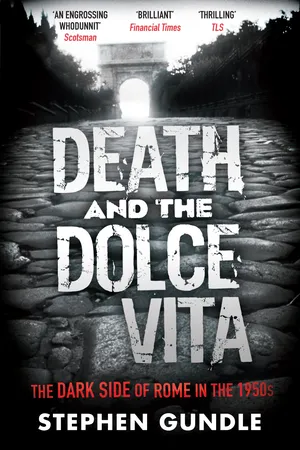
On 9 April 1953 an attractive twenty-one-year-old woman went missing from her family home in Rome. Thirty-six hours later her body was found washed up on a neglected beach at Torvaianica, forty kilometres from the Italian capital. Some said it was suicide; others, a tragic accident. But as the police tried to close the case, darker rumours bubbled to the surface. Could it be that the mysterious death of this quiet, conservative girl was linked to a drug-fuelled orgy, involving some of the richest and most powerful men in Italy? It was a crime that the newspapers, the public and one particularly determined detective wanted to get to the heart of.
The short life and tragic death of Wilma Montesi was played out against a fascinating backdrop. By the 1950s Italy, in the wake of Mussolini's brutal Fascist government, was in the process of reinventing itself. And with the help of Hollywood stars such as Audrey Hepburn and Gregory Peck, it seemed to be succeeding. Suddenly Italy, and Rome in particular, was the most glamorous place on earth. But the murder of Wilma Montesi exposed a darker side of Roman life - a life of corruption, cover-ups and carnal pleasures.
In Death and the Dolce Vita the distinguished cultural historian Stephen Gundle uses the gripping and tragic story of Wilma Montesi to explore the fascinating contradictions of this most complex country.
- 416 pages
- English
- ePUB (mobile friendly)
- Available on iOS & Android
eBook - ePub
About this book
Information
PART ONE
I
The Body on the Beach
The Montesi family lived in a large apartment block built in the 1920s to house public employees. A handsome seven-storey building with an elegant, decorative façade, it featured eight internal stairwells and a large central courtyard embellished with palm trees and a fishpond. Wilma’s maternal grandfather, a post-office clerk, had originally been allocated the three-room, third-floor apartment on Staircase 5 – no. 9. The low rent meant that Wilma’s father, Rodolfo, who had moved in after his marriage, could save enough money to establish his own carpentry business.
Rodolfo was a thrifty type who liked to think of himself as a poor artisan, even though by 1953 he employed two men in his workshop. He was known for his fine furniture and cinema fittings – the Holiday cinema in Largo Benedetto Marcello, which in the 1950s was called the Astra, still boasts examples of his craftsmanship. His daughters addressed him affectionately as ‘Papetto’ but his parenting style was neither relaxed nor informal. He wouldn’t countenance the idea of his daughters working and kept them on a short leash.
Maria, his wife, was short, rotund, and known for her showy elegance, her lively temper and her frequent emotional outbursts. She was the dominant figure in a household that, until 9 April, had included twenty-four-year-old Wanda,Wilma, their younger brother Sergio, aged seventeen, and Maria’s elderly parents.Wanda wasn’t as pretty as Wilma – her features were similar, but she had a large nose and a dumpy figure. She also lacked the poise that made Wilma stand out. She was closer to her mother than Wilma was, mainly because she was less argumentative and a good listener. Sergio was the cleverest of the bunch. A studious boy, he would be the first in the family to graduate from university.
The family’s living conditions were cramped, but not unusually so for the time. The girls slept on narrow beds in the living room while Sergio occupied a bed in his grandparents’ room. Everyone gathered at the dining table to sew, read, do homework and talk. They had a telephone, a gramophone and a radio.
Rodolfo, Maria and their offspring were accustomed to dining together at eight thirty p.m. sharp. Maria and Wanda had changed their plans at the last minute and had gone to see John Ford’s The Sun Shines Bright at the nearby Astra cinema instead of The Golden Coach.When they returned to via Tagliamento they noticed that there were no lights on in the apartment – a sure sign that Wilma was still out. The two women began preparing the meal and at eight thirty, after Rodolfo and Sergio had come home, everyone sat down. By nine o’clock, when Wilma still hadn’t arrived, they started to worry. What could have delayed her? Had she had an accident? Wanda stood up and walked round the apartment. She found the bracelet, necklace and photograph of Wilma’s fiancé, which her sister always carried with her, on the chest of drawers in her parents’ bedroom. Her identity card was there too.
In the hours that followed, they made desperate attempts to find her. Sergio went off with a neighbour on a scooter to tour the hospitals in case there had been an accident. Rodolfo, for some reason fearing suicide, rushed to Ponte Garibaldi over the River Tiber – several people had jumped off it to end their lives – and then to the district police station to report his daughter’s disappearance. Finally he took the tram to the Policlinico hospital.
Meanwhile, Maria went to quiz the concierge and spread the word among the neighbours of her daughter’s disappearance. At nine thirty she called her father-in-law Riccardo, the only close relative with a telephone: two of her husband’s siblings lived with their father. She was told that Wilma had visited the previous day but that they hadn’t seen her since. Rodolfo’s sister Ida ran to the Montesis’ apartment block and found Maria in the street on her knees, crying, ‘Wilma, come back! I forgive you!’ She wondered if a quarrel lay behind Wilma’s disappearance.
Rodolfo and Sergio returned, hoping to find that Wilma had reappeared. She hadn’t, and their concern continued to mount. At eleven o’clock, when Rodolfo’s youngest brother Giuseppe – known in the family as Peppe or Peppino – heard the news he drove to Via Tagliamento. He owned a Fiat Topolino Belvedere and offered to take Rodolfo to search for Wilma. They patrolled nearby streets, explored a park and ended up at Rodolfo’s workshop. Having found no trace of her, they phoned home, where Maria, Wanda, Sergio and Ida were waiting for news.
When Rodolfo and Giuseppe got back to the apartment, they found Wanda and Sergio trying to comfort Maria. They learned that although Wilma had left her photograph, she had taken her keys, which indicated that she had expected to return. The spectre of suicide receded.
At midday, on Friday, 10 April, Rodolfo went once more to the district police station, where the duty officer tried to reassure him. It was too early for the police to get involved, he said: lots of perfectly good girls left home for one reason or another, only to reappear after a short time. Dissatisfied, Rodolfo sent a telegram to Angelo Giuliani, Wilma’s fiancé: ‘Wilma missing: reasons unknown.’ Perhaps he thought she might have fled to her future husband. He would soon learn that hadn’t.
Rodolfo’s next move was to go to Police Headquarters. Here the police took his concern seriously but Rodolfo was horrified – and intensely angry – when the officer dealing with him checked the register of prostitutes arrested the previous night for soliciting. Wanda, meanwhile, had gone to consult a fortune-teller, who assured her that she would soon hear something.
Early on the morning of Saturday, 11 April, Giuliani phoned Rodolfo for news. On learning that there was none, he told his potential father-in-law that if he wanted him to come to Rome he had to send a more alarmist telegram. Otherwise he wouldn’t be granted leave. Wilma’s father obliged and in the process revived his initial fear: ‘Suicide likely. Keep calm. Come immediately.’ The family still had no idea what had happened to Wilma. Suicide still seemed improbable but could not be entirely discounted – Maria’s mother had attempted to kill herself as a young woman and the memory of that event had entered family lore. If there had been an accident, it would surely have been reported by now.
Bereft of ideas, they searched for other explanations. Curiously, given their later insistence that Wilma had had no secrets, they even imagined an elopement.Wanda recalled that, some years earlier, during a stay at the family’s holiday home at Rocca di Papa, Wilma had become infatuated with a local engineer – he had been married and probably hadn’t noticed the effect he had had on the teenager. But on Sunday morning Giuseppe, with his fiancée, Mirella, and Sergio, went to Rocca di Papa.When they confronted the man, he had no recollection of Wilma, let alone information on her current whereabouts, so the trio returned to Rome.
Giuliani arrived from the southern town of Potenza early on Sunday, 12 April, having travelled through the night. He gulped some coffee, then went with Rodolfo to the local police station, where they asked if there was any news. An officer was reading a newspaper, which reported that a body had been found near the fishing village of Torvaianica: the previous morning, at seven thirty, a young building worker had come across it on his way to work.A beautiful unidentified girl had been washed up on the beach.
Fearing the worst, Rodolfo and Giuliani left the station and hastened to the mortuary.When Giuliani recognised Wilma on the slab, and noticed certain marks on her face, he cried, ‘They have killed her, my poor Wilma.’
In those days Torvaianica was not the desirable resort it would one day become. It was a simple fishing village, set on a barren stretch of coastline. Early on Monday, 13 April, Giuseppe drove Giuliani, Rodolfo and Sergio there. By now the elite mobile squad of Rome’s bloated police force had taken over the case. But Giuliani was not content to leave the matter to them: he and the other three men were determined to find out for themselves how Wilma had ended up in such an unlikely place.
Their minds must have been racing as they approached the coast.The so-called Zingarini area of Torvaianica where Wilma had been found was barely inhabited, apart from a few fishermen, peasants, gamekeepers and their families. They discovered, though, that it was popular with courting couples from Rome: lacking privacy at home, young people often sought out secluded spots to make love. Many used the Borghese gardens in the city, but those with their own car could venture further afield.
The four men were shown where Wilma had been found. A makeshift cross tied with string had been stuck in the sand by a photographer keen for a picture and some flowers had been placed by it. Locals told them that the body had looked fresh, not like that of a drowned person. Two villagers had some interesting information: Jole Manzi and Anna Minniti claimed they had seen a girl wearing Wilma’s distinctive coat in the area on 8 April, the day before the girl disappeared. Others said that a large car carrying a man and a dark-haired young woman had been spotted a few days before. They suggested that the Montesis and Giuliani make more enquiries further along the coastal road, which had not yet been formally opened to traffic, where there was a hunting estate: it was frequented by well-to-do people from the city.
The four men took this advice but struggled to find their way and had to ask for directions. Eventually, they came to a large iron gate, the estate’s entrance. Convinced that there might be something to learn on the other side, they tracked the perimeter fence, calling for assistance. When a guard appeared and challenged them, they showed him a photograph of Wilma. Anastasio Lilli let them in and took them to his wife, who was in bed, unwell. She had been at the gate on 9 April and had seen a luxury saloon carrying a man and a young woman. However, when she saw the picture of Wilma, she was unable to confirm that she had been the woman on board.
Frustrated, the men made their way back to Rome. They had found nothing, but they were forced to contemplate the possibility that someone had taken Wilma to the area where her body was discovered.
This was apparently confirmed the next day when a local worker, a mechanic named Mario Piccinini, claimed that he had seen the Montesi girl in a car one night early in March. He had been approached at the nearby Castel Fusano station by a railwayman who had asked if he could help free a car that was stuck in the sand. Piccinini had helped to push it while the driver’s young brown-haired female companion sat inside. Piccinini remembered the model: an Alfa Romeo 1900cc saloon, a luxury vehicle not long on the market. Thinking it might be significant, he had reported the event to the police station in Ostia soon after the body had been discovered on 11 April. When he had seen Wilma’s picture in the newspaper, he had said that the girl in the car perfectly resembled her.
Had she been to that area before with the vehicle’s owner?
In Via Tagliamento, the telephone rang constantly. One unexpected call was from a Rosa Passarelli, a clerk at the Ministry of Defence. She was sure she had seen Wilma on the five thirty p.m. train to Ostia on the Thursday afternoon.When she had read about her in the newspaper she had decided not to go to the police but to contact the family. After some hasty consultations, Rodolfo and Maria invited her to pay them a visit. Smartly dressed and articulate, the thirty-five-year-old Passarelli described to the family Wilma’s unusual green and yellow coat, then commented on her neat appearance and ladylike deportment. From this portrait, the parents recognised their daughter.Aldo Morlacchi, a plainclothes officer from the police mobile squad, happened to be in the apartment when she arrived: he watched as the parents showed her some photographs, which she confirmed were of the girl she had seen on the train.
But why had Wilma taken the train to Ostia? It seemed an unlikely journey to undertake so late on a cold April afternoon, and it didn’t fit the Wilma the family had known. As they pondered, Passarelli suggested it might be best for all concerned if her death were to be regarded as accidental.That way trouble would be avoided: there would be no unwanted publicity and Wilma’s reputation would not be called into question. The policeman agreed, and it was at this point that Wanda said her sister had spoken of going to the seaside to soothe her feet – Wilma had tried to persuade her to join her but Wanda hadn’t wanted to go.The family quickly concluded that Wilma must have gone to the coast to bathe her feet but, perhaps due to her period, had fainted, slipped into the water and drowned.
At last the police were taking an active interest in the case. Morlacchi’s superior, Alfredo Magliozzi, had heard about Angelo Giuliani’s exclamation in the mortuary and wanted to find out what lay behind it – hence the policeman’s presence in the apartment. He also ordered that enquiries should be made in Ostia where several people claimed to have spotted the girl. A nanny swore she had seen her on a stretch of beach immediately next to the area reserved for trainee members of the Financial Police.Two students had noticed a girl they now thought had been Wilma at the Miramare bar with two other girls and a man. The party had arrived in an Alfa Romeo 1900. A news-vendor said she had sold a postcard to a girl resembling Wilma at around seven p.m – she had lent her a pen to write a message and then had offered to post the card to the girl’s fiancé, a soldier.
It was doubtful, though, that even if Wilma had been in Ostia and had somehow fallen accidentally into the water, her body could have been carried to where it was found. The harbour master’s office said it was unlikely that a body could be swept, within thirty hours or so, the twenty kilometres from Ostia to Torvaianica, even on a night when the currents were flowing fast, as they had been on 9 April.
The possibility that Wilma had committed suicide still hung heavily over the family. As she had not taken her jewellery or her fiancé’s photograph with her, as she usually did when she left the house, the local Salario police station in Rome initially recorded the death as suicide – and suicide meant that Wilma would be denied a religious funeral. Such a verdict would cast a cloud over the entire household, possibly even prejudicing Wanda’s chances of finding a husband. Instead the Montesis embraced the theory of the accident, even though it was based on little more than conjecture. More than anything, Rodolfo and Maria wanted a plausible story that preserved Wilma’s respectability.
Respectability was important to a family like the Montesis and they clung to it like limpets to a rock.The girls had been too young to be tempted by the quick cash earned by women who had consorted with American troops during the Allied occupation, or to be pimped by a desperate family.The Montesis had weathered the final stages of the war and its aftermath, facing fewer troubles than many. They had not starved or lost their home, and while work was sometimes scarce, it had never dried up completely.The relatively affluent community in the Salario area had somehow held together.
In other districts of the capital it was a different story. Prostitution had flourished as women had serviced troops with time on their hands and money to spend. In his epic film of the liberation, Paisà, Roberto Rossellini had chosen prostitution as the theme for the Rome episode: a middle-class girl full of hope and joy at the outset has become, by the end, a whore, unrecognisable to an American soldier to whom she had offered some welcome refreshment a few months earlier.
Respectability did not amount to morality – the Church was always prepared to forgive the penitent sinner. Once lost, respectability could not – like a young woman’s virginity – be reacquired. It was a matter of social standing. In the face of the fortunes accumulated by those who had done well out of the war and the liberation, the relatively impoverished lowermiddle class consoled itself with conventional markers of decorum: sexual continence went with being well dressed, attending mass at the major religious festivals, keeping the home clean, the women off the labour market, working hard and taking holidays. Although Rodolfo sometimes struggled to keep his business afloat, Maria dreamed of a splendid future for the family, and had conveyed this idea to her daughters.
So, the Montesi family were determined to defend Wilma’s reputation at all costs.The case of the ‘beautiful woman’ whose lifeless corpse had been spewed up by the sea had been frontpage news in the Roman daily Il Messaggero on 12 April. The following day she was named and the talk was of why she might have committed suicide. Indignant at this interpretation, the family issued a statement to the press:
Wilma was a calm and well-adjusted girl. She was engaged to a policeman whom she was planning to marry in December. Everything was ready for the wedding, including a house in Foggia [Angelo’s home town], where the couple would have moved after the wedding. Wilma was only twenty-one, life was smiling on her, and a happy event awaited her. She had no reason to give up. Besides, she had never shown signs of depression or of dejection. She did not leave a single line of explanation. We are sure Wilma did not kill herself.
Meanwhile the police continued their enquiries. They conducted searches along the coast between Ostia and Torvaianica for the missing shoes, stockings, skirt, suspender belt and handbag, on the assumption that Wilma must have removed them and left them on the beach somewhere. They found more witnesses near Ostia who claimed to have seen Wilma, although some of the testimonies were confused or referred to the wrong day. Oddly, the police did not attempt to track down the mysterious owner of the Alfa Romeo 1900cc saloon, even though there were no more than three hundred in Rome.
On 14 April, an autopsy was performed by two forensic specialists, Dr Fracche and Dr Carelli. Those who asked why it had not been carried out sooner were told that no one had been available at the weekend. Journalists were eager to know the results – and so were the public.
It produced some new facts. Crucially, the time of death was backdated by a day and a half: Wilma had died not on 10 April, but the day before, on the Thursday on which she had disappeared. In support of the fainting hypothesis,Wilma’s heart was found to be slightly smaller than normal. On the other hand, she would not have been weakened by her period since she was close to the end of her cycle. As for the foot irritation, no trace of eczema or rubbing was found. No poison, drug or alcohol was identified in the stomach, although there was evidence that ice cream had been consumed. There was no obvious sign of violence on the body, although there was some superficial bruising. Death had been caused by drowning.
This document, and the report compiled by the mobile squad that summed up their enquiries and included information about Wilma’s reputation and habits, enabled the police commissioner for Rome to call a press conference. Saverio Polito was seventy-four, kept on past retirement age on account of his standing with his political bosses, and well used to handling awkward matters.A Neapolitan, with a direct manner, he informed his audience of reporters at Police Headquarters that he had delivered his opinion on the cause of Wilma Montesi’s death to the national head of police, Tommaso Pavone, and was terminating the investigation.The matter was simple, he said. The girl had gone to Ostia by train. After writing a postcard to her fiancé, she had selected a quiet place on the beach and removed some items of clothing in order to paddle more easily in the sea. She had lost consciousness, was sucked into the water and drowned. Her body was carried away by a strong current and eventually washed up on the beach further down the coast.
It ...
Table of contents
- Cover
- Also by Stephen Gundle
- Title Page
- Copyright Page
- Dedication
- Contents
- Dramatis Personae
- Prologue
- Part One
- Part Two
- Part Three
Trusted by 375,005 students
Access to over 1.5 million titles for a fair monthly price.
Study more efficiently using our study tools.
Frequently asked questions
Yes, you can cancel anytime from the Subscription tab in your account settings on the Perlego website. Your subscription will stay active until the end of your current billing period. Learn how to cancel your subscription
No, books cannot be downloaded as external files, such as PDFs, for use outside of Perlego. However, you can download books within the Perlego app for offline reading on mobile or tablet. Learn how to download books offline
Perlego offers two plans: Essential and Complete
- Essential is ideal for learners and professionals who enjoy exploring a wide range of subjects. Access the Essential Library with 800,000+ trusted titles and best-sellers across business, personal growth, and the humanities. Includes unlimited reading time and Standard Read Aloud voice.
- Complete: Perfect for advanced learners and researchers needing full, unrestricted access. Unlock 1.5M+ books across hundreds of subjects, including academic and specialized titles. The Complete Plan also includes advanced features like Premium Read Aloud and Research Assistant.
We are an online textbook subscription service, where you can get access to an entire online library for less than the price of a single book per month. With over 1.5 million books across 990+ topics, we’ve got you covered! Learn about our mission
Look out for the read-aloud symbol on your next book to see if you can listen to it. The read-aloud tool reads text aloud for you, highlighting the text as it is being read. You can pause it, speed it up and slow it down. Learn more about Read Aloud
Yes! You can use the Perlego app on both iOS and Android devices to read anytime, anywhere — even offline. Perfect for commutes or when you’re on the go.
Please note we cannot support devices running on iOS 13 and Android 7 or earlier. Learn more about using the app
Please note we cannot support devices running on iOS 13 and Android 7 or earlier. Learn more about using the app
Yes, you can access Death and the Dolce Vita by Stephen Gundle in PDF and/or ePUB format, as well as other popular books in History & Italian History. We have over 1.5 million books available in our catalogue for you to explore.