"I have no idea why everyone thinks nature is so benign and glorious and wonderful. All nature is trying to do is kill us as efficiently as possible."
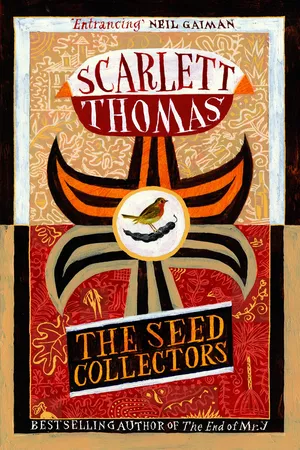
Great Aunt Oleander is dead. To each of her nearest and dearest she has left a seed pod. The seed pods might be deadly, but then again they might also contain the secret of enlightenment. Not that anyone has much time for enlightenment. Fleur, left behind at the crumbling Namaste House, must step into Oleander's role as guru to lost and lonely celebrities. Bryony wants to lose the weight she put on after her botanist parents disappeared, but can't stop drinking. And Charlie struggles to make sense of his life after losing the one woman he could truly love.
A complex and fiercely contemporary tale of inheritance, enlightenment, life, death, desire and family trees, The Seed Collectors is the most important novel yet from one of the world's most daring and brilliant writers. As Henry James said of George Eliot's Middlemarch, The Seed Collectors is a 'treasurehouse of detail' revealing all that it means to be connected, to be part of a society, to be part of the universe and to be human.
- 384 pages
- English
- ePUB (mobile friendly)
- Available on iOS & Android
eBook - ePub
The Seed Collectors
About this book
Information
Holly’s Friendship Tree
It is a chilly spring morning in Hackney, but in Charlie’s mind he is somewhere else, somewhere perhaps sub-tropical, definitely pre-fertile-crescent, somewhere where there is no wheat swaying in the breeze and quietly enslaving people. In this place, Charlie, a hunter-gatherer wearing a simple garment made not from cotton but from skin, plucks some blueberries from a tree. He steals a small amount of honey from a bees’ nest, perhaps led there by the honey-guide – a bird that evolved along with humans and uses its song to tell people where to find bees’ nests in return for the beeswax the humans drop. Perhaps there are some primitive wild oats too – dodgy, but not as bad as contemporary wheat, which studies have shown stimulates the same neurological pathways as opiates. Charlie should use these ingredients to make a simple muesli, in which the nuts and fruits far outnumber the oats, but, even though he knows it is unlikely that you would come across a microwave in this pre-agricultural, sub-tropical wilderness, he still fancies porridge after his run.
Charlie was brought up to be a proper scientist, and not to fall into the trap of giving evolution by natural selection (evolution on its own has been around for a lot longer) the indignity of consciousness, even though the whole thing sped up almost seems conscious in the same way that the walking palm sped up seems to be walking. He should not think that the honeyguide deliberately decided to help the humans in return for the beeswax, because this is not how nature happens. In nature everything is completely random, and the things that work, well, work and so they endure. That’s it. Oh, except for the Darwinian twist which is that things only change when life is so dangerous that everything that doesn’t work dies. This is why humans are now so pathetic: they have no predators. Since the agricultural revolution 10,000 years ago, which led to barns full of grain, basically living seeds that don’t want to be eaten, not really, and will get their revenge, but for the time being meant people could stop starving and start political debates, legal systems and wars, there has been no selection pressure on human beings.
Even the obesity epidemic, some believe caused by the barns of grain, does not stop people being able to reproduce. There is nothing that kills screwed-up humans before they can fuck, except perhaps online bullying and severe anorexia. Charlie had a very interesting conversation about this with Skye Turner at Oleander’s funeral supper last week. Skye Turner and Bryony were talking about high heels, and Skye Turner said that evolution had made people become taller in the last 200 years. Charlie laughed at her, and Bryony glared at him. But he explained that this is simply not true because in that time period nothing came along and wiped out the short people. The gene for being short was not destroyed. In the history of civilisation there has never been a famine that favoured tall people (and presumably also giraffes?) by providing food that only grew at the tops of trees. In the last 10,000 years, Charlie said, he would guess that very few short people have died because they can’t reach fruit, or catch fish or kill enough prey or because they get eaten by taller things. Short people just go to Sainsbury’s like everyone else.
‘So why did people get taller, then?’ Skye asked him.
‘Phenotypes, baby,’ said Charlie. ‘Expression of genes.’
And even though Bryony kept glaring at Charlie, Skye Turner lapped this up to the extent that, OK, she did give him her number, which meant he could have fucked her. A pop star! With really a very nice . . . And then Fleur glared at Charlie as well, which meant he threw the number away, and in her kitchen bin too, hoping that she would notice. As Charlie opened Fleur’s bin to do this he was taken aback by how elegant, colourful and exotic its contents were: the dark yellow wrappers from her homemade hibiscus truffles; the pieces of bright green lime from the cocktails; the poppy leaves smeared red with saffron. Yes, Fleur manages to have a beautiful bin. How is that even possible?
Charlie makes his porridge with bottled spring water, of course, as Palaeolithic man would not have had access to anything resembling North London tap water, that in any case often tastes of bleach, metal, hash and/or semen and in which traces of cocaine have recently been found. Of course, Charlie’s double espresso is also not quite authentic, although he reckons that Grok, which is what nerdy people on the internet call the ideal primal man, would not exactly have turned it down if some other caveman had offered it to him. The big question, of course, is whether Palaeolithic man had sex toys. According to some evolutionary psychologist whose name Charlie has forgotten, and who was actually a bit of a twat, once fire was discovered, women agreed to cook stuff for men in return for their protection, thus beginning the first ever dysfunctional nuclear family. And as if men couldn’t cook for themselves anyway. But in this scenario all you have to do is go ‘Ug, ug’ at another caveman every so often and in return you get hot food and fucking. But what kind of fucking? In the shower Charlie imagines his really quite young cave girl on all fours with one dinosaur bone in her cunt, and one up her arse, sucking his cock, while a fire burns in some sort of primitive cauldron. He is halfway through really quite a nice wank when he hears his phone bleep a text message. Izzy? He’s dreading facing her this morning, and a friendly message would just . . . But when he gets out of the shower he finds it’s just his daily text from his bank, telling him he is nearing his overdraft limit.

Someone call a fucking mathematician! Ollie’s To Do list (yes, since he turned forty he has To Do lists) is taking so long to write that it’s becoming clear that even writing the list is going to have to be one of the things on the list. Can a To Do list contain its own construction? Can it exist as a set within a set, or an instruction within an instruction, as a recursive positive feedback loop or whatever? Ollie imagines himself at a dinner party with Derrida, and this is what he’s saying to him, and Derrida is nodding and laughing in a French way and saying that this is the most insightful thing about a To Do list that he’s ever heard. Barthes is there too, saying that if he could only come back to life and rewrite Mythologies, then he would include this concept of the To Do list, and Ollie’s reading of it, and use it as a way of defining and, yes, OK, almost satirising (if close reading can be satirical on purpose, which Ollie actually doubts) the whole of the work-mad early twenty-first century.
So Ollie does add Write To Do list to his To Do list, partly as a philosophical, mathematical, metaphysical joke, yes, joke, but mainly so that he can, in theory at least, start the day by crossing something off. Ollie has never, ever seen Clem write a To Do list, but if she did write them they’d probably be specific, achievable and so on. Ollie’s To Do lists are not like that. They always contain everything that he intends to do with the rest of his life, more or less, or at least the next two years, and he makes no distinction at all between short-term goals and long-term goals, or between things to do today, this week, this month and this year. As a result, Ollie can not only never finish writing his To Do list (all right, yes, keep laughing, Derrida, you big-haired fucking French genius) but has to keep infinite fragments of To Do lists strewn around his desk because Ollie can never cross off all the items on any To Do list he ever makes, because they always contain things like ANSWER ALL EMAILS and Organise next year’s teaching and Apply for big grant and Book dental appointment and Overhaul Eighteenth-century website (which would give Derrida another laugh, if you think about it).
Did Derrida have to blow-dry his hair like that, or did he in fact . . .
There’s a knock at Ollie’s door. Ollie’s door is always closed, because he always has things to do. Other colleagues leave their doors semi-open if they don’t mind being disturbed, which is probably what Clem does all the time, not that Ollie is allowed to visit her at work because it might be seen as unprofessional or too domestic or something. Ollie can’t possibly ever have his door semi-open because he is never even semi-available because he has SO MUCH TO FUCKING DO, as evidenced by his To Do list, to which he has just added, as well as Write To Do list, Read papers for USC, which he has to do by half one today. As well as that, he has to, as usual, ANSWER ALL EMAILS. At this moment, Ollie has 3,000 emails. Yes, literally 3,000. Well, 3,124. And what the hell is he supposed to do with 3,124 emails? He spends literally all his fucking time filing his emails, replying to (some of) his emails, and deleting his emails, but they always come back. There are always, give or take, 3,000. They are probably zombie emails. That is why they cannot die.
One of Ollie’s favourite jokes is this: a woman, let’s call her Jacqueline, goes for a night of passion with an elderly wine enthusiast but is disappointed to discover he only has a Semillon. Do you get it, Derrida? Of course you do, you high-cheekboned dreamboat. Ollie never remembers jokes, but he has remembered this one so he takes out his iPhone and brings up his Note called Jokes and adds it. He’ll tell it to Clem later, despite the fact that he has probably told it to her before. He needs a system not just of remembering his jokes, but who he has told them to and when. Maybe a kind of spreadsheet.
The only way to approach 3,000 emails is to file them by sender and then basically play Asteroids with them, blasting them in clusters. Everything from Amazon: BLAMMO. Barbican Music: a shame, but they are all out of date anyway, so KER-POW. British Gas: those cunts deserve to be BLOWN AWAY. Virgin Wines: GONE. Every single email from the new secretary, Zelda (really), not exactly shot down in flames but brought under control and imprisoned in Ollie’s ADMIN folder. If Zelda really needs those 131 things, like, REALLY, REALLY needs them, then she can fucking well chase him for them. Ollie does not work his way through the alphabet logically. In fact, the emails he is trying most to avoid are under D for David, the Director of the Centre for Eighteenth Century Studies (known colloquially as CECS, obviously pronounced SEX), and also F for Frank, the Director of Research, who keeps wanting to know why Ollie has not yet had any books published, despite being in the department for SIX YEARS. Clem hardly ever sends him emails, and when she does they are usually Re: Alison or Re: Shopping or, most recently, Re: Granny. Still, he has never, ever deleted anything she has sent him. Nor has he ever thrown away anything she has given him. He has every ticket of every concert, art exhibition and play they have been to. Often he has to go and get her ticket or stub or sometimes even – yes – programme from the bin in her study, which otherwise only ever contains tissues and pencil shavings. It’s not because she doesn’t care that she throws things out. It’s just how she is. She literally throws everything out.
Another knock at the door. FFS. Who could it be?...
Table of contents
- Cover Page
- Also by Scarlett Thomas
- Title Page
- Copyright Page
- Dedication
- Contents
- Family Tree
- Funeral
- Holly’s Friendship Tree
- The Outer Hebrides
- Triathlon
- Fruit
- Family Tree (revised)
- Acknowledgments
Trusted by 375,005 students
Access to over 1.5 million titles for a fair monthly price.
Study more efficiently using our study tools.
Frequently asked questions
Yes, you can cancel anytime from the Subscription tab in your account settings on the Perlego website. Your subscription will stay active until the end of your current billing period. Learn how to cancel your subscription
No, books cannot be downloaded as external files, such as PDFs, for use outside of Perlego. However, you can download books within the Perlego app for offline reading on mobile or tablet. Learn how to download books offline
Perlego offers two plans: Essential and Complete
- Essential is ideal for learners and professionals who enjoy exploring a wide range of subjects. Access the Essential Library with 800,000+ trusted titles and best-sellers across business, personal growth, and the humanities. Includes unlimited reading time and Standard Read Aloud voice.
- Complete: Perfect for advanced learners and researchers needing full, unrestricted access. Unlock 1.5M+ books across hundreds of subjects, including academic and specialized titles. The Complete Plan also includes advanced features like Premium Read Aloud and Research Assistant.
We are an online textbook subscription service, where you can get access to an entire online library for less than the price of a single book per month. With over 1.5 million books across 990+ topics, we’ve got you covered! Learn about our mission
Look out for the read-aloud symbol on your next book to see if you can listen to it. The read-aloud tool reads text aloud for you, highlighting the text as it is being read. You can pause it, speed it up and slow it down. Learn more about Read Aloud
Yes! You can use the Perlego app on both iOS and Android devices to read anytime, anywhere — even offline. Perfect for commutes or when you’re on the go.
Please note we cannot support devices running on iOS 13 and Android 7 or earlier. Learn more about using the app
Please note we cannot support devices running on iOS 13 and Android 7 or earlier. Learn more about using the app
Yes, you can access The Seed Collectors by Scarlett Thomas in PDF and/or ePUB format, as well as other popular books in Literature & Literature General. We have over 1.5 million books available in our catalogue for you to explore.