The world might be in the throes of a global recession but when an author on the brink of despair, an enigmatic musician, a supermodel and a Satanic sect meet with the cream of Italian high society at the home of a Roman property tycoon, the world outside the mansion's walls is soon forgotten.
There's going to be one hell of a party. And you've got a VIP ticket.
- 336 pages
- English
- ePUB (mobile friendly)
- Available on iOS & Android
eBook - ePub
Let the Games Begin
About this book
Information
PART TWO
The Party
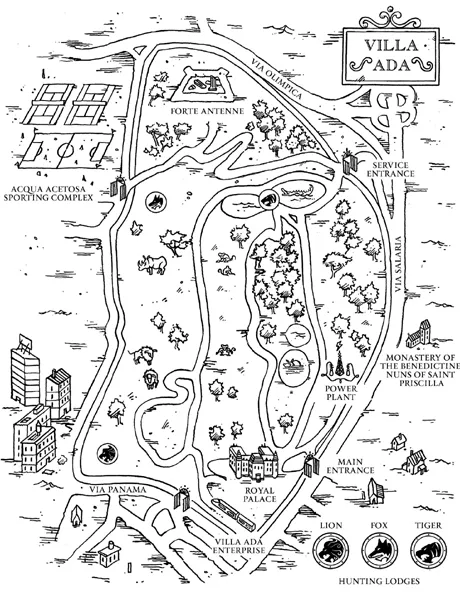
When dining outside, the Romans often discuss which is the most beautiful park in the city. In the end, inevitably, first place is disputed by Villa Doria Pamphili, Villa Borghese and Villa Ada.
Villa Doria Pamphili, behind the suburb of Monteverde, is the largest and most scenic; Villa Borghese, right in the centre of the city, is the most famous (who hasn't been on the Piazzale del Pincio, which offers an unforgettable view over the centre of Rome and Piazza del Popolo?); of the three, Villa Ada is the oldest and the wildest.
In the modest opinion of the author of this story, Villa Ada beats the other two hands down. It's very big; about a hundred and seventy hectares of woods, lawns and thorn bushes squashed between Via Salaria, the Olimpica Viaduct and the Sports Centre of Acqua Acetosa. It still houses squirrels, moles, hedgehogs, wild rabbits, porcupines, weasels and a rich community of birds. It must be the sense of total abandonment and negligence, but as soon as you enter one of the woods there's a feeling of being in a forest. The city and its sounds disappear and you find yourself amidst one-hundred-year-old pine trees, laurel bushes, muddy tracks that wind around impenetrable blackberry bushes and fallen tree trunks, fields of poison ivy and large lawns covered in weeds. Amidst the branches you can catch a glimpse of old abandoned buildings covered in ivy, fountains taken to pieces by wild fig trees and bunkers destined, to who knows what purpose. If you aren't extremely familiar with the park it's best not to venture in there alone, or you risk getting lost for days. The subsoil of the Villa is covered with the Catacomb of Priscilla, where the early Christians buried their dead.
In the northern part, beyond the big artificial lake, is a tree-covered hill called Forte Antenne because at the end of the nineteenth century the Italian Army built fortifications upon it to defend Rome from French attack. When Rome hadn't yet come into existence, in that position lay the city of Antemnae. The name, according to the Roman historian Varrone, derives from ante amnem (in front of the river) because that is the point where the Aniene runs into the Tiber. From that position, the city dominated the river traffic that headed towards the ford at the Tiberian Island. In 735 AD Romolo conquered the city, its citizens were welcomed as Romans, and tenant farmers sent to occupy the land. From the third century AD onwards, the city fell into neglect and was abandoned. The highlands of Antemnae, during the centuries of Roman decay, housed the Alaric Goths who, coming from the north, prepared to attack Rome. Nothing more was said for centuries and centuries, until the seventeenth century. The area had become the farming estate of the Irish College. Then, in 1783, the land was bought by Prince Pallavicini, who built a country house on it. Ownership passed in the mid-eighteen hundreds to the Potentian Princes, and was sold in 1872 to the Royal Family, who turned it into their Roman residence. Victor Emanuel II, who was a great lover of the art of hunting, then acquired other lands that bordered with his, to turn it into his hunting lodge.
Upon his death he was succeeded by Umberto I, who moved his whole court to the Presidential Palace. The country house was bought for five hundred and thirty-one thousand lira by the Swiss Count Tellfner, the administrator of the Royal Family's assets, and he named it in honour of his wife, Ada, with whom it seems he was deeply in love.
In 1900 King Umberto I was killed by an anarchist. His successor, Victor Emanuel III, decided to move back to his grandfather's villa, and it was the official residence of the Royal Family until 1946, the year in which the monarchy was ousted, and the king and his kin were forced into exile.
The villa now passed to the Italian Government, with the exception of the Royal Villa, which the Savoys generously granted to the Egyptian Government as a token of their gratitude for hospitality received during the exile of 1946. The building subsequently became the Egyptian Embassy.
From that moment onwards, Villa Ada became public property and was transformed into a city park. New roads were designed, specially equipped tracks for athletes were set up, artificial lakes were dug and many non-native trees were planted.
In 2004, in order to fatten the local government's coffers, the capital city's mayor decided to auction the entire area of Villa Ada for the astronomical sum of three hundred million euro.
The auction took place on Capitoline Hill on the 24th of December, amidst protests by infuriated Romans at what would go down in history as ‘the big rip-off’. Bidders included celebrities of the calibre of Bono from U2, the Russian businessman Roman Abramovich, Sir Paul McCartney, Air France and a cartel of Swiss banks.
Unexpectedly, it was snapped up for the sum of four hundred and fifty million euro by Salvatore Chiatti, nicknamed Sasà, a businessman from Campagna (but otherwise of obscure origins) who had in the course of the nineties managed to amass an immense portfolio of real estate. He had at one point been in jail on charges of tax evasion and cattle-stealing, but thanks to the pardon he had been set free.
A few days later, in an interview with the daily newspaper Il Messaggero, the businessman explained the acquisition as follows: ‘My mum always took me there when I was little. I was driven by nostalgia.’ A big lie, since Chiatti had spent his childhood in Mondragone, working in his father's garage. The journalist had gone on to ask: ‘And what do you plan on doing with it?’
‘It will be my Roman residence.’
For a few years the Villa was closed. Locals formed a committee to return the park to the Romans. People said that Chiatti had actually bought it as an investment and was looking for foreign partners to transform it into a residential area, with golf courses, horse-riding clubs and go-kart racing.
In 2007 the renovations began. The boundary walls were raised by ten metres and rolls of barbed wire were placed on top. Every fifty metres along the walled perimeter were little towers hung with clusters of video cameras.
The Marquess Clothilde, the widow of General Farinelli, from her penthouse suite on Via Salaria was able to glimpse through the branches a slice of the park. The elderly woman had revealed to a journalist from the weekly magazine Panorama that she could see workers coming and going non-stop. They were planting trees, clearing the land. And she had even seen two giraffes and a rhinoceros. The journalist, however, didn't give her credence because the Widow Farinelli was seventy-eight years old and had the beginnings of Alzheimer's.
But the marquess had seen correctly.
Sasà Chiatti had built marshland, rivers and quicksand, and committed himself to repopulating the park. He had bought from the neglected zoos and abandoned circuses of the Eastern countries bears, seals, tigers, lions, giraffes, foxes, parrots, cranes, storks, macaques, Barbary macaques, hippopotamus and piranhas, and he had scattered them throughout the one hundred and seventy hectares of Villa Ada. All of the animals had been born and bred in captivity, hence docile and dependent on the food supplied by the guardians. They lived in a natural paradise where the primordial rules of prey–predator no longer existed. With the passing of the months, the diverse fauna had found a sort of balance. Each species had carved out its own ecological niche. The hippopotamus positioned themselves in the little lake next to the old kiosk of the cafeteria, and they didn't move from there ever again. The crocodiles and the piranha colonised the second artificial body of water, not far from the swings and the slides. Lions and tigers formed a colony on Mount Antenne. The Australian bats, huge beasts weighing six kilos each, took refuge in the catacomb. Beside the ex-Embassy, gnus, zebra, camels and herds of buffalo that Sasà had brought in straight from Mondragone grazed on a big grassy plain.
With the avian breeds, things were a little more complex. Stefano Coppé, lying on the ground next to his Burgman 250 scooter after having been rear-ended by an Opel Meriva on the exit between the Salaria and the Olimpica, saw a flock of vultures circling overhead and understood that the situation was serious. A pair of condors built their nest on the Rossetti family's balcony, in Via Taro, and tore Anselmo, the pet tabby cat, to pieces as he tried desperately to defend the small terrace. The athletes of the Acqua Acetosa centre witnessed kites and barn owls perching on the bars of the rugby goal posts. The fishmonger on Via Locchi was plundered of a sea bass weighing three kilos by a fish eagle. Parrots and toucans slammed into the windscreens of cars driving along the ring road.
Sasà Chiatti's idea was simple and magnificent at the same time: to organise a housewarming party so exclusive and sumptuous that it would be remembered throughout the centuries to come as the biggest, globally important event to take place in the history of our republic. And he would go from being famous as a suspicious real-estate magnate to being famous as a radiant millionaire and eccentric. Politicians, entrepreneurs, people from showbusiness and from the sports world would come to court to pay him homage, just like the Sun King at Versailles. But to achieve this, a party with music, dancing, buffet and cotillion would not be enough. It needed to be something so special and inimitable that everyone would be speechless.
The idea came to him one night while he was watching Out of Africa, starring Robert Redford and Meryl Streep.
A safari! He would organise a surprise safari for the guests. His megalomania led him, however, to the decision that one was not enough. There had to be three of them. The classic English fox hunt, the African lion hunt with coloured beaters, and then the Indian tiger hunt, on elephants.
But in order for everything to work as planned, it was fundamental that nothing regarding the party preparation be leaked. All of the guards, workers and employees were forced to sign a confidentiality agreement.
He summoned the famous white hunter Corman Sullivan, whose claim to fame was having accompanied the writer Ernest Hemingway on the great hunt of 1934. Sullivan's age was undefined and ranged from eighty to one hundred years old. He suffered from chronic cirrhosis of the liver and had spent the last twenty years living in a rest home run by missionary nuns in Manzini Town in Swaziland, the small...
Table of contents
- Front Cover
- Editor Page
- Title Page
- Copyright
- Dedication
- Contents
- Genesis
- The Party
- Katakumba
- Four Years Later
- Acknowledgements
Trusted by 375,005 students
Access to over 1.5 million titles for a fair monthly price.
Study more efficiently using our study tools.
Frequently asked questions
Yes, you can cancel anytime from the Subscription tab in your account settings on the Perlego website. Your subscription will stay active until the end of your current billing period. Learn how to cancel your subscription
No, books cannot be downloaded as external files, such as PDFs, for use outside of Perlego. However, you can download books within the Perlego app for offline reading on mobile or tablet. Learn how to download books offline
We are an online textbook subscription service, where you can get access to an entire online library for less than the price of a single book per month. With over 1.5 million books across 990+ topics, we’ve got you covered! Learn about our mission
Look out for the read-aloud symbol on your next book to see if you can listen to it. The read-aloud tool reads text aloud for you, highlighting the text as it is being read. You can pause it, speed it up and slow it down. Learn more about Read Aloud
Yes! You can use the Perlego app on both iOS and Android devices to read anytime, anywhere — even offline. Perfect for commutes or when you’re on the go.
Please note we cannot support devices running on iOS 13 and Android 7 or earlier. Learn more about using the app
Please note we cannot support devices running on iOS 13 and Android 7 or earlier. Learn more about using the app
Yes, you can access Let the Games Begin by Niccolò Ammaniti, Kylee Doust in PDF and/or ePUB format, as well as other popular books in Literature & Literature General. We have over 1.5 million books available in our catalogue for you to explore.