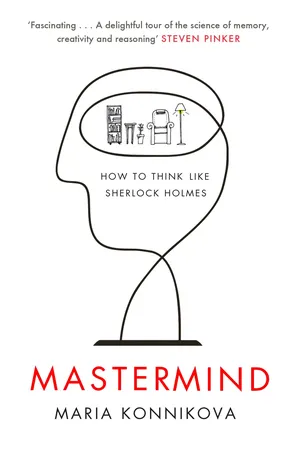
No fictional character is more renowned for his extraordinary powers of mind than Sherlock Holmes. But what exactly is it that sets him apart as a detective of the highest order, and can we harness his genius?
In Mastermind, psychologist Maria Konnikova shows us how we can all channel Holmes's famous powers of deduction, observation, memory and imagination. Drawing on the latest research in neuroscience and psychology, Konnikova unpacks the mental strategies that can help sharpen our perceptions, improve our logic and enhance our creative powers. Mastermind is a remarkable and entertaining guide to upgrading the mind.
- 288 pages
- English
- ePUB (mobile friendly)
- Available on iOS & Android
eBook - ePub
About this book
Information
Topic
PsychologieSubtopic
Psychologie appliquéePART ONE

CHAPTER ONE
The Scientific Method of the Mind
Something sinister was happening to the farm animals of Great Wyrley. Sheep, cows, horses—one by one, they were falling dead in the middle of the night. The cause of death: a long, shallow cut to the stomach that caused a slow and painful bleeding. Farmers were outraged; the community, shocked. Who would want to cause such pain to defenseless creatures?
The police thought they had their answer: George Edalji, the half-Indian son of the local vicar. In 1903, twenty-seven-year-old Edalji was sentenced to seven years of hard labor for one of the sixteen mutilations, that of a pony whose body had been found in a pit near the vicar’s residence. Little did it matter that the vicar swore his son was asleep at the time of the crime. Or that the killings continued after George’s imprisonment. Or, indeed, that the evidence was largely based on anonymous letters that George was said to have written—in which he implicated himself as the killer. The police, led by Staffordshire chief constable captain George Anson, were certain they had their man.
Three years later, Edalji was released. Two petitions protesting his innocence—one, signed by ten thousand people, the other, from a group of three hundred lawyers—had been sent to the Home Office, citing a lack of evidence in the case. And yet, the story was far from over. Edalji may have been free in person, but in name, he was still guilty. Prior to his arrest he had been a solicitor. Now he could not be readmitted to his practice.
In 1906, George Edalji caught a lucky break: Arthur Conan Doyle, the famed creator of Sherlock Holmes, had become interested in the case. That winter, Conan Doyle agreed to meet Edalji at the Grand Hotel, at Charing Cross. And there, across the lobby, any lingering doubts Sir Arthur may have had about the young man’s innocence were dispelled. As he later wrote:
He had come to my hotel by appointment, but I had been delayed, and he was passing the time by reading the paper. I recognized my man by his dark face, so I stood and observed him. He held the paper close to his eyes and rather sideways, proving not only a high degree of myopia, but marked astigmatism. The idea of such a man scouring fields at night and assaulting cattle while avoiding the watching police was ludicrous. . . . There, in a single physical defect, lay the moral certainty of his innocence.
But though Conan Doyle himself was convinced, he knew it would take more to capture the attention of the Home Office. And so, he traveled to Great Wyrley to gather evidence in the case. He interviewed locals. He investigated the scenes of the crimes, the evidence, the circumstances. He met with the increasingly hostile Captain Anson. He visited George’s old school. He reviewed old records of anonymous letters and pranks against the family. He traced the handwriting expert who had proclaimed that Edalji’s hand matched that of the anonymous missives. And then he put his findings together for the Home Office.
The bloody razors? Nothing but old rust—and, in any case, incapable of making the type of wounds that had been suffered by the animals. The dirt on Edalji’s clothes? Not the same as the dirt in the field where the pony was discovered. The handwriting expert? He had previously made mistaken identifications, which had led to false convictions. And, of course, there was the question of the eyesight: could someone with such astigmatism and severe myopia really navigate nocturnal fields in order to maim animals?
In the spring of 1907, Edalji was finally cleared of the charge of animal slaughter. It was less than the complete victory for which Conan Doyle had hoped—George was not entitled to any compensation for his arrest and jail time—but it was something. Edalji was readmitted to his legal practice. The Committee of Inquiry found, as summarized by Conan Doyle, that “the police commenced and carried on their investigations, not for the purpose of finding out who was the guilty party, but for the purpose of finding evidence against Edalji, who they were already sure was the guilty man.” And in August of that year, England saw the creation of its first court of appeals, to deal with future miscarriages of justice in a more systematic fashion. The Edalji case was widely considered one of the main impetuses behind its creation.
Conan Doyle’s friends were impressed. None, however, hit the nail on the head quite so much as the novelist George Meredith. “I shall not mention the name which must have become wearisome to your ears,” Meredith told Conan Doyle, “but the creator of the marvellous Amateur Detective has shown what he can do in the life of breath.” Sherlock Holmes might have been fiction, but his rigorous approach to thought was very real indeed. If properly applied, his methods could leap off the page and result in tangible, positive changes—and they could, too, go far beyond the world of crime.
Say the name Sherlock Holmes, and doubtless, any number of images will come to mind. The pipe. The deerstalker. The cloak. The violin. The hawklike profile. Perhaps William Gillette or Basil Rathbone or Jeremy Brett or any number of the luminaries who have, over the years, taken up Holmes’s mantle, including the current portrayals by Benedict Cumberbatch and Robert Downey, Jr. Whatever the pictures your mind brings up, I would venture to guess that the word psychologist isn’t one of them. And yet, perhaps it’s time that it was.
Holmes was a detective second to none, it is true. But his insights into the human mind rival his greatest feats of criminal justice. What Sherlock Holmes offers isn’t just a way of solving crime. It is an entire way of thinking, a mindset that can be applied to countless enterprises far removed from the foggy streets of the London underworld. It is an approach born out of the scientific method that transcends science and crime both and can serve as a model for thinking, a way of being, even, just as powerful in our time as it was in Conan Doyle’s. And that, I would argue, is the secret to Holmes’s enduring, overwhelming, and ubiquitous appeal.
When Conan Doyle created Sherlock Holmes, he didn’t think much of his hero. It’s doubtful that he set out intentionally to create a model for thought, for decision making, for how to structure, lay out, and solve problems in our minds. And yet that is precisely what he did. He created, in effect, the perfect spokesperson for the revolution in science and thought that had been unfolding in the preceding decades and would continue into the dawn of the new century. In 1887, Holmes became a new kind of detective, an unprecedented thinker who deployed his mind in unprecedented ways. Today, Holmes serves an ideal model for how we can think better than we do as a matter of course.
In many ways, Sherlock Holmes was a visionary. His explanations, his methodology, his entire approach to thought presaged developments in psychology and neuroscience that occurred over a hundred years after his birth—and over eighty years after his creator’s death. But somehow, too, his way of thought seems almost inevitable, a clear product of its time and place in history. If the scientific method was coming into its prime in all manner of thinkings and doings—from evolution to radiography, general relativity to the discovery of germs and anesthesia, behaviorism to psychoanalysis—then why ever not in the principles of thought itself?
In Arthur Conan Doyle’s own estimation, Sherlock Holmes was meant from the onset to be an embodiment of the scientific, an ideal that we could aspire to, if never emulate altogether (after all, what are ideals for if not to be just a little bit out of reach?). Holmes’s very name speaks at once of an intent beyond a simple detective of the old-fashioned sort: it is very likely that Conan Doyle chose it as a deliberate tribute to one of his childhood idols, the philosopher-doctor Oliver Wendell Holmes, Sr., a figure known as much for his writing as for his contributions to medical practice. The detective’s character, in turn, was modeled after another mentor, Dr. Joseph Bell, a surgeon known for his powers of close observation. It was said that Dr. Bell could tell from a single glance that a patient was a recently discharged noncommissioned officer in a Highland regiment, who had just returned from service in Barbados, and that he tested routinely his students’ own powers of perception with methods that included self-experimentation with various noxious substances. To students of Holmes, that may all sound rather familiar. As Conan Doyle wrote to Bell, “Round the centre of deduction and inference and observation which I have heard you inculcate, I have tried to build up a man who pushed the thing as far as it would go—further occasionally. . . .” It is here, in observation and inference and deduction, that we come to the heart of what it is exactly that makes Holmes who he is, distinct from every other detective who appeared before, or indeed, after: the detective who elevated the art of detection to a precise science.
We first learn of the quintessential Sherlock Holmes approach in A Study in Scarlet, the detective’s first appearance in the public eye. To Holmes, we soon discover, each case is not just a case as it would appear to the officials of Scotland Yard—a crime, some facts, some persons of interest, all coming together to bring a criminal to justice—but is something both more and less. More, in that it takes on a larger, more general significance, as an object of broad speculation and inquiry, a scientific conundrum, if you will. It has contours that inevitably were seen before in earlier problems and will certainly repeat again, broader principles that can apply to other moments that may not even seem at first glance related. Less, in that it is stripped of any accompanying emotion and conjecture—all elements that are deemed extraneous to clarity of thought—and made as objective as a nonscientific reality could ever be. The result: the crime as an object of strict scientific inquiry, to be approached by the principles of the scientific method. Its servant: the human mind.
What Is the Scientific Method of Thought?
When we think of the scientific method, we tend to think of an experimenter in his laboratory, probably holding a test tube and wearing a white coat, who follows a series of steps that runs something like this: make some observations about a phenomenon; create a hypothesis to explain those observations; design an experiment to test the hypothesis; run the experiment; see if the results match your expectations; rework your hypothesis if you must; lather, rinse, and repeat. Simple seeming enough. But how to go beyond that? Can we train our minds to work like that automatically, all the time?
Holmes recommends we start with the basics. As he says in our first meeting with him, “Before turning to those moral and mental aspects of the matter which present the greatest difficulties, let the enquirer begin by mastering more elementary problems.” The scientific method begins with the most mundane seeming of things: observation. Before you even begin to ask the questions that will define the investigation of a crime, a scientific experiment, or a decision as apparently simple as whether or not to invite a certain friend to dinner, you must first explore the essential groundwork. It’s not for nothing that Holmes calls the foundations of his inquiry “elementary.” For, that is precisely what they are, the very basis of how something works and what makes it what it is.
And that is something that not even every scientist acknowledges outright, so ingrained is it in his way of thinking. When a physicist dreams up a new experiment or a biologist decides to test the properties of a newly isolated compound, he doesn’t always realize that his specific question, his approach, his hypothesis, his very view of what he is doing would be impossible without the elemental knowledge at his disposal, that he has built up over the years. Indeed, he may have a hard time telling you from where exactly he got the idea for a study—and why he first thought it would make sense.
After World War II, physicist Richard Feynman was asked to serve on the State Curriculum Commission, to choose high school science textbooks for California. To his consternation, the texts appeared to leave students more confused than enlightened. Each book he examined was worse than the one prior. Finally, he came upon a promising beginning: a series of pictures, of a windup toy, an automobile, and a boy on a bicycle. Under each was a question: “What makes it go?” At last, he thought, something that was going to explain the basic science, starting with the fundamentals of mechanics (the toy), chemistry (the car), and biology (the boy). Alas, his elation was short lived. Where he thought to finally see explanation, real understanding, he found instead four words: “Energy makes it go.” But what was that? Why did it make it go? How did it make it go? These questions weren’t ever acknowledged, never mind answered. As Feynman put it, “That doesn’t mean anything. . . . It’s just a word!” Instead, he argued, “What they should have done is to look at the windup toy, see that there are springs inside, learn about springs, learn about wheels, and never mind ‘energy.’ Later on, when the children know something about how the toy actually works, they can discuss the more general principles of energy.”
Feynman is one of the few who rarely took his knowledge base for granted, who always remembered the building blocks, the elements that lay underneath each question and each principle. And that is precisely what Holmes means when he tells us that we must begin with the basics, with such mundane problems that they might seem beneath our notice. How can you hypothesize, how can you make testable theories if you don’t first know what and how to observe, if you don’t first understand the fundamental nature of the problem at hand, down to its most basic elements? (The simplicity is deceptive, as you will learn in the next two chapters.)
The scientific method begins with a broad base of knowledge, an understanding of the facts and contours of the problem you are trying to tackle. In the case of Holmes in A Study in Scarlet, it’s the mystery behind a murder in an abandoned house on Lauriston Gardens. In your case, it may be a decision whether or not to change careers. Whatever the specific issue, you must define and formulate it in your mind as specifically as possible—and then you must fill it in with past experience and present observation. (As Holmes admonishes Lestrade and Gregson when the two detectives fail to note a similarity between the murder being investigated and an earlier case, “There is nothing new under the sun. It has all been done before.”)
Only then can you move to the hypothesis-generation point. This is the moment where the detective engages his imagination, generating possible lines of inquiry into the course of events, and not just sticking to the most obvious possibility—in A Study in Scarlet, for instance, rache need not be Rachel cut short, but could also signify the German for revenge—or where you might brainstorm possible scenarios that may arise from pursuing a new job direction. But you don’t just start hypothesizing at random: all the potential scenarios and explanations come from that initial base of knowledge and observation.
Only then do you test. What does your hypothesis imply? At this point, Holmes will investigate all lines of inquiry, eliminating them one by one until the one that remains, however improbable, must be the truth. And you will run through career change scenarios and try to play out the implications to their logical, full conclusion. That, too, is manageable, as you will later learn.
But even then, you’re not done. Times change. Circumstances change. That original knowledge base must always be updated. As our environment changes, we must never forget to revise and retest out hypotheses. The revolutionary can, if we’re not careful, become the irrelevant. The thoughtful can become unthinking through our failure to keep engaging, challenging, pushing.
That, in a nutshell, is the scientific method: understand and frame the problem; observe; hypothesize (or imagine); test and deduce; and repeat. To follow Sherlock Holmes is to learn to apply that same approach not just to external clues, but to your every thought—and then turn it around and apply it to the every thought of every other person who may be involved, step by painstaking step.
When Holmes first lays out the theoretical principles behind his approach, he boils it down to one main idea: “How much an observant man might learn by an accurate and systematic examination of all that came his way.” And that “all” includes each and every thought; in Holmes’s world, there is no such thing as a thought that is taken at face value. As he notes, “From a drop of water, a logician could infer the possibility of an Atlantic or a Niagara without having seen or heard of one or the other.” In other words, given our existing knowledge base, we can use observation to deduce meaning from an otherwise meaningless fact. For what kind of scientist is that who lacks the ability to imagine and hypothesize the new, the unknown, the as-of-yet untestable?
This is the scientific method at its most basic. Holmes goes a step further. He applies the same principle to human beings: a Holmesian disciple will, “on meeting a fellow-mortal, learn at a glance to distinguish the history of the man and the trade or profession to which he belongs. Puerile as such an exercise may seem, it sharpens the faculties of observation, and teaches one where to look and what to look for.” Each observation, each exercise, each simple inference drawn from a simple fact will strengthen your ability to engage in ever-more-complex machinations. It will lay the groundwork for new habits of thinking that will make such observation second nature.
That is precisely what Holmes has taught himself—and can now teach us—to do. For, at its most basic, isn’t that the detective’s appeal? Not only...
Table of contents
- Cover
- Title Page
- Copyright Page
- Dedication
- Epigraph
- Contents
- Prelude
- Part One: Understanding (Yourself)
- Part Two: From Observation to Imagination
- Part Three: The Art of Deduction
- Part Four: The Science and Art of Self-Knowledge
- Postlude
- Acknowledgments
- Further Reading
- Index
- Promo page for other Canongate titles
Trusted by 375,005 students
Access to over 1.5 million titles for a fair monthly price.
Study more efficiently using our study tools.
Frequently asked questions
Yes, you can cancel anytime from the Subscription tab in your account settings on the Perlego website. Your subscription will stay active until the end of your current billing period. Learn how to cancel your subscription
No, books cannot be downloaded as external files, such as PDFs, for use outside of Perlego. However, you can download books within the Perlego app for offline reading on mobile or tablet. Learn how to download books offline
Perlego offers two plans: Essential and Complete
- Essential is ideal for learners and professionals who enjoy exploring a wide range of subjects. Access the Essential Library with 800,000+ trusted titles and best-sellers across business, personal growth, and the humanities. Includes unlimited reading time and Standard Read Aloud voice.
- Complete: Perfect for advanced learners and researchers needing full, unrestricted access. Unlock 1.5M+ books across hundreds of subjects, including academic and specialized titles. The Complete Plan also includes advanced features like Premium Read Aloud and Research Assistant.
We are an online textbook subscription service, where you can get access to an entire online library for less than the price of a single book per month. With over 1.5 million books across 990+ topics, we’ve got you covered! Learn about our mission
Look out for the read-aloud symbol on your next book to see if you can listen to it. The read-aloud tool reads text aloud for you, highlighting the text as it is being read. You can pause it, speed it up and slow it down. Learn more about Read Aloud
Yes! You can use the Perlego app on both iOS and Android devices to read anytime, anywhere — even offline. Perfect for commutes or when you’re on the go.
Please note we cannot support devices running on iOS 13 and Android 7 or earlier. Learn more about using the app
Please note we cannot support devices running on iOS 13 and Android 7 or earlier. Learn more about using the app
Yes, you can access Mastermind by Maria Konnikova in PDF and/or ePUB format, as well as other popular books in Psychologie & Psychologie appliquée. We have over 1.5 million books available in our catalogue for you to explore.