Stories are everywhere...
Exploring the great plots from Plato to The Matrix and from Tolstoy to Toy Story, this is a book for anyone who wants to unlock any narrative and learn to create their own. With startling and original insights into how we construct stories, this is a creative writing book like no other. It will show you how to read and write better.
eBook - ePub
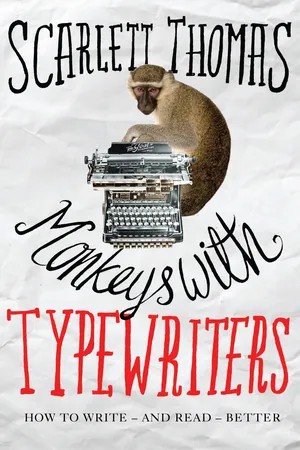
Monkeys with Typewriters
How to Write Fiction and Unlock the Secret Power of Stories
- 496 pages
- English
- ePUB (mobile friendly)
- Available on iOS & Android
eBook - ePub
About this book
Information
PART I
THEORY
INSIDE PLATO’S CAVE
All the great story lines are great practical jokes that people fall for over and over again . . . Somebody gets into trouble and then gets out again; somebody loses something and gets it back; somebody is wronged and gets revenge; Cinderella; somebody hits the skids and just goes down, down, down; people fall in love with each other, and a lot of other people get in the way; a virtuous person is falsely accused of sin; a sinful person is believed to be virtuous; a person faces a challenge bravely, and succeeds or fails; a person lies, a person steals, a person kills, a person commits fornication.
Kurt Vonnegut4
Either follow tradition, or develop something that is consistent within itself, writer.
Horace5
HAVE YOU EVER had your heart broken, or broken someone else’s heart? Have you ever won an argument but later realised you were wrong? Have you ever tripped over in public, or spilled wine on someone else’s carpet? Have you ever tried to help someone who didn’t want to be helped (or even someone who did)? Have you ever been in trouble, big or small? Have you ever felt trapped? Have you ever gossiped, felt bad about it, and then found that you’ve been the subject of gossip yourself? And have you, as the result of any of these situations, found yourself thinking and thinking about what really happened, and what it meant? Have you edited your life in your head and wondered what would have happened if you’d said or done something else, or if someone else had? Do you drive yourself half mad sometimes thinking about life, and how you and other people live it?
If the answer to these questions is yes, then you almost certainly have what it takes to be a writer, or to understand how and why other people write. Why? You know what drama is, you have suffered, and, most importantly, you’ve started to analyse these things.
At the moment, though, your life experiences are probably a bit like a pile of steel, with, perhaps, a few nuts and bolts scattered around. If someone told you to go and build a bridge with these components, I’m guessing you wouldn’t be able to do it. It certainly wouldn’t be easy. This is what I think it is like when you try to write your first novel, short story or screenplay. You have all this stuff, but you don’t know what to do with it, or even which way up it all goes. You probably don’t know how bridges are built, even if you have gone over thousands of them. Of course, one way of learning how to build bridges is to go out and examine some examples, and see how they work. This is how most people who write good fiction learn to do it. We will be doing that too, in this book. We will start by taking apart all kinds of different narratives, from Tolstoy to Toy Story, in order to see how they are put together. Only after we know exactly how narrative works will we start to think about how it looks and feels and how it could potentially change us. We will also spend a good deal of time later on considering how to write with depth, humour and originality.
I am assuming you are reading this because you want to become a better writer, or a more informed reader. But I hope you don’t mind that I am going to pretend, in this book, that you do want to be a writer, and that you want to be a writer for some reason other than just making money. This won’t necessarily be true, I know. I do hope that you will write fiction, and that you’ll become the kind of storyteller who changes people’s lives in some way. But in fact you might want to write commercial fiction (and there are far worse things to do). You might want to be a screenwriter. You might want to know how to apply fictional techniques to narrative non-fiction. You might want to become an English teacher, a book reviewer or a journalist, or gain a greater understanding of how fiction works for another reason, or just for fun. This book will help you do all those things – I hope. But for simplicity’s sake, I am going to address you as if you want to write fiction. And the first thing you need to do if you want to write good fiction (or do any of the things I’ve just mentioned) is to understand the basics of how narrative works. That’s what this chapter is about.
I will define ‘narrative’ for now as ‘the way we tell stories’. Narrative tells a story, which means that narrative is different from story. Plato says in Part III of The Republic that stories – in Greek the word pseudos: a ‘fiction’ or a ‘lie’ – ‘. . . are of two kinds: true stories and fiction’.6 This is quite a profound idea to begin with. We all know the fictional story of Cinderella, of course. But we also spend our days being told stories with varying degrees of fictionality. There might be news stories, gossip, the story of how Arsenal did last night, a story about how we can become more relaxed using meditation techniques. And those are just what you get in newspapers. As we drive to work, we might listen to a story on the radio about someone trying to climb a mountain, and this might really have happened, or it might not have. We might be told, though billboards, stories that suggest how happy our family would be if only we would buy this apartment, or that breakfast cereal. Other billboards might subtly (or not so subtly) suggest parts of familiar stories: the princess in beautiful clothes; the hero in a fast car. Story, clearly, does not necessarily mean ‘something that is made up’. Or maybe it does, if you realise that ‘made up’ means ‘put together’ or ‘constructed’, not just ‘fictional’. ‘Making up’ can of course refer to creating a dress from a pattern, or a meal from a recipe, both of which are not that different from the way fiction is constructed, as we will see.
Something happens, and then because of that, something else happens. That’s a story. When we tell it, it becomes a narrative. Although we could spend many hours talking about terminology, and how to break down all the parts of narrative, we can say for now that basic narrative comprises a story, often arranged into a plot. Very basic narrative may not have imagery, theme, characterisation and all the other elements we’ll be looking at in this book, and the story and the plot might be the same thing. So what is the most basic possible narrative? ‘The cat sat on the mat’ is not a narrative, because it tells no story: nothing happens and no change occurs. It is a statement. ‘The cat sat on the mat and then went outside to look at birds’ is two statements, and although something happens, it doesn’t happen because of something that has happened before. In other words, it doesn’t work according to cause and effect. ‘The cat was shooed off the mat and so decided to go outside and look at birds’ is a narrative because it tells a story based on cause and effect. The cat is outside now partly because she was on the mat before. This narrative is a simple chronological story that has not been plotted. ‘The cat was outside watching birds. She had been comfortable on her mat before Rachel came and shooed her away’ is now a plotted narrative, because it is not simply chronological. In the narration, the past happens after the present, not before. Other writers and theorists will look at these distinctions differently.7 But I think this is the most useful way for writers to look at narrative.
We’ll be looking at motivation much later, but note for now that in our most basic story the cat has some motivation to get off the mat, and so change occurs. Change is one of the most important aspects of fiction. And it helps us to understand what distinguishes a basic chronological story from a sequence of statements. Change occurs because of something. And because of that something else happens, and then something else. So let’s begin by properly exploring the difference between this kind of chronological story (which Russian formalists call ‘fabula’), where change happens on a simple timeline, and plot (which you might come across as ‘sujet’ or ‘sjužet’). As Boris Tomashevsky says, ‘Plot is distinct from story. Both include the same events, but in the plot the events are arranged.’8
A simple example of how story and plot differ from one another can be found in the Harry Potter series of novels. The chronological story being narrated begins before Harry is born, with the rise of Voldemort and the Death Eaters, or even before that, with the birth of Dumbledore and the founding of Hogwarts School. However, the first scene in Harry Potter and the Philosopher’s Stone is set much later than this, and we meet Harry as an older child living with his uncle and aunt. The plot begins when Harry finds he is going to attend Hogwarts school, and elements from the chronological story are revealed later. Most narratives do not begin at ‘the beginning’, as we will see. While most narratives begin with some kind of question about the future of the main character (Will he/she fall in love? Save the world? Escape?), complex plotted narrative usually at some point asks questions about a past, or ‘backstory’, which has been concealed. One of the key skills of writing is knowing what to conceal and when to reveal it.
The dramatic effect of Pride and Prejudice relies on parts of its backstory being concealed from its protagonist Elizabeth Bennett (and from the reader). There is a ‘true’ story concerning the past actions of Mr Darcy and Mr Wickham that she must discover if she is to truly love Darcy. Who betrayed whom? First she believes that Darcy is the betrayer, but she later discovers that it was Wickham after all. In a narrative like this, there is a ‘true story’ that is not fully known until the end of the novel. The plot is made up of several competing stories – Elizabeth Bennett’s story about Darcy, Wickham’s story about Darcy, and Darcy’s story about Wickham, among others – and in this competition there is drama. We would not find the novel anywhere near as compelling if Jane Austen simply just told us chronologically ‘what happened’, beginning with Darcy as a sweet child being kind to the servants, then with him and Wickham at Cambridge, then Wickham’s descent as it really happened, then the meeting with Elizabeth Bennett.
Plot gives a story drama. In the crime genre, each narrative has a plot arranged in such a way as to conceal an entire chronological story from the protagonist and usually from the reader as well, until the final chapter, where the plot reveals the story hidden within it all along. The story may be, in chronological order: Mr White’s colleague does something awful to him; then it begins to snow;9 then Mr White kills his colleague, exits through a window and leaves footprints in the snow; then a detective comes, sees the footprints and arrests Mr White. In a plotted detective narrative we’d get the detective’s investigation first, then the seeing of the footprints, then the apprehension of Mr White, and only then the reason for the murder. We’d need to wait for the end of the story to know the beginning. The whole of this story arguably contains the births of all the characters and all their motivations for doing everything they do. Some parts of the entire chronological story will be left out of any narrative. In Pride and Prejudice, we don’t learn very much about Elizabeth’s childhood, because it has no effect on the story: nothing is caused by it. Darcy’s childhood is important, however, and so we do learn something of that.
To help think more about this relationship between chronological story and plot, we could use some analogies. The relationship between the story and the plot in narrative is similar to the relationship between the material and the pattern in sewing, the ingredients and the recipe in cooking, and the construction materials and the architectural drawings in house-construction. In each of these a basic material is cut and shaped according to some plan, and the result is a whole new thing. As I said before, it’s all to do with ‘making things up’, although it helps to remember that this doesn’t necessarily mean (and will actually hardly ever mean) fabricating things entirely from your imagination. We’ll see why later. For now, it is important to realise that when you write fiction you will work with familiar patterns, even if you plan to be very original. Great fashion designers still make dresses that we recognise as such, even though we have perhaps never seen this dress, in this material, before. In fashion, no one would actually present a roll of material as a dress, but the equivalent does sometimes happen when we begin to write fiction – we forget to shape our story. Patterns and shapes are not the point of storytelling. But it is very important that we understand them, and learn how to work with them.
We already work confidently with patterns and shapes in our everyday narratives, although we might not always realise this. Looking at some of these structures will help us begin to understand more about how narrative works. Those funny anecdotes that you might tell your friends about your life will all have a similar structure. Something unexpected or problematic will happen. There’ll be a ‘narrative question’ that will later be resolved. (‘How did he get home with no clothes?’ ‘Did everyone really overhear what she said about her colleague?’ ‘Does the fact that he blushed mean that he is attracted to her?’) Often these anecdotes are little tragedies, and in the resolution we are embarrassed – we seem to like telling each other stories of our embarrassment. One of my friends’ favourite anecdotes is about the time her puppy ate one of her library books. She tells it the same way every time: taking a phone call in the other room and leaving the puppy alone with the book, then returning to discover the book partially in shreds and partially digested by the dog. It was a shame, she always says, because she hadn’t even finished it. The problem of how to return the book to the library was resolved when she decided to buy a new copy to give them. Most people have been in a social situation with a couple who want to tell a shared anecdote and say things like, ‘No, you tell it. You tell it best.’ In these cases at least, we can see that there are obviously better or worse ways of constructing a narrative (or it wouldn’t matter who tells it).
In The Poetics of Prose, Tzvetan Todorov attempts to uncover a ‘grammar’ of narrative and suggests that all narrative has the same basic ‘rules’. He says:
An ‘ideal’ narrative begins with a stable situation which is disturbed by some power or force. There results a state of disequilibrium; by the action of a force directed in the opposite direction, the equilibrium is re-established; the second equilibrium is similar to the first, but the two are never identical.10
My friend’s anecdote fits this pattern exactly. The puppy eating the book is the disequilibrium, and the final return of the book to the library is the re-establishment of equilibrium. If you look closely at the stories you tell, you’ll often find the same structure. Indeed, if you look at the way you understand your life so far, you will probably find several stories fitting this pattern. You will also find it in ‘factual’ news stories, gossip columns, conversations and in all sorts of other places too. Even our fears – perhaps especially our fears – often take on a familiar narrative structure. It’s very common to fear that something bad is going to happen because something good just has. Being in an exciting new relationship makes us all anxious, because we know what happens in any story that has a good beginning. Usually, things soon start to go wrong, and there is no such thing as equilibrium that lasts (unless it’s at the end of a story).
We can express the basic act of storytelling, therefore, as follows: taking a character in a state of equilibrium, messing it all up to create disequilibrium, and then resolving this into a new state of equilibrium. The character travels through these states in what is commonly called an arc. We may begin our narrative at any point on this arc – remember that narrative has a plotted story, not just a chronological story. In The Odyssey, for example, we meet Odysseus when he is already in a state of disequilibrium, but understand that there was some equilibrium before he left for Troy. Hamlet is already in the midst of trouble and com...
Table of contents
- Cover
- Also by Scarlett Thomas
- Title Page
- Copyright page
- Contents
- Introduction
- Part I: Theory
- Part II: Practice
- Appendix One: Blank Matrix
- Appendix Two: Completed Matrixes
- Appendix Three: Technical Matrix
- Appendix Four: Bank of Words Examples
- Notes
- Bibliography
Trusted by 375,005 students
Access to over 1.5 million titles for a fair monthly price.
Study more efficiently using our study tools.
Frequently asked questions
Yes, you can cancel anytime from the Subscription tab in your account settings on the Perlego website. Your subscription will stay active until the end of your current billing period. Learn how to cancel your subscription
No, books cannot be downloaded as external files, such as PDFs, for use outside of Perlego. However, you can download books within the Perlego app for offline reading on mobile or tablet. Learn how to download books offline
Perlego offers two plans: Essential and Complete
- Essential is ideal for learners and professionals who enjoy exploring a wide range of subjects. Access the Essential Library with 800,000+ trusted titles and best-sellers across business, personal growth, and the humanities. Includes unlimited reading time and Standard Read Aloud voice.
- Complete: Perfect for advanced learners and researchers needing full, unrestricted access. Unlock 1.5M+ books across hundreds of subjects, including academic and specialized titles. The Complete Plan also includes advanced features like Premium Read Aloud and Research Assistant.
We are an online textbook subscription service, where you can get access to an entire online library for less than the price of a single book per month. With over 1.5 million books across 990+ topics, we’ve got you covered! Learn about our mission
Look out for the read-aloud symbol on your next book to see if you can listen to it. The read-aloud tool reads text aloud for you, highlighting the text as it is being read. You can pause it, speed it up and slow it down. Learn more about Read Aloud
Yes! You can use the Perlego app on both iOS and Android devices to read anytime, anywhere — even offline. Perfect for commutes or when you’re on the go.
Please note we cannot support devices running on iOS 13 and Android 7 or earlier. Learn more about using the app
Please note we cannot support devices running on iOS 13 and Android 7 or earlier. Learn more about using the app
Yes, you can access Monkeys with Typewriters by Scarlett Thomas in PDF and/or ePUB format, as well as other popular books in Literature & Literature General. We have over 1.5 million books available in our catalogue for you to explore.