'I am with you always, even unto the end of the world . . .'
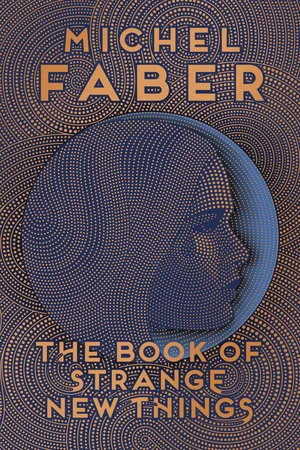
Peter Leigh is a missionary called to go on the journey of a lifetime. Leaving behind his beloved wife, Bea, he boards a flight for a remote and unfamiliar land, a place where the locals are hungry for the teachings of the Bible - his 'book of strange new things'. It is a quest that will challenge Peter's beliefs, his understanding of the limits of the human body and, most of all, his love for Bea.
The Book of Strange New Things is a wildly original tale of adventure, faith and the ties that might hold two people together when they are worlds apart. This momentous novel, Faber's first since The Crimson Petal and the White, sees him at his expectation-defying best.
WINNER OF THE SALTIRE BOOK OF THE YEAR AWARD
SHORTLISTED FOR THE ARTHUR C. CLARKE AWARD
AS HEARD ON BBC RADIO 4
- 592 pages
- English
- ePUB (mobile friendly)
- Available on iOS & Android
eBook - ePub
The Book of Strange New Things
About this book
Information
II
ON EARTH
10
The happiest day of my life
Peter hung suspended between ground and sky, in a net, his body covered with dark blue insects. They weren’t feeding on him, they were just using him as a place to be. Every time he stretched or coughed, the bugs would hover up from his skin or hop elsewhere, then settle back. He didn’t mind. Their legs didn’t tickle. They were quiet.
He’d been awake for hours, resting his cheek on his upflung arm so that his eyes were in line with the horizon. The sun was rising. It was the end of the long night, his fifth night spent among the Oasans.
Not that he was among the Oasans now, strictly speaking. He was alone on his improvised hammock, strung aloft between two pillars of his church. His church-in-progress. Four walls, four internal pillars, no roof. No contents except for a few tools and coils of rope and vats of mortar and braziers of oil. The braziers of oil were cold now, glimmering in the dawn light. Far from serving any religious purpose, they had a purely practical function – throughout the long dark spell, for the duration of each working ‘day’, they were ignited to throw light on the proceedings, and extinguished again when the last of the Oasans had gone home and ‘Father Peter’ was ready to retire.
His congregation were labouring as fast as they could to build this place, but they weren’t here with him today; not yet. They were still asleep, he supposed, in their own houses. Oasans slept a lot; they got tired easily. They’d work for an hour or two, and then, whether the task had been arduous or not, they would go home and rest in bed for a while.
Peter stretched in his hammock, recalling what those beds looked like, glad he wasn’t in one now. They resembled old-fashioned bathtubs, sculpted out of a sort of tough, dense moss, as lightweight as balsa wood. The tubs were lined with many layers of a cotton-like material, swaddling the sleeper in a loose, fluffy cocoon.
Three hundred hours ago, when he first succumbed to tiredness after the great exhilarations of his first day, Peter had been offered such a bed. He’d accepted it, in deference to his hosts’ hospitality, and there had been much ceremonial well-wishing for a good long rest. But he hadn’t been able to sleep.
For one thing, it was daytime, and the Oasans felt no need to darken their bedchambers, positioning their cots right under the brightest sunbeams. He’d climbed in anyway, squinting against the glare, hoping he might lose consciousness through sheer exhaustion. Unfortunately, the bed itself was an obstacle to sleep; the bed, in fact, was insufferable. The fluffy blankets were soon drenched with sweat and vapour, they exuded a sickly coconutty smell, and the tub was slightly too small, even though it was larger than the standard model. He suspected it had been carved specially for him, which made him all the more determined to adjust to it if he could.
But it was no good. As well as the absurd bed and the excessive light, there was also a noise problem. On that first day, there were four Oasans sleeping near him – the four who called themselves Jesus Lover One, Jesus Lover Fifty-Four, Jesus Lover seventy-Eight and Jesus Lover seventy-Nine – and all four of them breathed very loudly, creating an obnoxious symphony of sucking and gurgling. Their cots were in another room, but Oasan houses had no closeable doors, and he could hear the sleepers’ every breath, every snuffle, every glutinous swallow. In his bed back home, he was used to the barely audible breathing of Bea and an occasional sigh from Joshua the cat, not this kind of racket. Lying in the house of the Oasans, he reconnected with a long-forgotten episode from his past life: the memory of being lured off the street by a charity worker and put in a hostel for rough sleepers, most of them alcoholics and addicts like himself. The memory, too, of sneaking out of there in the middle of the night, back onto the bitter streets, to look for his own quiet space to doss down in.
So: here he was in a hammock, suspended in his half-built church, in the open air, in the absolute desert stillness of the Oasan dawn.
He had slept well and deeply. He’d always been able to sleep outdoors: a legacy of his homeless years, perhaps, when he’d lain comatose in public parks and doorways, lain so still that people would mistake him for a dead body. Without alcohol, it was a bit more difficult to drift off, but not much. The intrusiveness of the vaporous Oasan atmosphere was easier to deal with, he felt, if he surrendered himself to it. Being indoors and yet not truly enclosed was the worst of both worlds. The Oasans’ houses weren’t sealed and air-conditioned like the USIC base; they were ventilated by open windows through which the insidious atmosphere swirled freely. There was something disconcerting about lying tucked up in a bed, and imagining every minute that the surrounding air was lifting the blankets with invisible fingers and slipping in beside you. Much better to lie exposed, wearing nothing but a single cotton garment. After a while, if you were sleepy enough, you felt as though you were reclining in a shallow stream, with the water flowing gently over you.
On waking today, he’d noted that the exposed flesh of his arms was intricately patterned with diamond-shaped welts, the after-impression of the net. It gave him a crocodilian appearance. For a minute or two, until the marks faded, he enjoyed the fantasy of having turned into a lizard-man.
His hosts had taken his rejection of their bed very well. On that first day, several hours after the formal commencement of communal sleep, when Peter had already been sitting upright for a long while, praying, thinking, fidgeting, taking sips from his plastic bottle of water, filling in the time before he dared to offend everyone by escaping outside, he sensed a presence enter his room. It was Jesus Lover One, the Oasan who’d first welcomed him to the settlement. Peter considered pretending to have been jolted out of a deep sleep, but decided that such childish dissembling would fool no one. He smiled and waved hello.
Jesus Lover One walked to the foot of Peter’s cot and stood there, head bowed. He was fully dressed in his blue robe, complete with hood, boots and gloves, his hands clasped in front of his abdomen. The lowered head and the cowl obscured his grisly visage, allowing Peter to imagine human features in that shadowy occlusion.
Lover One’s voice, when it came, was hushed so as not to wake the others. A soft, suppressed sound, eerie as the creak of a door in a distant building.
‘You are praying,’ he said.
‘Yes,’ whispered Peter.
‘I also am praying,’ said Lover One. ‘Praying in hope for the hearing of God.’
The two of them were silent for a while. In the adjacent room, the other Oasans snortled on. Eventually, Lover One added:
‘I fear all my praying go astray.’
Peter replayed the half-dissolved word in his mind several times. ‘Astray?’ he echoed.
‘Astray,’ confirmed Lover One, unclasping his hands. With one he pointed upwards. ‘God abide there.’ With the other he pointed downwards. ‘Prayer go here.’
‘Prayers don’t travel in space, Lover One,’ said Peter. ‘Prayers don’t go anywhere; they just are. God is here with us.’
‘You hear God? Now?’ The Oasan raised his head in rapt attention; the cleft in his face quivered.
Peter stretched his cramped limbs, aware suddenly of a full bladder.
‘Right now, I only hear my body telling me I need to pass water.’
The Oasan nodded, and motioned for them to go. Peter clambered out of the cot and found his sandals. There were no toilets in Oasan dwellings, as far as he’d been able to tell during the first twenty-odd hours of his visit. Wastes were disposed of out-of-doors.
Together, Peter and Jesus Lover One left the bedchamber. In the adjacent room, they passed the other sleepers, who lay swaddled in their cocoons, immobile as corpses apart from their raucous respirations. Peter tip-toed; Lover One walked normally, the velvety skin of his boots making no noise on the floor. Side by side they passed through a vaulted corridor, and emerged through a curtain of beads into the open air (if the air on Oasis could ever truly be called open). The sun shone into Peter’s swollen eyes, and he was even more aware of how sweaty and itchy the bedding had made him.
Glancing back at the building he’d emerged from, he noticed that, in the hours since his arrival, the Oasan atmosphere had been applying its energies to the WEL COME on the outer wall, loosening the paint’s purchase, transforming it into a perspirous froth that now trickled towards the ground, the letters blurred into Cyrillic patterns.
Jesus Lover One saw him looking at the remains of the message. ‘Word on wall soon gone,’ he said. ‘Word, in memory, abide.’ And he touched his chest, as if to indicate where memory abided for his kind, or maybe he was signalling heartfelt emotion. Peter nodded.
Then Jesus Lover One led him through the streets (could unpaved paths be called streets, if they were wide enough?), further into the settlement. There was no one else about, no sign of life, although Peter knew that the throng of people he’d met earlier in the day must be in there somewhere. The buildings all looked the same. Oblong, oblong, oblong; amber, amber, amber. If this settlement and the USIC base constituted the only architecture on Oasis, then this was a world where aesthetic niceties weren’t wanted and utilitarianism ruled. It shouldn’t bother him, but it did. All along, he’d assumed that the church he would build here should be simple and unpretentious, to give the message that its outward form didn’t matter, only the souls inside; but now he was inclined to make it a thing of beauty.
With every step, he grew more desperate to piss, and wondered if Lover One was going to unnecessary lengths to find him a private place to do it. Oasans themselves had no such concern for privacy, at least not when it came to toilet matters. Peter had seen them expelling their wastes freely in the streets, unheedful of the loss. They’d be walking along, solemnly focused on where they were going, and then, out of the bottom of their robes, a trail of turdlets would patter onto the earth: grey-green pellets that didn’t smell and, if accidentally stepped on by other people, disintegrated into a powdery pulp, like meringue. Nor did the faeces linger long on the ground. Either the wind blew it away, or it got swallowed up by the earth. Peter had not seen any Oasan expelling liquid waste. Perhaps they didn’t need to.
Peter most certainly needed to. He was just about to tell Lover One that they must stop right now, anywhere, when the Oasan came to a halt in front of a circular structure, the architectural equivalent of a biscuit tin, but the size of a warehouse. Its low roof was festooned with chimneys . . . no, funnels – large, ceramic-looking funnels, like kiln-fired vases – all pointing up at the sky. Lover One motioned Peter to enter through the beaded doorway. Peter obeyed. Inside, he was faced with a jumbled array of vats and canisters and kegs, each different and hand-made, each fed from tubes that snaked up to the ceiling. The containers were arranged around the sides of the room, leaving the centre free. An artificial pond, the size of a backyard swimming pool in the wealthier parts of Los Angeles, glimmered with pale emerald water.
‘Water,’ said Lover One.
‘Very . . . clever,’ Peter complimented him, having rejected the word ‘resourceful’ as too difficult. The sight of the full pond and the dozens of tubes fogged with moisture made him only more convinced that he was about to wet himself.
‘Enough?’ enquired Lover One, as they turned to leave.
‘Uh . . . ’ hesitated Peter, nonplussed.
‘Enough water? We pas now?’
At last, Peter understood the misunderstanding. ‘Pass water’ – of course! Such collisions between the literal and the colloquial – he’d read about them so often in accounts of other missionary expeditions, and had promised himself he would avoid ambiguity at all times...
Table of contents
- Cover
- Title Page
- Copyright
- Dedication
- Contents
- I Thy Will Be Done
- II On Earth
- III As It Is
- IV In Heaven
- Acknowledgements
Trusted by 375,005 students
Access to over 1.5 million titles for a fair monthly price.
Study more efficiently using our study tools.
Frequently asked questions
Yes, you can cancel anytime from the Subscription tab in your account settings on the Perlego website. Your subscription will stay active until the end of your current billing period. Learn how to cancel your subscription
No, books cannot be downloaded as external files, such as PDFs, for use outside of Perlego. However, you can download books within the Perlego app for offline reading on mobile or tablet. Learn how to download books offline
Perlego offers two plans: Essential and Complete
- Essential is ideal for learners and professionals who enjoy exploring a wide range of subjects. Access the Essential Library with 800,000+ trusted titles and best-sellers across business, personal growth, and the humanities. Includes unlimited reading time and Standard Read Aloud voice.
- Complete: Perfect for advanced learners and researchers needing full, unrestricted access. Unlock 1.5M+ books across hundreds of subjects, including academic and specialized titles. The Complete Plan also includes advanced features like Premium Read Aloud and Research Assistant.
We are an online textbook subscription service, where you can get access to an entire online library for less than the price of a single book per month. With over 1.5 million books across 990+ topics, we’ve got you covered! Learn about our mission
Look out for the read-aloud symbol on your next book to see if you can listen to it. The read-aloud tool reads text aloud for you, highlighting the text as it is being read. You can pause it, speed it up and slow it down. Learn more about Read Aloud
Yes! You can use the Perlego app on both iOS and Android devices to read anytime, anywhere — even offline. Perfect for commutes or when you’re on the go.
Please note we cannot support devices running on iOS 13 and Android 7 or earlier. Learn more about using the app
Please note we cannot support devices running on iOS 13 and Android 7 or earlier. Learn more about using the app
Yes, you can access The Book of Strange New Things by Michel Faber in PDF and/or ePUB format, as well as other popular books in Literature & Literature General. We have over 1.5 million books available in our catalogue for you to explore.