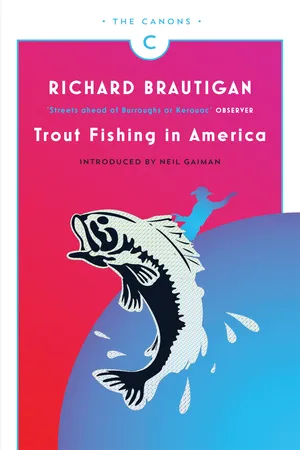
Richard Brautigan's wonderfully zany, hilarious episodic novel set amongst the rural waterways of America.
Here's a journey that begins at the foot of the Benjamin Franklin statue in San Francisco's Washington Square, wanders through the wonders of America's rural waterways and ends, inevitably, with mayonnaise. With pure inventiveness and free-wheeling energy, the counterpoint to all those angry Beatniks, Brautigan tells the story of rural America, and the hunt for a bit of trout fishing. Funny, wild and sweet, Trout Fishing in America is an incomparable guidebook to the delights of exploration - of a country and a mind.
- 140 pages
- English
- ePUB (mobile friendly)
- Available on iOS & Android
eBook - ePub
Trout Fishing in America
About this book
Information
KNOCK ON WOOD
(PART ONE)
(PART ONE)
As a child when did I first hear about trout fishing in America? From whom? I guess it was a stepfather of mine.
Summer of 1942.
The old drunk told me about trout fishing. When he could talk, he had a way of describing trout as if they were a precious and intelligent metal.
Silver is not a good adjective to describe what I felt when he told me about trout fishing.
I’d like to get it right.
Maybe trout steel. Steel made from trout. The clear snow-filled river acting as foundry and heat.
Imagine Pittsburgh.
A steel that comes from trout, used to make buildings, trains and tunnels.
The Andrew Carnegie of Trout!
The Reply of Trout Fishing in America:
I remember with particular amusement, people with three-cornered hats fishing in the dawn.
KNOCK ON WOOD
(PART TWO)
(PART TWO)
One spring afternoon as a child in the strange town of Portland, I walked down to a different street corner, and saw a row of old houses, huddled together like seals on a rock. Then there was a long field that came sloping down off a hill. The field was covered with green grass and bushes. On top of the hill there was a grove of tall, dark trees. At a distance I saw a waterfall come pouring down off the hill. It was long and white and I could almost feel its cold spray.
There must be a creek there, I thought, and it probably has trout in it.
Trout.
At last an opportunity to go trout fishing, to catch my first trout, to behold Pittsburgh.
It was growing dark. I didn’t have time to go and look at the creek. I walked home past the glass whiskers of the houses, reflecting the downward rushing waterfalls of night.
The next day I would go trout fishing for the first time. I would get up early and eat my breakfast and go. I had heard that it was better to go trout fishing early in the morning. The trout were better for it. They had something extra in the morning. I went home to prepare for trout fishing in America. I didn’t have any fishing tackle, so I had to fall back on corny fishing tackle.
Like a joke.
Why did the chicken cross the road?
I bent a pin and tied it onto a piece of white string.
And slept.
The next morning I got up early and ate my breakfast. I took a slice of white bread to use for bait. I planned on making doughballs from the soft center of the bread and putting them on my vaudevillean hook.
I left the place and walked down to the different street corner. How beautiful the field looked and the creek that came pouring down in a waterfall off the hill.
But as I got closer to the creek I could see that something was wrong. The creek did not act right. There was a strangeness to it. There was a thing about its motion that was wrong. Finally I got close enough to see what the trouble was.
The waterfall was just a flight of white wooden stairs leading up to a house in the trees.
I stood there for a long time, looking up and looking down, following the stairs with my eyes, having trouble believing.
Then I knocked on my creek and heard the sound of wood.
I ended up by being my own trout and eating the slice of bread myself.
The Reply of Trout Fishing in America:
There was nothing I could do. I couldn’t change a flight of stairs into a creek. The boy walked back to where he came from. The same thing once happened to me. I remember mistaking an old woman for a trout stream in Vermont, and I had to beg her pardon.
“Excuse me,” I said. “I thought you were a trout stream.”
“I’m not,” she said.
RED LIP
Seventeen years later I sat down on a rock. It was under a tree next to an old abandoned shack that had a sheriff’s notice nailed like a funeral wreath to the front door.
NO TRESPASSING
4/17 OF A HAIKU
Many rivers had flowed past those seventeen years, and thousands of trout, and now beside the highway and the sheriff’s notice flowed yet another river, the Klamath, and I was trying to get thirty-five miles downstream to Steelhead, the place where I was staying.
It was all very simple. No one would stop and pick me up even though I was carrying fishing tackle. People usually stop and pick up a fisherman. I had to wait three hours for a ride.
The sun was like a huge fifty-cent piece that someone had poured kerosene on and then had lit with a match and said, “Here, hold this while I go get a newspaper,” and put the coin in my hand, but never came back.
I had walked for miles and miles until I came to the rock under the tree and sat down. Every time a car would come by, about once every ten minutes, I would get up and stick out my thumb as if it were a bunch of bananas and then sit back down on the rock again.
The old shack had a tin roof colored reddish by years of wear, like a hat worn under the guillotine. A corner of the roof was loose and a hot wind blew down the river and the loose corner clanged in the wind.
A car went by. An old couple. The car almost swerved off the road and into the river. I guess they didn’t see many hitchhikers up there. The car went around the corner with both of them looking back at me.
I had nothing else to do, so I caught salmon flies in my landing net. I made up my own game. It went like this: I couldn’t chase after them. I had to let them fly to me. It was something to do with my mind. I caught six.
A little ways up from the shack was an outhouse with its door flung violently open. The inside of the outhouse was exposed like a human face and the outhouse seemed to say, “The old guy who built me crapped in here 9,745 times and he’s dead now and I don’t want anyone else to touch me. He was a good guy. He built me with loving care. Leave me alone. I’m a monument now to a good ass gone under. There’s no mystery here. That’s why the door’s open. If you have to crap, go in the bushes like the deer.”
“Fuck you,” I said to the outhouse. “All I want is a ride down the river.”
THE KOOL-AID WINO
When I was a child I had a friend who became a Kool-Aid wino as the result of a rupture. He was a member of a very large and poor German family. All the older children in the family had to work in the fields during the summer, picking beans for two-and-one-half cents a pound to keep the family going. Everyone worked except my friend who couldn’t because he was ruptured. There was no money for an operation. There wasn’t even enough money to buy him a truss. So he stayed home and became a Kool-Aid wino.
One morning in August I went over to his house. He was still in bed. He looked up at me from underneath a tattered revolution of old blankets. He had never slept under a sheet in his life.
“Did you bring the nickel you promised?” he asked.
“Yeah,” I said. “It’s here in my pocket.”
“Good.”
He hopped out of bed and he was already dressed. He had told me once that he never took off his clothes when he went to bed.
“Why bother?” he had said. “You’re only going to get up, anyway. Be prepared for it. You’re not fooling anyone by taking your clothes off when you go to bed.”
He went into the kitchen, stepping around the littlest children, whose wet diapers were in various stages of anarchy. He made his breakfast: a slice of homemade bread covered with Karo syrup and peanut butter.
“Let’s go,” he said.
We left the house with him still eating the sandwich. The store was three blocks away, on the other side of a field covered with heavy yellow grass. There were many pheasants in the field. Fat with summer they barely flew away when we came up to them.
“Hello,” said the grocer. He was bald with a red birthmark on his head. The birthmark looked just like an old car parked on his head. He automatically reached for a package of grape Kool-Aid and put it on the counter.
“Five cents.”
“He’s got it,” my friend said.
I reached into my pocket and gave the nickel to the grocer. He nodded and the old red car wobbled back and forth on the road as if the driver were having an epileptic seizure.
We left.
My friend led the way across the field. One of the pheasants didn’t even bother to fly. He ran across the field in front of us like a feathered pig.
When we got back to my friend’s house the ceremony began. To him the making of Kool-Aid was a romance and a ceremony. It had to be performed in an exact manner and with dignity.
First he got a gallon jar and we went around to the side of the house where the water spigot thrust itself out of the ground like the finger of a saint, surrounded by a mud puddle.
He opened the Kool-Aid and dumped it into the jar. Putting the jar under the spigot, he turned the water on. The water spit, splashed and guzzled out of the spigot.
He was careful to see that the jar did not overflow and the precious Kool-Aid spill out onto the ground. When the jar was full he turned the water off with a sudden but delicate motion like a famous brain surgeon removing a disordered portion of the imagination. Then he screwed the lid tightly onto the top of the jar and gave it a good shake.
The first part of the ceremony was over.
Like the inspired priest of an exotic cult, he had performed the first part of the ceremony well.
His mother came around the side of the house and said in a voice filled with sand and string, “When are you going to do the dishes? … Huh?”
“Soon,” he said.
“Well, you better,” she said.
When she left, it was as if she had never been there at all. The second part of the ceremony began with him carrying the jar very carefully to an abandoned chicken house in the back. “The dishes can wait,” he said to me. Bertrand Russell could not have stated it better.
He opened the chicken house door and we went in. The place was littered with half-rotten comic books. They were like fruit under a tree. In the corner was an old mattress and beside the mattress were four quart jars. He took the gallon jar over to them, and filled them carefully not spilling a drop. He screwed their caps on tightly and was now ready for a day’s drinking.
You’re supposed to make only two quarts of Kool-Aid from a package, but he always made a gallon, so his Kool-Aid was a mere shadow of its desired potency. And you’re supposed to add a cup of sugar to every package of Kool-Aid, but he never put any sugar in his Kool-Aid because there wasn’t any sugar to put in it.
He created his own Kool-Aid reality and was able to illuminate himself by it.
ANOTHE...
Table of contents
- Cover
- Trout Fishing In America
- Also by Richard Brautigan
- Title Page
- Copyright Page
- Introduction by Billy Collins
- Dedication
- Contents
- The Cover for Trout Fishing in America
- Knock on Wood (Part One)
- Knock on Wood (Part Two)
- Red Lip
- The Kool-Aid Wino
- Another Method of Making Walnut Catsup
- Prologue to Grider Creek
- Grider Creek
- The Ballet for Trout Fishing in America
- A Walden Pond for Winos
- Tom Martin Creek
- Trout Fishing on the Bevel
- Sea, Sea Rider
- The Last Year the Trout Came up Hayman Creek
- Trout Death by Port Wine
- The Autopsy of Trout Fishing in America
- The Message
- Trout Fishing in America Terrorists
- Trout Fishing in America with the FBI
- Worsewick
- The Shipping of Trout Fishing in America Shorty to Nelson Algren
- The Mayor of the Twentieth Century
- On Paradise
- The Cabinet of Dr. Caligari
- The Salt Creek Coyotes
- The Hunchback Trout
- The Teddy Roosevelt Chingader’
- Footnote Chapter to “The Shipping of Trout Fishing in America Shorty to Nelson Algren”
- The Pudding Master of Stanley Basin
- Room 208, Hotel Trout Fishing in America
- The Surgeon
- A Note on the Camping Craze that is Currently Sweeping America
- A Return to the Cover of This Book
- The Lake Josephus Days
- Trout Fishing on the Street of Eternity
- The Towel
- Sandbox Minus John Dillinger Equals What?
- The Last Time I Saw Trout Fishing in America
- In the California Bush
- The Last Mention of Trout Fishing in America Shorty
- Witness for Trout Fishing in America Peace
- Footnote Chapter to “Red Lip”
- The Cleveland Wrecking Yard
- A Half-Sunday Homage to a Whole Leonardo da Vinci
- Trout Fishing in America Nib
- Prelude to the Mayonnaise Chapter
- The Mayonnaise Chapter
Trusted by 375,005 students
Access to over 1.5 million titles for a fair monthly price.
Study more efficiently using our study tools.
Frequently asked questions
Yes, you can cancel anytime from the Subscription tab in your account settings on the Perlego website. Your subscription will stay active until the end of your current billing period. Learn how to cancel your subscription
No, books cannot be downloaded as external files, such as PDFs, for use outside of Perlego. However, you can download books within the Perlego app for offline reading on mobile or tablet. Learn how to download books offline
Perlego offers two plans: Essential and Complete
- Essential is ideal for learners and professionals who enjoy exploring a wide range of subjects. Access the Essential Library with 800,000+ trusted titles and best-sellers across business, personal growth, and the humanities. Includes unlimited reading time and Standard Read Aloud voice.
- Complete: Perfect for advanced learners and researchers needing full, unrestricted access. Unlock 1.5M+ books across hundreds of subjects, including academic and specialized titles. The Complete Plan also includes advanced features like Premium Read Aloud and Research Assistant.
We are an online textbook subscription service, where you can get access to an entire online library for less than the price of a single book per month. With over 1.5 million books across 990+ topics, we’ve got you covered! Learn about our mission
Look out for the read-aloud symbol on your next book to see if you can listen to it. The read-aloud tool reads text aloud for you, highlighting the text as it is being read. You can pause it, speed it up and slow it down. Learn more about Read Aloud
Yes! You can use the Perlego app on both iOS and Android devices to read anytime, anywhere — even offline. Perfect for commutes or when you’re on the go.
Please note we cannot support devices running on iOS 13 and Android 7 or earlier. Learn more about using the app
Please note we cannot support devices running on iOS 13 and Android 7 or earlier. Learn more about using the app
Yes, you can access Trout Fishing in America by Richard Brautigan in PDF and/or ePUB format, as well as other popular books in Literature & Literature General. We have over 1.5 million books available in our catalogue for you to explore.