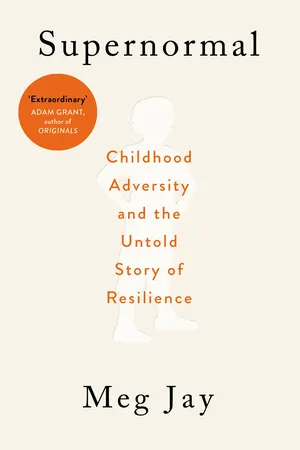
In this seminal new study of resilience, Meg Jay tells the stories of a diverse group of people who have overcome trauma in their childhoods to go on and live successful lives as adults. These are the 'supernormal', who having shouldered greater than average hardship as children defy expectation and achieve better than average success as adults. But how, and at what cost?
Whether it was experiencing parental divorce, or growing up with an alcohol or drug-abusing parent, living with a parent or sibling with mental illness, being bullied, living in poverty, being a witness to domestic violence, suffering physical or emotional neglect, the people Meg Jay introduces us to are all survivors. She explores what they have in common that made it possible for them to transcend the trauma of their early years and to build successful adult lives. And she asks the questions: What was the cost of developing those powers? And having survived, even thrived, how do you go on and build a trusting, fulfilled life?
Drawing on her clinical experience with survivors of childhood trauma, Meg Jay documents ordinary people made extraordinary by the experience of all-too-common trauma. Bringing together personal, scientific and cultural knowledge Jay gives a voice to the experience of the 'supernormal', furnishes them with the tools to better understand themselves and take full advantage of their strengths, and gives a window into their world for those who seek to understand them.
- 400 pages
- English
- ePUB (mobile friendly)
- Available on iOS & Android
eBook - ePub
About this book
Information
CHAPTER 1
Supernormal
There is no greater agony than bearing an untold story inside you.
—Maya Angelou
Helen looked as put together in person as she had sounded on the phone. Precisely on time for her first appointment, she sat on the couch with her back straight and her hands resting on top of one another, the bottom hand clenched. We exchanged some pleasantries, which included my asking if she had found my office without incident. To this, Helen replied, almost offhandedly, that she had been late getting out of a meeting at work, rushed over in her car, gotten a flat tire on the way, rolled into the closest service station, dashed in to drop off her keys, dashed back out yelling over her shoulder that she would return in an hour, jumped on a bus heading in the right direction, hopped off a mile or so later, and ran the last couple of blocks.
“You sound like a superhero,” I said.
Tears began to fall down Helen’s cheeks, and she looked at me wryly, sadly. “You don’t know the half of it,” she replied.
Helen told me she had spent most of the last several years since college—“How many has it been?” She paused to count. “Ten? Eleven?”—crisscrossing the globe with nongovernmental organizations fighting for a better world. Social justice in Africa. Climate justice in Southeast Asia and Latin America. Juvenile justice in Eastern Europe and the Caribbean. Helen went wherever she was needed and then, one day, her mother sent word she was needed back home.
Helen’s father had killed himself in the house where she grew up. Theirs was a modest home in a suburban neighborhood about two hours outside San Francisco. It was a place where there had been a yard to run around in, and Helen and her two younger brothers each had a bedroom of their own. Maybe this was why, many years ago, no one heard the youngest boy sneak out of the house in the middle of the night and head for the backyard pool. Maybe this was why no one saw him drown.
Before she was even a teenager, Helen had begun to sneak out of the house at night, too. At first, she wanted to know what the world had looked like to her brother just before he died, but then she kept doing it because it felt like getting away, at least for a while. Her father was not arguing for a fresh start somewhere else. Her mother was not crying, refusing to leave her memories of her youngest child—and the marks she had made on the kitchen doorway as he had grown taller—behind. During the day, Helen walked down the halls at school where she earned good grades with a smile—her parents needed her to be “the strong one,” and she was. In the dark of night, though, Helen could walk for blocks and blocks, and as she moved in and out of the cones of yellow light from the streetlamps, there was no one to be strong for, no one to save.
Back from her work around the world, Helen drove her rental car down those same streets, unsure of what she hated more about her neighborhood: the fact that the houses were all supposed to look alike or the feeling that hers never had seemed like the rest. Next, she went to her father’s office where she packed his personal items into a cardboard box, among them an empty water bottle stashed suspiciously in the bottom desk drawer. When she unscrewed the top and put her nose to it, it smelled of alcohol. Helen felt like drinking, too, as she sat back and swiveled side to side in her father’s desk chair and eyed the hundreds of files stacked haphazardly in chairs around the room. On her way out, Helen politely thanked her father’s colleagues as they fumbled with awkward condolences, and with congratulations, too, about her many good works: “Your father was so proud of you. He talked about you all the time, you know.” Helen did know. She was, and had always been, living proof that her family was all right.
In a flash, Helen had a new job near her hometown, this time as a fund-raiser for a presidential campaign. There was work that needed to be done right here in the United States, she reasoned; besides, her mother needed her, too. At the office, friendly, impassioned calls with donors were interspersed with weepy calls from her mother: her house—the one she vowed never to leave—might go into foreclosure. It was on a day like this one that she made her way to my office and told me her story.
“I’ve never said all this to anyone before,” Helen confided as tears rolled in steady tracks down her cheeks. “Some people know some of it, but no one knows all of it. People look at me and they see all these great things I have done—and they are sort of astonished when they find something out about my family but no one really knows me. I don’t think anyone has ever really known me. It’s lonely.”
Helen sat silent for a long while, folding and unfolding a tissue.
“I’m so tired,” she continued. “I feel embarrassed to say that, to be sitting here crying, when I think about all the people in the world who have had it so much harder than I have. It’s like I don’t have the right to be as worn out or as sad as I am. I don’t know what’s wrong with me. Sometimes I feel like I don’t fit anywhere, like there isn’t a word for . . . whatever I am. I just have this feeling that I’m not like other people,” she concluded. “That I’m not normal.”
When I asked Helen if she had ever thought of herself as resilient, she was more taken aback than confused. Her answer was swift and firm: “No.”
“If I was resilient,” she went on to explain matter-of-factly, as if I was the one who was mistaken, “I wouldn’t be here. I wouldn’t need to talk to someone like you.”
Then, with impeccable timing, Helen glanced at her watch and interrupted herself to say, “Our time is up. I’ll see you next week.” She wiped the tears from her face and walked out the door, off to race back to her car.
***
Helen is a marvel. Whether she was making it through her childhood or to my office that first day, she overcame hardships, both big and small. The loss of her brother. Her parents’ grief. Her father’s death. International injustice. A flat tire. Helen leapt into action no matter what. Strong and determined, compassionate and brave, she was a hero to her family, and maybe to some others, too. Tirelessly, it seemed, she came to the rescue of those who needed her and she stood up for strangers around the globe. To those who knew her, Helen was a wonder, and maybe few would have guessed that, behind closed doors, she felt exhausted and different and alone.
But Helen was not as different from other people as she imagined. What follows are the most common adversities that children and teens wake up to every day. If you are wondering if you might have been one of those children or teens, ask yourself the following questions. Before the age of twenty:
• Did you lose a parent or sibling through death or divorce?
• Did a parent or sibling often swear at you, put you down, humiliate you, isolate you, or act in a way that made you feel afraid?
• Did you live with a parent or sibling who was a problem drinker, or who abused other drugs?
• Were you ever bullied by, or afraid of, kids at school or in your neighborhood?
• Did you live with an adult or sibling who struggled with a mental illness, or some other serious illness or special need?
• Did a parent or a sibling often push, grab, slap, or throw something at you, or ever hit you so hard that you had bruises, marks, or other injuries?
• Did you live in a home where you went without clean clothes or enough to eat, you could not afford a doctor, or you felt you had no one to protect you?
• Did someone in your household go to jail?
• Did a parent, sibling, or another person at least five years older touch your body in a sexual way or ask you to do something similar?
• Was a parent or sibling in your household sometimes hit, kicked, or slapped, or ever threatened with a weapon?
If you answered yes to one or more of these questions—or if you lived with an adversity not mentioned just above—you are not the only one. Considered individually, each of these experiences may affect only a minority of the population, but considered together under the umbrella of childhood adversity, multiple studies in the United States and around the world suggest that up to 75 percent of children and teens are exposed to one of these events—or more—as one problem may lead to another and another. Yet, as we all know, many young people, like Helen—and maybe like yourself—grow up and do well in the world, not just in spite of the difficulties they have known, but maybe even because of them. Social scientists call men and women like these “resilient.”
According to the American Psychological Association, resilience is adapting well in the face of adversity, trauma, tragedy, or significant ongoing stressors. Researchers say it is unexpected competence despite significant risks; it is achieving success despite serious challenges. No matter how exactly one chooses to phrase it, resilience is doing better than one might expect; it is making good when much has been bad. Certainly, after all she had been through, Helen had made good. She had adapted well, and she was more competent and successful than many may have predicted. So why, then, did Helen not think of herself as resilient?
The problem is that, colloquially, we talk about resilience in deceptively simple terms. We say people who are resilient “bounce back.” They “rebound.” And if we look in the dictionary, we see resilience defined as elasticity, as the ability to recover quickly and easily, to return to one’s original state after an illness or misfortune or shock. There are all sorts of situations for which this kind of springy definition makes sense, such as when we rebound from having the flu or we bounce back from losing a job. But none of these popular descriptions matches what goes on inside those like Helen, most of whom do not recover quickly or return to their original state, but are forever changed by their early experiences. When it comes to overcoming childhood adversity, resilience is no snap.
In fact, social scientists argue that resilience is best understood not as some kind of elastic trait that someone either does or does not have, but as a phenomenon—as something we can see but do not entirely understand. We can see this sort of phenomenal resilience in stories of those like Helen, and we can see it in the lives of well-known women and men we will hear a bit about in the pages ahead, ones who show us that those like Helen are not as alone as they feel but are, in fact, in good company. Here are a few:
Andre Agassi, tennis champion
Maya Angelou, author
Alison Bechdel, cartoonist
Johnny Carson, comedian
Johnny Cash, country singer
Stephen Colbert, comedian
Misty Copeland, ballet dancer
Alan Cumming, actor
Viola Davis, actor
Viktor Frankl, psychiatrist and Holocaust survivor
LeBron James, basketball champion
Barack Obama, 44th president of the United States
Paul Ryan, 54th Speaker of the House
Oliver Sacks, neurologist
Howard Schultz, chairman of Starbucks
Akhil Sharma, author
Elizabeth Smart, child safety advocate
Sonia Sotomayor, US Supreme Court Justice
Andy Warhol, artist
Elizabeth Warren, US senator
Oprah Winfrey, media mogul and philanthropist
Jay Z, rapper and businessman
But of course, most resilient people aren’t celebrities. Most are everyday women and men hiding in plain sight as doctors, artists, entrepreneurs, lawyers, neighbors, parents, activists, teachers, students, readers, and more. These women and men deserve a better metaphor than the bounce of a ball or the snap of an elastic band. They deserve a metastory, one that does justice to the full experience of being resilient, and that is what Supernormal is all about.
In the chapters ahead, what the stories of both private and public individuals will show us is that, contrary to the notion that resilient youth bounce back from hard times, what they actually do is something much more complicated and courageous. They are nothing if not protagonists in their own lives, often waging fierce and unrelenting battles others cannot see. As we are about to learn, theirs is a heroic, powerful, perilous lifelong journey, a phenomenon indeed—one that, after decades of interest and research, still amazes and confounds.
***
In 1962, psychologist Victor Goertzel, along with his wife, Mildred, published a book titled Cradles of Eminence: A Provocative Study of the Childhoods of Over 400 Famous Twentieth-Century Men and Women. Their famous men and women were those who had at least two biographies written about them, and who made positive contributions to society: Louis Armstrong, Frida Kahlo, Pablo Picasso, Eleanor Roosevelt, to name a few. What was “provocative,” or at least surprising, about the Goertzels’ book was the revelation that, as children, three-quarters of these prominent individuals had been burdened by poverty, broken homes, abusive parents, alcoholism, handicaps, illness, or other misfortunes. Only fifty-eight, or less than 15 percent, seemed to have been raised in supportive, untroubled homes. “The ‘normal man,’” concluded the Goertzels, “is not a likely candidate for the Hall of Fame.”
Perhaps former First Lady Abigail Adams was right when she said, “The habits of a vigorous mind are formed in contending with great difficulties. When a mind is raised and animated by scenes that engage the heart, then those qualities which would otherwise lay dormant, wake into life and form the character of the hero and the statesman.” Or maybe it is simply true that no matter where one looks, if one looks closely enough, adversity is more common than not. Rather than the freakish burden of the unlucky few, hard times can be found in the personal histories of the eminent, the heroic, and countless everyday resilient individuals.
Social scientists initially stumbled upon these everyday resilient individuals mostly by accident. For almost a hundred years, since the founding of the field of psychology, researchers had largely concerned themselves with mental illness, and especially with how problems in childhood led to problems in adulthood. Sigmund Freud is probably best known for popularizing this notion late in the nineteenth century, but it was, in fact, a point of view that was already well established. “Everywhere I go I find that a poet has been there before me,” Freud purportedly said, and indeed it was eighteenth-century poet Alexander Pope whose words became this popular adage: “As the twig is bent, so is the tr...
Table of contents
- Cover
- Title Page
- Copyright Page
- Dedication
- Epigraph
- Contents
- Author’s Note
- 1. Supernormal
- 2. Origin Story
- 3. Secret
- 4. Fight
- 5. Flight
- 6. Vigilance
- 7. Superhuman
- 8. Orphan
- 9. Mask
- 10. Alien
- 11. Antihero
- 12. Reboot
- 13. Kryptonite
- 14. Secret Society
- 15. Cape
- 16. Avenger
- 17. The Power of Love
- 18. Never-Ending
- Notes
- Acknowledgments
Trusted by 375,005 students
Access to over 1.5 million titles for a fair monthly price.
Study more efficiently using our study tools.
Frequently asked questions
Yes, you can cancel anytime from the Subscription tab in your account settings on the Perlego website. Your subscription will stay active until the end of your current billing period. Learn how to cancel your subscription
No, books cannot be downloaded as external files, such as PDFs, for use outside of Perlego. However, you can download books within the Perlego app for offline reading on mobile or tablet. Learn how to download books offline
Perlego offers two plans: Essential and Complete
- Essential is ideal for learners and professionals who enjoy exploring a wide range of subjects. Access the Essential Library with 800,000+ trusted titles and best-sellers across business, personal growth, and the humanities. Includes unlimited reading time and Standard Read Aloud voice.
- Complete: Perfect for advanced learners and researchers needing full, unrestricted access. Unlock 1.5M+ books across hundreds of subjects, including academic and specialized titles. The Complete Plan also includes advanced features like Premium Read Aloud and Research Assistant.
We are an online textbook subscription service, where you can get access to an entire online library for less than the price of a single book per month. With over 1.5 million books across 990+ topics, we’ve got you covered! Learn about our mission
Look out for the read-aloud symbol on your next book to see if you can listen to it. The read-aloud tool reads text aloud for you, highlighting the text as it is being read. You can pause it, speed it up and slow it down. Learn more about Read Aloud
Yes! You can use the Perlego app on both iOS and Android devices to read anytime, anywhere — even offline. Perfect for commutes or when you’re on the go.
Please note we cannot support devices running on iOS 13 and Android 7 or earlier. Learn more about using the app
Please note we cannot support devices running on iOS 13 and Android 7 or earlier. Learn more about using the app
Yes, you can access Supernormal by Meg Jay in PDF and/or ePUB format, as well as other popular books in Psychology & History & Theory in Psychology. We have over 1.5 million books available in our catalogue for you to explore.