Shortlisted for the Edward Stanford Travel Writing Awards
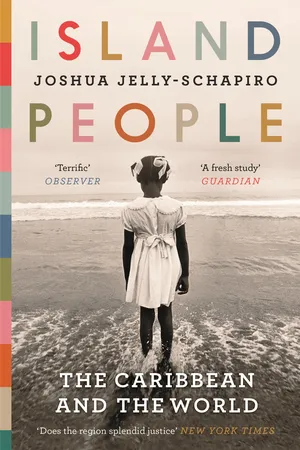
Clustered together in azure-blue waters are a collection of little islands whose culture, history and people have touched every corner of the world. From the moment Columbus gazed out at what he mistook for India, and wrote in his journal of 'the most beautiful land that human eyes have ever seen,' the Caribbean has been the subject of fantasies, myths and daydreams. It was claimed, and its societies were built to enrich old Europe, and much later its beaches were splashed across billboards advertising fizzy drinks, its towns and people pictured in holiday brochures.
But these islands are so much more than gloss, white sand and palm trees, they form a region rich in colour, beauty and strength. Home of the Rastafarian faith, Che Guevara's stomping ground and birthplace of reggae, the Caribbean has produced some of the world's most famous artists, activists, writers, musicians and sportsmen - from Usain Bolt to Bob Marley and from Harry Belafonte to V. S. Naipaul. In the pages of Island People we hear the voices of the Caribbean people, explore their home and learn what it means to them, and to the world.
In this fascinating and absorbing book, the product of almost a decade of travel and intense study, Joshua Jelly-Schapiro strips away the fantasy and myth to expose the real islands, and the real people, that make up the Caribbean.
- 464 pages
- English
- ePUB (mobile friendly)
- Available on iOS & Android
eBook - ePub
About this book
Information
PART I

The Greater Antilles
Jamaica: The Wages of Love

CHAPTER 1
BRANDING
ON TV, IT LOOKED LIKE the others were jogging.
Halfway through the Olympic 100-meter final, Usain Bolt—Jamaican hero, fastest man in the world, performing in London before eighty thousand flashbulb-popping fans—pulled away. At six-foot-five, hurtling down the tile-red track, Bolt stretched his stride in a way none of his rivals—compact, muscular men all—could match. One moment, eight Lycra-clad figures were sprinting in a pack. Then there was one: long legs churning, face calm. In Beijing four years before, he’d turned this race, as one oft-quoted account had it, into “a palette on which an emerging and transcendent talent could splash his greatness.”1 Slapping his chest before the line, exulting as he crossed—Bolt charmed the world with his brash joie de vivre. Now, as he pulled away, TV replays caught him glancing at the stadium clock: in Beijing, he’d entered history; here, he wanted to make it. And so he did. The clock showed the time—a new Olympic record. And Jamaica’s pride, his nation’s black, yellow, and green flag draped over his broad back, grinned and danced as he circled the stadium, soaking up its warm lights’ love.
For most of the few hundred million around the globe watching on TV, the scene showed what the Olympic Games, Visa-sponsored corporate dross aside, could still be. Here was a beautiful human, from a little nation, moving with supernal grace on the world stage. But to Jamaicans, this win meant much more. In Kingston that night, they’d ignored tropical storm warnings to gather in their thousands, by one of the city’s main crossroads, at Half Way Tree, before a big screen to watch him run. Dressed in yellow or green, blaring plastic horns, they could be seen, on videos posted to YouTube, hopping in place as the race began—and then, when Bolt won (and as his young Jamaican teammate Yohan Blake took silver for good measure), leaping higher. They raised their fingers to the sky, hands held like pistols, yelling out Jamaicans’ favored expression for affirming joy, in this city as well known for gunplay as for Bob Marley. Brap, brap, brap! The sound mimicked the sound of shots fired in the air. Behind them, on a big screen, was Usain Bolt in London performing dance moves that may have looked, to the world, like so much wiggling; people here knew, though, that they were moves born at street parties nearby.
In Jamaica, at any time, Bolt’s win would have been a big deal. In this athletics-mad nation of two and a half million souls, sprinting—the source of fifty-two of the fifty-five Olympic medals Jamaica has ever won—matters. But what made the resonance of this triumph, at these London Olympics, extra deep, was its timing. August 5, 2012, fell on the eve of Jamaica’s Golden Jubilee. The very next night, in Kingston’s National Stadium, the island would celebrate its fiftieth birthday as a sovereign state. At midnight on this date in 1962, Princess Margaret lowered the Union Jack, which flew over this island for 307 years, and watched Alexander Bustamante, independent Jamaica’s first prime minister, raise a bright new standard in its place. As Jamaica’s sprinters, in London, raised that standard in the old empire’s capital—Bolt and Blake followed up their 100-meter sweep with one at 200 meters, and then helped Jamaica’s 4 x 100 relay team win gold, too—Jamaica’s anniversary celebrations, which had been building for months, were reaching a peak.
This, as one government official later put it to me, was a “cosmological convergence,” impossible to ignore. And Jamaica’s leaders, that August, didn’t. Hailing Bolt’s glory, they sought to dovetail Jamaicans’ pride in their athletes with the prideful celebration they hoped “Jamaica 50” might represent for its people. (Naturally, they also sought, in ways subtle and less so, whether or not they belonged to the party of Prime Minister Portia Simpson-Miller, to leverage this all for political gain.) None of this was surprising. What I found striking, as I read Jamaica’s papers online that month, and tuned in to watch the Jamaica 50 Grand Gala, was their language.
“Brand Jamaica,” said an official from the Olympic committee praising Bolt’s win, “has benefited tremendously from the exposure of our athletes in London.”2 The government’s minister of youth and culture agreed. “Jamaica’s Golden Jubilee,” she proclaimed, “presents a glorious context in which to present the value proposition of Brand Jamaica.”3 The prime minister, in an interview with Time magazine, praised “the brand the world recognizes so well.”4 During her speech at the Jamaica 50 gala, the subtext of her remarks, about how “in the area of sport and music, we are the toast of the world,” was plain.5 The leader every Jamaican calls “Portia” spent her first months in office urging, as her inaugural speech put it, that “Jamaica must remain ‘a quality brand.’”6
I’d heard the term—“Brand Jamaica”—before. Mostly from tourism officials, during recent trips to the island, who sometimes invoked it when interviewed on Jamaican TV about their industry. Members of the film board, too, were fond of it: Brand Jamaica featured prominently on the website of their parent outfit, JAMPRO, the Jamaican Promotions Company, the agency charged with attracting foreign investment here. Since the government’s release of a much-publicized report on the theme—its findings: Jamaica was “sitting on a treasure-house of natural brand equity”7—Brand Jamaica had become a popular subject. At dinner parties with island intellectuals, it was ridiculed. It was a much more intriguing curio, though, than a ubiquitous slogan.
But now, as Jamaica toasted its fiftieth, Brand Jamaica was everywhere.
* * *
THE PHRASE SOUNDED NEW, though Brand Jamaica dated from the 1960s, when the new country’s Tourist Board was launched to help Jamacia make its mark on the world. Hiring a fancy New York marketing firm to help attract the world’s tourists to its shores, the Tourist Board registered Jamaica’s name, and brand identity (as “the most complete, diverse, and unique warm weather destination in the world”8), and aired ads everywhere. But then, in the 1970s, Jamaica’s shores had become as well known for shootings as for sun. The island’s rival political parties—Edward Seaga’s Jamaican Labor Party, or JLP, backed by the CIA, and the People’s National Party, or PNP, led by charismatic, Cuba-loving Michael Manley—enjoined a hot local variant of the Cold War. The parties armed their supporters and built them housing-projects-cum-patronage-communities, called “garrisons.” No one talked much about Brand Jamaica. The garrisons’ criminal lords, called “dons,” became flush with drug money and grew to dominate the politicians to whom they’d once answered. And two years before Jamaica 50, that dynamic exploded, as it had before. State police stormed Tivoli Gardens, a historic community built by Seaga’s JLP. The ensuing debacle saw seventy-odd Jamaican citizens die, underscoring in red the corruption that had killed Brand Jamaica in the ’70s. It also furnished the lingering backdrop, amid a tanking economy, for Jamaica’s fiftieth anniversary. But none of this stopped Jamaica’s powers that be from resurrecting the term to tout the island’s achievements at venues ranging from Kingston’s National Stadium to the Clive Davis School of Recorded Music, at New York University, where old Edward Seaga turned up, one day that fall, to tout the release of a CD box set of Jamaica’s “100 most significant songs.”
Those “significant songs,” as Seaga’s presence at NYU signaled, have been significant far beyond Jamaica: their sounds sowed seeds for hip-hop; they permanently altered the texture of rock and pop and R&B. Jamaica’s wiliest politician of its modern era, a white-maned hipster statesman in a dark suit, affirmed these truths to the Manhattan music mavens who came to see him. Seaga explained that before entering politics, he had worked as an ethnographer in Kingston’s ghettos; that he’d helped launch Jamaica’s record industry. Back in the 1950s, he had released not a few songs now included on the CDs he was here to hawk. Seaga’s biography—Harvard-trained anthropologist; record producer and label owner; thrice-elected Caribbean head of state—was hardly imaginable anywhere but Jamaica. But here, he spoke most of using this box set, and birthday, to “rebuild Brand Jamaica.” His island’s brand had many facets. These included swift sprinters and shining sands. But “our music has been the greatest,” he intoned at NYU, “because it has made us a brand name.”
And so, “brand” language aside, it did. No Jamaican, apart from Bolt, because of his recent quadrennial bursts, has ever approached the fame of the reggae king whose “One Love” has long been the Tourist Board’s anthem, and whose dreadlocked visage, thirty years after his death, still adorns dorm rooms everywhere. Bob Marley, who in 1973 recalled the Middle Passage like it was yesterday, became the “first Third World Superstar” by making historical links with no right to resound as pop hits. He hailed the prospect, on singles from “Slave Driver” to “Get Up, Stand Up,” of redeeming our bloody histories. And then, in the tune that’s endured as his epitaph, he distilled his art’s thrust. “Redemption songs,” he sang at his life’s end, “are all I ever have.” Those lines carried more than one meaning from this artist far cannier than the saintly stoner image projected onto his sharp-featured face, who came of age just as freedom’s hopes were being dashed by poverty’s violence. What Marley had, like the larger Third World, was less freedom’s benefits than its promise. Songs of redemption, rather than the thing itself. These were the great product of a poor society where “development” has seemed an ever-receding dream. But none of this has stopped Jamaica’s boosters from seeing the island’s very history as a redemption song—or from hailing how “this little island,” as Seaga recited at NYU, “changed the world.”
A couple of months later, I booked a flight to Kingston. Boarding the plane at JFK with Jamaicans doffing puffy coats to do the same, I intended to spend some weeks on their island as its leaders tried, a half century into Jamaica’s struggle to enjoy freedom’s benefits, to turn their culture’s riches into a “brand” for the world to consume.
Those weeks, this being Jamaica, turned into months.
* * *
“LADIES AND GENTLEPERSONS.” The flight attendant’s tuneful voice shook the canned air. “Is’ yard we reach!” Four hours out of New York, the plane banked over Kingston’s glinting lights. A pair of women in my row sporting magenta-hued hair and six-inch heels tittered at our steward’s invoking their slang name for Jamaica, resonant of the grim “government yards” where many of our cabinmates—“yardies,” in the parlance—grew up. We would not have heard that patois on a flight to Montego Bay. That’s the purpose-built entrepôt, on Jamaica’s north shore, that receives nearly all the million-plus tourists who still come here each year to rent time on chaise longues nearby. But we were flying to Kingston. I was the sole passenger without brown skin, apart from a couple of well-fed businessmen in first class, and this cabin full of returning migrants—teachers or cabbies, doctors or dealers—laughed along as another man’s voice rang out from a back row, as we bumped aground, to keep the “yardie” riff going.
Brap, brap, brap!
In Jamaica, the language people speak, even more than many aspects of their culture, has tricky implications for its brand. Jamaican patois—now often simply called “Jamaican” here—has in recent years won increased acceptance: in schools, educators understand patois as a language in its own right, with English vocabulary but African syntax, and treat it as their pupils’ first tongue; the nation’s main newspapers, each day, run “patwa” columns; its star sprinters speak it. (As the bronze medalist Warren Weir put it to the BBC, after Jamaica’s 200-meter sweep: “Nuh English, straight patwa!”) It is the Queen’s English, though, that remains the language of Jamaica’s ruling classes—of the people both most keen to tout Jamaica’s charms—its exuberance and rebel allure—and most conscious of the fact that in places like the UK (where Jamaicans remain among the few Commonwealth citizens requiring a visa to visit), “yardie” is as synonymous with “gangster” as it is with “Jamaican.” Rising to open the luggage racks overhead, I helped my row mates lower tied-together parcels, to their murmured “T’anks,” and I recalled hearing after the Olympics how, when the nation’s Ministry of Youth, Sports, and Culture had grown concerned with the image their young patwa-speaking athletes might project abroad, they instituted a strict training program in media English, to go with their wind sprints, so their Bolts and Blakes and Weirs would be ready when the foreign cameras shone.
Some months had passed since the main celebration of Jamaica 50. The blandishments of that time—including the “Nation on a Mission” theme song its leaders had commissioned to go with it, with its patriotic verses mouthed by reggae stars and sprinters—were starting to fade. I’d timed my visit, though, to coincide with the island’s annual celebration of Black History Month. In the United States, we’ve grown used to our cafeterias breaking out paper place mats each February depicting Sojourner Truth and Martin Luther King. In Jamaica, Black History Month also congrues with a yearly salute to the local music that’s made Black History its great theme: in 2008, the government proclaimed that every February, forevermore, would officially be “Reggae Month,” too. That week in Kingston, the University of the West Indies was to host a conference on “Global Reggae, a’ [at] yard and abroad,’” which promised to attract a devoted tribe of scholars and obsessives outlining Jamaica’s nation-branding efforts, and the culture behind them, in panel discussion form.
Jamaica is hardly the sole world nation in the early twenty-first century to have embraced a branding agenda. England has its “Cool Britannia” ad campaign; Korea, its “K-Pop.” In an era when the public sphere can feel like a marketing consultancy, even artists and grade schoolers know that it’s not the product, it’s the brand. But the branding concept’s uses and abuses, in a society whose forebears’ flesh was once singed like cattle’s, was striking. Striking, for that history. Striking, for how Jamaica’s attempts to forge a Pavlovian link, in the world’s mind, between the island’s flag and its charms, involved a process of at once touting and quieting its foremost pathologies—for sex and sun, frenetic energy and violence. Brand Jamaica was striking for how all its facets, from sports to music to frolicking tourists, were implicated within the garrison complex that came during the 1970s and ’80s to rule and ruin island life. And it was striking, too, because of what Brand Jamaica’s story could maybe reveal about the larger fortunes of the old Third World.
Since the Cold War’s end, many members of that fraternity of less have seen their economies, devalued and debt-ridden, advance little. When Marley sang, “Today they say are we free / only to be chained in poverty,” in 1973, Jamaica had a dollar whose value still equaled that of a U.S. greenback. Now a single American dollar bought one hundred Jamaican ones. Yet Jamaica had demonstrated a remarkable gift, like many of its Third World peers, for exporting its people to First World cities. And those cities’ cultures, if not their civil politics, have thrived on the toothsome frisson, “ethnic” or “exotic” (choose your queasy word), of those migrants’ pepper and sounds. In this complex of fresh spring rolls and green tofu curries and cumbia-for-white-folks, Jamaican reggae’s image and sounds held a prideful place. This is a fact, to Brand Jamaica’s touters, that was extremely crucial. How and whether it mattered at all, or could be made to matter, to the Jamaicans with whom I filed off that flight in Kingston, not one of them a dreadlocked singer or a world-class sprinter, was another question.
* * *
WE STEPPED THROUGH the balmy night air to enter an arrivals hall bedecked with yellow, green, and black bunting. A large banner hung on a back wall. It was affixed with the hummingbird-adorned Jamaica 50 logo and a prosaic message—“WELCOME HOME”—that echoed our flight attendant’s protocol breach and evinced how its hangers hoped Jamaica’s birthday might resonate for this émigré nation. The line at immigration for JAMAICA/CARICOM entrants was, as usual in Kingston, much longer than the one for foreigners. At the customs desk, a uniformed agent stamped my passport with a perfunctory nod. His approach toward my magenta-haired friends was more dilatory. The women hoisted their bags onto the agent’s steel table and glared daggers at his colleague, whose dog sniffed at parcels perhaps full of new Nikes for their cousins, or bras and cell phones to sell. With hustlers’ mores and the outsized manner of a people about whom the song “Everybody Is a Star” might have been written, the members of Jamaica’s émigré nation are certainly on a mission—if not, most times, the patriotic one their government had hailed in its Jamaica 50 theme song, and that the island’s largest cell phone company, by the baggage claim, touted on another wall-sized mural. “NATION ON A MISSION,” it yelled in 1,000-point type, above where the phone company Digicel’s logo was affixed to a photomontage of Bolt spreading his seven-foot wingspan to the world, as Shelly Ann Frazer-Price, “di pocket rocket,” who also won London gold, sprinted from the ghetto where she grew. Stepping beneath another banner hailing the nation’s fiftieth, I paused after customs. There, by the money changers’ booths, a more homely pantheon entombed its elder heroes in papier-mâché.
A man-sized figure in antique cottons, first in line, had “Sam Sharpe” inked on a plate at his feet: Sharpe led a rebellion of Jamaica’s slaves, in 1831, that helped force its owners to abolish slavery throughout their empire. By Sharpe’s side was Paul Bogle, the Baptist preacher who led another uprising, a few decades later, of ex-slaves now freed from bondage but still chained in poverty. Marcus Mosiah Garvey, next up, was unmistakable in his Horatio Nelson hat: he founded the United Negro Improvement Association in 1917 after emigrating from Jamaica to Harlem, and helped the world’s black masses see themselves as a diaspora like the Jewish one. The two men here whose papier-mâché skin was painted lighter than the others had led Jamaica’s drive to independence in 1962, and founded the two parties that define its politics still: Alexander Bustamente, the populist demagogue who formed the JLP (and Jamaica’s first government), and his first cousin Norman Manley, the high-minded barrister (and father of the country’s fourth prime minister, Michael Manley), who birthed the PNP. The last figure in this lineup was its sole woman. Recognizable for her gender and her head scarf, Queen Nanny of the Maroons was the eighteenth-century matriarch of the island’s runaway slaves. She led the Maroons’ fight for freedom—but she’s a figure perhaps most recalled by school kids now, on this island of women-led households whose culture’s mores can feel matriarchal and misogynist all at once, for her alleged ability, when faced with the redcoats’ muskets, to catch their bullets in her...
Table of contents
- Cover
- Title Page
- Copyright
- Dedication
- Contents
- Map
- Introduction
- Part I: The Greater Antilles
- Part II: The Lesser Antilles
- Acknowledgments
- Notes
- Bibliography and Further Reading
- Text Permissions
Trusted by 375,005 students
Access to over 1.5 million titles for a fair monthly price.
Study more efficiently using our study tools.
Frequently asked questions
Yes, you can cancel anytime from the Subscription tab in your account settings on the Perlego website. Your subscription will stay active until the end of your current billing period. Learn how to cancel your subscription
No, books cannot be downloaded as external files, such as PDFs, for use outside of Perlego. However, you can download books within the Perlego app for offline reading on mobile or tablet. Learn how to download books offline
Perlego offers two plans: Essential and Complete
- Essential is ideal for learners and professionals who enjoy exploring a wide range of subjects. Access the Essential Library with 800,000+ trusted titles and best-sellers across business, personal growth, and the humanities. Includes unlimited reading time and Standard Read Aloud voice.
- Complete: Perfect for advanced learners and researchers needing full, unrestricted access. Unlock 1.5M+ books across hundreds of subjects, including academic and specialized titles. The Complete Plan also includes advanced features like Premium Read Aloud and Research Assistant.
We are an online textbook subscription service, where you can get access to an entire online library for less than the price of a single book per month. With over 1.5 million books across 990+ topics, we’ve got you covered! Learn about our mission
Look out for the read-aloud symbol on your next book to see if you can listen to it. The read-aloud tool reads text aloud for you, highlighting the text as it is being read. You can pause it, speed it up and slow it down. Learn more about Read Aloud
Yes! You can use the Perlego app on both iOS and Android devices to read anytime, anywhere — even offline. Perfect for commutes or when you’re on the go.
Please note we cannot support devices running on iOS 13 and Android 7 or earlier. Learn more about using the app
Please note we cannot support devices running on iOS 13 and Android 7 or earlier. Learn more about using the app
Yes, you can access Island People by Joshua Jelly-Schapiro in PDF and/or ePUB format, as well as other popular books in History & Latin American & Caribbean History. We have over 1.5 million books available in our catalogue for you to explore.