'If a man truly desires to write, then he will.
Rejection and ridicule will only strengthen him . . . There is no losing in writing, it will make your toes laugh as you sleep, it will make you stride like a tiger, it will fire the eye and put you face to face with death. You will die a fighter, you will be honored in hell. The luck of the word. Go with it, send it.'
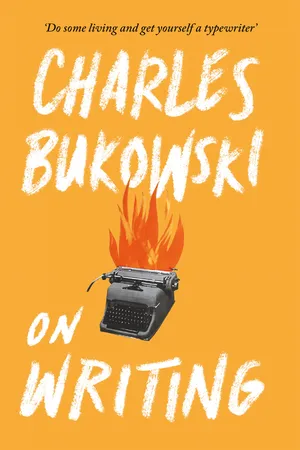
Charles Bukowski was one of our most iconoclastic, raw and riveting writers, one whose stories, poems and novels have left an enduring mark on our culture. On Writing collects Bukowski's reflections and ruminations on the craft he dedicated his life to.
Piercing, unsentimental and often hilarious, On Writing is filled not only with memorable lines but also with the author's trademark toughness, leavened with moments of grace, pathos and intimacy. In the previously unpublished letters to editors, friends and fellow writers collected here, Bukowski is brutally frank about the drudgery of work and uncompromising when it comes to the absurdities of life and of art.
- 224 pages
- English
- ePUB (mobile friendly)
- Available on iOS & Android
eBook - ePub
On Writing
About this book
Information
1970
The introduction below was originally published in Dronken Mirakels & Andere Offers, translated by Belart into Dutch, but it has never been printed in English.
[To Gerard Belart]
January 11, 1970
[ . . . ] “Introduction”
Looking over these poems—to put it simply and perhaps melodramatically: they were written with my blood. They were written out of fear and bravado and madness and not knowing what else to do. They were written as the walls stood, holding out the enemy. They were written as the walls fell and they came through and got hold of me and let me know of the sacred atrocity of my breathing. There is no out; there is no way of winning my particular war. Each step I take is a step through hell. I think the days are bad and then the night comes. The night comes and the lovely ladies sleep with other men—men with faces like rats, with faces like toads. I stare up at the ceiling and listen to the rain or the sound of nothing and I wait for my death. These poems came out of that. Something like that. I will not be entirely alone if one person in the world understands them. The pages are yours.

[To Marvin Malone]
April 4, 1970
[ . . . ] my hope is that the Wormwood Review goes on as long as you do. I have watched the magazines since around the late 30’s, so I can’t cover for Blast or the early Poetry, A Magazine of Verse. But I would place Wormwood on top along with the old Story magazine, The Outsider, Accent, Decade, a very definite force in the moulding of a lively and meaningful literature. if this sounds stuffy, let it. you’ve done a blockbuster job.
let me roll a smoke. there. yes, I understand your wish not to hear from the prima d’s, but I’d like you to know I’m not a p.d. you might have heard some shit and scam on me but I’d advise you to ignore gossip. I am a loner, always have been, and just because I’ve had a few madrigals published doesn’t mean I’m going to change my ways. I never did like the literary type, then or now. I drink with my landlady and landlord; I drink with x-cons, madmen, fascists, anarchists, thieves, but keep the literary away from me. christ, how they bitch and carry on and gossip and cry and suck. there are exceptions. Richmond is one. there’s no bullshit about him. I can drink 5 or ten cans of beer with Steve and he will never come up with the sad literary bullshit, or any kind of bullshit. you ought to hear him laugh. but there are other types. many other types. mothers’ boys. salesmen. pitchmen. weaklings. sucks. vicious little fawns. [ . . . ]
yes, I’m hustling via the typer and brush, what the fuck. and it has been a fine life—and I’ve made it writing and painting exactly the way I’ve felt like it. how long I can stay on top of the water, I don’t know. your offer of $10 for 2 poems, damn gracious. well, since I’m hustling, can we cut that in half? how about $5 for 2 poems? can you make that? that would make $20 on the 8 poems, when published. the reason I hustle is not only the kid—for that’s a sob story, after all, even if I do love her—but it’s hard to typewrite down on skid row, you know. so, Malone, if you can make the 20 I’ll take the 20, whenever, all right?
[To John Martin]
May 10, 1970
[ . . . ] I can’t agree with you on the dictionary idea for the novel [Post Office], but if you insist, we’ll go ahead, keep writing down words. I think though that most of the terms are obvious, even to an outsider. but I’m glad enough that you are probably going to do the novel, so I’ll compromise if nec. I do think the dictionary has a cheapening and commercial effect, however. Think it over a while.
[To John Martin]
[?July] 1970
[ . . . ] On Post Office, I have located the “perfect English” spot that (which?) bothered me. If you want to let it run that way, all right. But I hit my toe on it right away and it may have even been in the original manu. Page 5:
3rd line: “and did not get paid.” It seems a little precious. “and didn’t get paid” seems less precious. however, either way. every time I look at the novel it looks better. I think I got away with what I intended—that is not to preach but to record. yeah, it’d be nice if we got movie rights and we both got rich, how do we split 50/50? your contract. I can see you in a big office with full-paid staff. and me in an old shack in the hills living with 3 young girls at the same time. ah, the dream!
[To Carl Weissner]
July 11, 1970
[ . . . ] on Post Office I get a lot of delay action from John Martin, who is a good guy but who is doing too many things at once. he claims that I wrote Post Office while I was a little bit out of my head—that transition period after quitting the eleven year hitch. well, it’s true I was balled-up. he says it’s a good novel . . . maybe even a great one but that I got my tenses balled-up and have participles dangling, all that. he says he has to straighten out the grammar and then get some typescripts made. I don’t agree with that. I think it should read exactly as written. John has done a lot of good things for me but there’s a lot of square in him. he won’t admit it but all the writers he prints, except one, are not very dangerous or new; they are quite safe, but Martin makes money, so balls . . . that proves a point of some sort, he even wanted me to write a little dictionary-like thing in front explaining some postal terms. I wasn’t for this and tried to get him off that, but he wrote back and explained that I was just feeling bad because I had lost at the track. the man treats me much like an idiot of some sort. I was going on a radio program one night and he phoned me and tried to tell me what to SAY. “listen, John,” I had to tell him, “which one of us is Bukowski?” but writers have to put up with this editor thing; it is ageless and eternal and wrong.
John says he wants to hold back on Post Office until The Days [Run Away Like Wild Horses Over the Hills] has sold out. he says that when a new book comes out the old ones stop selling, so now we must wait. “I assure you,” he writes, “that the Germans would not accept Post Office in its present form.” what the hell is this? nobody corrected the grammar in Notes [of a Dirty Old Man]. I have signed a contract with him and he has an option on my next 3 books, so there’s that. and I don’t think he wants to turn loose of the typescripts until he’s ready to do the book himself in English. of course, if I’m still around and you and Meltzer are still around I’ll ship you and a couple of others over there a typescript and then we can hope for acceptance by somebody and some haggling? christ. and I’ll have to go over his grammar-corrected version and put some of myself back into it. he says the book will be out in the Fall or the Winter or something, but somehow I sense a drag-on. the books he has published have been pretty safe so far and in Post Office there is a lot of fucking and railing around and perhaps some madness. I think it is better than Notes and I wrote short machine-gun style chapters in hope of giving verve and pace and getting away from the novel atmosphere which I hate.
Don’t get me wrong, John is a fine person but I feel here that he is a little afraid of publishing the book. it is far more raw than literary and I think subconsciously he is afraid that it will spoil his rep. so there we have all this—a dead stale thing and I feel locked in. [ . . . ]
By the way, I have sold 3 or 4 chapters from the novel to the dirty mags, one of them out the other day; already paid for the others. that’s before I mailed the typescript to Martin, which is like sending one of your children to the fucking tombs. anyhow, I typed the stories right out of the typescript and I didn’t hear any complaints about dangling participles. I really ought to mail this letter to Martin instead of to you, but he’d only come on with the father advice. I even told him once, “Christ, you act like my father.” Then I told him, “Maybe I ought to name you co-author of Post Office.”
“O, no, no, you don’t understand. I’m not changing your style or anything. I want you to come through just as you are. But I assure you that the Germans would never . . .”
“Yes, father.”
“Look, I’ve been phoning you, Bukowski, but you’re never in. Have you been on a toot or playing the horses?”
“Both.”
So there it is, Carl, a rather greasy sticky mess. I have some scenes where flowerpots fall on the guy’s ass while fucking, taken from my life. my wife. a dirty place on a hill with flies and an idiot dog. part of the book. my wife vomiting while chewing the assholes of Chinese snails, myself hollering, “Everybody’s got assholes! Even trees have assholes, only you can’t see them!” so on and so on.
guy phoned me. “I read that bit in the dirty mag. is that from your novel?”
“yeh.”
“Christ, it’s rich! When’s the novel coming out?”
“There are some technical holdups.”
“Tell him to get it out. I can’t wait.”
“I’m afraid,” I tell him, “you’ll have to.” [“told” –ha ha ha! added in handwriting] [ . . . ]
all right, I guess I bitch too much tonight. I’m just some guy from Andernach. which somebody told me is a crappy square city. well, blame Andernach on me too. Andernach is a dangling participle, a dry pussy, a fly in the icewater . . . But I was born there and when somebody says, “Andernach” I grin and say, “yeh.” let them hang me for that. and that’s about that.
[To Robert Head and Darlene Fife]
August 19, 1970
It appears to me that some members of The Women’s Lib. are attempting to impose a censorship upon freedom of expression, a censorship which exceeds even the ambitions of some city, county, state and govt. groups out to practice the same ends and methods. A man can write a story about fucking or even lousy women without being a woman-hater. The sisters must realize that limitations on certain forms of writing will eventually lead to control and limitation of all forms of writing except that chosen by some sanctioned body. A writer must be allowed to touch upon everything. Celine was accused of being anti-semitic and when asked about a certain passage—“The Jew’s heavy footsteps . . . ,” he stated, “I just don’t like people. In this case it happened to be a Jew.” Certain groups are more sensitive to being mentioned than others. Certain people object to being used as models. After Thomas Wolfe’s first novel, he couldn’t go home again. Until later. Until he had been justified and sanctioned by the critics. Until he had made money. Then his people were proud to be in his novels. Creation can’t bear up under restrictions. Tell the sisters to keep their panties kool. we all need each other.
[To Harold Norse]
September 15, 1970
there’s nothing to write. I’m hung up by the balls. the stories come back as fast as I can write them. it’s over. of course, I land with poems. but you can’t pay rent with poems. I’m very down, that’s all. there’s nothing to write. no hope. no chance. finis. Neeli writes that he sees Notes of a Dirty Old Man and Penguin 13 everywhere. now Notes has been translated into the German, got a good review in Der Spiegel—German Newsweek—circulation one million, but for all that, my stuff might as well have been written by Jack the Ripper. very difficult to go on. first check in 2 months today—a lousy $50. story for a dirty magazine about a guy in a nuthouse who climbs the wall, gets on a bus, pulls a woman’s tit, jumps off, goes into drugstore, grabs a pack of smokes, lights up, tells everybody he’s God, then reaches over, lifts a little girl’s dress and pinches her butt. guess that’s my future. finis finis finis. Hal, I’m down. can’t write.
...
Table of contents
- Cover
- By Charles Bukowski
- Title Page
- Copyright Page
- Contents
- Editor’s Note
- 1945
- 1946
- 1947
- 1953
- 1954
- 1955
- 1956
- 1958
- 1959
- 1960
- 1961
- 1962
- 1963
- 1964
- 1965
- 1966
- 1967
- 1968
- 1969
- 1970
- 1971
- 1972
- 1973
- 1975
- 1978
- 1979
- 1980
- 1981
- 1982
- 1983
- 1984
- 1985
- 1986
- 1988
- 1990
- 1991
- 1992
- 1993
- Afterword
- Acknowledgments
Trusted by 375,005 students
Access to over 1.5 million titles for a fair monthly price.
Study more efficiently using our study tools.
Frequently asked questions
Yes, you can cancel anytime from the Subscription tab in your account settings on the Perlego website. Your subscription will stay active until the end of your current billing period. Learn how to cancel your subscription
No, books cannot be downloaded as external files, such as PDFs, for use outside of Perlego. However, you can download books within the Perlego app for offline reading on mobile or tablet. Learn how to download books offline
Perlego offers two plans: Essential and Complete
- Essential is ideal for learners and professionals who enjoy exploring a wide range of subjects. Access the Essential Library with 800,000+ trusted titles and best-sellers across business, personal growth, and the humanities. Includes unlimited reading time and Standard Read Aloud voice.
- Complete: Perfect for advanced learners and researchers needing full, unrestricted access. Unlock 1.5M+ books across hundreds of subjects, including academic and specialized titles. The Complete Plan also includes advanced features like Premium Read Aloud and Research Assistant.
We are an online textbook subscription service, where you can get access to an entire online library for less than the price of a single book per month. With over 1.5 million books across 990+ topics, we’ve got you covered! Learn about our mission
Look out for the read-aloud symbol on your next book to see if you can listen to it. The read-aloud tool reads text aloud for you, highlighting the text as it is being read. You can pause it, speed it up and slow it down. Learn more about Read Aloud
Yes! You can use the Perlego app on both iOS and Android devices to read anytime, anywhere — even offline. Perfect for commutes or when you’re on the go.
Please note we cannot support devices running on iOS 13 and Android 7 or earlier. Learn more about using the app
Please note we cannot support devices running on iOS 13 and Android 7 or earlier. Learn more about using the app
Yes, you can access On Writing by Charles Bukowski, Abel DeBritto,Abel Debritto, Abel DeBritto in PDF and/or ePUB format, as well as other popular books in Literature & Literary Essays. We have over 1.5 million books available in our catalogue for you to explore.