The Abbess of Crewe displays the best of Sparkian satire, placing her at the heart of a great literary tradition alongside Waugh and Trollope, Wilde and Wodehouse. It demands rediscovery.
The Abbess of Crewe is Muriel Spark's razor sharp, wickedly humorous and surreal satire of a real life political scandal - reimagined within the claustrophobic walls of a convent. A steely, Machiavellian nun, secret surveillance, corruption, cloak-and-dagger plotting, rivalries and a rigged election all send the wonderful cast of characters into disarray as a chain of events unfold that become weirder and weirder.
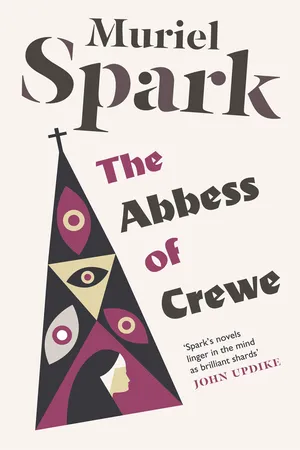
- 112 pages
- English
- ePUB (mobile friendly)
- Available on iOS & Android
eBook - ePub
The Abbess of Crewe
About this book
Information
Subtopic
Literature GeneralIndex
LiteratureII
IN THE SUMMER BEFORE the autumn, as God is in his heaven, Sister Felicity’s thimble is lying in its place in her sewing-box.
The Abbess Hildegarde is newly dead, and laid under her slab in the chapel.
The Abbey of Crewe is left without a head, but the election of the new Abbess is to take place in twenty-three days’ time. After Matins, at twenty minutes past midnight, the nuns go to their cells to sleep briefly and deeply until their awakening for Lauds at three. But Felicity jumps from her window on to the haycart pulled up below and runs to meet her Jesuit.
Tall Alexandra, at this time Sub-Prioress and soon to be elected Abbess of Crewe, remains in the chapel, kneeling to pray at Hildegarde’s tomb. She whispers:
Sleep on, my love, in thy cold bed
Never to be disquieted.
My last goodnight! Thou wilt not wake
Till I thy fate shall overtake:
Till age, or grief, or sickness must
Marry my body to that dust
It so much loves, and fill the room
My heart keeps empty in thy tomb.
She wears the same black habit as the two sisters who wait for her at the door of the chapel.
She joins them, and with their cloaks flying in the night air they return to the great sleeping house. Up and down the dark cloisters they pace, Alexandra, Walburga and Mildred.
‘What are we here for?’ says Alexandra. ‘What are we doing here?’
‘It’s our destiny,’ Mildred says.
‘You will be elected Abbess, Alexandra,’ says Walburga.
‘And Felicity?’
‘Her destiny is the Jesuit,’ says Mildred.
‘She has a following among the younger nuns,’ Walburga says.
‘It’s a result of her nauseating propaganda,’ says lofty Alexandra. ‘She’s always talking about love and freedom as if these were attributes peculiar to herself. Whereas, in reality, Felicity cannot love. How can she truly love? She’s too timid to hate well, let alone love. It takes courage to practise love. And what does she know of freedom? Felicity has never been in bondage, bustling in, as she does, late for Mass, bleary-eyed for Prime, straggling vaguely through the Divine Office. One who has never observed a strict ordering of the heart can never exercise freedom.’
‘She keeps her work-box tidy,’ Mildred says. ‘She’s very particular about her work-box.’
‘Felicity’s sewing-box is the precise measure of her love and her freedom,’ says Alexandra, so soon to be Abbess of Crewe. ‘Her sewing-box is her alpha and her omega, not to mention her tiny epsilon, her iota and her omicron. For all her talk, and her mooney Jesuit and her pious eyelashes, it all adds up to Felicity’s little sewing-box, the norm she departs from, the north of her compass. She would ruin the Abbey if she were elected. How strong is her following?’
‘About as strong as she is weak. When it comes to the vote she’ll lose,’ Mildred says.
Walburga says sharply, ‘This morning the polls put her at forty-two per cent according to my intelligence reports.’
‘It’s quite alarming,’ says Alexandra, ‘seeing that to be the Abbess of Crewe is my destiny.’ She has stopped walking and the two nuns have stopped with her. She stands facing them, drawing their careful attention to herself, lighthouse that she is. ‘Unless I fulfil my destiny my mother’s labour pains were pointless and what am I doing here?’
‘This morning the novices were talking about Felicity,’ Mildred says. ‘She was seen from their window wandering in the park between Lauds and Prime. They think she had a rendezvous.’
‘Oh, well, the novices have no vote.’
‘They reflect the opinions of the younger nuns.’
‘Have you got a record of all this talk?’
‘It’s on tape,’ says Mildred.
Walburga says, ‘We must do something about it.’ Walburga’s face has a grey-green tinge; it is long and smooth. An Abbess needs must be over forty years, but Walburga, who has just turned forty, has no ambition but that Alexandra shall be elected and she remain the Prioress.
Walburga is strong; on taking her final vows she brought to the community an endowment of a piece of London, this being a section of Park Lane with its view of Rotten Row, besides an adjoining mews of great value. Her strength resides in her virginity of heart combined with the long education of her youth that took her across many an English quad by night, across many a campus of Europe and so to bed. A wealthy woman, more than most, she has always maintained, is likely to remain virgin at heart. Her past lovers had been the most learned available; however ungainly, it was invariably the professors, the more profound scholars, who attracted her. And she always felt learned herself, thereafter, by a kind of osmosis.
Mildred, too, has brought a fortune to the Abbey. Her portion includes a sizeable block of Chicago slums in addition to the four big flats in the Boulevard St Germain. Mildred is thirty-six and would be too young to be a candidate for election, even if she were disposed to be Abbess. But her hopes, like Walburga’s, rest on Alexandra. This Mildred has been in the convent since her late schooldays; it may be she is a nourisher of dreams so unrealizable in their magnitude that she prefers to keep them in mind and remain physically an inferior rather than take on any real fact of ambition that would defeat her. She has meekly served and risen to be Novice Mistress, so exemplary a nun with her blue eyes, her pretty face and nervous flutter of timidity that Thomas the Jesuit would at first have preferred to take her rather than Felicity. He had tried, following her from confession, waiting for her under the poplars.
‘What did you confess?’ he asked Mildred. ‘What did you say to that young priest? What are your sins?’
‘It’s between myself and God. It is a secret.’
‘And the priest? What did you tell that young confessor of your secrets?’
‘All my heart. It’s necessary.’
He was jealous but he lost. Whatever Mildred’s deeply concealed dreams might be, they ran far ahead of the Jesuit, far beyond him. He began at last to hate Mildred and took up with Felicity.
Alexandra, who brought to the community no dowry but her noble birth and shrewd spirit, is to be Abbess now that Hildegarde lies buried in the chapel. And the wonder is that she bothers, or even her favourite nuns are concerned, now, a few weeks before the election, that Felicity causes a slight stir amongst the forty nuns who are eligible to vote. Felicity has new and wild ideas and is becoming popular.
Under the late Abbess Hildegarde this quaint convent, quasi-Benedictine, quasi-Jesuit, has already discarded its quasi-natures. It is a mutation and an established fact. The Lady Abbess Hildegarde, enamoured of Alexandra as she was, came close to expelling Felicity from the Abbey in the days before she died. Alexandra alone possesses the authority and the means to rule. When it comes to the vote it needs must be Alexandra.
They pace the dark cloisters in such an evident happiness of shared anxiety that they seem not to recognize the pleasure at all.
Walburga says, ‘We must do something. Felicity could create a crisis of leadership in the Abbey.’
‘A crisis of leadership,’ Mildred says, as one who enjoys both the phrase and the anguish of the idea. ‘The community must be kept under the Rule, which is to say, Alexandra.’
Alexandra says, ‘Keep watch on the popularity chart. Sisters, I am consumed by the Divine Discontent. We are made a little lower than the angels. This weighs upon me, because I am a true believer.’
‘I, too,’ says Walburga. ‘My faith remains firm.’
‘And mine,’ Mildred says. ‘There was a time I greatly desired not to believe, but I found myself at last unable not to believe.’
Walburga says, ‘And Felicity, your enemy, Ma’am? How is Felicity’s faith. Does she really believe one damn thing about the Catholic faith?’
‘She claims a special enlightenment,’ says Alexandra the Abbess-to-be. ‘Felicity wants everyone to be liberated by her vision and to acknowledge it. She wants a stamped receipt from Almighty God for every word she spends, every action, as if she can later deduct it from her income-tax returns. Felicity will never see the point of faith unless it visibly benefits mankind.’
‘She is so bent on helping lame dogs over stiles,’ Walburga says. ‘Then they can’t get back over again to limp home.’
‘So it is with the Jesuit. Felicity is helping Thomas, she would say. I’m sure of it,’ Mildred says. ‘That was clear from the way he offered to help me.’
The Sisters walk hand in hand and they laugh, now, together in the dark night of the Abbey cloisters. Alexandra, between the two, skips as she walks and laughs at the idea that one of them might need help of the Jesuit.
The night-watch nun crosses the courtyard to ring the bell for Lauds. The three nuns enter the house. In the great hall a pillar seems to stir. It is Winifrede come to join them, with her round face in the moonlight, herself a zone of near-darkness knowing only that she has a serviceable place in the Abbey’s hierarchy.
‘Winifrede, Benedicite,’ Alexandra says.
‘Deo Gratias, Alexandra.’
‘After Lauds we meet in the parlour,’ Alexandra says.
‘I’ve got news,’ says Winifrede.
‘Later, in the parlour,’ says Walburga. And Mildred says, ‘Not here, Winifrede!’
But Winifrede proceeds like beer from an unstoppered barrel. ‘Felicity is lurking somewhere in the avenue. She was with Thomas the Jesuit. I have them on tape and on video-tape from the closed-circuit.’
Alexandra says, loud and clear, ‘I don’t know what rubbish you are talking.’ And motions with her eyes to the four walls. Mildred whispers low to Winifrede, ‘Nothing must be said in the hall. How many times have we told you?’
‘Ah,’ breathes Winifrede, aghast at her mistake. ‘I forgot you’ve just bugged the hall.’
So swiftly to her forehead in despair goes the hand of Mildred, so swivelled to heaven are Walburga’s eyes in the exasperation of the swifter mind with the slow. But Alexandra is calm. ‘Order will come out of chaos,’ she says, ‘as it always has done. Sisters, be still, be sober.’
Walburga the Prioress turns to her: ‘Alexandra, you are calm, so calm . . . ’
‘There is a proverb: Beware the ire of the calm,’ says Alexandra.
Quietly the congregation of nuns descends the great staircase and is assembled. Walburga the Prioress now leads, Alexandra follows, and all the community after them, to sing the Hour.
It is the Hour of None, three in the afternoon, when Sister Felicity slips sleepily into the chapel. She is a tiny nun, small as a schoolgirl, not at all like what one would have imagined from all the talk about her. Her complexion looks as if her hair, sprouting under her veil, would be reddish. Nobody knows where Felicity has been all day and half the night, for she was not present at Matins at midnight nor Lauds at three in the morning, nor at breakfast at five, Prime at six, Terce at nine; nor was she present in the refectory at eleven for lunch, which comprised barley broth and a perfectly nourishing and tasty, although uncommon, dish of something unnamed on toast, that something being in fact a cat-food by the name of Mew, bought cheaply and in bulk. Felicity was not there to partake of it, nor was she in the chapel singing the Hour of Sext at noon. Nor between these occasions was she anywhere in the convent, not in her cell nor in the sewing-room embroidering the purses, the vestments and the altar-cloths; nor was she in the electronics laboratory which was set up by the great nuns Alexandra, Walburga and Mildred under the late Abbess Hildegarde’s very nose and carefully unregarding eyes. Felicity has been absent since after Vespers the previous day, and now she slips into her stall in the chapel at None, yawning at three in the afternoon.
Walburga, the Prioress, temporarily head of the convent, turns her head very slightly as Felicity takes her place, and turns away again. The community vibrates like an evanescent shadow that quickly fades out of sight, and continues fervently to sing. Puny Felicity, who knows the psalter by heart, takes up the chant but not her Office book:
They have spoken to me with a lying tongue and have compassed me about with words of hatred:
And have fought against me without cause.
Instead of making me a return of love, they slandered me:
but I gave myself to prayer.
And they repaid evil for good:
and hatred for my love.
The high throne of the Abbess is empty. Felicity’s eyes, pink-rimmed with sleeplessness, turn towards it as she chants, thinking, maybe, of the dead, aloof Abbess Hildegarde who lately sat propped in that place, or maybe how well she could occupy it herself, little as she is, a life-force of new ideas, a quivering streak of light set in that gloomy chair. The late Hildegarde tolerated Felicity only because she ...
Table of contents
- Cover
- About the Author
- Title page
- Copyright page
- Epigraph page
- Contents
- I
- II
- III
- IV
- V
- VI
Trusted by 375,005 students
Access to over 1.5 million titles for a fair monthly price.
Study more efficiently using our study tools.
Frequently asked questions
Yes, you can cancel anytime from the Subscription tab in your account settings on the Perlego website. Your subscription will stay active until the end of your current billing period. Learn how to cancel your subscription
No, books cannot be downloaded as external files, such as PDFs, for use outside of Perlego. However, you can download books within the Perlego app for offline reading on mobile or tablet. Learn how to download books offline
Perlego offers two plans: Essential and Complete
- Essential is ideal for learners and professionals who enjoy exploring a wide range of subjects. Access the Essential Library with 800,000+ trusted titles and best-sellers across business, personal growth, and the humanities. Includes unlimited reading time and Standard Read Aloud voice.
- Complete: Perfect for advanced learners and researchers needing full, unrestricted access. Unlock 1.5M+ books across hundreds of subjects, including academic and specialized titles. The Complete Plan also includes advanced features like Premium Read Aloud and Research Assistant.
We are an online textbook subscription service, where you can get access to an entire online library for less than the price of a single book per month. With over 1.5 million books across 990+ topics, we’ve got you covered! Learn about our mission
Look out for the read-aloud symbol on your next book to see if you can listen to it. The read-aloud tool reads text aloud for you, highlighting the text as it is being read. You can pause it, speed it up and slow it down. Learn more about Read Aloud
Yes! You can use the Perlego app on both iOS and Android devices to read anytime, anywhere — even offline. Perfect for commutes or when you’re on the go.
Please note we cannot support devices running on iOS 13 and Android 7 or earlier. Learn more about using the app
Please note we cannot support devices running on iOS 13 and Android 7 or earlier. Learn more about using the app
Yes, you can access The Abbess of Crewe by Muriel Spark in PDF and/or ePUB format, as well as other popular books in Literature & Literature General. We have over 1.5 million books available in our catalogue for you to explore.