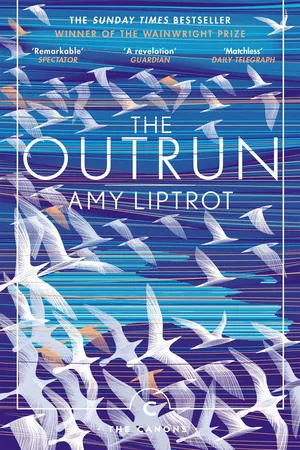
NOW A MAJOR FILM STARRING SAOIRSE RONAN
WITH A NEW AFTERWORD FROM THE AUTHOR
THE SUNDAY TIMES TOP TEN BESTSELLER
WINNER OF THE PEN ACKERLEY PRIZE AND THE WAINWRIGHT PRIZE
After spending her twenties in London, Amy Liptrot returns to her home in Orkney where she comes to terms with the addiction that has consumed the past decade of her life. On the remote island, Amy spends her mornings swimming in the cold sea, her days observing wildlife, and her nights searching the sky for any signs of the Northern Lights. She soon discovers how the natural world can restore life, heal old wounds and renew hope.
eBook - ePub
The Outrun
About this book
Information
I
THE OUTRUN
ON MY FIRST DAY BACK I shelter beside an old freezer, down by some stinging nettles, and watch the weather approach over the sea. The waves crashing do not sound very different from the traffic in London.
The farm is on the west edge of the main and largest island in Orkney, on the same latitude as Oslo and St Petersburg, with nothing but cliffs and ocean between it and Canada. As agricultural practices changed, new buildings and machinery were added to the farm but the old sheds and tools remain, corroding in the salty air. A broken tractor shovel acts as a sheep trough. Stalls where cattle were once tied are now filled with defunct machinery and furniture that used to be in our house. In that byre I strung a rope swing from the rafters, and hung backwards by my knees over a gate that’s now rusting into the ground.
To the south, the farm stretches along the shore to sandier land, which becomes the Bay of Skaill, a mile-long beach where the Stone Age village, Skara Brae, sits. To the north, the farm follows cliffs up to higher ground where heather grows. Each field has a prosaic name: ‘front field’, as you come up the track to the house; or ‘lambing field’, sheltered on all sides by drystone dykes. The largest of the fields, the ‘Outrun’, is a stretch of coastland at the top of the farm where the grass is always short, pummelled by wind and sea spray year-round. The Outrun is where the ewes and their lambs graze in summer after they are taken up from the nursery fields. It’s where the Highland cattle overwinter, red and horned, running out under the huge sky.
Some historical agricultural records list farmland in two parts: the ‘in-bye’ arable land, close to the farm steading; and the ‘out-bye’ or ‘outrun’, uncultivated rough grazing further away, often on hillsides. In the past, outrun was sometimes used as communal grazing for a number of farms. This land is the furthest reaches of a farm, only semi-tamed, where domestic and wild animals co-exist and humans don’t often visit so spirit people are free to roam. In Orcadian folklore, trowies are told to live in communities in mounds and hollows of the hills and there are tales of hillyans, little folk who emerge from the rough land to make mischief in the summer.
In a photo of the Outrun from the early eighties, I ride on Dad’s shoulders as he and Mum show visiting English friends the desolate-seeming land they have bought. My parents wanted to buy a farm and kept travelling further north until they found one they could afford. Family and friends were surprised, and unsure if they could make it work, as were the locals. Orcadians had watched many idealistic southerners move to the islands only to leave after a couple of winters.
I grew up here next to these cliffs. I have never been afraid of heights. Dad would take us clifftop-walking as children. I’d shake free of Mum’s hand and look over the edge at the churning water below. Grey flagstone – sheer drops and massive slabs – fringes the farm, and this monumental material and unforgiving forces formed the limits of the island and my world.
We had a dog once that went over. The collie pup set off chasing rabbits in a gale, did not notice the drop and was never seen again.
It’s a windy day. I leave the shelter of the freezer and walk up to the Outrun for the first time in years, breathing deeply. There are no trees on the farm and in this open landscape there is an abundance of space.
All the rocks slope towards the sea. In my wellies, I walk along the cracks in the flagstones so I don’t slip. Wisps of hair have blown free of my ponytail and are getting into my eyes and mouth, sticking to my face with sea spray, like when I was a kid and followed the sheepdogs, under gates and over dykes.
I find my favourite place: a slab of rock balanced at a precarious angle at the top of a cliff. I’d come here as a teenager, headphones on, dressed up and frustrated, looking out to the horizon, wanting to escape. From my spot on the stone I would watch the breakers crash, the gulls and fighter jets flying out over the sea.
On a clear day, south across the Pentland Firth, I can see the tips of the mountains of mainland Scotland from here: Ben Hope, Ben Loyal, Cape Wrath. About the horizon’s distance due west of the Outrun lies Sule Skerry, once home to Britain’s most remote manned lighthouse. Out at sea, bobbing on the surface, I can make out wave-energy devices being tested by engineers. It’s low tide and below me, at the base of the cliff, the rocks are exposed where a fishing boat came aground when I was eleven.
From my seat on the slab, I look north to the headland at Marwick, with its tower built in memorial to Lord Kitchener. In 1916, Kitchener died with 643 of his crew of 655 when HMS Hampshire went down two miles north-west of here, sunk by a mine from a German U-boat. Some of the twelve survivors were given shelter in the farmhouse that later would be ours.
In his account of the loss of the Hampshire, one survivor, W. M. Phillips, a sailor, vividly describes the night of the tragedy: ‘I with my boots off, but otherwise fully clad, jumped, and with a last goodbye plunged into seething waters.’ He was able to climb onto a large float and gives an account of how, since it was overloaded, those wearing lifebelts were ‘asked to leave’: ‘With a few smiling remarks such as “We shall be there first”, some 18 answered the call and plunged into the billows, thus sacrificing themselves to give their fellow shipmates their only possible chance of survival.’
After many hours when the sailors feared being dashed to their deaths on the rocks, the float came ashore in one of the geos – Nebbi Geo – on the Outrun. Walking this stretch of coast, I imagine the raft, as Phillips described, ‘wedged in between the cliffs as if human hands had placed it there’. I picture farmers of the time searching the coastline in the dark for survivors, and the bodies of sailors strewn on the rocks.
The wind in Orkney is almost constant. At the farm, the westerly gales are the worst, bringing the sea with them, and tonnes of rock can be moved overnight, the map altered in the morning. Easterlies can be the most beautiful – when the wind blows towards the tide and skims a glittering canopy of spray from the top of the waves, catching the sun. The old croft houses are squat and firm, like many Orcadian people, built to survive the strongest gales. That sturdy balance has not been bred into me: I am tall and gangly.
Following the familiar coast, I’m trying not to feel unstable. It’s been more than a decade since I lived here and memories from my childhood are merging with more recent events: the things that brought me back to Orkney. As I struggle to open a wire gate, I remember what I repeated to my attacker: ‘I am stronger than you.’
At the end of a winter the land is brown and washed-out and the Outrun seems barren, but I know its secrets. A broken-down and overgrown boundary dyke was found to date back to the Neolithic Age and some of the stones that make up the Ring of Brodgar six miles away were from a quarry just north of here. One similar stone lies broken on the hillside – perhaps dropped on the way to the circle four thousand years ago. I remember the colony of Arctic terns that nested here, dive-bombing our heads during the breeding season, swooping close enough for us to feel their wings. The endangered great yellow bumblebee is found here in the summer, pollinating the red clover; magic mushrooms grow in the autumn; and a rare type of seaweed, Fucus distichus, unique to wave-battered rocky northern shores, grows on the rocks all year round.
At the top of the Outrun there is a sea stack known as ‘the Spord’ or ‘the Stack o’ Roo’, a tower-block-sized rock that was once part of the cliff but now stands alone. In the summer, puffins nest on the stack, along with fulmars, shags, black-backed gulls and ravens. Carefully avoiding rabbit holes, I used to clamber down a grass slope to a ledge, the best place to tuck myself in, look across to the stack and watch the bustling seabird society – fulmars noisily defending their nests and puffins returning from far out at sea.
There are no fences on the Outrun to keep the sheep off the rocks and cliffs. In the early years of the farm, Dad climbed down and rescued ewes that got stuck on ledges, but as the flock matured, geographical knowledge and foot-sureness was bred into the bloodline.
After recent rain, the burn that runs down to the sea is flowing, where my brother Tom and I played, pushing ourselves and the dogs under a small stone bridge. Oystercatchers and curlews made nests in the tracks left by the tractor and we’d chase and catch the chicks, feeling their soft, hotly beating bodies in our hands before letting them go.
I stop at the place where, when I was a kid, a neighbour left his new tractor running while he jumped out to open a gate and neglected to pull on the handbrake. He was turned the other way as the tractor began to roll, driverless, down the sloping field. He could not run fast enough to catch it as it accelerated and, with unstoppable force, the expensive machine plunged over the edge of the cliff and smashed into the Atlantic.
Later in the afternoon, I come back up to the Outrun to feed the Highland cattle, squeezing in next to Dad in the cab of his tractor, the way I used to when I was small. I still know where the bumps and dips in the land are so I can hold on tightly when necessary. Dad lowers the loader holding the silage bale into the ring-feeder and the kye gather around. It’s already dark and I stay in the cab and watch him, lit by the tractor headlights, cutting the thin black plastic off the bale and pulling it away so they can eat. His hair is mainly white now, and although he wears a padded boiler suit almost year round, he no longer needs gloves.
The Outrun is tucked away behind a low hill and beside the coast, and in the right spot you can’t see any houses or be seen from the road. Dad told me that when he was high, in a manic phase, he had slept out here. At the end of the day, crouched away from the wind beside the freezer again, rolling a cigarette and eyeing the livestock, I have become my father.
2
TREMORS
WHEN I GET BACK FROM my walk on the Outrun, instead of entering the farmhouse I go to the machinery paddock and open the door to the caravan where Dad now lives. The sheepdog waits outside for him and the horses have their heads over the gate, looking for hay. The old caravan is weighted down with concrete blocks against the wind. One of the windows was blown out in a gale last winter and has been patched up with a wooden sheet.
Inside, Dad is wearing his outdoor boiler suit, with baler twine and a penknife always in the pockets, over a jumper that Mum knitted, which he still wears, now patched at the elbows. He’s sitting in the upholstered corner seat with the best view out through the large Perspex window, across the farmyard and fields, over the bay to a headland. The colours of the sky and the light on the sea change all day as rapid Atlantic weather systems pass over. When the clouds break, sunlight dazzles on the water. An outcrop of rock is exposed at low tides. Sometimes the light picks out in fine detail the hills of Hoy, another island to the south beyond the headland, and on other days they disappear completely in the haar.
In a shaft of winter sun, the air is dusty with muck from outside and smoke from the roll-ups Dad smokes. There are outdoor clothes and wellies by the door, farm paperwork spread over the low table, and the glow of a gas fire. At the other end of the caravan is a bedroom and the dog sleeps directly below Dad, under the caravan, like a wolf in its cave.
‘Did you feel anything up there?’ Dad asks, before beginning to tell me, although I’ve heard it before, about the tremors. This stretch of cliffs and beaches, where the mythical Mester Muckle Stoorworm is first said to have made himself known, where the people of Skara Brae eked out their lives and where HMS Hampshire was sunk, has mysteries.
Some people on the west coast of Orkney, including Dad, say they experience tremors or booms sometimes, low echoes that seem strong enough to vibrate the whole island while at the same time being quiet enough to make them wonder if they imagined it. ‘You hardly hear it, but feel it more,’ says Dad. ‘It’s a low-grade boom, like thunder at a distance. There are vibrations of the ground enough to shake windows and shelves. It lasts for one pulse and is often repeated a few times in a couple of hours.’ Locals say they have felt the booms over many years but are unable to identify a pattern to their occurrence. They wonder if it is geographical, man-made, even supernatural – or if it happens at all.
To understand the tremors I have to look deep within Orkney’s topography. The geology of the West Mainland coast, with high cliffs at Marwick, Yesnaby and Hoy, strewn with the sea stacks, sloping rocks and treacherous currents responsible for many shipwrecks, is the first place to look. It is possible that the booms and tremors are caused by wave action within caves deep below the fields. As a large wave travels into a dead-end cave, it traps and compresses air at high pressure. When the wave retreats, the air bubble explodes, causing a boom.
Others blame the tremors on the military, and sonic booms produced by jet aircraft. Around sixty miles from Orkney, on mainland Scotland, the Cape Wrath Ministry of Defence range is where the military train on and offshore. This sparsely populated area is one of the few places in the UK where the ‘big stuff’ can be detonated. Heavy air weapons would be the only thing that could send a sonic wave as far as Orkney but wind conditions would have to be perfect. High-speed aircraft can also cause sonic booms as, on dive-bombing runs, they descend into denser air, but although Dad sometimes sees and hears the planes, he says the tremors do not come at the same time. I wonder if other, harder to grasp, even ghostly, island forces could be at play. The legend of Assipattle and the Mester Muckle Stoorworm tells of a huge sea monster, so large it could wrap its body around the world and destroy cities with a flick of its tongue. A layabout called Assipattle dreamed of saving the world and got his chance when he killed the Stoorworm by stuffing a burning peat into its liver, cooking it slowly from the inside. Writhing in agony, the Stoorworm thrashed its head, knocking out hundreds of its teeth, which formed the islands of Orkney, Shetland and the Faroes. Dragging itself to the edge of the earth, it curled up and died, its smouldering body becoming Iceland – a country full of hot springs, geysers and volcanoes. That liver is still burning so maybe the Stoorworm isn’t dead at all. A tentacle may still be twitching around these shores and the tremors may be the aftershocks of the monster’s death-throes.
Talking to Dad about the tremors, I feel slightly nervous. Our conversations are normally limited to the farm – what jobs need to be done or the condition of the sheep and the land – so hearing him speak about uncanny sensations and strange geology makes me concerned that he might be getting high. Mum taught me to look for the signs. At first it could be exciting, with Dad talking a lot, full of optimism and energy, but this would bubble over into his making impulsive purchases, such as expensive rams or farm equipment, staying up all night and moving animals at four in the morning, then grandiose thoughts, with him feeling he could change time and control the weather.
On the floor of the caravan there’s a stool I remember from the farmhouse that Dad made in the hospital when he was a teenager. He was fifteen when he was first diagnosed with manic depression, now known as bipolar disorder, and schizophrenic tendencies. Since then, periodically, he has ups and downs of varying amplitude. Our family life was rocked by the waves of life at its extremes, by the cycles of manic depression. As well as the incidents with sectioning and straitjackets, followed by time away in a psychiatric hospital, there were months when he stayed in bed without saying a word. Today Dad is buoyant but, on other occasions, if he’s subdued, I worry it may signal the beginning of a period of depression and one of his long winters of inactivity.
Once, when I was about eleven, Dad was so ill that he went round the f...
Table of contents
- Glossary
- Prologue
- 1 The Outrun
- 2 Tremors
- 3 Flotta
- 4 London Fields
- 5 Nightbike
- 6 Flitting
- 7 Wrecked
- 8 Treatment
- 9 Drifting
- 10 Dyking
- 11 Ambergris
- 12 Abandoned Islands
- 13 Lambing
- 14 The Corncrake Wife
- 15 Rose Cottage
- 16 Papay
- 17 Merry Dancers
- 18 North Hill
- 19 Online
- 20 Sea Swimming
- 21 The Holm
- 22 Personal Geology
- 23 Triduana
- 24 Fair Isle
- 25 Bonfire
- 26 Undersea
- 27 Strandings
- 28 Renewables
- Acknowledgements
- Extract from The Instant
- An essay by Amy Liptrot: On Being Adapted
Trusted by 375,005 students
Access to over 1.5 million titles for a fair monthly price.
Study more efficiently using our study tools.
Frequently asked questions
Yes, you can cancel anytime from the Subscription tab in your account settings on the Perlego website. Your subscription will stay active until the end of your current billing period. Learn how to cancel your subscription
No, books cannot be downloaded as external files, such as PDFs, for use outside of Perlego. However, you can download books within the Perlego app for offline reading on mobile or tablet. Learn how to download books offline
Perlego offers two plans: Essential and Complete
- Essential is ideal for learners and professionals who enjoy exploring a wide range of subjects. Access the Essential Library with 800,000+ trusted titles and best-sellers across business, personal growth, and the humanities. Includes unlimited reading time and Standard Read Aloud voice.
- Complete: Perfect for advanced learners and researchers needing full, unrestricted access. Unlock 1.5M+ books across hundreds of subjects, including academic and specialized titles. The Complete Plan also includes advanced features like Premium Read Aloud and Research Assistant.
We are an online textbook subscription service, where you can get access to an entire online library for less than the price of a single book per month. With over 1.5 million books across 990+ topics, we’ve got you covered! Learn about our mission
Look out for the read-aloud symbol on your next book to see if you can listen to it. The read-aloud tool reads text aloud for you, highlighting the text as it is being read. You can pause it, speed it up and slow it down. Learn more about Read Aloud
Yes! You can use the Perlego app on both iOS and Android devices to read anytime, anywhere — even offline. Perfect for commutes or when you’re on the go.
Please note we cannot support devices running on iOS 13 and Android 7 or earlier. Learn more about using the app
Please note we cannot support devices running on iOS 13 and Android 7 or earlier. Learn more about using the app
Yes, you can access The Outrun by Amy Liptrot in PDF and/or ePUB format, as well as other popular books in Social Sciences & Social Science Biographies. We have over 1.5 million books available in our catalogue for you to explore.