NEW YORK TIMES 100 NOTABLE BOOKS OF 2017: 'masterly'
GUARDIAN BEST BOOKS OF THE YEAR: 'An absolute tour de force'
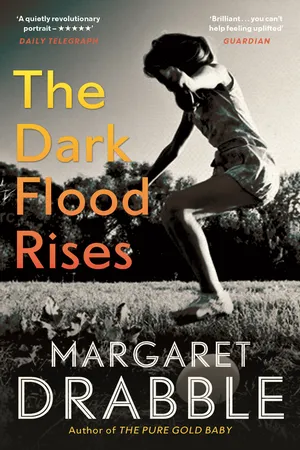
Fran may be old but she's not going without a fight. So she dyes her hair, enjoys every glass of red wine, drives restlessly around the country and lives in an insalubrious tower block that her loved ones disapprove of. And as each of them - her pampered ex Claude, old friend Jo, flamboyant son Christopher and earnest daughter Poppet - seeks happiness in their own way, what will the last reckoning be? Will they be waving or drowning when the end comes? By turns joyous and profound, darkly sardonic and moving, The Dark Flood Rises questions what makes a good life, and a good death.
- 336 pages
- English
- ePUB (mobile friendly)
- Available on iOS & Android
eBook - ePub
The Dark Flood Rises
About this book
Information
She has often suspected that her last words to herself and in this world will prove to be ‘You bloody old fool’ or, perhaps, depending on the mood of the day or the time of the night, ‘you fucking idiot’. As the speeding car hits the tree, or the unserviced boiler explodes, or the smoke and flames fill the hallway, or the grip on the high guttering gives way, those will be her last words. She isn’t to know for sure that it will be so, but she suspects it. In her latter years, she’s become deeply interested in the phrase ‘Call no man happy until he is dead’. Or no woman, come to that. ‘Call no woman happy until she is dead.’ Fair enough, and the ancient world had known women as well as men who had met unfortunate ends: Clytemnestra, Dido, Hecuba, Antigone. Though of course Antigone, one must remember, had rejoiced to die young, and in a good (if to us pointless) cause, thereby avoiding all the inconveniences of old age.
Fran herself is already too old to die young, and too old to avoid bunions and arthritis, moles and blebs, weakening wrists, incipient but not yet treatable cataracts, and encroaching weariness. She can see that in time (and perhaps in not a very long time) all these annoyances will become so annoying that she will be willing to embark on one of those acts of reckless folly that will bring the whole thing to a rapid, perhaps a sensational ending. But would the rapid ending cancel out and negate the intermittent happiness of the earlier years, the long struggle towards some kind of maturity, the modest successes, the hard work? What would the balance sheet look like, at the last reckoning?
It was the obituaries of Stella Hartleap that set her thoughts in this actuarial direction, as she drove along the M1 towards Birmingham, at only three or four miles above the speed limit.
The print obituaries had been annoying, piously annoying, in a sexist, ageist, hypocritical, mealy-mouthed manner, reeking of Schadenfreude. And just now, yet another mention of Stella on the car radio, in that regular Radio 4 obituary slot, has revived her irritations. She hadn’t known Stella very well, having met her late in the day in Highgate through Hamish, but she’d known her long enough to recognise the claptrap and the bullshit. So, Stella had died of smoke inhalation, having set her bedclothes on fire while smoking in bed in her remote farmstead in the Black Mountains, and having just polished off a tumbler of Famous Grouse. So what? A better exit than dying in a hospital corridor in a wheelchair while waiting for another dose of poisonous chemotherapy, which had recently been her good friend Birgit’s dismal fate. At least Stella had nobody to blame but herself, and although the last minutes couldn’t have been pleasant, neither had Birgit’s. Not at all pleasant, by all accounts, and without any complementary frisson of autonomy.
Birgit wouldn’t have approved of Stella Hartleap’s end. She might even have been censorious about it. She had been a judgmental woman. But that was neither here nor there. We don’t have to agree with anyone, ever.
Her new-old friend Teresa, who is grievously ill, wouldn’t be censorious, as she is never censorious about anyone.
I am the captain of my fate, I am the master of my soul. A Roman, by a Roman, valiantly vanquished.
There is a truck, too close behind her, she can see its great dead smeared glass underwater eyes looming at her in her driving mirror. In the old days, Hamish used to slam on his brakes in situations like this, as a warning. She’d always thought that was dangerous, but he’d never come to any harm. He hadn’t died at the wheel. He’d died of something more insidious, less violent, more cruelly protracted.
She chooses the accelerator. It’s safer than the brake. Her first husband Claude had believed in the use of the accelerator, and she was with him on that.
Francesca Stubbs is on her way to a conference on sheltered housing for the elderly, a subject pertinent to her train of thought, but not in itself heroic. Fran is something of an expert in the field, and is employed by a charitable trust which devotes generous research funds to examining and improving the living arrangements of the ageing. She’s always been interested in all forms of social housing, and this new job suits her well. She’s intrigued by the way more and more people in England opt to live alone, in the early twenty-first century. Students don’t seem to mind cohabitation, even like it, and cohabitation is forced upon the ill and the elderly, but more and more of the able-bodied in their mid-life choose to live alone. This is making demands on the housing stock which successive governments are unable and possibly unwilling even to try to satisfy.
Fran is in favour of a land tax. That would shake things up a bit. But the English are extraordinarily tenacious of land. They hate to relinquish even a yard of it. The word ‘freehold’ has a powerful resonance.
No, there is nothing heroic about the housing stock and planning policy, subjects which currently occupy her working life, but old age itself is a theme for heroism. It calls upon courage.
Fran had from an unsuitably early age been attracted by the heroic death, the famous last words, the tragic farewell. Her parents had on their shelves a copy of Brewer’s Dictionary of Phrase and Fable, a book which, as a teenager, she would morbidly browse for hours. One of her favourite sections was ‘Dying Sayings’, with its fine mix of the pious, the complacent, the apocryphal, the bathetic and the defiant. Artists had fared well: Beethoven was alleged to have said ‘I shall hear in heaven’; the erotic painter Etty had declared ‘Wonderful! Wonderful this death!’; and Keats had died bravely, generously comforting his poor friend Severn.
Those about to be executed had clearly had time to prepare a fine last thought, and of these she favoured the romantic Walter Raleigh’s, ‘It matters little how the head lies, so the heart be right’. Harriet Martineau, who had suffered much as a child from religion, as Fran had later discovered, had stoically remarked, ‘I see no reason why the existence of Harriet Martineau should be perpetuated’, an admirably composed sentiment which had caught the child Fran’s attention long before she knew who Harriet Martineau was. But most of all she had liked the parting words of Siward the Dane who had commanded his men: ‘Lift me up that I may die standing, not lying down like a cow’. She didn’t know why this appealed to her so strongly, as she was herself very unlikely to die on a battlefield. Maybe it meant she had Danish blood? Well, she probably had, of course, as many, perhaps most of us in England have. Or maybe she had liked the mention of the cow, which she heard as strangely affectionate, not as contemptuous.
She was much more likely to die on a motorway than on a battlefield.
The Vikings hadn’t approved of dying quietly and comfortably in bed. Unlike her first husband Claude, who was currently making himself as comfortable as he could.
She has pulled away from the truck, and is now overtaking a dirty maroon family saloon with an annoying sticker about its ‘Baby on Board’. There is an anonymous dirty white van just behind her now. It isn’t raining, but it’s dirty weather, and there’s grimy February splatter and spray on her windscreen. There’s worse weather on the way, the forecast warns, but it hasn’t reached her yet. It’s been a grim winter so far.
Why the hell is she driving, anyway? Why hadn’t she taken the train? Because, like all those people who insist on living alone when they don’t have to, she likes being on her own, in her own little space, not cooped up with invasively dressed strangers eating crisps and sandwiches and clutching polystyrene coffee and obesely overflowing their seat space and chattering on their mobiles. She is hurtling happily along to the car park of a Premier Inn on the outskirts of Birmingham, guided by her satnav, and looking forward to her evening meal. Some of the other delegates will be staying at the Premier Inn, and she is looking forward to seeing them. She’ll be able to get away from them if she wants to and take herself off to her anonymous bedroom to watch some regional TV.
Fran loves regional TV. You find out a lot of odd things, watching regional TV up and down the land. She’s glad she’s still got the energy and the will to drive around England, looking at housing developments and care homes. She’s a lucky woman, lucky in her work. Sometimes, in her more elevated moments, she thinks she is in love with England, with the length and breadth of England. England is now her last love. She wants to see it all before she dies. She won’t be able to do that, but she’ll do her best.
The charity that employs her doesn’t cover Scotland and Wales.
She wouldn’t mind dying on the road, driving around the country, though she wouldn’t want to take any innocent people with her.
The dirty white van is far too close. The bad name of white van drivers is well deserved, in Fran’s opinion.
There’d been another section in Brewer’s, called ‘Death from Strange Causes’. It wasn’t as good as ‘Dying Sayings’, but it had its charms. Memorable recorded deaths, most of them occurring in antiquity, had involved the swallowing of goat-hairs, grape stones, guineas and toothpicks. According to Pliny, Aeschylus had been killed by a falling tortoise. Many have been killed by pigs. Some choke to death with laughter. Nobody, as far as she knows, has yet thought to keep the white van tally, which must be high.
She is looking forward to seeing her colleague Paul Scobey again. As she checks in at the Premier Inn reception desk, having parked in the allotted space in the subterranean metal car cage, there he is, sitting on an orange and purple couch in the foyer, nursing half a pint and watching a super-coloured soccer match on a giant overhead TV. He waves when she spots him, and she goes over to say hello, begging him not to interrupt his viewing. Paul is her friend and ally. He is far too young to share her first-hand empathetic familiarity with some of the needs of the elderly, but he has a pleasantly sardonic manner, a detachment that she finds enabling. He doesn’t expect people to want what they ought to want. So many in the geriatric business can’t understand the perversity of human beings, their attachments to or impatience with irrational aspects of their old homes and neighbourhoods, their sudden detestations of members of their family with whom they had rubbed along without protest for years, their refusal to admit that they were old and would soon be incapable. Paul seems unusually accepting of the changing vagaries of human need. He’s in favour of community living and co-operative schemes, but he understands those who refuse to downsize and need at the end to die alone in a five-storey building, fixing the threat of a mansion tax with a cold eye. Carrots and sticks, says Paul. If you want to get them out, you have to tempt them out.
Fran doesn’t like that phrase, ‘carrots and sticks’. Old people aren’t donkeys. But he’s got the right ideas.
He has a mother living stubbornly alone in the house where he had been born, in the low-rise Hagwood 1950s estate on the western edge of Smethwick. He speaks of her sometimes, but not very often. He talks more about the merits and failings of corporation and council housing than he speaks of his mother, but Fran knows that thoughts of his mother inform his thinking. And he also has an elderly and long-demented aunt, his mother’s older sister Dorothy, living very near to where they are now. A visit to see her is on his two-day agenda, and Fran has agreed to accompany him, to see the small care home where she has lived for years. This was his neck of the woods, not Fran’s, although he himself now lives down south in Colchester.
Paul pats the couch by him, suggests she sit, and she sits. The leathery fireproof hollow-fill foam of the couch sinks deeply under her modest weight. She’ll have to struggle to get up.
Paul is a gingery fellow, sandy-haired and lashed, lightly freckled, strikingly pale-skinned, pleasantly featured in a snub-nosed boyish way, in his mid forties she supposes, a little younger than her son Christopher. Hazel eyes, not Viking blue. He had wanted to be an architect but the qualifications took too long, he’d needed to start earning, and he had settled for planning and housing. His views on aesthetics (not often requested) are surprising. He has a nostalgic private weakness for Modernism, but recognises that most old people in England detest Modernism (not that they get asked much about their preferences) and prefer a post-modern pseudo-cottage, bungalowesque, mini-Tesco mix. You can get all those features into a housing estate quite easily, as he knows from the avenues and crescents of Hagwood.
His expertise lies in adaptation. He really knows, or thinks he knows, how features of a dwelling space ought to be adapted to the ageing and disabled, to the increasingly ageing and increasingly disabled. He relies on Fran, who is well ahead of him on the road of ageing (though as yet far from disabled) to advise him and offer him her insights. He had been fascinated by her account of the woman who had died because she hadn’t been able to open the bathroom door. There was nothing much wrong with her, apart from her loss of grip. She’d been unable to turn the doorknob, couldn’t get out to the phone to dial 999 after a very minor stroke, and had passed away on her cold bathroom floor.
If she’d had a lever-type doorknob instead of an old-fashioned screw doorknob, she’d have been alive today. If she hadn’t shut the door after herself (and what on earth was the point in doing that, as she lived alone?), she’d have been alive today.
Killed by a doorknob.
For the lack of a nail the battle was lost.
You have to be careful, when you’re old.
And all for the want of a horseshoe nail.
Fran declines a beer. I’ll see you down here at seven, she says. And up she goes to her room, to kick off her boots and lie on her bed and gaze at the rich daily life of the Black Country and the West Midlands. It’s on the chilly side in her bedroom, there must be a thermostat somewhere, but she can’t find it. Never mind, you can’t die of hypothermia in a Premier Inn.
She likes her bedroom. She likes the whiteness of the pillows, and the rich loud purple of the Inn’s informative boasts about its reliable facilities and its notable breakfasts. It’s very purple, the Premier Inn branding.

There are several items of soothingly mild interest on the regional news – a promotional chat by some staunchly upbeat florist’s about a Valentine’s Day event, an interview with a volunteer at a food bank, a report of a non-fatal knifing at a bus stop in Bilston, and, most unexpectedly, an item about a small earthquake which had hit Dudley and its neighbourhood at dawn that day. It had caused little consternation and most people had not even noticed it, although one or two said their breakfast crockery had rattled or a standard lamp had fallen over. Cats and dogs and budgerigars hadn’t liked it, and had wisely seen it coming, or so their owners said. This was routine stuff, but Fran’s attention is caught by a lively account ...
Table of contents
- Cover
- Also by Margaret Drabble
- Title Page
- Copyright Page
- Dedication Page
- Contents
- She has often suspected…
- Envoi
- Acknowledgements
Trusted by 375,005 students
Access to over 1.5 million titles for a fair monthly price.
Study more efficiently using our study tools.
Frequently asked questions
Yes, you can cancel anytime from the Subscription tab in your account settings on the Perlego website. Your subscription will stay active until the end of your current billing period. Learn how to cancel your subscription
No, books cannot be downloaded as external files, such as PDFs, for use outside of Perlego. However, you can download books within the Perlego app for offline reading on mobile or tablet. Learn how to download books offline
Perlego offers two plans: Essential and Complete
- Essential is ideal for learners and professionals who enjoy exploring a wide range of subjects. Access the Essential Library with 800,000+ trusted titles and best-sellers across business, personal growth, and the humanities. Includes unlimited reading time and Standard Read Aloud voice.
- Complete: Perfect for advanced learners and researchers needing full, unrestricted access. Unlock 1.5M+ books across hundreds of subjects, including academic and specialized titles. The Complete Plan also includes advanced features like Premium Read Aloud and Research Assistant.
We are an online textbook subscription service, where you can get access to an entire online library for less than the price of a single book per month. With over 1.5 million books across 990+ topics, we’ve got you covered! Learn about our mission
Look out for the read-aloud symbol on your next book to see if you can listen to it. The read-aloud tool reads text aloud for you, highlighting the text as it is being read. You can pause it, speed it up and slow it down. Learn more about Read Aloud
Yes! You can use the Perlego app on both iOS and Android devices to read anytime, anywhere — even offline. Perfect for commutes or when you’re on the go.
Please note we cannot support devices running on iOS 13 and Android 7 or earlier. Learn more about using the app
Please note we cannot support devices running on iOS 13 and Android 7 or earlier. Learn more about using the app
Yes, you can access The Dark Flood Rises by Margaret Drabble in PDF and/or ePUB format, as well as other popular books in Literature & Literature General. We have over 1.5 million books available in our catalogue for you to explore.