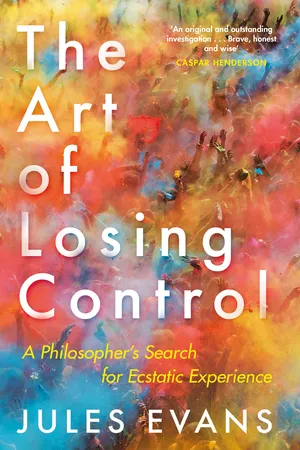
Since the Enlightenment, western culture has written off ecstatic experience as a form of mental illness. But why should rationality be considered the highest part of human nature when we are capable of so many more states of experience?
Piecing together interviews, analysis of ancient and modern philosophy, and his own eclectic encounters with the sublime, philosopher Jules Evans mounts an investigation into what we can gain from mastering the art of losing control. From Aristotle and Plato to the Bishop of London and Sister Bliss, radical jihadis to Silicon Valley transhumanists, The Art of Losing Control is a funny, life-enhancing journey that will change the way you think about how you feel.
- 352 pages
- English
- ePUB (mobile friendly)
- Available on iOS & Android
eBook - ePub
About this book
Information
Topic
PhilosophySubtopic
Philosophy History & Theory1: The Entrance Gate
In the winter of 1958, a 17-year old American named Barbara Alexander wandered into the tiny town of Lone Pine, California. She’d spent the night in a car with two friends, hadn’t slept, and had barely eaten in days. As the sun rose over the Sierra Nevada, she left her two friends sleeping in the car by the highway, and wandered through the desert and into town. She walked through the empty streets, and then suddenly:
the world flamed into life . . . There were no visions, no prophetic voices or visits by totemic animals, just this blazing everywhere. Something poured into me and I into it. This was not the passive beatific merger with ‘the All’, as promised by the Eastern mystics. It was a furious encounter with a living substance that was coming at me through all things at once . . . Nothing could contain it. Everywhere, ‘inside’ and out, the only condition was overflow. ‘Ecstasy’ would be the word for this, but only if you are willing to acknowledge that ecstasy does not occupy the same spectrum as happiness or euphoria, that it participates in the anguish of loss and can resemble an outbreak of violence.1
The experience – or ‘encounter’ as she thought of it back then – didn’t burst out of nowhere. For some years, Barbara had experienced moments of dissociative absorption, when something ‘peeled off the visible world, taking with it all meaning, inference, association, labels and words’ and she felt plunged into ‘the indivisible, elemental material out of which the entire known and agreed upon world arises’. She was also a depressed, introspective and solitary teenager, with an alcoholic father, a suicidal mother, and few friends or boyfriends. She was gripped by a search for life’s meaning, torn between a reductive materialism and the Romantic mysticism of Dostoevsky and Walt Whitman.
The encounter seemed a response to her searching. But who or what had she encountered? She had no religion to make sense of it – she had come back from a Baptist summer-camp contemptuous of the ‘mental degenerates’ she’d met there. Her confusion and sense of loss when the moment failed to reoccur led to a half-hearted suicide attempt. And then, gradually, she grew up and joined the human race: she went to college, took a PhD in cellular immunology, got married, had kids. When lab work seemed too dry for her, she became a freelance writer and campaigner for socialism and feminism. Like others in the progressive movement, she was a committed atheist, and wrote off her teenage experience as a mental disorder, possibly even an attack of schizophrenia. But she couldn’t shake off the feeling she’d betrayed her younger self.
In middle age, she experienced the ‘return of the repressed’. She started to write about the history of ecstasy, first about the ecstasy of war in her 1997 book Blood Rites: Origins and History of the Passions of War, and then the ecstasy of dancing in her 2006 book Dancing in the Streets: A History of Collective Joy, both of which were big inspirations for this book. Barbara Ehrenreich, as she was called by then, was engaging with her own past through the medium of third-person cultural history. And then in 2014 she took the plunge and wrote a first-person account of her own spiritual experiences, Living with a Wild God: A Nonbeliever’s Search for the Truth about Everything. She has decided her teenage experiences really were ‘encounters’ with spiritual beings, but she still isn’t sure who They are, what Their purpose is, whether They even care about humans. She is worried her fellow scientific atheists will think she is insane (‘when good sceptics go bad’ is how leading atheist Jerry Coyne reacted) but she insists she remains committed to rational empiricism. ‘I want science to look at these odder phenomena,’ she told one perplexed fellow atheist in an interview, ‘and not rule out the possibility of mystical experiences. We need databases. It is unexamined, the data that might be there . . . This is going to sound totally crazy to you but this is a public health issue! When people have a shattering type of experience and never say anything about it, it is time to investigate.’2
The science of spontaneous spiritual experiences
In fact, such a database already exists. In an unassuming building in the Welsh town of Lampeter there is a room full of cardboard boxes, and in those boxes – like the warehouse in Raiders of the Lost Ark – there is a collection of 6,000 accounts of people’s spiritual experiences, filed and classified for scientific research. A crowd-sourced Bible stuffed with so many revelations that some remain unread to this day – who knows what divine message has slipped down the back of the filing cabinet?
The Religious Experience Research Centre (RERC) – where this archive exists – was the brainchild of Sir Alister Hardy, a distinguished biologist who devoted the last two decades of his life to studying religious and spiritual experiences. Hardy grew up in Nottinghamshire, where as a teenager he’d experienced moments of spiritual communion with the natural world:
There was a little lane leading off the Northampton road to Park Wood as it was called, and it was a haven for the different kinds of brown butterflies. I had never seen so many all together . . . I wandered along the banks of the river, at times almost with a feeling of ecstasy . . . Somehow, I felt the presence of something that was beyond and in a way part of all things that thrilled me – the wild flowers and indeed the insects too . . . I became so overcome with the glory of the natural scene that, for a moment or two, I fell on my knees in prayer.3
Hardy studied zoology at Oxford, where one of his tutors was Julian Huxley, brother of Aldous. He eventually became the Linacre chair of zoology at Oxford, the leading marine biologist of his day, with students including Richard Dawkins. Hardy always considered himself a fervent Darwinian, yet he felt that the reductive materialism which usually accompanied evolutionary biology missed out something important – the spiritual aspects of human nature, and in particular humans’ ubiquitous sense of being in contact with a spiritual power, presence or energy, which guides and revitalises us. In this sense, he was more of a disciple of Alfred Russel Wallace than Charles Darwin. Wallace, who discovered natural selection at the same time as Darwin, believed in a spiritual and teleological dimension to reality that is part of the evolutionary process. But he was side-lined for his embarrassing views, and evolutionary biologists stubbornly debunked the spiritual aspects of human existence. As a result, Hardy believed, Western culture had become spiritually desiccated. Christianity was intellectually incredible, but there was no new cult to help us connect to God. People still had spontaneous spiritual experiences, but they were embarrassed to talk about them in case people thought they were mad. Hardy himself never told any colleagues, or even his family, about his spiritual experiences or his interest in the topic.
Perhaps, Hardy wondered, there could be a science of religious experiences, a new sort of natural theology, which would build up a sufficient evidence base to prove this was a very common aspect of human nature, one that was positive, beneficial and adaptive. ‘What we have to do,’ he later wrote, ‘is present such a weight of objective evidence in the form of written records of these subjective spiritual feelings and of their effects on the lives of the people concerned, that the intellectual world must come to see that they are in fact as real and as influential as the forces of love.’4 The database would be the foundation for a new ‘experimental faith’.
Collecting specimens
The endeavour was inspired by the example of William James, Frederic Myers and the Society for Psychical Research, which had tried to launch the scientific study of religious and paranormal experiences in the 1890s by collecting first-person accounts and searching for common features. Hardy wondered if he could continue their work in a more systematic fashion. When he turned 60, he decided to leave behind the plankton and dedicate the rest of his life to his spiritual research. He would collect specimens of religious or spiritual experience, as Darwin and Wallace had collected specimens of fossils, birds and insects. He set up the RERC at Manchester College in Oxford, then set out nets to collect the specimens, via a series of announcements in newspapers. He posed what’s become known as ‘the Hardy Question’: ‘Have you ever been aware of or influenced by a presence of power, whether you call it God or not, which is different from your everyday self?’
The specimens began to flood in, numbering around 4,000 within ten years. But how to classify them all? A good science of spiritual experiences needs a reliable taxonomy – one needs to be able to categorise and classify the specimens, like Linnaeus classifying the natural world into kingdoms, classes, orders, genera and species. Without a good taxonomy, you simply have a jumble of anomalous experiences – less like the Natural History Museum, more like a seventeenth-century cabinet of wonders. And yet religious experiences proved hard to pin down. Hardy initially tried to classify experiences according to a dozen categories (visual, auditory, sensory and so on) but the taxonomy rapidly spiralled out of control, with more and more categories being added. The 18th entry in the database is classified by the following labels: ‘Visions nitrous oxide dentists movement tunnels light karma beard Paul reincarnation Jesus Christ brain’. As the decades progressed, the RERC classification system grew even more complicated. A recent entry is classified: ‘Presence of Deceased Relative. Tears. Noises. Ghost. Apparition. Dreams. Guidance. Automatic Writing. Healing. Father. Voice. Hymns. Book. David Cameron.’ Even the numerical classification for the online database goes haywire: it goes from one to 2,000, then jumps to three million, then back to 4,000. Many of the entries are also blank – revelations apparently so ineffable they were beyond words.
Bertrand Russell, who himself had a mystical experience shortly before the First World War, thought that one of the arguments mystics had in their favour was the apparent unanimity of their experiences. They seemed to point to a common core experience. But what conclusions can one draw if the specimens one collects are incredibly varied, from psychic experiences to UFO abductions to encounters with evil spirits to celestial visions on the dentist’s chair? Is there something in the nature of ecstasy that resists rational classification?
Spiritual experiences are becoming more common
One conclusion we can draw, at least, is that such experiences are common, and apparently becoming more so. In 1978, 36 per cent of respondents to a RERC survey said they’d experienced ‘a presence or power, whether you call it God or not, different from your ordinary self’. In 1987, the figure had risen to 48 per cent. In 2000, more than 75 per cent of respondents to a UK survey conducted by RERC director David Hay said they were ‘aware of a spiritual dimension to their experience’. In the US, spiritual experiences are also apparently becoming more frequent – in 1962, when Gallup asked Americans if they’d ‘ever had a religious or mystical experience’, 22 per cent said yes. That figure rose to 33 per cent by 1994, and 49 per cent in 2009. I carried out my own online spiritual experiences survey in 2016, sending it out through my website and newsletter.5 I asked people if they had ‘ever had an experience where you went beyond your ordinary sense of self and felt connected to something bigger than you’. I received 309 responses to the survey from a cross-section of Christians, atheists, agnostics and those who describe themselves as ‘spiritual but not religious’ that is roughly equivalent to national demographics. A surprising 84 per cent of people said they had; 46 per cent had had less than ten such experiences in their lives, while 37 per cent had them quite often.
Spiritual experiences seem to happen all through life, but particularly in childhood and adolescence. They are slightly more common in women than in men and, interestingly, more common in ‘spiritual but not religious’ than in the religiously affiliated. This may be because some Christian denominations, like Baptists, are suspicious of putting too much emphasis on spiritual experiences, although this is not the case with Methodists, Pentecostalists and other charismatic Christians. Atheists are the least likely to report such experiences: 43 per cent of atheists in my survey said they’d never had a spiritual experience, although that still means the majority of atheists had had one or more. William James thought such experiences mainly happened to people on their own. In fact, 63 per cent of respondents said they’d had spiritual experiences with others.
Why are spiritual experiences becoming more common? As I argued in the introduction, I think it’s a consequence of the sixties counter-culture and the explosion of interest in ecstatic experiences, which has lessened the taboo around discussing them. When David Hay undertook his first survey in 1976, 40 per cent of people said they had never told anyone about their spiritual experience, out of fear of being thought mad.6 In my survey, 75 per cent of respondents agreed that there was still a taboo against talking about such experiences in Western society. However, 70 per cent said they had told a few other people about them. So, although it’s still deemed a bit weird and taboo to talk about spiritual experiences, particularly if you claim an encounter with a spiritual being, we’re becoming more prepared to admit to them.
Spiritual experiences may also be becoming more common because we increasingly expect to have them, due to the expansion of higher education since the 1960s. Hay’s surveys found spiritual experiences occur more often to the university-educated than those who leave education at 16 or 18. This suggests the importance of education, particularly arts education, in establishing cultural expectations of epiphany. We are primed for them through our reading of Romantics, like Wordsworth, Whitman, Tolstoy, Kerouac and others.
Although the RERC database houses an initially bewildering variety of specimens, and my own survey also brought in a rich and exotic haul, one can identify three spontaneous experiences that seem to occur quite often in a similar form:
1) epiphanies of connection and oneness
2) a surrender to God when at a particularly low ebb
3) near-death experiences
Epiphanies of connection and oneness
One evening in the winter of 1969, the author Philip Pullman had a transcendent experience on London’s Charing Cross Road. He told me:
Somewhere in the Middle East, some Palestinian activists had hijacked a plane and it was sitting on a runway surrounded by police, soldiers, fire engines, and so forth. I saw a photo of it on the front page of the Evening Standard, and then I walked past a busker who was surrounded by a circle of listeners, and I saw a sort of parallel. From then on for the rest of the journey [from Charing Cross to Barnes] I kept seeing things doubled: a thing and then another thing that was very like it. I was in a state of intense intellectual excitement throughout the whole journey. I thought it was a true picture of what the universe was like: a place not of isolated units of indifference, empty of meaning, but a place where everything was connected by similarities and correspondences and echoes. I was very interested at the time in such things as Frances Yates’s books about Hermeticism and Giordano Bruno. I think I was living in an imaginative world of Renaissance magic. In a way, what happened was not surprising, exactly: more the sort of thing that was only to be expected. What I think now is that my consciousness was temporarily altered (certainly not by drugs, but maybe by poetry) so that I was able to see things that are normally beyond the range of visible light, or routine everyday perception.
Pullman has rarely discussed the experience, although it left him with a conviction that the universe is ‘alive, conscious and full o...
Table of contents
- Cover
- Also by Jules Evans
- Title Page
- Copyright Page
- Dedication
- Contents
- List of Illustrations
- Introduction: Welcome to the Festival
- 1: The Entrance Gate
- 2: The Revival Tent
- 3: The Ecstatic Cinema
- 4: Rock and Roll Main Stage
- 5: Psychedelic Wonderland
- 6: The Contemplation Zone
- 7: The Tantric Love Temple
- 8: The Mosh-Pit
- 9: The Forest of Wonder
- 10: Futureland
- Notes
- Acknowledgements
- Illustrations
- Index
- Promo page for other Canongate titles
Trusted by 375,005 students
Access to over 1.5 million titles for a fair monthly price.
Study more efficiently using our study tools.
Frequently asked questions
Yes, you can cancel anytime from the Subscription tab in your account settings on the Perlego website. Your subscription will stay active until the end of your current billing period. Learn how to cancel your subscription
No, books cannot be downloaded as external files, such as PDFs, for use outside of Perlego. However, you can download books within the Perlego app for offline reading on mobile or tablet. Learn how to download books offline
We are an online textbook subscription service, where you can get access to an entire online library for less than the price of a single book per month. With over 1.5 million books across 990+ topics, we’ve got you covered! Learn about our mission
Look out for the read-aloud symbol on your next book to see if you can listen to it. The read-aloud tool reads text aloud for you, highlighting the text as it is being read. You can pause it, speed it up and slow it down. Learn more about Read Aloud
Yes! You can use the Perlego app on both iOS and Android devices to read anytime, anywhere — even offline. Perfect for commutes or when you’re on the go.
Please note we cannot support devices running on iOS 13 and Android 7 or earlier. Learn more about using the app
Please note we cannot support devices running on iOS 13 and Android 7 or earlier. Learn more about using the app
Yes, you can access The Art of Losing Control by Jules Evans in PDF and/or ePUB format, as well as other popular books in Philosophy & Philosophy History & Theory. We have over 1.5 million books available in our catalogue for you to explore.