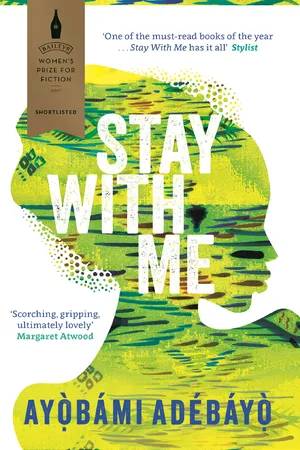
SHORTLISTED FOR THE 2017 BAILEYS WOMEN'S PRIZE FOR FICTION
SHORTLISTED FOR THE 2018 WELLCOME BOOK PRIZE
LONGLISTED FOR THE 2018 INTERNATIONAL DYLAN THOMAS PRIZE
Yejide is hoping for a miracle, for a child. It is all her husband wants, all her mother-in-law wants, and she has tried everything. But when her relatives insist upon a new wife, it is too much for Yejide to bear.
Unravelling against the social and political turbulence of 1980s Nigeria, Stay With Me is a story of the fragility of married love, the undoing of family, the power of grief, and the all-consuming bonds of motherhood. It is a tale about the desperate attempts we make to save ourselves, and those we love, from heartbreak.
- 304 pages
- English
- ePUB (mobile friendly)
- Available on iOS & Android
eBook - ePub
Stay With Me
About this book
Information
Topic
LiteraturaSubtopic
Literatura generalPart I
1
JOS, DECEMBER 2008
I must leave this city today and come to you. My bags are packed and the empty rooms remind me that I should have left a week ago. Musa, my driver, has slept at the security guard’s post every night since last Friday, waiting for me to wake him up at dawn so we can set out on time. But my bags still sit in the living room, gathering dust.
I have given most of what I acquired here – furniture, electronic devices, even house fittings – to the stylists who worked in my salon. So, every night for a week now, I’ve tossed about on this bed without a television to shorten my insomniac hours.
There’s a house waiting for me in Ife, right outside the university where you and I first met. I imagine it now, a house not unlike this one, its many rooms designed to nurture a big family: man, wife and many children. I was supposed to leave a day after my hairdryers were taken down. The plan was to spend a week setting up my new salon and furnishing the house. I wanted my new life in place before seeing you again.
It’s not that I’ve become attached to this place. I will not miss the few friends I made, the people who do not know the woman I was before I came here, the men who over the years have thought they were in love with me. Once I leave, I probably won’t even remember the one who asked me to be his wife. Nobody here knows I’m still married to you. I only tell them a slice of the story: I was barren and my husband took another wife. No one has ever probed further, so I’ve never told them about my children.
I have wanted to leave since the three corpers in the National Youth Service programme were killed. I decided to shut down my salon and the jewellery shop before I even knew what I would do next, before the invitation to your father’s funeral arrived like a map to show me the way. I have memorised the three young men’s names and I know what each one studied at the university. My Olamide would have been about their age; she too would just have been leaving university about now. When I read about them, I think of her.
Akin, I often wonder if you think about her too.
Although sleep stays away, every night I shut my eyes and pieces of the life I left behind come back to me. I see the batik pillowcases in our bedroom, our neighbours and your family which, for a misguided period, I thought was also mine. I see you. Tonight I see the bedside lamp you gave me a few weeks after we got married. I could not sleep in the dark and you had nightmares if we left the fluorescent lights on. That lamp was your solution. You bought it without telling me you’d come up with a compromise, without asking me if I wanted a lamp. And as I stroked its bronze base and admired the tinted glass panels that formed its shade, you asked me what I would take out of the building if our house was burning. I didn’t think about it before saying, our baby, even though we did not have children yet. Something, you said, not someone. But you seemed a little hurt that, when I thought it was someone, I did not consider rescuing you.
I drag myself out of bed and change out of my nightgown. I will not waste another minute. The questions you must answer, the ones I’ve choked on for over a decade, quicken my steps as I grab my handbag and go into the living room.
There are seventeen bags here, ready to be carried into my car. I stare at the bags, recalling the contents of each one. If this house was on fire, what would I take? I have to think about this because the first thing that occurs to me is nothing. I choose the overnight bag I’d planned to bring with me for the funeral and a leather pouch filled with gold jewellery. Musa can bring the rest of the bags to me another time.
This is it then – fifteen years here and, though my house is not on fire, all I’m taking is a bag of gold and a change of clothes. The things that matter are inside me, locked up below my breast as though in a grave, a place of permanence, my coffin-like treasure chest.
I step outside. The air is freezing and the black sky is turning purple in the horizon as the sun ascends. Musa is leaning against the car, cleaning his teeth with a stick. He spits into a cup as I approach and puts the chewing stick in his breast pocket. He opens the car door, we exchange greetings and I climb into the back seat.
Musa switches on the car radio and searches for stations. He settles for one that is starting the day’s broadcast with a recording of the national anthem. The gateman waves goodbye as we drive out of the compound. The road stretches before us, shrouded in a darkness transitioning into dawn as it leads me back to you.
2
ILESA, 1985 ONWARDS
Even then, I could sense that they had come prepared for war. I could see them through the glass panes on the door. I could hear their chatter. They did not seem to notice that I had been standing on the other side of the door for almost a full minute. I wanted to leave them standing outside and go back upstairs to sleep. Maybe they would melt into pools of brown mud if they stayed long enough in the sun. Iya Martha’s buttocks were so big that, if melted, they would have taken up all the space on the concrete steps that led up to our doorway.
Iya Martha was one of my four mothers; she had been my father’s oldest wife. The man who came with her was Baba Lola, Akin’s uncle. They both hunched their backs against the sun and wore determined frowns that made their faces repulsive. Yet, as soon as I opened the door, their conversation stopped and they broke into smiles. I could guess the first words that would come out of the woman’s mouth. I knew it would be some lavish show of a bond that had never existed between us.
‘Yejide, my precious daughter!’ Iya Martha grinned, cupping my cheeks with moist and fleshy hands.
I grinned back and knelt to greet them. ‘Welcome, welcome. God must have woken up thinking of me today-o. That is why you are all here,’ I said, bending in a semi-kneel again after they had come in and were seated in the sitting room.
They laughed.
‘Where is your husband? Do we meet him at home?’ Baba Lola asked, looking around the room as though I had stashed Akin under a chair.
‘Yes, sir, he is upstairs. I’ll go and call him after I serve your drinks. What should I prepare for food? Pounded yam?’
The man glanced at my stepmother as though, while rehearsing for the drama that was about to unfold, he had not read this part of their script.
Iya Martha shook her head from side to side. ‘We cannot eat. Get your husband. We have important things to discuss with the two of you.’
I smiled, left the sitting-room area and headed for the staircase. I thought I knew what ‘important things’ they had come to discuss. A number of my in-laws had been in our home previously to discuss the same issue. A discussion consisted of them talking and me listening while on my knees. At those times, Akin pretended to listen and jot notes while writing his to-do list for the next day. No one in the series of delegations could read or write and they were all in awe of those who could. They were impressed that Akin wrote down their words. And sometimes, if he stopped writing, the person speaking at the time would complain that Akin was disrespecting him or her by not noting anything down. My husband often planned his entire week during such visits, while I got terrible cramps in my legs.
The visits irritated Akin and he wanted to tell his relatives to mind their own business, but I would not allow it. The long discussions did give me leg cramps, but at least they made me feel I was part of his family. Until that afternoon, no one in my family had paid me that kind of visit since I’d got married.
As I went up the stairs, I knew that Iya Martha’s presence meant some new point was about to be made. I did not need their advice. My home was fine without the important things they had to say. I did not want to hear Baba Lola’s hoarse voice being forced out in between coughs or see another flash of Iya Martha’s teeth.
I believed I had heard it all already anyway and I was sure my husband would feel the same way. I was surprised to find Akin awake. He worked six days a week and slept through most Sundays. But he was pacing the floor when I entered our room.
‘You knew they would come today?’ I searched his face for the familiar mix of horror and irritation that it wore any time a special delegation came visiting.
‘They are here?’ He stood still and clasped his hands behind his head. No horror, no irritation. The room began to feel stuffy.
‘You knew they were coming? You didn’t tell me?’
‘Let’s just go downstairs.’ He walked out of the room.
‘Akin, what is going on? What is happe...
Table of contents
- Cover Page
- About the Author
- Title Page
- Copyright Page
- Dedication
- Part I
- Part II
- Part III
- Part IV
- Acknowledgements
- · 1 ·
Trusted by 375,005 students
Access to over 1.5 million titles for a fair monthly price.
Study more efficiently using our study tools.
Frequently asked questions
Yes, you can cancel anytime from the Subscription tab in your account settings on the Perlego website. Your subscription will stay active until the end of your current billing period. Learn how to cancel your subscription
No, books cannot be downloaded as external files, such as PDFs, for use outside of Perlego. However, you can download books within the Perlego app for offline reading on mobile or tablet. Learn how to download books offline
Perlego offers two plans: Essential and Complete
- Essential is ideal for learners and professionals who enjoy exploring a wide range of subjects. Access the Essential Library with 800,000+ trusted titles and best-sellers across business, personal growth, and the humanities. Includes unlimited reading time and Standard Read Aloud voice.
- Complete: Perfect for advanced learners and researchers needing full, unrestricted access. Unlock 1.5M+ books across hundreds of subjects, including academic and specialized titles. The Complete Plan also includes advanced features like Premium Read Aloud and Research Assistant.
We are an online textbook subscription service, where you can get access to an entire online library for less than the price of a single book per month. With over 1.5 million books across 990+ topics, we’ve got you covered! Learn about our mission
Look out for the read-aloud symbol on your next book to see if you can listen to it. The read-aloud tool reads text aloud for you, highlighting the text as it is being read. You can pause it, speed it up and slow it down. Learn more about Read Aloud
Yes! You can use the Perlego app on both iOS and Android devices to read anytime, anywhere — even offline. Perfect for commutes or when you’re on the go.
Please note we cannot support devices running on iOS 13 and Android 7 or earlier. Learn more about using the app
Please note we cannot support devices running on iOS 13 and Android 7 or earlier. Learn more about using the app
Yes, you can access Stay With Me by Ayobami Adebayo in PDF and/or ePUB format, as well as other popular books in Literatura & Literatura general. We have over 1.5 million books available in our catalogue for you to explore.