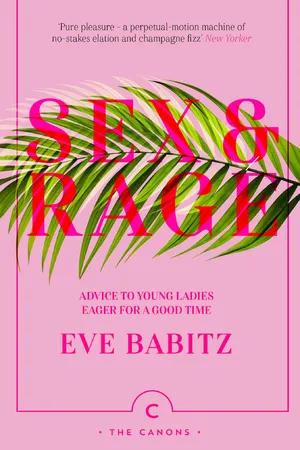
It is the 1970s in LA, and Jacaranda Leven - child of sun and surf - is swept into the dazzling cultural milieu of the beautiful people. Floating on a cloud of drink, drugs and men, she finds herself adrift, before her talent for writing, and a determined literary agent, set her on a course for New York and a new life.
Sex & Rage is a recently re-discovered classic from author Eve Babitz, herself a muse to many an artist, writer and musician in the 1970s. A semi-autobiographical novel, it charts the highs and lows of a life lived at the limits, and transports the reader to a sunnier, dreamier, more reckless time and place.
- 250 pages
- English
- ePUB (mobile friendly)
- Available on iOS & Android
eBook - ePub
About this book
Information
PART I
Jacaranda
Jacaranda’s name was pronounced “Jack-ah-ran-dah,” as in jack-o’-lan-tern, the same rhythm. It’s the name of a Central American flowering tree that grows in Los Angeles, and in Spanish it was originally “Hawk-ah-rahn-dah.” It was just like her parents to name their daughter Jacaranda. Her father was a Trotskyite descended from bomb-throwing Russian anarchists, and Jacaranda’s mother was born illegitimately, because her mother refused to marry the man who was the father. “I’m not marrying a rapist,” Jacaranda’s maternal grandmother explained. She moved to Texas and lost her illusions about the Catholic Church in one fell swoop—she was excommunicated, not him!
The Ocean
They lived in Santa Monica near the ocean. Jacaranda’s father was a studio musician and they lived in a bungalow house, one with a mortgage, about two blocks from the ocean. Jacaranda grew up tan, with streaky blond hair, and tar on the bottom of her feet. Her sister, April, grew up three years younger, with a darker tan, and streaky reddish layers in her darker hair, and tar on the bottom of her feet. They looked absolutely nothing alike.
From the very start, Jacaranda was the big one with the large head who, till she was three, had to be swathed in pink for people not to say, “My, what a nice healthy boy you’ve got there . . .” April was a girl, a girlish girl with curly brown curls and a rosy-cheeked smile, delicate bone structure, and a small head. Neither Jacaranda nor April looked anything at all like the parents, Mort and Mae Leven, except that Jacaranda’s head and Mort Leven’s head were 7 ⅞ in hat size—one of the largest hat sizes, even for men.
The two girls grew up at the edge of the ocean and knew it was paradise, and better than Eden, which was only a garden. All Jacaranda cared about was surfing. First it was body-surfing where she would stare at the edge of the water, watching the waves to see which side the riptide was twisting back out on; then she’d slowly force herself upon the sea though it resisted. She’d walk out till she was up to her waist and all tangled up in the problem. The waves would now be coming and it was her choice, as they came, whether to slide on through under them in the glassgreen water and ignore them crashing toward L.A. behind her—or to match herself up with the ocean’s rhythm, to swim out just far enough, then stop, wait, push herself forward to catch the wave, and tumble into shore. Sometimes, if she miscalculated, she’d be swung back under the wave’s lip and squashed down into the sand. When she was twelve, Jacaranda was given a surfboard.
No matter what the waves were doing, no matter what tides and thunders went on beneath her, she stayed on the board. The board tilted and tried to buck her off, the whole world slanted suddenly, the board would shoot out from under her before she knew it—the trick was to get the board back and keep going.
Jacaranda would surf before school and after school, and during school if she could, if the day was too nice. Mae Leven was “understanding” and would write notes to Jacaranda’s teachers about her daughter “coming down with a cold.” If Jacaranda tried it too often, Mae would turn into a black mamba snake and whirl around like a whip, snarling something darkly Southern.
Mort Leven played in the orchestra at Twentieth Century-Fox. They paid him $150 a week, which, in 1949 when he went “under contract,” was a comfortable salary. It allowed him to put a down payment on their house in Santa Monica where they could live happily ever after for as long as ever after would bear up. Mort Leven’s great-aunt Sonia was a major star in the early twenties and thirties, and two decades later was still so powerful with the studio executive system that she was able to get Mort a job. (In Hollywood, if you can’t have a father in the Industry, the least you can have is a great-aunt.) It didn’t matter that Mort Leven had been a concert violinist or that he had studied with the greatest masters of his time and toured Europe; it didn’t matter that he was probably one of the finest violinists in the world—not to Twentieth Century-Fox. What mattered to the studio was Sonia, Jacaranda’s great-great-aunt and “godmother.” Sonia was able to get Mort the interview with Harry Katz, the studio’s chief musical administrator, an interview that in those days only a miracle or a father in the Industry merited.
Harry Katz had started out in the Yiddish theater on the Lower East Side and had a brother in the Industry, who in 1931 had sent for him to come out on a train to Hollywood. The pictures had sound and Harry could conduct the orchestra. After all, he’d been doing it since he was a kid in Toronto, a Jewish refugee like everybody else, a friend of Sonia’s from “the old days” before Toronto, in Kiev. So “For Sonia’s great-nephew, I put aside the official rules,” he declared. “I let a total unknown try out in my office.”
Mort was told to “bring something with a piano part” so Harry could play along and see just how well Mort could keep up. Mort Leven couldn’t quite bring himself to debase his musical worth either. So he brought a piece, a new piece by Igor Stravinsky that he’d purchased in Paris, a piece that hadn’t even been published in America yet, a piece where every measure was in a different time signature—so that it went from two-four to three-four (the waltz) to seven-eight to two-two to five-eight . . . Mort Leven casually handed the piano part to Harry and, on a music stand, set up his violin score.
“Who is this guy Stravinsky?” Harry asked. “That how you pronounce it?” He opened the music, took one look at the time signatures, and burst into roaring laughter. “Is this a joke?” To Harry Katz, this was the funniest thing a job applicant had ever done—faked up a whole score of music this way! (Later, when Harry found out a certain Igor Stravinsky did exist, and was the musical genius of the century, and was the man who had just left Jacaranda’s sixteenth birthday party with his glorious wife, Vera, he asked, “Morty, tell me the truth, a man like that, he can’t be making more than twenty-five grand a year, can he?”)
IT WAS AN easy life, growing up by the beautiful sea with her tan sister, her beautiful mother and black-curly-hair genius father, the Twentieth Century-Fox money rolling beautifully in every week, allowing Mort to save enough to buy real estate in Santa Monica. “Income property,” it was called. (So many musicians at the studio had apartment houses and courts that the joke, one day, became “Tenants, anyone?”)
In the days of her childhood, she was formally educated in three city schools where she mostly sat drawing pictures of Frederick’s of Hollywood models dressed in comic-book high boots and masks, with garter belts, knives, and whips, with long wavy blond hair down to their waists in the back, cleavage in the front, and beauty marks dotting to the left of their left eyes. She had not been raised in any religion, though she assumed she was Jewish. She found matzah hidden underneath her grandparents’ brocaded satin couch cushions, over at their West Los Angeles house every Passover. She really believed that the great religions of the world so far had come into being before anyone had grown up by the ocean. She believed in the ocean. Jacaranda believed that the ocean was a giant lullaby god who could be seduced into seeing things her way and could bring forth great waves. “Great waves, great waves, great waves,” Jacaranda used to chant on bland days. On days when there were great waves, she would in silence bow her head toward the sea and thank it. She would talk to the water, implore it to hotten up. When the surf was hot, everything reached a state of hurling glory and perfect balance between her body and the tides and eternity. “You children who’ve grown up in California,” she was often told, “you don’t know what life is. One day you’re going to run into a brick wall.”
“Like what?” she asked. “Snow?”
Jacaranda spent the first summer after graduating from high school custom-painting surfboards for twenty-five dollars apiece in her parents’ garage and bought a new old ’59 Plymouth station wagon.
By the time she got out of Santa Monica High School, she was a spare figure out on the beach wearing torn blue shorts or a torn blue bikini. From afar, she looked as if she’d washed up on the shore, a piece of driftwood with blond seaweed caught at one end. She had calcium deposits on her knees and on the tops of her feet that were caused by the pressure of paddling huge older boards out into the ocean. (These bumps were called “surf bumps” and even the scientists down at the Scripps Institute in La Jolla didn’t know exactly what they were.) From far away, she looked like all the other girls her age who were growing up near the water.
Up close, her expression—when she wasn’t smiling—gave people the impression that she was brand-new—a child, almost. When she smiled, her perfect white teeth slashed the air with sudden beauty, giving her a glow of confidence that smacked of rude invincibility. (“Are those teeth real?” was the common question.) Her bangs were too long (down to her nose), making her eyes difficult to notice. (She’d always wished they’d been blue—blue the color of improved skies on postcards.)
Mae Leven used to watch Jacaranda and April come in from the beach at sunset, with their hair tangled and salty and their taut arms and legs dragging sand into the house behind them, and she’d coo, “Oh, there you are. My two string beans.”
By the time Jacaranda was eighteen, she no longer looked like a boy, even with April standing right next to her.
People told Jacaranda she was lucky.
But luck is like beauty or diamond earrings: people who have it cannot simply stay home and receive compliments unless they’ve an enormous sense of public duty. Jacaranda wanted to see things before her luck ran out and she came upon the prophesied brick wall.
She imagined that she would be an adventuress and not need to go to UCLA or even Chouinard Art Institute, like Shelby Coryell, her one friend her own age. She would be an adventuress-painter, and just paint, because that’s what she’d be good at. Blue was everything.
Outside, that first September, everyone had gone back to school and she had the whole empty beach to herself. Everything in the horizon looked clear and blue.
True Love
Colman didn’t like the ocean.
“It’s too cold,” he explained, shuddering in his black turtleneck. “How can you go where it’s too cold? That’s why I left New York.”
“Cold?” she said.
“Cold,” he enunciated clearly.
But she was in love, so she moved in with him, way inland, to West Hollywood where he rented a ramshackle house all choked by passionflower vines. He had four ramshackle cats, named Harry, Dean, Stan, and Tentoes. His wife was divorcing him. He covered all his windows with black curtains because he hated the light in L.A., and daytime in general.
He had black curly hair and was plainly a genius—just like her father. He taught acting and everyone in his class said he was brilliant. He was twenty-nine and she was eighteen the night they met in Barney’s Beanery, a ramshackle West Hollywood bar where she drank beer and flirted with artists at night. Barney’s was one of the oldest bars in West Hollywood. Most of the artists were surfers who lived at the beach.
Colman was standing near the bar and his eyebrows went up gently when he saw Jacaranda. Everything Colman did made her laugh, and all he had to do was begin to tell a joke and she was lost.
After three weeks, Colman told her his wife had changed her mind about the divorce and was moving back in with him and bringing her cats, Fred and Rooster.
“More cats?” Jacaranda asked. “Your wife?”
He raised his eyebrows and spread his hands out in a “What can I do?” gesture.
Colman lied to her about everything and for a long time Jacaranda thought that that was what actors did offstage. But she found out most actors only lied for money in movies. He was entirely irresistible to all women, even Jacaranda’s grandmother, who took one look at him and started blushing and afterward said, “The Irish are a lovely people.”
“But, Grandma, you don’t like Irish people because of their red hair, I thought.”
“He has black hair,” she said.
He was not too tall, five feet eleven, with pale Irish skin, and beautiful gracefully endearing eyes—there was nothing “wild Irish rose” about him. Even his lies weren’t wild. His lies always leaned toward the tame. He lied that things were dull and lifeless without Jacaranda. If she asked him what was “new, terrific, and exciting,” he’d sigh, yawn, and say, “Peace and quiet, my darling, just nothing but peace and quiet . . .” And she knew—three people would have told her—that he’d been with some starlet on the coats at a party the night before.
What she loved about Colman was his New York accent. He talked like a Dead End Kid. Ever since Jacaranda was little and first saw television, Leo Gorcey had been her idea of “a man.” He was a lot like Mort Leven, but—instead of being Jewish—it was the Irishness that drove Jacaranda into peals of merriment; New York Irishness. New York Irishness was so exotic to Jacaranda that she had practically been able to overlook Elvis Presley’s Southern comfort. Jacaranda always felt that...
Table of contents
- Cover
- About the Author
- Praise for Eve’s Hollywood
- Praise for Slow Days, Fast Company
- Title Page
- Copyright
- Dedication
- Contents
- Part I
- Part II
Trusted by 375,005 students
Access to over 1.5 million titles for a fair monthly price.
Study more efficiently using our study tools.
Frequently asked questions
Yes, you can cancel anytime from the Subscription tab in your account settings on the Perlego website. Your subscription will stay active until the end of your current billing period. Learn how to cancel your subscription
No, books cannot be downloaded as external files, such as PDFs, for use outside of Perlego. However, you can download books within the Perlego app for offline reading on mobile or tablet. Learn how to download books offline
Perlego offers two plans: Essential and Complete
- Essential is ideal for learners and professionals who enjoy exploring a wide range of subjects. Access the Essential Library with 800,000+ trusted titles and best-sellers across business, personal growth, and the humanities. Includes unlimited reading time and Standard Read Aloud voice.
- Complete: Perfect for advanced learners and researchers needing full, unrestricted access. Unlock 1.5M+ books across hundreds of subjects, including academic and specialized titles. The Complete Plan also includes advanced features like Premium Read Aloud and Research Assistant.
We are an online textbook subscription service, where you can get access to an entire online library for less than the price of a single book per month. With over 1.5 million books across 990+ topics, we’ve got you covered! Learn about our mission
Look out for the read-aloud symbol on your next book to see if you can listen to it. The read-aloud tool reads text aloud for you, highlighting the text as it is being read. You can pause it, speed it up and slow it down. Learn more about Read Aloud
Yes! You can use the Perlego app on both iOS and Android devices to read anytime, anywhere — even offline. Perfect for commutes or when you’re on the go.
Please note we cannot support devices running on iOS 13 and Android 7 or earlier. Learn more about using the app
Please note we cannot support devices running on iOS 13 and Android 7 or earlier. Learn more about using the app
Yes, you can access Sex & Rage by Eve Babitz in PDF and/or ePUB format, as well as other popular books in Literature & Literature General. We have over 1.5 million books available in our catalogue for you to explore.