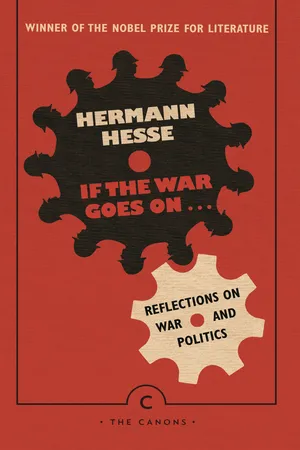
Herman Hesse remained clear-sighted and consistent in his political views and his passionate espousal of pacifism and the bloody absurdity of war from the start of World War I to the end of his life. He wrote the earliest essay in this book in September 1914, before he cemented his fame with the novels Steppenwolf and Siddhartha, and continued writing a stream of letters, essays and pamphlets throughout the war. In his native Germany his views earned him the labels 'traitor' and 'viper', but after World War II he was moved to reiterate his beliefs in another series of essays and letters.
If The War Goes On . . . resonates as strong today as it did when originally published and begs the question: have our politicians learnt nothing in the last seventy years?
- 192 pages
- English
- ePUB (mobile friendly)
- Available on iOS & Android
eBook - ePub
About this book
Information
Topic
LetteraturaSubtopic
Prima guerra mondialeZarathustra’s Return
A WORD TO GERMAN YOUTH
1919
There was once a German spirit, a German courage, a German manhood that did not express themselves in the uproar of the herd or in mass enthusiasm. The last great vehicle of that spirit was Nietzsche, who, amid the business boom and sheeplike conformism that characterised the beginnings of the German Empire, became an antipatriot and anti-German. In this little book I wish to remind the young German intellectuals of that man, of his courage and solitude, and in so doing turn their minds away from the herd outcry (whose present whining tone is not a jot more pleasant than the brutal, bullying tone it assumed in those ‘great days’) to a few simple facts and experiences of the soul. With regard to nation and collectivity, let every man act as his needs and conscience dictate – but if in the process he loses himself, his own soul, whatever he does will be worthless. Only a few men in our impoverished and defeated Germany have begun to recognise that weeping and complaining are fruitless, and to gird themselves like men for the future. Only a few suspect how deeply the German mind had degenerated long before the war. If we wish once again to have minds and men capable of securing our future, we must not begin zarathustra’s return at the tail end, with political methods and forms of government, but at the beginning, with the building of the personality. That is the subject of my little book. It first appeared anonymously in Switzerland (where it went into several printings), because I did not wish to arouse the young people’s distrust with a familiar name. I wanted them to consider it without prejudice, and that they did. Accordingly, I have no further ground for remaining anonymous.
Hermann Hesse’s preface to the first signed edition
When the rumour went round among the young people in the capital that Zarathustra had reappeared and had been seen here and there in the streets and squares, a few young men went out to look for him. These were young men who had returned home from the war and were seized with anguish amid the change and upheaval of their homeland, for they saw that great things were happening, but the meaning of these things was obscure and to many they were without rhyme or reason. In former years all these young men had looked upon Zarathustra as their prophet and guide; they had read what is written concerning him with the enthusiasm of youth; they had spoken and thought about him on their wanderings over heath and mountain, and at night in the lamplight of their rooms. And because the voice that first and most forcefully turns a man’s thoughts to his own self and his own fate is held sacred, they had held Zarathustra sacred.
The young men found Zarathustra in a wide street filled with people. He was standing pressed against a wall, listening to a demagogue who was haranguing the crowd from the top of a vehicle. Zarathustra listened, smiled, and looked into the faces of the people. He looked into those faces as an aged hermit looks into the waves of the sea or the clouds at morning. He saw the fear; he saw the impatience and the perplexed, plaintive, childlike anxiety; he saw the courage and hatred in the eyes of the resolute and despairing. And he did not weary of looking, while at the same time listening to the speaker. The young men recognised him by his smile. He was neither old nor young, he looked neither like a teacher nor like a soldier, he looked like a man – like man himself when he first rose out of the darkness of the beginning, the first of his kind.
And yet, after doubting for a time that it was he, they recognised him by his smile. His smile was bright but not kindly; it was guileless, but not good-natured. It was the smile of a warrior, but still more the smile of an old man who has seen much and has ceased to set store by tears.
When the speech was at an end and the people began, amid a great uproar, to disperse, the young men approached Zarathustra and greeted him with reverence.
‘Master, you are here,’ they stammered; ‘at last in our day of greatest affliction, you have returned. Welcome, Zarathustra! You will tell us what to do, you will lead us. You will save us from this greatest of all perils.’
Smiling, he bade them accompany him, and when they had started off he said: ‘I am in very good spirits, my friends. I have returned, perhaps for a day, perhaps for an hour, and I see you play-acting. It has always been a pleasure to me to watch people play-acting. They are never so honest as then.’
The young men heard him and exchanged glances; they thought there was too much mockery, too much levity, too much unconcern in Zarathustra’s words. How could he speak of play-acting when his people were in misery? How could he smile and be so cheerful when his country had been defeated and was facing ruin? How could all this, the people and the public speaker, the gravity of the hour, their own solemnity and veneration – how could all this be a mere spectacle to him, merely something to observe and smile at? Should he not, at such a time, shed bitter tears, lament and rend his garments? And, most of all, was it not time, high time, to act? To do great deeds? To set an example? To save his country and people from certain doom?
‘I see, my young friends,’ said Zarathustra, who divined their unspoken thoughts, ‘that you are displeased with me. I expected as much, and yet you surprise me. Such expectations always go hand in hand with their contrary; one part of us expects something, another part hopes for the opposite. That, my friends, is how I feel now. – But come now, you wished to speak with Zarathustra, did you not?’
‘Yes! Yes, indeed!’ they cried eagerly.
Then Zarathustra smiled and said: ‘Well then, my dear friends, speak with Zarathustra, hear Zarathustra. The man who stands before you is not a demagogue, or a soldier, or a king, or a general; he is Zarathustra, the old hermit and joker, inventor of the last laugh, and of so many other sad last things. From me, my friends, you cannot learn how to govern nations and repair defeats. I cannot teach you how to drive herds or appease the hungry. Those are not Zarathustra’s arts. Those are not Zarathustra’s concerns.’
The young men were silent and a look of disappointment passed over their faces. Dejected and disgruntled, they walked beside the prophet and for a long time found no words with which to answer him. At length one of them, the youngest, spoke; and his eyes flashed as he spoke, and Zarathustra looked upon him with pleasure.
‘Then tell us,’ began the youngest of the young men, ‘tell us what you have to say. For if you have only come to mock us and to mock the affliction of your people, we have better things to do than to walk about with you, listening to your excellent jokes. Look at us, Zarathustra. All of us, young as we are, have fought in the war and looked death in the face; and we are in no mood for games and amusing pastimes. We revered you, O master, and loved you, but greater than our love for you is our love for ourselves and our people. We want you to know that.’
Zarathustra’s countenance brightened when he heard the young man speak, and he looked with kindness, nay, tenderness, into his angry eyes.
‘My friend,’ he said with his best smile, ‘how right you are not to accept old Zarathustra sight unseen, to sound him out, and to tickle him in what you take to be his vulnerable spot. How right you are, my dear boy, to be mistrustful! Moreover, I must tell you, you have just spoken excellent words, the kind of words Zarathustra likes to hear. Did you not say: ‘We love ourselves more than we love Zarathustra’? Such forthrightness goes straight to my heart! With those words you have baited me, slippery old fish that I am; soon you will have me dangling from your hook!’
At that moment shouts, loud cries, and tumult were heard from far off; it sounded strange and absurd in the quiet evening. And when Zarathustra saw the eyes and thoughts of his young companions darting in that direction like young hares, he changed his tone. Suddenly his voice sounded as though it came from a strange, remote place – it sounded just as it had when the young men had first come to know him, like a voice that comes not from men but from stars or gods or, still more, like the voice that every man hears secretly in his own heart at times when God is in him.
The friends harkened, their thoughts and senses returned to Zarathustra, for now they recognised the voice that had once burst upon their early youth like the voice of an unknown God.
‘Hear me, my children,’ he said earnestly, addressing himself chiefly to the youngest. ‘If you wish to hear a bell tone, you must not strike upon tin. And if you wish to play the flute, you must not set your lips to a wineskin. Do you understand me, my friends? Think back, my dear friends, think back and remember: what was it that you learned from your Zarathustra in those hours of enthusiasm? What was it? Was it wisdom for the counting house, or for the street, or for the battlefield? Did I give you advice for kings, did I speak to you like a king, or a citizen, or a politician, or a merchant? No, if you recall, I spoke like Zarathustra, I spoke my language, I stood before you like a mirror, in which to see yourselves. Did you ever ‘learn something’ from me? Was I ever a language teacher or a teacher of any other subject? No, Zarathustra is not a teacher, you cannot ask him questions and learn from him, and jot down big and little formulas to be used as the need arises. Zarathustra is a man, he is you and I. Zarathustra is the man for whom you are searching in yourselves, the forthright, unseduced man – how could he wish to seduce you? Zarathustra has seen much and suffered much, he has cracked many nuts and been bitten by many snakes. But he has learned only one thing, he prides himself only on one bit of wisdom. He has learned to be Zarathustra. And that is what you want to learn from him, yet so often lack the courage to learn. You must learn to be yourselves, just as I have learned to be Zarathustra. You must unlearn the habit of being someone else or nothing at all, of imitating the voices of others and mistaking the faces of others for your own. – Therefore, my friends, when Zarathustra speaks to you, look for no wisdom, no arts, no formulas, no Pied Piper’s tricks in his words; look for the man himself. From a stone you can learn what hardness is, from a bird what it is to sing. And from me you can learn what man and destiny are.’
Thus conversing, they had come to the edge of the city, and for a long while they walked together in the evening, under the rustling trees. They asked him many questions, often they laughed with him and often they despaired of him. And one of them wrote down what Zarathustra said to them that evening, or some part of it, and preserved it for his friends.
This is what he wrote as he recollected Zarathustra and his words:
OF DESTINY
So spake Zarathustra to us:
One thing is given to man which makes him into a god, which reminds him that he is a god: to know destiny.
What makes me Zarathustra is that I have come to know Zarathustra’s destiny. That I have lived his life. Few men know their destiny. Few men live their lives. Learn to live your lives! Learn to know your destiny!
You have been lamenting so much over the destiny of your people. But a destiny we lament over is not yet ours; it is an alien, hostile destiny, an alien god and evil idol, a destiny flung at us like a poisoned arrow out of the darkness.
Learn that destiny does not come from idols; then at last you will know that there are no idols or gods! As a child grows in a woman’s womb, so destiny grows in each man’s body, or if you will you may say: in his mind or soul. They are the same thing.
And just as the woman is one with her child and loves it beyond all else in the world – so must you learn to love your destiny beyond all else in the world. It must be your god, for you yourselves must be your gods.
When destiny comes to a man from outside, it lays him low, just as an arrow lays a deer low. When destiny comes to a man from within, from his innermost being, it makes him strong, it makes him into a god. It made Zarathustra into Zarathustra – it must make you into yourself!
A man who has recognised his destiny never tries to change it. The endeavour to change destiny is a childish pursuit that makes men quarrel and kill one another. Your emperor and generals tried to change destiny, and so did you. Now that you have failed to change destiny, it has a bitter taste and you look upon it as poison. If you had not tried to change it, if you had taken it to heart as your child, if you had made it into your very own selves, how sweet it would taste! All sorrow, poison, and death are alien, imposed destiny. But every true act, everything that is good and joyful and fruitful on earth, is lived destiny, destiny that has become self.
Before your long war, you were too rich, my friends, you and your fathers were too rich and fat and glutted, and when there was pain in your bellies, you ought to have recognised destiny in your pain and harkened to its good voice. But, children that you were, the pain in your bellies made you angry and you contrived to think that hunger and want were the source of your pain. And so you struck out: to conquer, to gain more space on earth, to acquire more food for your bellies. And now that you have returned home and have not gained what you were after, you have started to moan again, you are beset by all manner of aches and pains; once again you are looking for the wicked, wicked enemy who is responsible for your pain, and you are prepared to shoot him even if he is your brother.
Dear friends, ought you not to consider? Ought you not, just this once, to treat your pain with more respect, more curiosity, more manliness, with less infantile fear and less infantile wailing? Might your bitter pain not be the voice of destiny, might that voice not become sweet once you understand it?
Another thing, my friends. I hear your perpetual lamentations and outcries over the bitter pain and bitter fate that have descended on your people and your fatherland. Forgive me, my friends, if I am just a little distrustful of such pain, just a little reluctant to believe in it! All of you – you and you and you – are you suffering only for your people and fatherland? Where is this fatherland? Where is its head? Where is its heart? Where is the cure to begin? Tell me! Yesterday your fears were for the Kaiser, for the empire that you were so proud of, that you held so sacred. Where is all that today? Your pain did not come from the Kaiser – if it had, would it still be so bitter now that the Kaiser is gone? It did not come from the army or from the fleet or from any conquered province or possession; that is evident to you now. – But why, if you are in pain, must you go on talking about nation and fatherland, about all those great and estimable things which are so easy to talk about but which so easily vanish into thin air? Who is the people? Is it a street speaker or is it those who listen to him; is it those who agree with him or those who brandish their cudgels and shout him down? Do you hear the shooting over there? Where is the people, your people? Is it shooting or being shot at? Is it attacking or being attacked?
You see, it is hard for men to understand each other, and still harder to understand ourselves when we persist in using such big words. If all of you – you and you – are in pain, if you are sick in body or soul, if you are afraid and have a foreboding of danger – why not, if only to amuse yourselves, if only out of curiosity, good healthy curiosity, try to put the question in a different way? Why not ask whether the source of your pain might not be you yourselves? For a brief period in the past you were all convinced that the Russians were your enemy and the root of all evil. A little while later it was the English, and then the French, and then others, and each time you were sure, and each time it was a dismal comedy, ending in misery. But now that you have seen that the pain has its source in ourselves, that we cannot heal it by blaming the enemy – why, once again, do you neglect to look for the source of your pain where it is: within yourselves. Might it not be that what pains you is not the people and not the fatherland and not world hegemony, and not democracy either for that matter, but your own stomach or liver, an ulcer or cancer inside you – and that only a childish fear of the truth and the doctor makes you imagine that you yourself are in perfect health but alas so afflicted by some ailment in your people? Might that not be so? Isn’t your curiosity aroused? Might it not be an amusing exercise for each one of you to examine what ails you and try to determine its source?
You might well discover that a third or a half of your pain and then some originates in your own selves, and that it might be a good idea to take cold baths or drink less wine or undertake some other sort of cure, instead of probing and doctoring the fatherland. That, I believe, is quite possible – and wouldn’t it be a fine thing? Mightn’t something be done about it? Wouldn’t there be hope for the future? A hope of transforming pain into profit and poison into destiny?
It strikes you as mean and selfish to forget the fatherland and heal yourselves. But perhaps, my friends, you are not as right as you suppose! Wouldn’t you say that a fatherland upon which every sick citizen does not project his own ailments, which hundreds of patients do not try to doctor, might be healthier and more likely to thrive?
Ah, my young friends, you have learned so much in your young lives! You have been soldiers, you have looked death in the face a hundred times. You are heroes. You are pillars of the fatherland. But I implore you: don’t content yourselves with that! Learn more! Strive higher! And remember from time to time what a fine thing integrity is!
ACTION AND SUFFERING
‘What ought we to do?’ you ask me. You ask me time and time again, and yourselves as well. ‘Doing’ – action – is so important to you, indeed all-important. That is good, my friends, or...
Table of contents
- Cover
- Also by Hermann Hesse
- Title Page
- Copyright
- Dedication
- Contents
- Foreword to the 1946 Edition
- O Freunde, nicht diese Töne! (September 1914)
- To a Cabinet Minister (August 1917)
- If the War Goes On Another Two Years (End of 1917)
- Christmas (December 1917)
- Shall There Be Peace? (December 1917)
- If the War Goes On Another Five Years (Early in 1918)
- The European (January 1918)
- Dream after Work (March 1918)
- War and Peace (Summer 1918)
- History (November 1918)
- The Reich (December 1918)
- The Path of Love (December 1918)
- Self-will (1919)
- Zarathustra’s Return (1919)
- Letter to a Young German (1919)
- Thou Shalt Not Kill (1919)
- Thoughts about China (1921)
- World Crisis and Books (1937)
- Page from a Notebook (1940)
- End of the Rigi-Journal (August 1945)
- Speech after Midnight (1946)
- Letter to Adele (1946)
- A Letter to Germany (1946)
- Message to the Nobel Prize Banquet (1946)
- Words of Moralising Thanks (1946)
- To a Young Colleague in Japan (1947)
- An Attempt at Justification (1948)
- On Romain Rolland (1948)
Trusted by 375,005 students
Access to over 1.5 million titles for a fair monthly price.
Study more efficiently using our study tools.
Frequently asked questions
Yes, you can cancel anytime from the Subscription tab in your account settings on the Perlego website. Your subscription will stay active until the end of your current billing period. Learn how to cancel your subscription
No, books cannot be downloaded as external files, such as PDFs, for use outside of Perlego. However, you can download books within the Perlego app for offline reading on mobile or tablet. Learn how to download books offline
Perlego offers two plans: Essential and Complete
- Essential is ideal for learners and professionals who enjoy exploring a wide range of subjects. Access the Essential Library with 800,000+ trusted titles and best-sellers across business, personal growth, and the humanities. Includes unlimited reading time and Standard Read Aloud voice.
- Complete: Perfect for advanced learners and researchers needing full, unrestricted access. Unlock 1.5M+ books across hundreds of subjects, including academic and specialized titles. The Complete Plan also includes advanced features like Premium Read Aloud and Research Assistant.
We are an online textbook subscription service, where you can get access to an entire online library for less than the price of a single book per month. With over 1.5 million books across 990+ topics, we’ve got you covered! Learn about our mission
Look out for the read-aloud symbol on your next book to see if you can listen to it. The read-aloud tool reads text aloud for you, highlighting the text as it is being read. You can pause it, speed it up and slow it down. Learn more about Read Aloud
Yes! You can use the Perlego app on both iOS and Android devices to read anytime, anywhere — even offline. Perfect for commutes or when you’re on the go.
Please note we cannot support devices running on iOS 13 and Android 7 or earlier. Learn more about using the app
Please note we cannot support devices running on iOS 13 and Android 7 or earlier. Learn more about using the app
Yes, you can access If the War Goes On . . . by Hermann Hesse, Ralph Manheim in PDF and/or ePUB format, as well as other popular books in Letteratura & Prima guerra mondiale. We have over 1.5 million books available in our catalogue for you to explore.